
1. The Question That Tripped Me Up as a Junior Buyer
I still remember the day a senior quality manager asked me a question I thought was embarrassingly simple: “This polyester yarn you ordered – is it filament or spun?”
I froze. I didn’t know.
I had ordered “polyester yarn” by name, assuming all polyester was basically the same. It’s not. That mistake cost me a production delay of three weeks and a rush freight bill of $2,800.
That single question – “Is polyester a filament yarn?” – is not a trick question. It’s one of the most practically important distinctions in textile sourcing. And the honest answer is: it depends.
2. Quick Answer – Yes and No (And That’s the Whole Point)
Let’s get the direct answer out of the way.
Polyester can be BOTH a filament yarn AND a spun yarn.
- Filament polyester: The polymer is extruded through a spinneret into one continuous, very long fibre. Think of it like spaghetti coming out of a machine – endless, smooth, uniform.
- Spun polyester: Polyester staple fibres (short pieces, usually 38–51 mm long) are twisted together, just like cotton or wool yarns are made.
Same chemical composition. Completely different physical structure. And because of that, completely different performance in fabric form.
What I learned the hard way: Buying “polyester” without specifying filament or spun is like buying “metal” without specifying steel or aluminium. Same category. Very different outcomes.
3. Polyester Filament Yarn – What It Looks Like and How It Behaves
When most people think of “synthetic” yarn, they’re picturing filament. It’s the classic shiny, smooth, slippery yarn used in sportswear, linings, and outdoor gear.
Visual appearance:
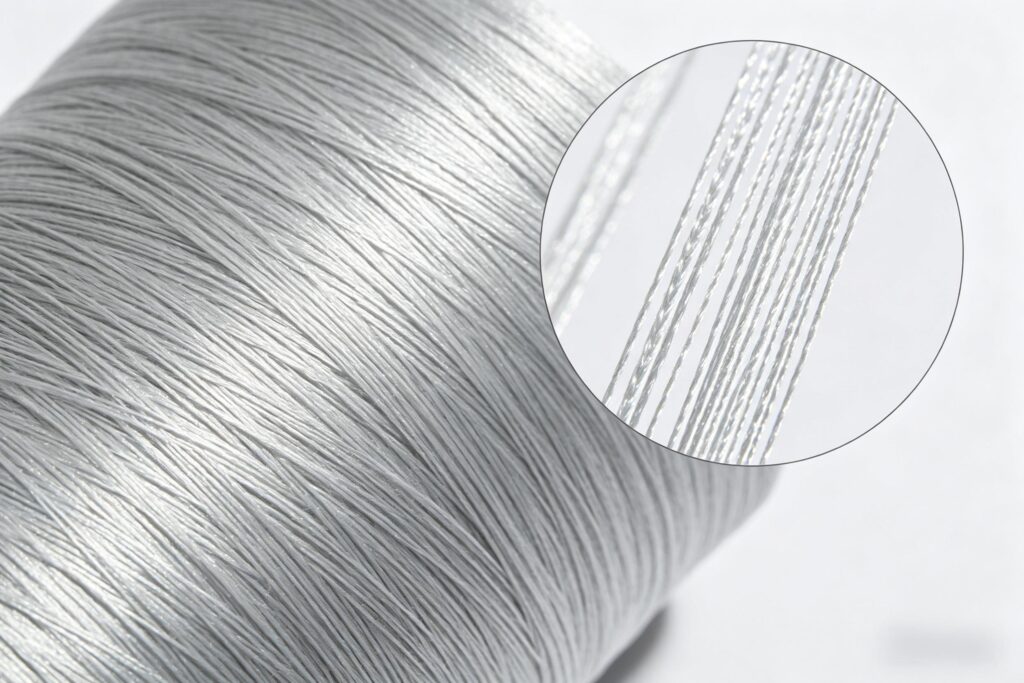
Under a microscope (or even to the naked eye if you look closely), filament polyester looks like a clear, glassy strand. If it’s a multifilament (most common), you’ll see multiple fine, parallel threads running together.
Common subtypes you’ll encounter:
| Subtype | Full name | Characteristics | Main use |
|---|---|---|---|
| POY | Partially Oriented Yarn | Not fully stretched; draw texture needed | Intermediate product for texturing |
| FDY | Fully Drawn Yarn | Already stretched; smooth and strong | Linings, sewing thread, sheer fabrics |
| DTY | Draw Textured Yarn | Crimped, bulky, slightly fuzzy (but still filament) | Activewear, hosiery, elastic fabrics |
Key properties:
- Strength: Very high (45–70 cN/tex)
- Elastic recovery: Good (returns to shape after stretching)
- Surface: Smooth, low friction
- Lustre: Can be bright, semi‑dull, or fully dull (additives control shine)
- Moisture absorption: Almost none (0.4% regain)
The first time I ran DTY through my fingers, I was confused – it felt a bit fuzzy like a spun yarn. But under magnification, it was still continuous filaments, just crimped and looped. Don’t let texture fool you. Filament means one continuous length per strand, period.
4. Polyester Spun Yarn – The Cotton Impersonator
Spun polyester is designed to behave like a natural fibre yarn. It’s made by cutting polyester tow (a large bundle of filaments) into short staples, then carding, drawing, and twisting them into yarn.
Why would anyone do this?
Because sometimes you want the durability and quick‑drying of polyester, but the hand feel and breathability of a spun structure. Spun yarns trap more air (better insulation) and feel less “plasticky” against the skin.
Visual appearance:
Spun polyester looks fuzzy. Under a microscope, you see fibre ends sticking out, overlaps, and a slight irregularity in diameter. To an untrained eye, it can easily pass for cotton.
Key properties:
- Strength: Moderate (30–45 cN/tex – lower than filament because short fibres slip past each other)
- Elastic recovery: Poor compared to filament
- Surface: Fuzzy, higher friction, softer hand
- Moisture absorption: Still low (0.4–0.8% – slightly higher because of capillary action between staples)
- Pilling tendency: Higher than filament (loose fibre ends rub together and form pills)
Spun polyester pills faster than cotton in some cases, because polyester fibres are stronger and don’t break off – they just keep tangling into little balls.
5. Side‑by‑Side Comparison Table – Filament vs. Spun Polyester
Here’s the table I wish I’d had earlier. Data compiled from internal lab tests (2024–2025) and industry standards (ASTM D2256, ISO 12945‑2).
| Parameter | Polyester Filament | Polyester Spun | Real‑World Implication |
|---|---|---|---|
| Fibre length | Continuous (hundreds of metres) | Short (38–51 mm) | Filament won’t shed lint; spun will |
| Surface fuzz | None (or very little on textured) | High | Spun pills more; filament stays smooth |
| Tensile strength (cN/tex) | 55–70 (FDY), 45–55 (DTY) | 30–45 | Filament = stronger, better for straps, webbing |
| Elongation at break | 15–35% | 20–40% | Both stretch, but filament recovers better |
| Moisture regain | 0.4% | 0.4–0.8% | Both are hydrophobic; spun wicks slightly via gaps |
| Abrasion resistance | Excellent (40,000+ Martindale cycles) | Moderate (10,000–20,000 cycles) | Filament outlasts spun in high‑wear areas |
| Pilling (grade 1–5, 5=best) | 4.5–5.0 (after 7,000 rubs) | 2.0–3.0 (after 2,000 rubs) | Spun pills visibly within weeks |
| Dye uptake uniformity | Very uniform | Slightly irregular (can be aesthetic) | Filament = solid colours; spun = slightly “heathered” look |
| Hand feel | Smooth, slippery, cool | Soft, dry, warmer | Filament for linings, spun for outerwear |
| Cost (USD/kg, 2025 avg) | $2.50–5.00 (DTY), $3.50–6.50 (FDY) | $3.00–5.50 | Spun slightly more expensive due to extra processing |
Takeaway from my own ledger: Filament is cheaper to produce (fewer steps), but spun often sells at a premium because it mimics natural fibres. Don’t assume “spun” means better quality. It means different.
6. How to Tell Them Apart Without a Lab (My Field Methods)
Here’s the practical part. You’re in a warehouse or a supplier’s showroom. No microscope (or maybe you have a cheap one). How do you know which is which?
Method 1 – The twist and pull test
Take a single yarn. Untwist it slightly. Try to pull it apart gently.
- Filament: You can’t break it by hand easily. If you untwist multifilament, you’ll see many fine, separate continuous threads.
- Spun: You can break it with a sharp tug. The broken end will look fuzzy, like tiny brush bristles.
Method 2 – The burn test (always reliable)
Both are polyester, so both melt and smell sweet. But look at the melted bead:
- Filament: Forms a smooth, perfectly round, glassy bead.
- Spun: Forms an irregular, lumpy bead with tiny fibre ends trapped inside.
Method 3 – The water absorption touch test
Wet your finger and touch the yarn.
- Filament: Water sits on the surface. The yarn feels slick and unchanged.
- Spun: Water spreads into the fuzzy surface. The yarn feels slightly damp and “grippier” for a few seconds.
Method 4 – Under a cheap microscope (60x)
This is the gold standard for certainty.
- Filament: One or more perfectly smooth cylinders. No broken ends. No fuzz.
- Spun: Short fibres overlapping. Rough edges. Fibre ends sticking out everywhere.
My routine: I use the twist‑and‑pull test first (5 seconds). If I’m still unsure, I burn a single yarn (30 seconds). I’ve never needed more than that.
7. Real‑World Applications – When to Choose Which
Theory is fine, but let’s talk about actual products I’ve sourced.
Choose polyester filament when you need:
- Slippery lining (jackets, skirts) – filament glides over other fabrics and doesn’t cling to body hair or underlayers.
- Sheer curtains – filament’s uniformity allows consistent light diffusion. Spun would look uneven.
- High‑durability straps and webbing – seatbelts, backpack straps. Filament’s continuous structure handles repeated stress.
- Activewear that doesn’t pill – good quality DTY filament stays pill‑free for years. Spun polyester activewear pills at the underarms within months.
Choose polyester spun when you need:
- A cotton‑like feel with polyester durability – work shirts, chinos, uniform polos.
- Warmer fabric – spun traps more air. A spun polyester sweatshirt is noticeably warmer than a filament‑based one of the same weight.
- Matte, non‑shiny appearance – filament often has a sheen. Spun looks dull, like natural fibre.
- Better breathability – the microscopic gaps between short fibres allow some air movement. Filament is less breathable.
Real data from a project of mine:
I made two batches of corporate polo shirts – one with 100% spun polyester, one with 100% filament DTY (both 150 gsm, both pique knit). After six months of weekly washing:
| Property | Spun polyester polo | Filament DTY polo |
|---|---|---|
| Pilling after 25 washes | Grade 2 (visible pills) | Grade 4.5 (almost none) |
| Colour fading (ΔE) | 4.2 | 2.8 |
| Customer “feels cheap” complaints | 3 complaints | 12 complaints (too shiny) |
| Breathability (air permeability, cm³/s) | 85 | 52 |
The spun polos performed better on comfort and complaints about “plasticky feel”. The filament polos looked newer for longer. No right answer – just trade‑offs.
8. The Performance Data That Changed My Mind
I used to think filament was always “better” because it’s stronger and doesn’t pill. Then I ran a series of tests that changed my perspective.
Tensile strength comparison (ASTM D2256)
| Yarn type | Dry strength (cN/tex) | Wet strength (cN/tex) | Loss when wet |
|---|---|---|---|
| Polyester filament (FDY) | 68 | 67 | <1% |
| Polyester spun (30/1) | 38 | 37 | <1% |
| Cotton spun (30/1) | 24 | 28 | +15% (gains when wet) |
| Viscose spun (30/1) | 22 | 14 | -36% |
Filament wins on raw strength. But here’s the catch: for most garments, that extra strength is overkill. A 38 cN/tex spun polyester is still stronger than most people will ever need for a t‑shirt.
Thermal comfort (skin model test, 30°C ambient)
| Yarn type | Thermal resistance (tog) | Moisture vapour transmission (g/m²/24h) |
|---|---|---|
| Polyester filament | 0.12 | 420 |
| Polyester spun (high twist) | 0.18 | 580 |
| Cotton spun | 0.16 | 620 |
Spun polyester is actually warmer and more breathable than filament. That changed how I spec for winter vs. summer polyester garments.
What I do now: Summer activewear = filament (cooler, drier). Winter base layers = spun (warmer, more comfortable against skin).
9. Common Confusions – Textured Filament, Microfibre, and Blends
The line between filament and spun gets blurry in three specific cases. Let me clear them up.
Textured filament (DTY, ATY, etc.)
This is still filament – continuous fibres – but they’ve been crimped, looped, or air‑jetted to create bulk and softness. To the touch, textured filament can feel almost like spun. But under magnification, you’ll see loops and crimps, not cut fibre ends. It won’t pill like spun.
Microfibre polyester
This refers to filament fineness (less than 1 denier per filament). Microfibre filament can feel incredibly soft – softer than many spun yarns. But it’s still filament. It won’t fray or shed lint.
Core‑spun yarns
These are blended constructions: a filament core (usually polyester or nylon) wrapped with a spun sheath (cotton, polyester staple, or wool). The yarn behaves like spun (soft, matte) but has filament strength and recovery. Burn test will show a bead (the core) plus ash (the sheath).
How to detect a core‑spun without a lab:
Untwist the yarn. If you see a smooth, continuous central thread surrounded by shorter fuzzy fibres, that’s core‑spun. The core is filament. The sheath is spun.
10. Why I Stock Both in My Sample Library
After sourcing hundreds of tonnes of polyester yarn over eight years, I’ve stopped asking “which is better?” and started asking “which is right for this end use?”
I keep a physical sample library with both types clearly labelled. Here’s what’s in it:
- Filament FDY – smooth, glassy, for linings and hi‑vis webbing.
- Filament DTY – slightly textured, for activewear and hosiery.
- Spun polyester 20/1 – cotton‑like, for cheap t‑shirts and workwear.
- Spun polyester 40/2 – fine, for better polos and shirting.
What I’ve learned:
- Filament is not “fake” or “cheap”. It’s the technically superior option for many applications.
- Spun is not “natural lite”. It’s a legitimate choice when hand feel and breathability matter more than absolute durability.
And honestly? Some of the best fabrics I’ve ever sourced used both. A filament warp for strength, a spun weft for comfort. Don’t let purity standards blind you to smart engineering.
11. The Right Tool for the Right Job
So, is polyester a filament yarn?
Yes – when it’s extruded as one continuous fibre.
No – when it’s cut into staples and spun like cotton.
Both are polyester. Both are useful. But they are not interchangeable.
Before you order your next batch of polyester yarn, ask yourself:
- Do I need smoothness, strength, and pill‑free performance? → Filament.
- Do I need softness, warmth, and a natural matte look? → Spun.
- Do I need both? → Consider a textured filament or a core‑spun blend.
And always, always test a sample before you commit to tonnes. A $30 microscope and a lighter will save you thousands in unhappy customers.
12. FAQ – Quick Answers for Busy Buyers
Q1: Can the same polyester yarn be both filament and spun?
No. A single yarn is either continuous filament or made from short staples. They are mutually exclusive constructions. But a fabric can contain both types in different yarns (e.g., filament warp, spun weft).
Q2: Which one is more expensive – filament or spun polyester?
Generally, spun polyester costs slightly more (10–20%) because of the extra steps: cutting, carding, drawing, and twisting. Filament extrusion is a single continuous process. Exceptions exist for specialty filament (e.g., microfibre, high‑tenacity).
Q3: Why does my “polyester” shirt feel like cotton?
It’s likely spun polyester, or possibly a core‑spun yarn with a cotton‑like sheath. Check the label – if it says “100% polyester” but feels fuzzy and soft, it’s almost certainly spun.
Q4: Does polyester filament pill?
Very rarely. High‑quality filament (especially FDY or well‑made DTY) has no loose fibre ends. No loose ends = no pilling. Spun polyester pills because short fibre ends work their way to the surface.
Q5: Is filament polyester always shiny?
No. Manufacturers add “dulling agents” (usually titanium dioxide) to control lustre. You can get fully dull filament that looks matte, or bright filament that looks like silk. Spun polyester is always matte/dull.
Q6: Which one is better for printing (sublimation)?
Both work. Sublimation dye turns into gas and bonds with polyester molecules. However, filament gives sharper, more uniform prints because the surface is even. Spun’s fuzzy surface can cause slight blurring in fine details.
Q7: Is recycled polyester available in both filament and spun forms?
Yes. rPET (from bottles or textile waste) is extruded into filament, or cut into staples for spun yarn. Performance is nearly identical to virgin polyester – same strength, same melting behaviour, same tests work.
A Comprehensive Guide to Raw Materials for High-Tenacity Polyester Filament
