
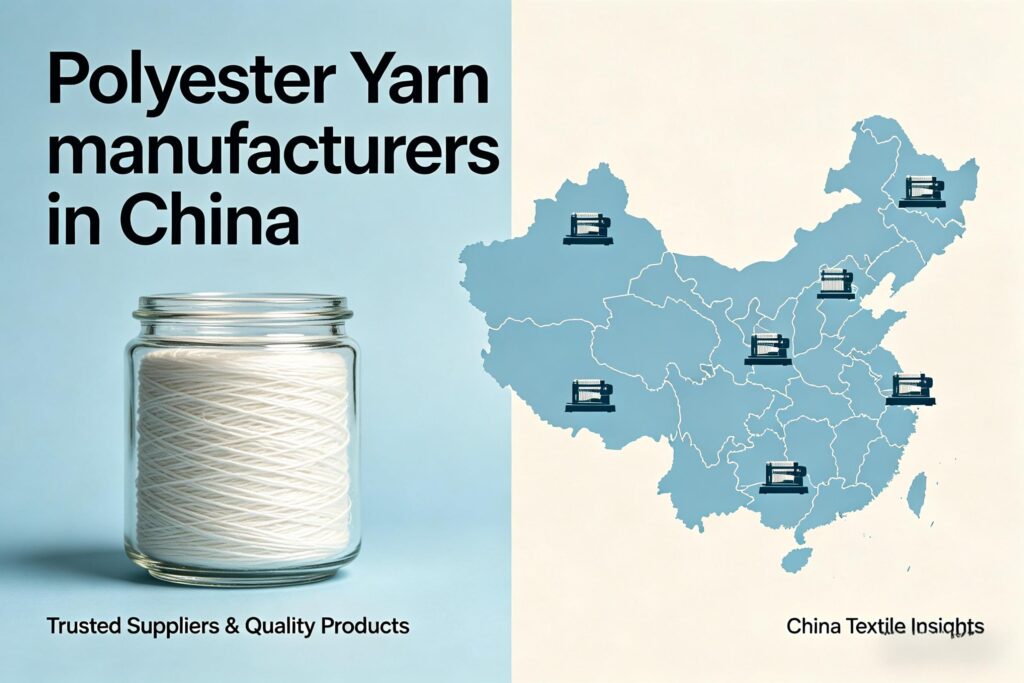
- The Macro View: Why China Dominates the Global Polyester Yarn Arena
- Navigating the Landscape: The “Big Three” Players
- Regional Breakdown: Where the Giants Are Located and Why It Matters
- 3.1 Zhejiang: The High-Volume Epicenter
- 3.2 Fujian: The Differentiated & High-End Hub
- 3.3 Jiangsu: The Technical & Industrial Yarn Powerhouse
4.Deep Dive into the Product Mix: POY, FDY, and DTY
- 4.1 A Comparative Analysis
- 4.2 The Trend Toward Differentiation
5.The Quality & Compliance Factor: Moving Beyond Cheap Labor
- 5.1 Quality Control Standards
- 5.2 Traceability & The “rPET” Revolution
6.Practical Sourcing Strategy: A Multi-Dimensional Supplier Comparison Table
7.Addressing the Shipping & Logistics Reality
8.What to Expect by 2032
9.Conclusion
10.Frequently Asked Questions (FAQs)
1. THE MACRO VIEW: WHY CHINA DOMINATES THE GLOBAL POLYESTER YARN ARENA
If you are sourcing synthetic fibers, you already know that China is the epicenter. But the numbers are staggering even by manufacturing standards. China currently accounts for over 70% of worldwide polyester production capacity . This isn’t just about cheap labor anymore; it’s about vertical integration and raw material access.
The global market size for Polyester Filament Yarn was valued at approximately $75.8 billion in 2025 and is projected to reach $108.7 billion by 2032, growing at a CAGR of 5.28% . While this growth is global, the vast majority of this capacity expansion is happening in the East.
I have been visiting textile mills in China for years, and the shift is palpable. We are moving away from the “cheap and cheerful” era. Today, major players like Tongkun Group, Xin Feng Ming Group, and Zhejiang Hengyi Group are leading the charge in innovation, not just volume . The investment in high-end equipment—like the Oerlikon Barmag spinning lines prevalent in Jiangsu—has drastically improved product consistency . For foreign buyers, this means you are increasingly looking at a supplier base that can offer consistency to meet international standards, rather than just the lowest price.
2. NAVIGATING THE LANDSCAPE: THE “BIG THREE” PLAYERS
The market is highly concentrated, but it’s not a monopoly. There is a distinct hierarchy. According to a 2025 Competitive Landscape report, the global manufacturers are generally divided into three tiers .
- Tier 1: The global behemoths like Tongkun, Xin Feng Ming, and Hengyi. These are the volume kings. They control a significant portion of the raw material (PTA) supply chain, allowing them to weather price fluctuations.
- Tier 2: Specialized giants like Billion Industrial, which is the second-largest producer of DTY in China and the largest in Southern China (Fujian), with an annual designed capacity of 2.83 million tons .
- Tier 3: Smaller, localized players who often excel in niche products or recycled yarns (rPET).
For the buyer, Tier 1 ensures supply chain security; Tier 2 offers a balance of scale and flexibility; Tier 3 offers customization.
3. REGIONAL BREAKDOWN: WHERE THE GIANTS ARE LOCATED AND WHY IT MATTERS
China’s manufacturing might is concentrated in three key provinces, each with its distinct DNA.
3.1 Zhejiang: The High-Volume Epicenter
Zhejiang (particularly Shaoxing, Hangzhou, and Ningbo) is the heart of the polyester industry. The supply chain here is incredibly integrated. You have polymer extrusion, melt spinning, texturing, and winding often happening within the same industrial park .
- Key Players: Hangzhou Zhongcai Chemical Fiber (founded in 2002, operating over 60 production lines) is a classic example of the export-focused Zhejiang supplier .
- Market Sentiment: These are high-efficiency, high-reliability suppliers. They are often the benchmark for pricing, but they deal in massive volumes.
3.2 Fujian: The Differentiated & High-End Hub
Fujian province (Jinjiang, Fuzhou, Shishi) is where the “specialty” yarns are born. This region has shifted focus toward high-margin differentiated yarns like moisture-absorbing, antibacterial, and flame-resistant fibers .
- Key Players: Sinrylion (established 1983) is a veteran here, boasting over 400 sets of textile machinery and a production capacity exceeding 8,000 tons annually .
- The Cost Reality: You pay more here, but you get specific functional properties that generic Zhejiang yarns might lack.
3.3 Jiangsu: The Technical & Industrial Yarn Powerhouse
Jiangsu focuses heavily on industrial yarns used in tire cord, conveyor belts, and geotextiles. For example, Jiangsu Hengli is the largest technical yarn manufacturer globally after completing a massive high-performance project in 2024 . In 2024 alone, China’s technical polyester industrial yarn output reached 2.207 million tons, with the best quality coming from this region .
4. DEEP DIVE INTO THE PRODUCT MIX: POY, FDY, AND DTY
This is where professional buyers need to pay attention. Do not ask for “Polyester Yarn.” You must specify POY, FDY, or DTY.
Table 1: Product Type Comparison (Multi-Dimensional)
| Feature | POY (Partially Oriented Yarn) | FDY (Fully Drawn Yarn) | DTY (Drawn Textured Yarn) |
|---|---|---|---|
| Core Characteristic | Semi-finished, high elasticity, low shrinkage. It must be processed further to be useful. | Fully oriented, smooth, strong, and rigid. It is ready for weaving immediately. | Textured, soft, bulky, highly elastic. It mimics the feel of natural fibers. |
| Primary Use Case | Weaving fabric for suits, trousers, and outerwear; or as a feedstock to create DTY. | High-strength textiles, sportswear, automotive interiors, and home furnishings . | Knitting, hosiery, underwear, and premium apparel where comfort is crucial. |
| Cost/Value Index | Low cost, lower profit margin. | Medium cost; high-speed production. | Higher cost; higher profit margin due to added processing. |
| Global Trend | Consolidating; volume-driven. | Growing demand due to industrial applications. | Heavy investment in “functional” DTY variants . |
If you want to sell a “performance” product, you spec DTY. If you want the absolute best price for bulk fabric, FDY is your friend. But looking at the investment trends, Chinese manufacturers are aggressively pivoting to DTY because the margins are simply better and more defensible against rising labor costs.
5. THE QUALITY & COMPLIANCE FACTOR
5.1 Quality Control Standards
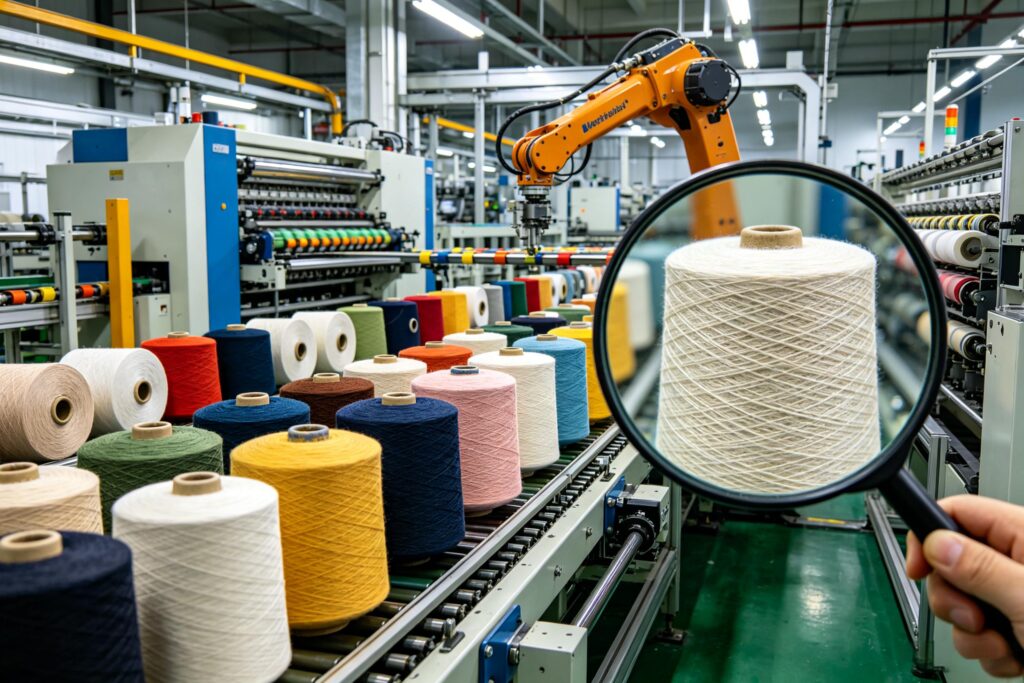
The days of “good enough” are fading. Modern Chinese factories are adopting Industry 4.0 practices. Sinrylion, for example, uses Manufacturing Execution Systems (MES) and online Uster Testers to measure yarn evenness and reduce breakage, which is critical for high-speed knitting . Factories are implementing:
- Online Monitoring: Real-time detection of color difference, melt flow, and impurities .
- Traceability: Detailed testing reports for raw material batches and production parameters.
5.2 The “rPET” Revolution
Sustainability is no longer a buzzword; it’s a compliance requirement for EU buyers. Provinces like Fujian are aggressively developing recycled polyester (rPET) yarns . The texturizing process often incorporates Lycra or other elastomers to meet the global demand for stretch and recovery.
6. PRACTICAL SOURCING STRATEGY: A COMPARISON TABLE
When you look at supplier data, responsiveness and delivery rates are just as important as price. Here is a snapshot of typical verified supplier performance:
Table 2: Supplier Performance Metrics (Based on Verified Transaction Data)
| Supplier Region | Avg. Review Score | Avg. Response Time | On-Time Delivery Rate | Reorder Rate | Best For |
|---|---|---|---|---|---|
| Zhejiang (e.g., Shiffon) | 5.0/5.0 | ≤ 2 hours | 100% | 50% | JIT (Just-in-Time) Manufacturing, Project Management . |
| Jiangsu (e.g., GLYarn) | 5.0/5.0 | ≤ 3 hours | 97.1% | 50% | Scalability, Large Batch Consistency . |
| Fujian (e.g., Fangtuosi) | 4.9/5.0 | ≤ 2 hours | 100% | 20% | Custom Specs, Large Volume Specialized Contracts . |
Analysis: While Fujian offers quality, the higher reorder rate in Zhejiang suggests that for standard yarns, Zhejiang suppliers often hit the “sweet spot” of service and quality. Fujian has a lower reorder rate but a massive facility footprint, indicating they are likely handling complex, one-off custom orders that don’t require immediate repeat orders.
7. ADDRESSING THE SHIPPING & LOGISTICS REALITY
It would be naive not to mention logistics. With the volatility in shipping routes (especially Red Sea diversions) impacting costs, the concentration of factories in ports like Ningbo and Xiamen becomes a massive advantage . Suppliers with vertical integration—from polymer chips to winding—tend to have shorter lead times.
8. WHAT TO EXPECT BY 2032
The data suggests a shift towards high-tenacity and functional yarns. The “technical polyester yarn” market is growing faster than standard textiles . We are likely to see:
- A flattening of POY production growth.
- A surge in DTY and specialized FDY capacities .
- Increased scrutiny on “green” practices, with a potential price premium for certified rPET.
9. CONCLUSION
Sourcing from China is not just about finding the cheapest supplier on Alibaba anymore. It is about selecting the right region for your supply chain needs. Use Zhejiang for volume and speed, Fujian for high-end specialties and sustainability, and Jiangsu for industrial-grade heavy-duty yarns. The capacity is there, the quality is improving, but the real value for buyers lies in finding the partner whose specific strengths align with your market demands.
10. FREQUENTLY ASKED QUESTIONS (FAQs)
Q1: Is it always cheaper to buy from Zhejiang than Fujian?
A: Generally yes, for standard undifferentiated yarns. However, the price gap narrows significantly when you factor in the specialized R&D and functional properties often found in Fujian yarns.
Q2: How do I ensure the yarn quality is consistent for large orders?
A: Look for manufacturers using modern MES (Manufacturing Execution Systems) and Uster testing equipment . Ask for audit reports of their online monitoring systems.
Q3: Is China shifting toward sustainable rPET production?
A: Yes, especially in Fujian. Major players are investing heavily in BOPET films and recycled chips to meet the stringent requirements of the European and North American markets .
Q4: What is the lead time difference between POY and DTY?
A: POY is quicker to produce as it skips the texturizing step. DTY requires additional processing time, often adding a 10-15 day difference to the total lead time depending on the twist level requested .
Q5: Which is better for outdoor automotive interiors: FDY or DTY?
A: FDY is usually preferred for automotive interiors because of its high tensile strength and dimensional stability, which resists stretching and wear over time .
Q6: Are these suppliers open to small trial orders?
A: While many factories have large MOQs, the Tier 3 and some Tier 2 suppliers (like those in Fujian) are increasingly offering “trial runs” for new clients to build trust, but expect the price per kg to be higher for sample orders.
Q7: Who are the “Big Four” manufacturers dominating the Chinese scene?
A: Tongkun Group, Zhejiang Hengyi, Xin Feng Ming, and Sheng Hong are generally considered the market leaders in terms of revenue and volume .
Q8: What does “c800” or “T400” mean?
A: These often refer to specific types of blended yarns (e.g., C400 PET/PTT is a type of stretch yarn). It’s best to ask for a technical data sheet with elongation and tenacity figures rather than relying on generic codes .
Is Custom Yarn from China Any Good? The Honest Truth About Quality in 2026
