
Article Directory
- Why “Eco-Friendly Yarn” Is More Complicated Than You Think
- The Usual Suspects: Breaking Down the Main Fiber Categories
- 2.1 Conventional Natural Fibers (Cotton, Wool, Linen)
- 2.2 Synthetic Fibers (Polyester, Nylon, Acrylic)
- 2.3 Regenerated Cellulosics (Viscose, Tencel™, Bamboo)
- The Recycling Route: Recycled Polyester and Regenerated Cotton
- The New Wave: Innovative Climate-Positive Yarns (AeoniQ, CELYS)
- The Multi-Dimensional Data Matrix
- 5.1 Carbon Footprint Comparison Table
- 5.2 Water Usage and Biodegradability Rankings
- 5.3 Durability and Microplastic Shedding Index
- The Certification Check: GOTS, RWS, OEKO-TEX, and What They Actually Mean
- My Personal Take on Weighing the “Least Bad” Option
- The Verdict on Eco-Friendly Yarns
- Frequently Asked Questions (FAQ)
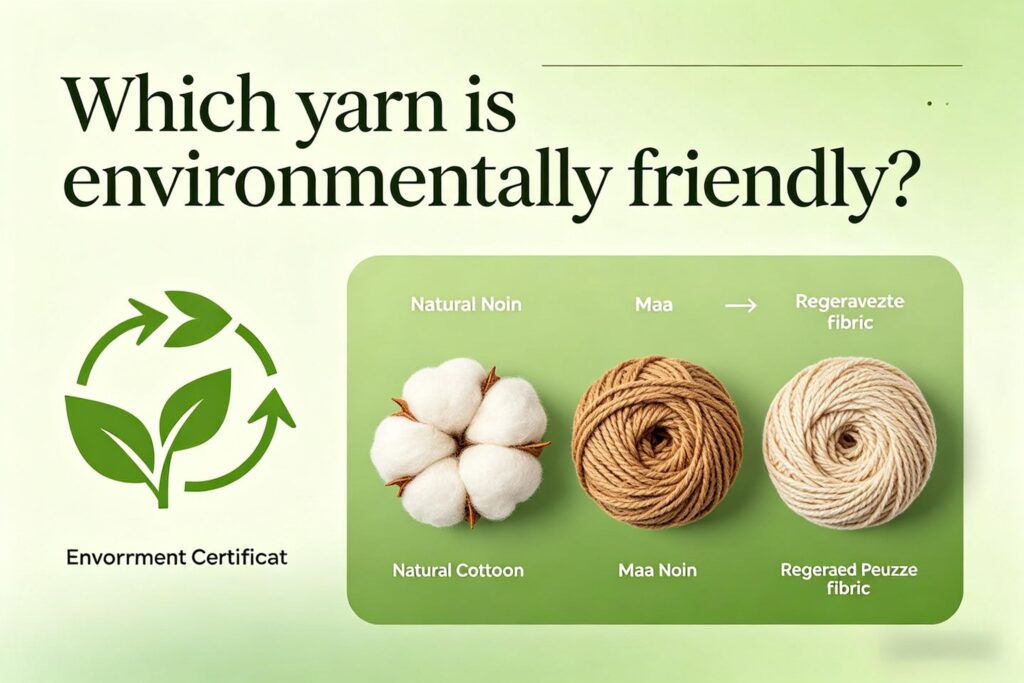
1. Why “Eco-Friendly Yarn” Is More Complicated Than You Think
I have been in this industry long enough to know that nothing is ever simply “good” or “bad.” When it comes to yarn, the question “Which is environmentally friendly?” always feels like a trap, because the answer is rarely a single fiber type. It’s a shifting spectrum of trade-offs.
A few years ago, everyone was singing the praises of bamboo. It felt silky, grew like a weed, and seemed like the perfect solution. Then, we realized that turning that bamboo into yarn involves soaking it in harsh chemicals that are arguably worse for the local environment than the microplastics we are trying to avoid. Similarly, while sheep’s wool is natural and biodegradable, the methane emissions from livestock and the controversial practice of mulesing often leave a sour taste in the mouth of a conscious shopper .
This guide is not just a list of “green” yarns. It is an attempt to dissect the lifecycle of each fiber—from cultivation or extraction to disposal. According to the Pulse of the Fashion Industry report, over 60% of a garment’s environmental impact is determined right here, in the raw materials phase . So, let’s get our hands dirty and look at the data.
2. The Usual Suspects: Breaking Down the Main Fiber Categories
To understand what is best, we need to understand the four main families of yarns that dominate the market.
2.1 Conventional Natural Fibers (Cotton, Wool, Linen)
These are the “traditional” choices. They are renewable, biodegradable, and have been worn for centuries.
- Cotton: Breathable and versatile. However, conventional cotton is a thirsty crop. It often relies heavily on pesticides and fertilizers that degrade soil health over time.
- Wool: A performance fiber. It insulates even when wet, is flame retardant, and is a renewable resource (sheep grow it back yearly). The environmental downside here is primarily methane (a potent greenhouse gas) emitted by the animals themselves . PETA ranks wool as a “Class E” material (the worst category) due to land clearing, waste, and chemical scouring, which puts it in an unfavorable light compared to plant fibers .
- Linen (Flax): One of the most environmentally friendly crops if grown conventionally in Europe. It requires very little water and practically no pesticides.
2.2 Synthetic Fibers (Polyester, Nylon, Acrylic)
These are essentially plastics. They offer incredible strength, wrinkle resistance, and colorfastness, which is why they dominate the fast-fashion market.
- The Problem: They are derived from fossil fuels. Production is energy-intensive. Worse, they shed microplastics every time they are washed. In fact, washing synthetic textiles is a primary source of microplastics in our oceans . The energy required to produce virgin nylon can be as high as 69 KWH per kilo .
2.3 Regenerated Cellulosics (Viscose, Tencel™, Modal)
These come from plants but are heavily processed. Wood pulp is dissolved in a chemical solution and extruded into fibers.
- Bamboo often falls into this category. While the plant is sustainable, the “rayon” process used to make it soft is chemically intensive.
- Tencel™ (Lyocell): This is the golden child of the cellulose world because it uses a closed-loop process where the solvent (amine oxide) is recycled with over 99% recovery. This dramatically reduces waste and pollution.
3. The Recycling Route: Recycled Polyester and Regenerated Cotton
This category sits in a grey area. You are turning waste into a product, which is fantastic for reducing landfill and virgin resource extraction.
- Recycled Cotton: Mechanically recycled cotton usually results in shorter, weaker fibers. To make it workable, it often needs to be blended with virgin fibers. An LCA study by Textile Exchange (2021) suggests that recycled cotton reduces water use by up to 98% and CO₂ emissions by 46% compared to conventional cotton .
- Recycled Polyester (rPET): Typically made from plastic water bottles. While it uses 59% less energy than virgin polyester, it is still plastic. It still sheds microplastics in the wash. We are essentially extending the life of a bottle, but it will likely end up in a landfill at the end of its garment life because textile-to-textile recycling isn’t widely available at scale. WRAP data supports the energy savings here, but the end-of-life issue remains unresolved .
4. The New Wave: Innovative Climate-Positive Yarns
This is where things get genuinely exciting, moving beyond “less bad” to “actively good.”
One of the most promising developments is AeoniQ. This is a cellulosic filament yarn designed to replace polyester and nylon, but with a critical difference: it is plastic-free and fully biodegradable in marine, soil, and composting environments. Independent Life Cycle Assessments show that AeoniQ reduces CO₂ emissions by at least 3.2 kg per kg compared to virgin polyester . Portuguese pulp leader Altri has recently acquired a majority stake to scale up commercial production, which is a huge vote of confidence in this technology .
Another interesting case is the KINDSOME yarn blend launched by De Bondt and CELYS. They combined 60% Merino wool with 40% CELYS compostable polyester, specifically for baby yarn . This blend addresses the fact that sometimes pure natural fibers lack the durability or specific softness needed for certain applications, and CELYS offers a synthetic that can biodegrade rather than persist in the environment.
5. The Multi-Dimensional Data Matrix
To truly compare, we need to look at multiple factors: Carbon, Water, Energy, Biodegradability, and Durability. Let’s break down the technical data.
5.1 Carbon Footprint Comparison Table
Based on data from LCAs and industry reports .
| Fiber Type | CO₂ Footprint (kg CO₂e per kg) | Energy Consumption (kWh/kg) | Notes |
|---|---|---|---|
| Conventional Cotton | ~5.0 – 8.0 | ~15 – 30 | High water usage; pesticide heavy. |
| Organic Cotton | ~2.7 – 4.0 | ~10 – 20 | 70% less CO₂ than conventional cotton . |
| Virgin Polyester | ~9.6 | ~35 | Derived from crude oil. High energy use . |
| Recycled Polyester (rPET) | ~5.3 | ~14.3 | Saves ~59% energy vs virgin but sheds microplastics . |
| Wool (Sheep) | ~5.0 – 7.0 | ~17 | Renewable, but methane (CH4) emissions are impactful . |
| AeoniQ Cellulosic | ~6.4 (potential) | ~15 | Climate Positive; replaces plastic. Biodegradable . |
| Nylon 6 (Virgin) | ~9.6 | ~69 | The most energy-intensive fiber . |
5.2 Water Usage and Biodegradability Rankings
A quick look at water impact is critical. Recycled cotton is a clear winner for water conservation.
| Fiber Type | Water Usage (Relative) | Biodegradability | Microplastic Shedding |
|---|---|---|---|
| Regenerated Cotton | -98% vs Conventional | High (but often blended) | No (Low shedding) |
| Organic Cotton | -91% vs Conventional | High | No |
| Hemp/Linen | Very Low (Rain-fed) | High | No |
| Tencel™ (Lyocell) | Low (Closed-loop) | High | No |
| Virgin Polyester | Very Low (Cooling) | Non-Biodegradable | High |
| Recycled Polyester | Very Low | Non-Biodegradable | High |
| AeoniQ | Low | High (Marine/Soil) | No (Cellulosic) |
5.3 Durability and Microplastic Shedding Index
This is a subjective but crucial metric. If a yarn breaks or pills easily, you throw it away. Throwing it away negates the “eco” aspect.
- Wool & Nylon: High durability.
- Linen: High strength.
- Cotton: Moderate (loses strength when wet; wears down over time).
- Tencel: Moderate (soft but can fibrillate).
- Acrylic/Polyester: High durability, but a major source of pollution when washed due to shedding .
6. The Certification Check: GOTS, RWS, OEKO-TEX, and What They Actually Mean
Navigating labels can be exhausting. Here is my “cheat sheet” for cutting through the noise .
- GOTS (Global Organic Textile Standard): This is the gold standard for organic plant fibers (like cotton). It covers environmental and social criteria across the entire processing chain, from harvesting to manufacturing. It ensures no toxic bleaches or dyes are used .
- Responsible Wool Standard (RWS): This addresses animal welfare (specifically banning mulesing) and land management. If I am buying wool, I look for this to avoid the cruelty issues associated with the Australian Merino industry .
- OEKO-TEX Standard 100: This is a safety label for the “ingredients.” It tests the final textile for harmful substances, ensuring it is safe for your skin. However, it does NOT guarantee the fiber is organic or environmentally sustainable in terms of water/carbon .
- ZQ Merino & NATIVA: Alternative certifications for wool that focus on animal welfare and traceability .
7. My Personal Take on Weighing the “Least Bad” Option
If I were to pick a yarn for a “perfect” sustainable garment based on current technology, I would not pick just one. I would look at the application.
- If I need warmth and longevity: I would pick RWS-certified Wool. Yes, methane is a problem, but the durability of wool means the item lasts longer, and at the end of its life, it returns to the soil. I avoid “Superwash” wool, however, because the treatment to make it machine washable coats it in a plastic resin that prevents biodegradation .
- If I need a lightweight summer top: I would choose European Flax Linen or GOTS Organic Cotton. The rain-fed nature of European flax makes it a win for water conservation .
- If I want a plastic alternative for activewear: I would look towards AeoniQ or Tencel™ blends. They offer the performance without the microplastic legacy .
I have often noticed that crafters buy cheap acrylic yarn because it is accessible, especially for baby blankets. However, as the data shows, that blanket will degrade into microfibers with every wash. I advise choosing KINDSOME blends or similar compostable polyesters for baby projects if washability is a must, but offsetting this by choosing natural dyes.
8. The Verdict on Eco-Friendly Yarns
So, which yarn is environmentally friendly? The data shows there is no single “green” fiber. The best is recycled or organic natural fibers, specifically GOTS organic cotton or RWS wool, because they keep the carbon in the ground and return to the earth. The worst is virgin nylon and acrylic, due to fossil fuel extraction and microplastic pollution.
However, the industry is innovating. The emergence of AeoniQ represents a serious game-changer—a climate-positive, biodegradable filament yarn that matches synthetics in performance .
As a buyer, the most powerful tool you have is not just the fiber type, but the certification. And above all, durability is sustainability. The most eco-friendly yarn is the one you use to make something that lasts for 10 years, rather than 10 washes.
9. Frequently Asked Questions (FAQ)
Q1: Is Bamboo yarn actually eco-friendly?
A: Not usually. While raw bamboo is highly sustainable, the viscose process used to turn it into soft yarn is chemically intensive and often involves toxic solvents like carbon disulfide. Unless it is specifically labeled “Lyocell” or “closed-loop,” it does not live up to its “green” image .
Q2: Is it better to use recycled polyester or organic cotton?
A: It depends on the use case. Organic cotton is superior from a microplastic perspective and end-of-life impact (it biodegrades). However, recycled polyester saves a significant amount of energy (59%) compared to virgin polyester and is more durable for activewear . For environmental purity, organic cotton is usually the better choice.
Q3: What does the “Responsible Wool Standard” (RWS) actually guarantee?
A: It guarantees that the wool comes from farms with a commitment to animal welfare (specifically banning mulesing without pain relief), land management, and social responsibility. It ensures traceability from the farm to the final product .
Q4: Does natural wool have a worse carbon footprint than synthetics?
A: Often, the carbon footprint is comparable or even higher due to methane emissions, making wool a “Class E” material in some benchmarks . However, it is renewable and biodegrades. The carbon is part of the natural cycle, whereas synthetic carbon is extracted from underground fossil reserves, which adds new greenhouse gases to the atmosphere.
Q5: What is the lowest carbon footprint nylon yarn available?
A: As of 2024, the Thrive® matter yarn by Universal Fibers is recognized as the lowest carbon footprint nylon, boasting 89% lower carbon than some virgin nylons, largely due to using 100% post-industrial recycled resin .
Q6: How much energy does making nylon require compared to wool?
A: Making nylon is extremely energy-intensive. Historically, it requires around 69 KWH per kilo, compared to roughly 17 KWH per kilo for wool or 35 KWH for virgin polyester .
Q7: Is a “GOTS” label better than “OEKO-TEX”?
A: They cover different things. GOTS covers the entire production chain and environmental standards (water, chemicals). OEKO-TEX Standard 100 specifically tests for harmful substances to your health. If you care about the planet, choose GOTS first. If you care about your skin safety, OEKO-TEX is excellent .
