
Article Outline
- A Simple Question That Sparked a 45-Minute Argument in My Studio
- The Weave of Confusion: Why Yarn Count Systems Are So Messy
- The Direct Answer: Which Is Thicker, 8/2 or 5/2?
- 8/2 vs 5/2 – More Than Just Thickness
- How I Learned the Hard Way: A Personal Story of a Scarf That Almost Bankrupted My Project
- Practical Applications: What Each Yarn Is Best For
- Cost & Yardage Comparison: The Hidden Economics No One Talks About
- How to Substitute One for the Other (And When You Absolutely Should Not)
- FAQ
1. A Simple Question That Sparked a 45-Minute Argument in My Studio
Let me paint you a picture. Last autumn, three of us were standing around a warping board in my rather messy studio in Portland. A new weaver, Sarah, had just finished her first rigid heddle project and wanted to move to a four-shaft loom. She held up two cones of yarn. One was labeled “8/2 cotton.” The other said “5/2 cotton.”
She asked, quite reasonably: “Which one is thicker?”
You would think this is a straightforward question. It is not. Two experienced weavers immediately gave opposite answers. One said, “8/2, because the number is bigger.” The other said, “5/2, because the first number is smaller but the plies mean something different.” They argued for 45 minutes. Coffee got cold. Sarah looked like she wanted to take up stamp collecting instead.
I’ve been weaving for over twelve years, and I still remember being just as confused when I started. The yarn count system – especially for cotton – feels like it was designed to keep beginners out. But here’s the truth: once you understand two simple things, it becomes obvious. And that’s what this article is for.
2. The Weave of Confusion: Why Yarn Count Systems Are So Messy
Before I give you the answer, let me explain why this question is so tricky. Because if you just memorize “X is thicker than Y,” you will forget it. But if you understand the logic, it sticks forever.
Most cotton yarns in weaving use the cotton count system (also called Ne, from the English “Number English”). This system was invented back when cotton mills were powered by water and children worked 14-hour days. It works like this:
- The base unit is 1/1: a single ply of yarn that requires 840 yards to weigh 1 pound.
- A higher count number means thinner yarn. This is the part that messes everyone up.
- So 20/1 is thinner than 10/1.
- The second number tells you how many plies are twisted together.
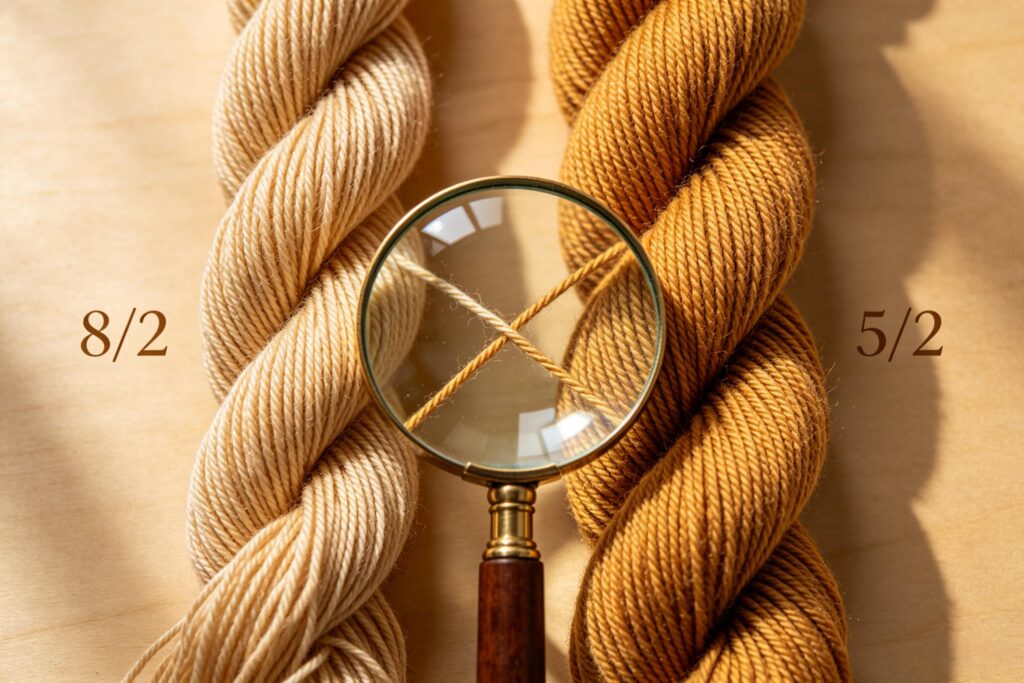
Example: 8/2 means a yarn that starts as an 8-count single (thin-ish), then two of those singles are plied together. 5/2 means a 5-count single (thicker base), then two plies.
So the ply number is the same (both are 2-ply). The difference is entirely in the base count: 5 vs 8.
The key insight: A lower base count = thicker individual strand = thicker final yarn.
Most beginners see “8” and “5” and assume 8 is bigger. But in cotton count, 5 is thicker than 8. It is a reverse scale. Like golf scores or pain ratings – lower number means more of something (in this case, thickness).
I genuinely believe this system survives only because everyone is too embarrassed to admit they find it confusing. You are not alone.
3. The Direct Answer: Which Is Thicker, 8/2 or 5/2?
Here it is, plain and clear:
5/2 is significantly thicker than 8/2.
Not a little. Not “depends on the brand.” Significantly. In fact, 5/2 is roughly twice as thick as 8/2 by weight per yard.
Let me give you the real numbers, because vague statements don’t help anyone.
| Yarn | Base Count | Ply | Approximate thickness (mm) | Yards per pound (approx) | Meters per 100g (approx) |
|---|---|---|---|---|---|
| 8/2 | 8 | 2 | 0.45 – 0.50 | 3,360 | 336 |
| 5/2 | 5 | 2 | 0.65 – 0.72 | 2,100 | 210 |
This means: for the same weight, you get about 60% more yardage from 8/2 than from 5/2. Or flipped: a project using 5/2 will weigh about 60% more than the same project in 8/2.
I remember the first time I put these two yarns side by side on a ruler. I had been weaving for two years and had somehow never done that. It felt like a small betrayal – why had no one shown me this earlier?
4. 8/2 vs 5/2 – More Than Just Thickness
Let me expand the comparison. Thickness matters, but so do many other factors. Here is a detailed table based on standard mercerized cotton (the most common type for weaving).
| Property | 8/2 Cotton | 5/2 Cotton |
|---|---|---|
| Thickness (subjective) | Light worsted / heavy lace | Light DK / sport weight |
| Typical wraps per inch (wpi) | 16 – 18 | 12 – 14 |
| Recommended sett (ends per inch – plain weave) | 16 – 20 | 12 – 14 |
| Twist direction (most common) | Z-twist single, S-ply | Z-twist single, S-ply |
| Drape | Soft, fluid | Firm, substantial |
| Breathability | High | Medium |
| Pilling tendency | Very low | Low |
| Best for | Garments, shawls, lightweight towels | Bags, rugs, upholstery, jackets |
| Loom recommendation | Rigid heddle (8-12 dent reed), floor loom | Floor loom, rigid heddle (8 dent or coarser) |
| Typical cone size (commercial) | 1 lb (454g) | 1 lb (454g) |
One thing this table does not capture: how they feel in your hand. 8/2 has a beautiful, almost slippery smoothness when woven at the right sett. It feels elegant. 5/2 feels honest. Sturdy. Like it will not fall apart if you take it camping. I keep both in my studio, but I reach for them for completely different moods.
5. How I Learned the Hard Way: A Personal Story of a Scarf That Almost Bankrupted My Project
Let me tell you about my biggest yarn substitution disaster. Because it involves exactly these two yarns.
About seven years ago, I found a pattern for a woven jacket. Gorgeous thing. Required 5/2 cotton, about 2,500 yards. I did not have 5/2. I had eight cones of 8/2 in a lovely teal color. I thought: “It’s both cotton. Both 2-ply. How different can they be?”
Very different. Catastrophically different.
I warped my floor loom for 2,500 yards of 8/2 using the sett recommended for 5/2 (12 epi). The warp went on fine. Then I started weaving. The cloth was … wrong. Too loose. You could see gaps between the weft picks. The fabric had no body – it flopped like a damp napkin.
I tightened the tension. That made it worse – the warp threads started drifting apart.
I finally understood: because 8/2 is thinner, it needs a higher sett (more threads per inch) to make a solid fabric. Using a 5/2 sett on 8/2 gives you something that resembles loosely woven cheesecloth.
I had to cut the warp off the loom. Two weeks of work. Fifteen cones of yarn (I bought more after I ran out). That jacket never happened.
The lesson: never substitute 8/2 for 5/2 without recalculating your sett and expected fabric weight. They are not interchangeable. I still have that teal yarn. I use it for towels now. Every time I see it, I sigh.
6. Practical Applications: What Each Yarn Is Best For
Let me give you specific project recommendations based on what I have actually woven and seen others weave successfully.
8/2 Cotton is excellent for:
- Lightweight summer tops – I made a tunic with 8/2 at 18 epi. Finished fabric weighed 180 gsm (grams per square meter). Breathes beautifully.
- Shawls and wraps – At 15 epi in twill, 8/2 creates a drape that feels almost like rayon.
- Baby blankets – Soft, washable, not too hot.
- Tea towels – The standard choice. A 20” x 28” towel uses about 220-250 yards of 8/2.
- Scarves that need drape – Not structure. Drape.
5/2 Cotton is excellent for:
- Market bags – I made one last year. 5/2 at 12 epi, plain weave. The bag stands up on its own. Holds two wine bottles and a loaf of bread without sagging.
- Rugs and mats – Durable, easy to clean, holds shape.
- Upholstery fabric – For chair seats, pillow covers that get heavy use.
- Heavy jackets and vests – The fabric has body. It does not wrinkle as easily as 8/2.
- Belts and straps – Weave it narrow and thick.
Here is a quick decision rule I use with my students: If you want the fabric to move like water, choose 8/2. If you want it to move like leather, choose 5/2.
7. Cost & Yardage Comparison: The Hidden Economics No One Talks About
Now let us talk about money. Because 5/2 and 8/2 are usually sold at the same price per pound, but they are not the same price per project.
Let’s say you buy a 1 lb cone of each from the same supplier. Typical pricing (as of 2025-2026):
- 8/2 cotton: ~$12-18 per lb
- 5/2 cotton: ~$12-18 per lb
Same price per pound. But look at the yardage difference again:
| Yarn | Yards per 1 lb cone | Typical yards for a scarf (8” x 70”) | Cost per scarf (yarn only) |
|---|---|---|---|
| 8/2 | 3,360 | 400 | $1.43 – $2.14 |
| 5/2 | 2,100 | 400 | $2.29 – $3.43 |
So a scarf in 5/2 costs about 60% more in raw yarn than the same scarf in 8/2 – if you use the same yardage. But here is the thing: a 5/2 scarf will be much heavier and stiffer. You might actually want less yardage for a 5/2 scarf because it is thicker.
Let me give you a real example. A standard 8” x 70” scarf in 8/2 at 18 epi uses about 450 yards including loom waste. The same scarf in 5/2, at 12 epi, uses about 320 yards. So the actual cost difference is smaller.
Let me put this in a table that shows effective cost per woven square foot.
| Yarn | Sett (epi) | Yards per sq ft of fabric | Cost per sq ft (yarn only) |
|---|---|---|---|
| 8/2 | 18 | 18 | $0.064 – $0.096 |
| 5/2 | 12 | 12 | $0.069 – $0.103 |
Surprise: per square foot of finished fabric, 5/2 is only slightly more expensive. The thickness does the work. You simply need fewer threads.
This was a revelation to me when I first calculated it. I had assumed 5/2 was a luxury. It is not. It is just a different tool.
8. How to Substitute One for the Other (And When You Absolutely Should Not)
Let me save you the pain I went through. If you want to use 8/2 in a pattern written for 5/2, you cannot just swap. You must adjust.
Substituting 8/2 for 5/2 (thinner for thicker):
- Increase sett by about 30-40%. If pattern says 12 epi for 5/2, try 16-18 epi for 8/2.
- Expect softer, drapier fabric. Not a bad thing – just different.
- Use more yards. Because 8/2 is thinner, it takes more length to cover the same area.
- Do not do this for structural items like rugs or bags. The fabric will be too flimsy.
Substituting 5/2 for 8/2 (thicker for thinner):
- Decrease sett by about 25-30%. If pattern says 20 epi for 8/2, try 12-14 epi for 5/2.
- Expect firmer, heavier fabric. Great for jackets. Terrible for draping shawls.
- Use fewer yards. About 60% of the 8/2 yardage for the same woven area.
- Check your reed. 5/2 at a low sett (e.g., 12 epi) fits in a standard 6, 8, or 10-dent reed. Do not try to cram it into a 15-dent reed – you will damage the yarn.
When you should absolutely NOT substitute:
- Any pattern where the fabric needs to match a specific finished size (like garment panels). The shrinkage and take-up will be totally different.
- Projects that require a specific weight per square yard for structural reasons (e.g., upholstery that needs to fit a frame).
- If you have never woven with the substitute yarn before. Sample first. I learned this the hard way.
I now keep a binder of samples. Every time I try a substitution, I weave a 6” x 6” sample, wash it, and tape it into the binder. It has saved me hundreds of dollars.
9. FAQ: 8 Questions Weavers, Knitters & Designers Always Ask
Q1: Which is thicker, 8/2 or 5/2?
5/2 is thicker. Lower first number = thicker yarn in the cotton count system. Always.
Q2: Can I use 8/2 on a rigid heddle loom?
Yes, absolutely. Use an 8, 10, or 12-dent reed. For plain weave, 8/2 at 16 epi works beautifully in a 8-dent reed (two threads per slot/hole).
Q3: Is 5/2 too thick for a scarf?
Not at all. It makes a warm, substantial winter scarf. But do not expect light, airy drape. Expect cozy and sturdy.
Q4: What about 8/4? Where does that fit?
8/4 is thicker than both 8/2 and 5/2. The base count is 8 (thin), but with 4 plies. Total thickness is roughly between 5/2 and 3/2. 8/4 is great for rugs.
Q5: How do I calculate how much yarn I need for a project in 8/2 vs 5/2?
Use this formula: (width in inches) x (sett in epi) x (length in inches) / 36 = yards needed for warp. Add 15-20% for weft and loom waste. Or use an online weaving calculator – I rely on mine constantly.
Q6: Do these numbers mean the same thing for wool?
No. Wool uses different systems (worsted count, woolen count, or metric Nm). Do not apply cotton count rules to wool. I have seen that mistake ruin a sweater.
Q7: Why is my 5/2 woven fabric feeling scratchy?
Two likely reasons: sett too high (threads are crowded and rubbing each other), or the cotton is not mercerized. Mercerized 5/2 is smooth. Unmercerized has a matte, slightly rougher feel.
Q8: Can I mix 8/2 and 5/2 in the same warp?
Yes, but with caution. They have different shrinkage rates. Use them in different sections (like stripes) rather than mixing in the same thread line. Always wash a sample first. I learned this after a wavy scarf incident.
