
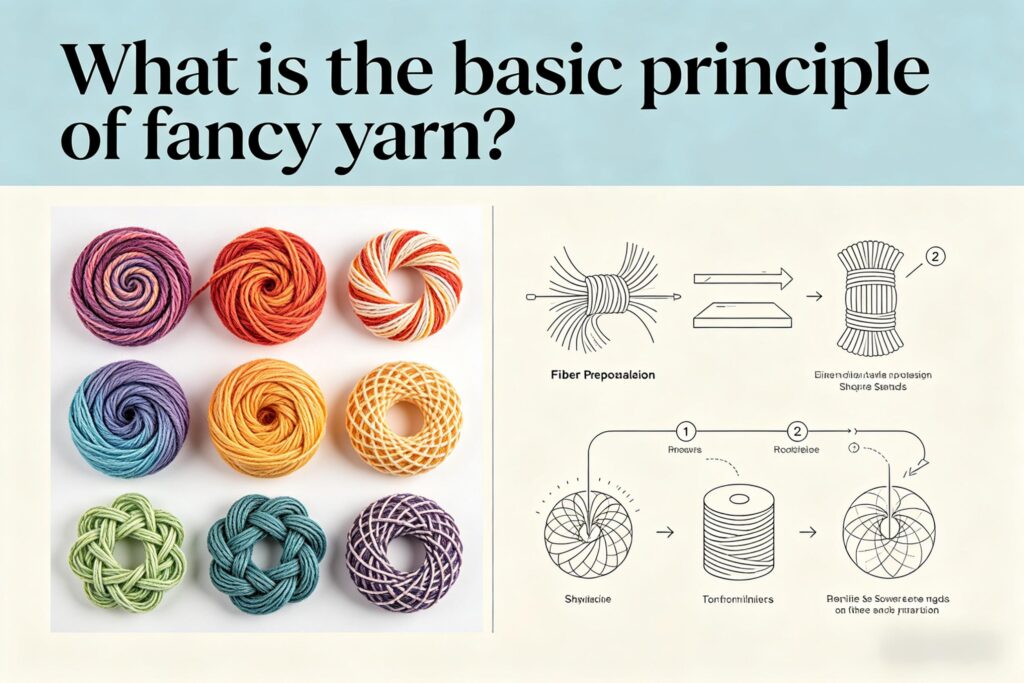
The Art of Irregularity: Understanding the Basic Principle of Fancy Yarn
In the world of textiles, where uniformity and consistency are often the hallmarks of quality, fancy yarns stand as a captivating exception. Also known as novelty or effect yarns, they are deliberately designed to break the rules, introducing visual and tactile interest that transforms simple fabric into a dynamic, expressive medium. The basic principle of fancy yarn production lies in the deliberate and controlled introduction of irregularities during the spinning process. This is achieved not by accident, but through sophisticated engineering that creates deliberate variations in the yarn’s structure, which manifest as slubs, loops, spirals, or vibrant color bursts.
At its core, the creation of any fancy yarn relies on a fundamental system involving at least two component threads: the core and the effect. The core thread provides the foundational strength and integrity of the yarn. It is typically a strong, straightforward yarn that runs through the center, bearing the structural load during weaving or knitting. The effect thread is the artistic element. It is this thread that is manipulated—overfed, twisted, or interrupted—to create the desired decorative feature. A third component, the binder thread, is often used to secure the effect thread to the core, locking the irregular structure in place and ensuring the fancy yarn is durable enough for subsequent manufacturing processes. This relationship is the cornerstone of fancy yarn construction.
The specific type of irregularity is dictated by the method of manipulation applied to the effect thread. For instance, a slub yarn is created by intermittently varying the tension or the feed rate of the effect thread, resulting in thickened, soft places along the length of an otherwise uniform yarn. This mimics the rustic, natural appearance of hand-spun yarns. A loop yarn is produced by overfeeding the effect thread significantly and then using a special device to push it into a series of regular loops, which are then bound by the binder thread. This creates a soft, textured yarn ideal for bouclé fabrics. For a spiral or corkscrew yarn, two threads of differing thicknesses or colors are plied together with a high level of twist, causing the thinner thread to spiral dramatically around the thicker one. The possibilities are nearly endless, with other techniques creating knop, gimp, and chenille effects, each with its own distinct character.
The impact of these principles extends far beyond aesthetics. Fancy yarns add significant value to textiles, enabling designers to create unique fabrics with enhanced depth, texture, and visual appeal without altering the base weave or knit structure. A simple plain-weave fabric can be transformed into a luxurious material simply by incorporating a slub or loop yarn. These yarns are pivotal in fashion for creating statement garments, in upholstery for producing rich, tactile surfaces, and in home furnishings for adding a layer of sophistication and interest. In conclusion, the principle of fancy yarn is a brilliant fusion of technical precision and artistic vision. It demonstrates that true beauty in textiles often arises not from flawless consistency, but from the masterful and intentional creation of controlled imperfection. By understanding the roles of the core, effect, and binder threads, and the techniques used to manipulate them, one can appreciate the remarkable engineering behind the textures that make our fabrics captivating to both the eye and the hand.
