
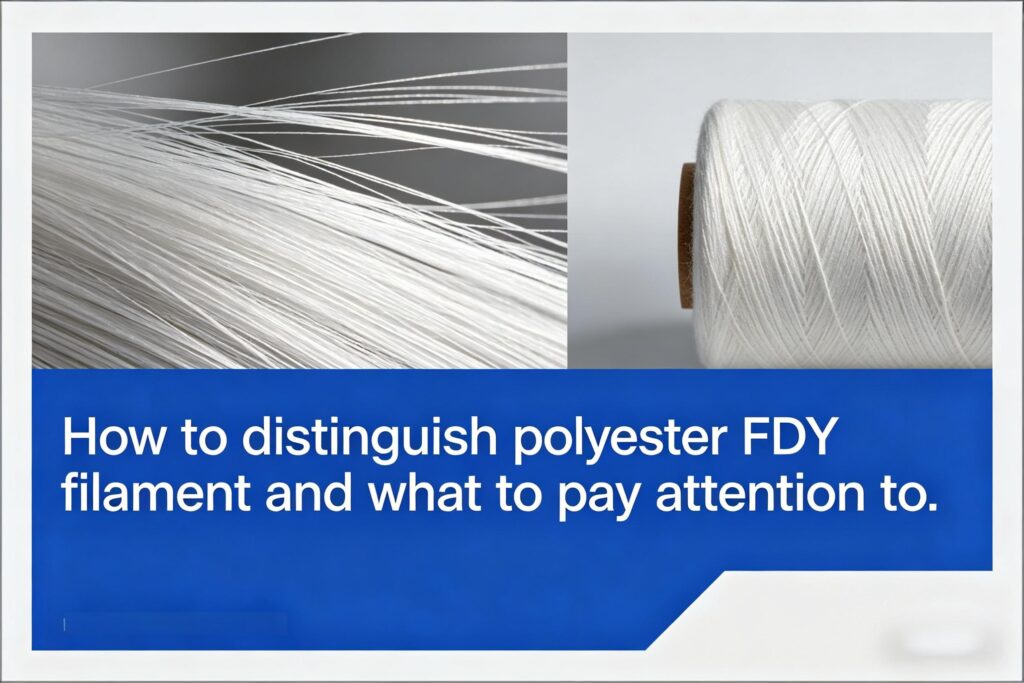
A Comprehensive Guide to Identifying Polyester FDY Filament: Key Characteristics and Precautions
Polyester Fully Drawn Yarn (FDY) is a fundamental material in the textile industry, widely used in weaving, knitting, and embroidery to produce fabrics for apparel, home furnishings, and industrial applications. Distinguishing FDY from other polyester yarns like Partially Oriented Yarn (POY) or Draw Textured Yarn (DTY) is crucial for manufacturers, traders, and quality control specialists to ensure the correct material is selected for specific end-uses. Proper identification hinges on observing physical characteristics, performing simple tests, and understanding its production process.
Key Characteristics for Distinguishing Polyester FDY
- Visual and Tactile Inspection:
- Smoothness and Sheen: FDY filaments are characterized by their exceptionally smooth, straight, and parallel structure. They possess a high, uniform luster. When held up to the light, the filament bundle appears very even and consistent.
- Strength and Elongation: A single filament of FDY is very strong and has relatively low elongation at break compared to POY. When pulled gently by hand, it feels strong and resists stretching, snapping with a clean break rather than a slow, ductile failure.
- Uniformity: FDY is known for its high uniformity in denier (fineness) along its entire length. There should be minimal variation in thickness.
- Distinguishing from POY and DTY:
- vs. Partially Oriented Yarn (POY): POY is an intermediate product with lower strength and higher elongation. It is much more elastic and less robust than FDY. POY cannot be used directly in weaving and requires further drawing, which is what transforms it into FDY. If you have a sample of both, POY will feel softer and stretch significantly more before breaking.
- vs. Draw Textured Yarn (DTY): DTY is made by texturizing POY, which introduces bulk, stretch, and a crimped appearance. This is the most straightforward distinction. DTY is fluffy, crimped, and has a duller appearance, resembling wool or cotton yarn. FDY is straight, smooth, and sleek. DTY fabrics are stretchy and soft (e.g., in fleece or sportswear), while FDY fabrics are smooth and less elastic (e.g., in linings or shirt fabrics).
- Simple Burn Test (Conducted with Extreme Caution):
The burn test is a classic, though potentially hazardous, method for fiber identification. Always perform this test in a well-ventilated area away from flammables, using tweezers and a small snippet of yarn.- Polyester FDY Behavior: When exposed to a flame, polyester melts and shrinks away from the fire. It burns with a slow, sputtering flame and gives off black smoke. Once the flame is removed, it tends to self-extinguish. The residue is a hard, black or brownish bead that can be crushed between fingers. The odor is distinctively sweet or aromatic, reminiscent of burning chemicals or honey.
Crucial Considerations and Precautions
When identifying and handling Polyester FDY, several factors must be considered to ensure accuracy and safety.
- Seek Technical Data Sheets (TDS): The most reliable method of identification is to consult the manufacturer’s Technical Data Sheet. This document provides definitive information on the yarn type, denier, filament count, luster, tenacity, and elongation, leaving no room for error from subjective tests.
- Precautions for the Burn Test: While informative, the burn test has limitations. The melting polymer can cause severe skin burns. The fumes may be irritating or toxic if inhaled. This test should only be used as a preliminary check and not as a definitive identification method, especially for blended fibers.
- Understand End-Use Requirements: Correct identification is not just an academic exercise. Using FDY in an application requiring the stretch of DTY, or vice versa, will result in product failure. Ensure the yarn’s properties—such as its strength, lack of stretch, and smoothness—align with the intended fabric and manufacturing process (e.g., high-speed weaving).
- Beware of Blends and Finishes: Sometimes, FDY may be combined with other fibers or treated with finishes (e.g., spin finishes for lubrication) that can alter its tactile properties or burn characteristics. Be aware that a coating might affect initial observations.
- Storage and Handling: FDY should be stored in a cool, dry place away from direct sunlight to prevent degradation of its properties. Proper handling is essential to avoid snagging or tangling the smooth filaments.
In conclusion, distinguishing polyester FDY involves a multi-faceted approach combining visual and tactile inspection with a clear understanding of how it differs from other yarn types. While simple field tests are useful, cross-referencing with technical specifications and handling the material with appropriate precautions are paramount for accurate identification and successful application.
