
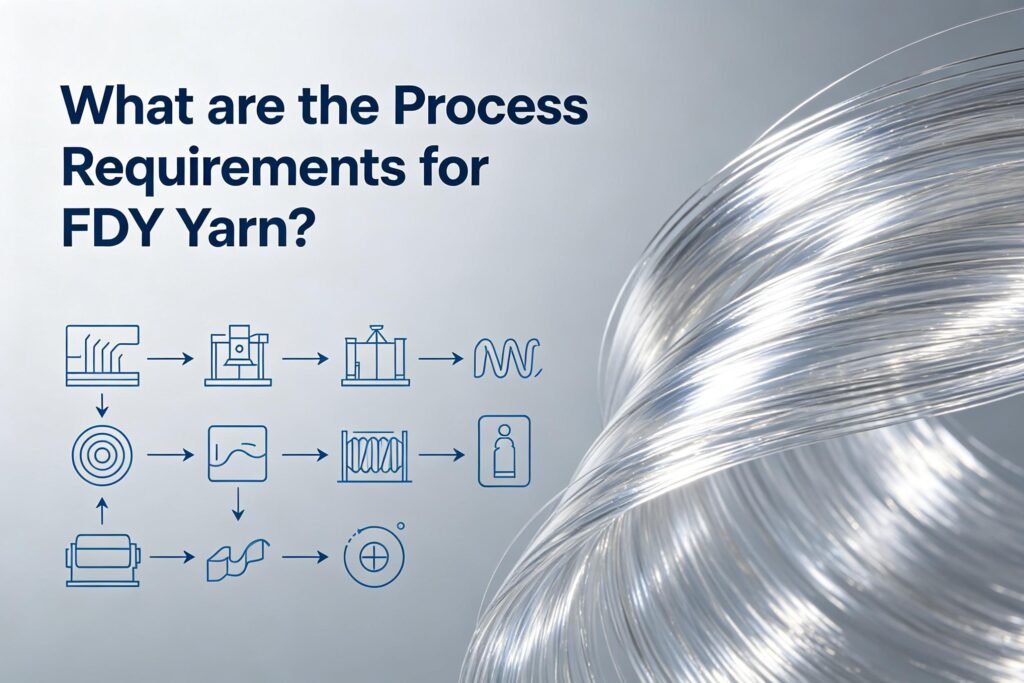
In the intricate world of synthetic textiles, Fully Drawn Yarn (FDY) stands as a cornerstone for creating fabrics known for their smoothness, high strength, and dimensional stability. Unlike Partially Oriented Yarn (POY), which requires further drawing, FDY is fully drawn during its manufacturing process, rendering it ready for direct use in weaving and knitting. Achieving the precise properties that define quality FDY—consistent denier, exceptional tensile strength, low shrinkage, and uniform dyeability—is not a simple feat. It is the result of meticulously controlling a complex series of interconnected process requirements. This article delves into the critical stages of FDY production, outlining the essential parameters and technological controls that transform polymer chips into a superior filament yarn. Understanding these requirements is key to appreciating the engineering behind the material and to sourcing FDY that meets exacting standards for high-end applications.
1. Raw Material Specification and Preparation
The journey of FDY begins long before the spinning process, with the fundamental requirement of high-purity raw materials.
- Polymer Chip Quality: The primary requirement is the use of polymer chips—typically polyester (PET) or nylon (PA6/PA66)—with extremely consistent intrinsic viscosity (IV). IV directly influences the molecular weight and, consequently, the final yarn’s strength and drawability. Chips must also have very low moisture content to prevent hydrolytic degradation during melting, which causes chain scission, uneven melting, and yarn defects. The shape, size, and additive content (e.g., delustrant Titanium Dioxide) of the chips must also be uniform to ensure stable feeding into the extruder.
- Masterbatch & Additives: For colored or functional FDY (e.g., UV-resistant, antimicrobial), the incorporation of masterbatches is a critical step. The process requires perfect compatibility between the masterbatch carrier and the base polymer, as well as ultra-precise dosing and dispersion systems. Any agglomeration or uneven distribution will lead to filament breakage, spinneret clogging, or streaky dyeing later on.
2. The Spinning & Drawing Process: A Symphony of Precision
The core of FDY manufacturing is an integrated, high-speed spinning and drawing line where parameters are interdependently critical.
A. Extrusion and Melting
The dried chips are fed into an extruder, which must maintain a precise and stable thermal profile. The temperature must be high enough to create a completely homogeneous melt but strictly controlled to prevent thermal oxidation or degradation. The molten polymer is then forced through a precision filtration system (often with filter fineness between 15-25 microns) to remove any gel particles or impurities that could cause spinneret blockage or yarn breaks.
B. Spinning and Quenching
The purified melt is metered by a high-precision gear pump to ensure a constant volumetric flow rate to the spinneret. The spinneret, a metal plate with numerous microscopic holes, defines the number of filaments (e.g., in a 75D/72F yarn). The design of these capillaries is crucial. As the molten filaments emerge, they enter the quenching chamber. Here, a key requirement is the controlled, uniform cross-flow of conditioned air at specific temperature, humidity, and velocity. Asymmetric or turbulent quenching creates differences in the cooling rate and crystalline structure across the filament bundle, leading to uneven dye uptake and the dreaded “barré” effect in finished fabrics.
C. Integrated Drawing and Heat Setting
This stage differentiates FDY from POY. The filaments pass over a series of high-speed godet (roller) pairs. The first godet (Godet 1) sets the initial spinning speed. The yarn is then drawn between Godet 1 and a subsequent, faster godet (Godet 2 or more). The draw ratio (the speed difference) is a fundamental requirement that determines the yarn’s final orientation, crystallinity, tenacity, and elongation. This drawing occurs over heated godets, which provide the thermal energy necessary for polymer chain alignment and relaxation. Precise temperature control of each godet is essential for stabilizing the yarn’s structure and setting its shrinkage properties.
D. Oil Application and Winding
After drawing, a spin finish oil is applied via a kiss-roll or metered applicator. The requirement here is for uniform, consistent application. This finish lubricates the filaments to prevent static and frictional damage during high-speed winding and subsequent weaving, provides cohesion to the yarn bundle, and can impart specific antistatic or antibacterial properties. Finally, the yarn is wound onto bobbins. The winding tension must be exquisitely controlled to produce a stable, perfectly layered package with the correct hardness, ensuring trouble-free unwinding in downstream processes at speeds often exceeding 4,000 meters per minute.
3. Quality Control and Testing Requirements
Meeting in-process parameters is verified through rigorous offline testing, a non-negotiable requirement for releasing saleable FDY.
- Physical Properties: Every batch must be tested for tenacity (g/denier), elongation at break, and modulus. For standard polyester FDY, tenacity is typically required to be above 4.0 g/d.
- Uniformity: An Uster® Tester is used to measure yarn evenness, quantifying imperfections like thick places, thin places, and neps. Low Uster% values are a hallmark of quality.
- Shrinkage: Hot-air or boil-off shrinkage is measured to predict the dimensional stability of fabrics made from the yarn.
- Dyeadility: For apparel-grade FDY, a core requirement is uniform dye affinity. Yarn packages are often sample-dyed to check for any streakiness or barré indicative of underlying structural inconsistencies from the quenching or drawing steps.
Conclusion: The Confluence of Science and Control
The production of high-quality FDY is a testament to precision engineering, where chemistry, fluid dynamics, thermodynamics, and mechanical control converge. Each requirement—from the IV of a chip to the temperature of a godet and the tension on the winder—is a critical link in a chain that defines the yarn’s performance. It is a process that demands not only advanced machinery but also deep operational expertise and an unwavering culture of quality control. For brands and manufacturers whose products depend on the reliability, consistency, and superior performance of their materials, partnering with a supplier that masters these requirements is paramount. In this context, a company like glyarn exemplifies this dedication. By integrating stringent control over every stage outlined above—from raw material selection to final winding—glyarn ensures its FDY meets the highest technical benchmarks, providing a dependable foundation for creating advanced textiles.
