
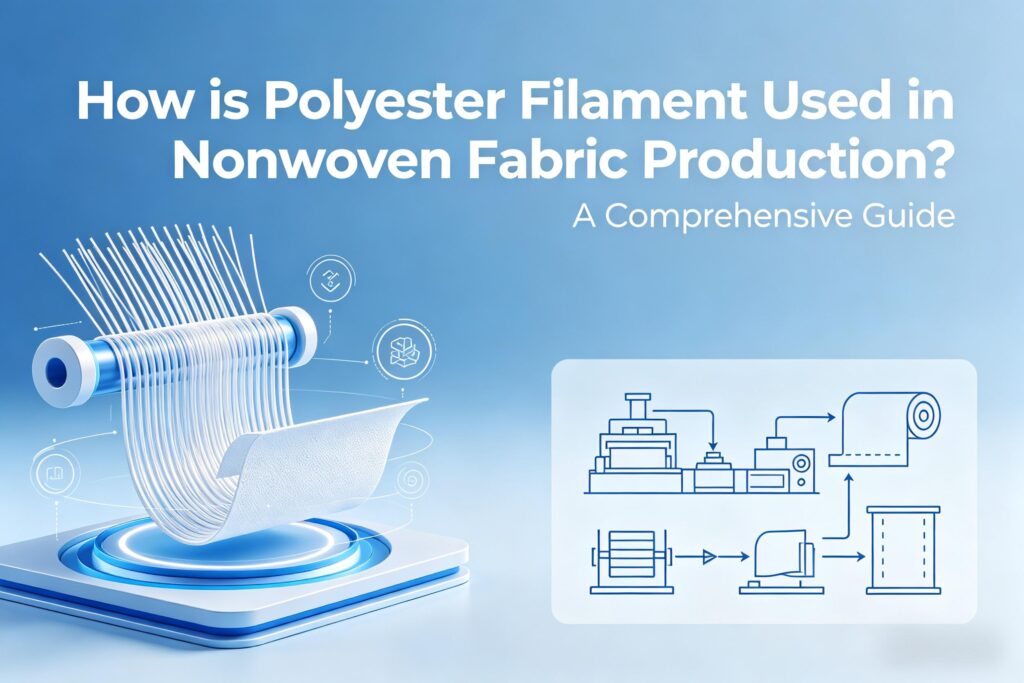
Polyester filament, particularly in the form of Polyester Spunbond (PES spunbond), represents a critical and high-performance segment within the nonwoven fabrics industry. Unlike nonwovens made from short staple fibers that are carded and bonded, those produced directly from continuous filaments offer superior strength, uniformity, and efficiency. This article provides a comprehensive technical overview of the primary industrial process for transforming polyester polymer into filament-based nonwoven fabrics: the spunbond process. We will examine the complete production line, from polymer chips to finished roll goods, analyze the key properties of the resulting fabric, and explore its dominant applications.
1. The Spunbond Process: A Continuous Filament Transformation
The spunbond process is a highly integrated, continuous one-line system that converts solid polyester polymer directly into a uniform nonwoven web. Its efficiency and consistency make it the industry standard for filament-based nonwovens.
1.1 Polymer Feeding and Extrusion
The process begins with polyester chips—typically virgin or recycled PET—which are dried to remove moisture that can cause hydrolysis and molecular degradation during melting. These chips are fed into an extruder. The extruder uses a rotating screw to convey, compress, melt, and homogenize the polymer through controlled heating zones. The resulting molten polyester is pumped under high pressure to the next critical component: the spinneret.
1.2 Filament Formation: Spinning and Drawing
The spinneret is a metal plate containing hundreds to thousands of precision-engineered micro-holes. As the molten polymer is forced through these holes, it forms a curtain of fine, continuous filaments. These freshly extruded filaments are immediately quenched and solidified by a stream of cool air. To develop the necessary molecular orientation and tensile strength, the filaments are then pneumatically drawn. High-velocity air jets accelerate the filaments, stretching them thin and aligning their polymer chains. This drawing step is crucial for achieving the final fabric’s strength and durability.
1.3 Web Formation and Bonding
The drawn filaments are then directed onto a moving conveyor belt or “forming wire.” Suction underneath the belt helps distribute the filaments randomly, creating a uniform, unbonded web. This web must be consolidated to become a coherent fabric. The most common method for polyester is thermal bonding.
- Calendaring (Point Bonding): The web passes through a heated calender roll pair. One roll is smooth and hot, while the other is engraved with a patterned surface (e.g., diamond, dot). Under heat and pressure, the filaments fuse together at the bond points, creating a fabric that is strong yet soft and breathable. The percentage of bonded area controls the fabric’s balance between strength and porosity.
- Through-Air Bonding: The web passes through a hot-air oven where heated air circulates through it, causing filaments to fuse at their. This method produces a loftier, bulkier, and very soft fabric, often used in high-loft hygiene products.
1.4 Finishing and Winding
After bonding, the fabric may undergo online finishing treatments. These can include applying additives for hydrophilicity (water absorption), hydrophobicity (water repellency), or antimicrobial properties. Finally, the continuous fabric is trimmed at the edges and wound into large jumbo rolls for shipment to converters.
2. Key Characteristics and Advantages of Polyester Spunbond Nonwovens
The spunbond process endows polyester filament nonwovens with a unique set of properties that drive their adoption.
2.1 Superior Mechanical Properties
- High Strength and Durability: Continuous filaments provide excellent tensile, tear, and burst strength compared to staple fiber nonwovens of similar weight. The drawing process ensures high tenacity.
- Excellent Dimensional Stability: The filaments are laid and bonded in a stable configuration, resulting in low elongation and minimal shrinkage, which is critical for precise manufacturing processes.
2.2 Uniformity and Consistency
The continuous, automated process produces a fabric with exceptional consistency in weight (gsm – grams per square meter), thickness, and mechanical properties across its width and length. This reproducibility is vital for automated converting lines (e.g., in diaper production).
2.3 Chemical and Environmental Resistance
Polyester is inherently resistant to many chemicals, acids, and alkalis. It does not mildew or rot, and it has excellent resistance to UV degradation when properly stabilized, making it suitable for outdoor applications like geotextiles.
2.4 Thermal Stability
Polyester has a high melting point (~250-260°C), allowing spunbond fabrics to be used in applications involving high temperatures or hot-air processes.
3. Comparative Analysis: Polyester Spunbond vs. Other Major Nonwovens
| Property | Polyester (PES) Spunbond | Polypropylene (PP) Spunbond | Spunlace (Hydroentangled) |
|---|---|---|---|
| Primary Fiber Form | Continuous Filament | Continuous Filament | Staple Fibers (can be PES, viscose, cotton) |
| Typical Bonding Method | Thermal (Calender) | Thermal (Calender) | Mechanical (High-pressure water jets) |
| Key Advantages | High strength, UV/chemical resistance, thermal stability. | Cost-effective, lightweight, good hydrophobicity. | Extremely soft, cloth-like hand feel, high absorbency. |
| Common Applications | Geotextiles, roofing, filtration, durable liners. | Hygiene (coverstock), medical gowns, disposable covers. | Wipes (facial, disinfecting), medical drapes, high-end hygiene. |
4. Primary Application Areas
The properties of polyester spunbond nonwovens direct them toward demanding, durable applications.
- Geotextiles and Civil Engineering: The largest application segment. Used for soil stabilization, drainage, erosion control, road and railway reinforcement, and landfill liners due to their high strength, puncture resistance, and permeability.
- Roofing and Construction: Used as a carrier scrim in built-up roofing systems and as a backing or reinforcement layer for membranes, providing dimensional stability and tear strength.
- Filtration: Used in liquid and air filter media for HVAC, automotive, and industrial processes, benefiting from consistent pore structure, chemical resistance, and thermal stability.
- Agriculture (Agrotextiles): Used for crop covers, weed control fabrics, and shade cloths, leveraging their UV resistance and durability.
- Durable Liners and Packaging: Used for furniture backing, luggage linings, and protective packaging where strength and abrasion resistance are needed.
Conclusion: The Engineered Fabric of Choice
In conclusion, the transformation of polyester filament into nonwoven fabrics via the spunbond process is a feat of modern industrial engineering. It is not merely a textile process but a highly controlled, polymer-to-product manufacturing system. The resulting fabrics are not traditional textiles but engineered materials with precisely defined performance characteristics. The combination of high strength, uniformity, environmental resistance, and thermal stability makes polyester spunbond nonwovens indispensable in critical technical sectors where durability and reliability are non-negotiable, such as infrastructure, construction, and industrial filtration. As the demand for sustainable solutions grows, the integration of recycled polyester (rPET) into the spunbond process further enhances its relevance, positioning it as a key technology for producing high-performance, circular materials for the future.
