
Table of Contents
- Introduction: The Ubiquitous Fiber
- Defining FDY in the Synthetic Fiber Landscape
- A Brief History and Market Position
- The Science of Spinning: How FDY is Made
- From Polymer to Pre-Oriented Yarn (POY): The First Step
- The Key Differentiator: The Simultaneous Draw-Roll Process
- Winding and Finishing: Preparing for Downstream Use
- Characteristics and Properties: The FDY Advantage
- Molecular Structure and Fiber Morphology
- Key Physical and Mechanical Properties
- Comparative Analysis with Related Yarns (POY, DTY)
- Applications Across Industries: Where FDY Excels
- Textiles and Apparel: The Foundation of Fabrics
- Home Furnishings and Upholstery
- Technical and Industrial Textiles
- A Comparative Table of FDY Applications
- Market Dynamics and Global Supply Chain
- Major Production Hubs and Leading Producers
- Raw Material Linkages: The PTA and MEG Connection
- Pricing Factors and Future Outlook
- Conclusion: The Enduring Relevance of a Modern Workhorse
1. Introduction: The Ubiquitous Fiber
Fully Drawn Yarn, universally known in the industry by its acronym FDY, represents one of the most significant and versatile categories of synthetic filament yarn. It is a fully oriented, high-strength, continuous filament yarn made primarily from polyethylene terephthalate (PET). The term “fully drawn” is its key descriptor, signifying that the yarn has undergone a complete drawing (or stretching) process during its manufacturing. This process aligns the long-chain polymer molecules along the fiber’s axis, maximizing its tenacity and dimensional stability before it is wound onto the final package.
FDY emerged as a technological advancement over its predecessor, Partially Oriented Yarn (POY), offering downstream manufacturers a ready-to-use yarn that eliminated the need for separate drawing steps in their own facilities. Today, FDY is a cornerstone of the global textile industry, prized for its consistent quality, excellent luster, smooth hand feel, and superior dyeability. It forms the foundational warp and weft in countless woven and knitted fabrics, serving markets from high-fashion apparel to durable home furnishings and demanding technical applications. Its production and consumption volumes are key indicators of economic activity in the textile sector, with China, India, and Southeast Asia serving as dominant production powerhouses.
2. The Science of Spinning: How FDY is Made
The manufacturing of FDY is a sophisticated, continuous, and highly automated process that transforms raw PET polymer into a finished, high-performance yarn.
- From Polymer to Pre-Oriented Yarn (POY): The First Step
The process begins with dried PET polymer chips, which are melted in an extruder at temperatures around 290°C. This molten polymer is then precisely metered through a spinneret—a metal plate containing dozens or hundreds of microscopic holes. As the nascent filaments emerge, they are rapidly cooled and solidified by a crossflow of conditioned air. At this stage, the filaments are collected at a relatively high speed (typically 2800-3500 m/min), inducing a small amount of orientation. The output of this stage is known as Pre-Oriented Yarn (POY), which has low orientation and strength but high elongation. - The Key Differentiator: The Simultaneous Draw-Roll Process
This is the defining stage for FDY. Unlike the two-step process where POY is first made, stored, and then drawn on a separate machine, the FDY process integrates drawing in-line with spinning. The POY filaments, immediately after formation, are fed through a series of heated godet rollers. The first set runs at a controlled speed. The filaments then pass over a hot plate or heated roller and are taken up by a second set of godet rollers spinning at a significantly higher speed (draw ratio typically between 1.5 and 2.0). This simultaneous drawing and thermal treatment is the core of the FDY process. The heat relaxes the polymer chains, allowing them to be permanently stretched and aligned. This dramatically increases the yarn’s tenacity (strength) and reduces its elongation to break, while also setting its final denier (fineness). - Winding and Finishing: Preparing for Downstream Use
After drawing, the filaments are treated with a spin finish—a carefully formulated emulsion of lubricants and antistatic agents—to reduce friction and control static electricity during downstream weaving or knitting. Finally, the fully oriented, finished filaments are wound onto large bobbins or cheeses at high speeds (4500-6000 m/min) under precise tension control, ready for shipment to fabric manufacturers.
3. Characteristics and Properties: The FDY Advantage
The integrated spin-draw process endows FDY with a unique set of properties that make it indispensable.
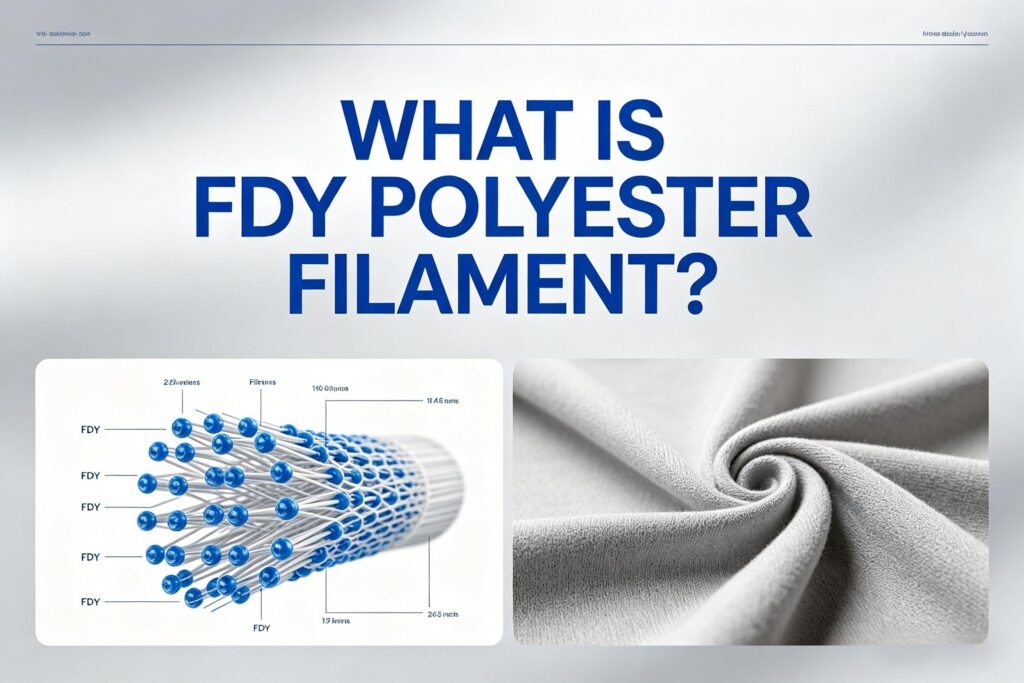
- Molecular Structure and Fiber Morphology: The high-speed drawing under heat creates a highly oriented and crystalline structure. The polymer chains are packed parallel to the fiber direction, with fewer entanglements and defects compared to POY. This results in a smooth, uniform filament with a round cross-section and high surface regularity.
- Key Physical and Mechanical Properties:
- High Tenacity and Low Elongation: FDY possesses superior strength (typically 3.5-5.0 g/denier) and low elongation at break (20-30%), making it robust for high-stress applications like warp yarns in looms.
- Excellent Dimensional Stability: The full orientation and heat-setting mean FDY has minimal shrinkage, ensuring fabrics maintain their shape during dyeing and end use.
- Good Luster and Smoothness: The uniform filaments reflect light evenly, providing a characteristic bright or semi-dull luster (controlled by the addition of delusterants like TiO2). The smooth surface gives fabrics a sleek, soft hand feel.
- Uniform Dye Uptake: The consistent morphology allows for even penetration of dye molecules, resulting in uniform, vibrant coloration with fewer barre defects.
- Comparative Analysis with Related Yarns:
- vs. POY (Partially Oriented Yarn): POY is the intermediate product, weaker, more elastic, and not ready for direct fabric formation. It is primarily used as the feed yarn for texturing (to make DTY) or for draw-warping.
- vs. DTY (Draw Textured Yarn): DTY is made by texturing POY, creating crimps, loops, and bulk for a soft, cotton-like feel. FDY remains straight and smooth. FDY is for smooth, lustrous fabrics (e.g., linings, shirting); DTY is for soft, bulky fabrics (e.g., fleece, sportswear).
4. Applications Across Industries: Where FDY Excels
The properties of FDY directly dictate its vast application portfolio.
- Textiles and Apparel: This is the largest market. FDY is the premier choice for:
- Lining Fabrics: Its smoothness allows garments to slip on easily.
- Shirting and Blouse Fabrics: Especially in high-thread-count poplin and voile, where strength and luster are valued.
- Lingerie and Loungewear: For its soft hand feel and durability.
- Outerwear Shell Fabrics: Often in microfiber deniers for a luxurious, water-resistant finish.
- Home Furnishings and Upholstery:
- Curtains and Drapery: FDY provides the necessary drape, luster, and dimensional stability.
- Bed Linens: Used in sateen and percale weaves.
- Furniture Upholstery: High-tenacity FDY offers abrasion resistance and durability.
- Technical and Industrial Textiles:
- Sewing Thread: High-strength FDY is a critical raw material.
- Conveyor Belts and Tire Cord Fabric: High-tenacity variants provide critical reinforcement.
- Geotextiles and Filter Fabrics: For stabilization, drainage, and filtration.
Comparative Table of FDY Applications by Key Property
| Key FDY Property | Primary Industry | Specific Applications | End-User Benefit |
|---|---|---|---|
| Smoothness & Luster | Apparel | Linings, satin fabrics, lingerie | Luxurious feel, aesthetic shine, comfort |
| High Tenacity | Apparel / Industrial | Shirt warps, sewing thread, tire cord | Durability, pilling resistance, structural strength |
| Dimensional Stability | Home Furnishings | Curtains, bed sheets, upholstery | Shape retention, no sagging, consistent fit |
| Uniform Dyeability | Apparel / Home | All dyed fabrics | Consistent, vibrant colors without defects |
5. Market Dynamics and Global Supply Chain
The FDY industry is a massive, globally integrated sector deeply tied to the petrochemical chain.
- Major Production Hubs and Leading Producers: Asia dominates global FDY capacity. China is the undisputed leader, accounting for over 65% of world production, with vast, vertically integrated companies like Tongkun Group, Zhejiang Hengyi Group, and Shenghong leading the way. India is a major and growing producer, with Reliance Industries being a key player. Significant capacity also exists in Southeast Asia (Vietnam, Indonesia, Thailand) and Turkey.
- Raw Material Linkages: The cost of FDY is predominantly driven by its raw materials: Purified Terephthalic Acid (PTA) and Monoethylene Glycol (MEG), which are polymerized to make PET. Therefore, FDY prices are highly correlated with global PTA/MEG prices and crude oil trends. Producers with backward integration into PTA or even paraxylene (PX) production enjoy a significant cost advantage.
- Pricing Factors and Future Outlook: FDY pricing is influenced by: 1) Feedstock (PTA/MEG) Costs, 2) Supply-Demand Balance within the polyester chain, 3) Cotton Prices (as a competing natural fiber), and 4) Export-Import Policies and Tariffs. The future of FDY lies in specialization: the development of microfilament FDY (denier per filament < 0.7 dpf) for ultra-soft fabrics, functional FDY with built-in moisture-wicking, UV resistance, or antimicrobial properties, and a strong push towards recycled FDY made from post-consumer PET bottles (rPET) to meet growing sustainability demands from global brands.
6. Conclusion: The Enduring Relevance of a Modern Workhorse
FDY polyester filament stands as a testament to materials engineering, transforming a basic petrochemical into a fiber of remarkable consistency, performance, and versatility. Its integrated manufacturing process delivers a product that perfectly balances strength, stability, and processability, making it the default choice for a staggering array of applications. While the market evolves towards sustainability and niche functionalities, the fundamental advantages of FDY—its reliability, quality, and cost-effectiveness—ensure it will remain an essential workhorse of the global textile and industrial sectors for decades to come. For anyone involved in the manufacturing, sourcing, or design of textile-based products, a deep understanding of FDY is not just useful—it is fundamental to making informed and successful decisions.
