
Table of Contents
- Introduction: The Need for Precision in Polyester Yarn Selection
- Two Pillars of Polyester Textiles
- Why Proper Distinction Matters
- Fundamental Differences: Definitions and Manufacturing Processes
- Polyester Filament Yarn (PFY): The Continuous Thread
- Polyester Textured Yarn (PTY): Engineering Bulk and Stretch
- Comparative Analysis: Key Physical and Performance Properties
- Visual and Tactile Characteristics
- Mechanical Performance and Elasticity
- End-Use Applications and Fabric Style
- Practical Identification Guide: From Laboratory to Production Floor
- Simple Visual and Manual Tests
- Advanced Analytical Methods
- Strategic Selection for Specific Applications
- Matching Yarn Properties to Product Needs
- Specialized Varieties and Market Trends
- Conclusion: Mastering Selection for Optimal Product Development
1. Introduction: The Need for Precision in Polyester Yarn Selection
The landscape of modern textiles is largely defined by polyester, the world’s most produced synthetic fiber. Within this vast category, two fundamental forms dominate production: Polyester Filament Yarn (PFY) and Polyester Textured Yarn (PTY). While both originate from the same polymer—polyethylene terephthalate (PET)—their distinct physical structures impart dramatically different characteristics to the final fabric. The ability to accurately distinguish between them is not merely academic; it is a critical skill for textile engineers, fabric developers, and sourcing specialists. Misidentification can lead to incorrect fabric specifications, poor product performance, and costly production errors. This guide provides a comprehensive framework for understanding, identifying, and strategically selecting between these two essential yarn types.
2. Fundamental Differences: Definitions and Manufacturing Processes
The core distinction lies in their physical form and the processes that create them.
- Polyester Filament Yarn (PFY): The Continuous Thread
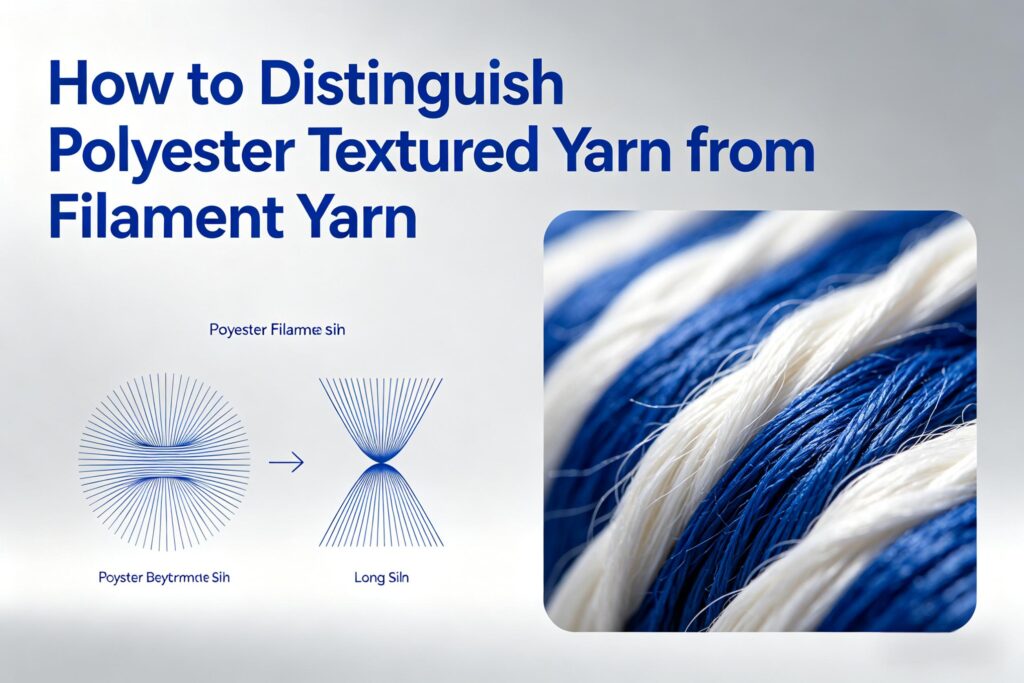
PFY, also known as “Filament” or “Fully Drawn Yarn (FDY)”, consists of one or more continuous, parallel filaments extruded to great lengths. In its production, molten PET is forced through a spinneret, solidified, and drawn (stretched) to align the polymer molecules, resulting in fibers that are smooth, straight, and have high tensile strength. The filaments can be grouped together without twist (a bundle) or with a slight twist to form the final yarn. This process yields a material with a sleek, uniform, and often lustrous appearance. - Polyester Textured Yarn (PTY): Engineering Bulk and Stretch
PTY, commonly referred to as “Textured Yarn” or “Draw Textured Yarn (DTY)”, begins its life as a partially oriented yarn (POY). This POY is then subjected to a texturing process—most commonly false-twist texturing—where it is heated, twisted, and then cooled to set a permanent crimp, loop, or coil into the otherwise straight filaments. This mechanical alteration is transformative. It converts the smooth filament into a voluminous, stretchy, and opaque yarn. “High-elastic” and “low-elastic” textured yarns differ in the degree of crimp and stretch imparted during this process.
The following table summarizes the core distinctions in their manufacture and basic form:
| Feature | Polyester Filament Yarn (PFY/FDY) | Polyester Textured Yarn (PTY/DTY) |
|---|---|---|
| Physical Form | Continuous, straight, parallel filaments. | Continuous filaments with permanent crimps, coils, or loops. |
| Primary Process | Melt extrusion, drawing, and winding. | False-twist texturing (heating, twisting, cooling) of POY. |
| Key Visual Trait | Smooth, sleek, often lustrous surface. | Bulky, opaque, wool-like or cotton-like appearance. |
3. Comparative Analysis: Key Physical and Performance Properties
The structural differences lead to a clear divergence in performance, which dictates their application.
- Visual and Tactile Characteristics
- PFY produces fabrics that are smooth, shiny, and have a distinct “synthetic” slip (like nylon). The surface is even, and the fabric tends to be lightweight and compact.
- PTY creates fabrics that are dull, soft, and have a dry, natural hand feel reminiscent of cotton or wool. The yarn’s bulk gives the fabric greater opacity, loft, and a warmer tactile sensation.
- Mechanical Performance and Elasticity
- Strength & Abrasion: PFY generally exhibits higher tensile strength due to the aligned molecular structure from drawing. Fabrics are very durable and resistant to pilling.
- Elasticity: This is the most definitive difference. PTY possesses significant elasticity and stretch recovery (from 15% to over 400% for high-stretch varieties), whereas PFY has minimal inherent stretch. The crimp in PTY allows it to elongate and spring back.
- Thermal Insulation: The air trapped within the bulky structure of PTY fabrics gives them superior thermal insulation properties compared to the compact structure of PFY fabrics.
- End-Use Applications and Fabric Style
The choice directly shapes the final product:- PFY Applications: Ideal for smooth, crisp, and lustrous fabrics. Common uses include linings, lightweight fashion fabrics (imitating silk), shirtings, waterproof coatings, sewing threads, and technical textiles where low porosity and high strength are key.
- PTY Applications: Chosen for softness, warmth, and stretch. It is the staple for fleece, knitted jerseys, sportswear, casual pants, upholstery, curtains, and any fabric where a natural, cozy, or elastic hand feel is desired.
4. Practical Identification Guide: From Laboratory to Production Floor
Accurate identification can be achieved through a combination of simple observations and technical tests.
- Simple Visual and Manual Tests
- Visual Inspection: Examine the yarn or fabric surface closely. A consistent, glossy sheen suggests PFY. A matte, fuzzy, or pebbled surface indicates PTY.
- Stretch Test: Gently pull a strand of yarn. PTY will elongate noticeably (especially high-elastic types) and retract when released. PFY will have very little give.
- Twist and Bulk Test: Untwist a short length. PFY will separate into a few straight, parallel filaments. PTY will separate into a disorganized mass of crimped filaments that spring apart and feel voluminous.
- Advanced Analytical Methods
For definitive verification, especially with blends or fine deniers:- Microscopy: Viewing under a microscope is conclusive. PFY filaments appear as straight rods, while PTY filaments show clear helical crimps, loops, or zig-zag patterns.
- Thermal Shrinkage Test: Applying controlled heat (e.g., from a lighter at a safe distance) can cause PTY to shrink more dramatically due to the relaxation of stresses set during texturing.
5. Strategic Selection for Specific Applications
Choosing the right yarn is a strategic decision that balances performance, aesthetics, and cost.
- Matching Yarn Properties to Product Needs:
- Select PFY when your design calls for: High sheen, smooth drape, wind resistance, high strength, and a sleek aesthetic (e.g., activewear shells, linings, flags, fine satins).
- Select PTY when your design requires: Softness, moisture-wicking (due to capillary action in crimps), thermal insulation, stretch comfort, and a natural look (e.g., sweaters, t-shirts, blankets, stuffed toys).
- Specialized Varieties and Market Trends:
Beyond standard types, the market offers engineered solutions. For instance, T400 is a sophisticated bicomponent PTY known for excellent permanent elasticity and softness without using spandex. For brands prioritizing sustainability, choosing a supplier that offers recycled (rPET) versions of either PFY or PTY is crucial. In this context, a brand like Glyarn has established itself as a reliable source by providing consistent quality in both standard and eco-friendly polyester yarns, helping manufacturers meet their performance and sustainability goals seamlessly.
6. Conclusion: Mastering Selection for Optimal Product Development
Distinguishing between polyester filament and textured yarn is fundamental to textile literacy. PFY offers strength, uniformity, and a sleek finish, while PTY delivers comfort, warmth, and elasticity through its engineered bulk. Mastery of their identification—through understanding their origins, recognizing their physical traits, and applying simple tests—empowers professionals to make precise sourcing decisions. In a market that increasingly demands both high performance and sustainable credentials, partnering with knowledgeable and quality-focused suppliers becomes the final, critical step in transforming these versatile yarns into successful textile products.
