
Table of Contents
- Executive Summary: The Strategic Importance of Classification
- Introduction: Polyester Filament Yarn in the Global Textile Ecosystem
- Fundamentals: Chemical Composition and Production Pathway
- 3.1 Core Raw Materials: From PX and PTA to PET Polymer
- 3.2 The Basic Manufacturing Process: Polymerization and Spinning
- Primary Classification by Production Process and Morphology
- 4.1 Partially Oriented Yarn (POY): The Versatile Precursor
- 4.2 Fully Drawn Yarn (FDY): The High-Strength Workhorse
- 4.3 Drawn Textured Yarn (DTY): The Engineered Performer
- 4.4 Other Process-Based Variants: FOY, HOY, and ATY
- Strategic Classification by Final Application and Performance
- 5.1 Apparel and Home Furnishing Filaments
- 5.2 Industrial and Technical Filaments
- 5.3 The Critical Role of Differentiated and Functional Filaments
- Detailed Classification by Physical and Structural Properties
- 6.1 Luster: From Bright to Super-Dull
- 6.2 Linear Density and Filament Count
- 6.3 Cross-Sectional Shape: Beyond the Standard Round
- 6.4 Special Finishes and Modifications
- Market Dynamics, Industry Trends, and Sourcing Intelligence
- 7.1 Global and Chinese Supply Landscape
- 7.2 Key Market Drivers and Demand Sectors
- 7.3 Future Trends: Sustainability, Intelligence, and Integration
- Conclusion: Making Informed Material Selection Decisions
1. Executive Summary: The Strategic Importance of Classification
Polyester filament yarn (PFY) is the dominant force in the global synthetic fiber market. With China’s production exceeding 53 million tons in 2022, accounting for over 80% of the nation’s chemical fiber output and approximately 70% of the global total, understanding its classification is not academic—it’s a commercial imperative. This complex categorization system, rooted in production process, application, and physical properties, serves as the essential roadmap for sourcing specialists, product developers, and business strategists.
Navigating this landscape correctly enables precise material specification, directly impacting final product cost, performance, and market competitiveness. This guide provides a comprehensive framework to decode PFY classifications, equipping industry professionals with the knowledge to optimize supply chains, innovate product lines, and capitalize on emerging trends such as sustainable and functional differentiated fibers. Mastering this classification is fundamental to succeeding in the modern textile value chain.
2. Introduction: Polyester Filament Yarn in the Global Textile Ecosystem
Polyester filament yarn, a continuous strand of polyester fibers with a length exceeding kilometers, forms the backbone of modern textiles. Its ascendancy is driven by an unparalleled combination of performance, versatility, and cost-effectiveness. Key properties include high tensile strength (significantly outperforming cotton and wool), excellent abrasion resistance, good elasticity and shape retention, and quick-drying capabilities. These attributes have propelled its penetration across diverse sectors, from everyday apparel and home furnishings to demanding industrial applications like tire cord, conveyor belts, and geotextiles. As the industry evolves, moving beyond commodity production toward high-value, specialized products, a nuanced understanding of yarn classification becomes the critical differentiator.
3. Fundamentals: Chemical Composition and Production Pathway
All PFY originates from the same chemical foundation but branches into diverse forms through subsequent processing.
- 3.1 Core Raw Materials: The primary upstream raw materials are Purified Terephthalic Acid (PTA) and Monoethylene Glycol (MEG), derived from petroleum. These are polymerized to form Polyethylene Terephthalate (PET). PET can be processed directly as a melt or solidified into chips for later re-melting, leading to two primary spinning methods: direct melt spinning and chip (or slice) spinning.
- 3.2 The Basic Manufacturing Process: The PET melt is forced through the fine holes of a spinneret to form nascent filaments. These filaments are then solidified, collected, and subjected to various post-spinning operations—primarily drawing (stretching) and heat-setting—which align the polymer molecules and develop the yarn’s final mechanical properties.
4. Primary Classification by Production Process and Morphology
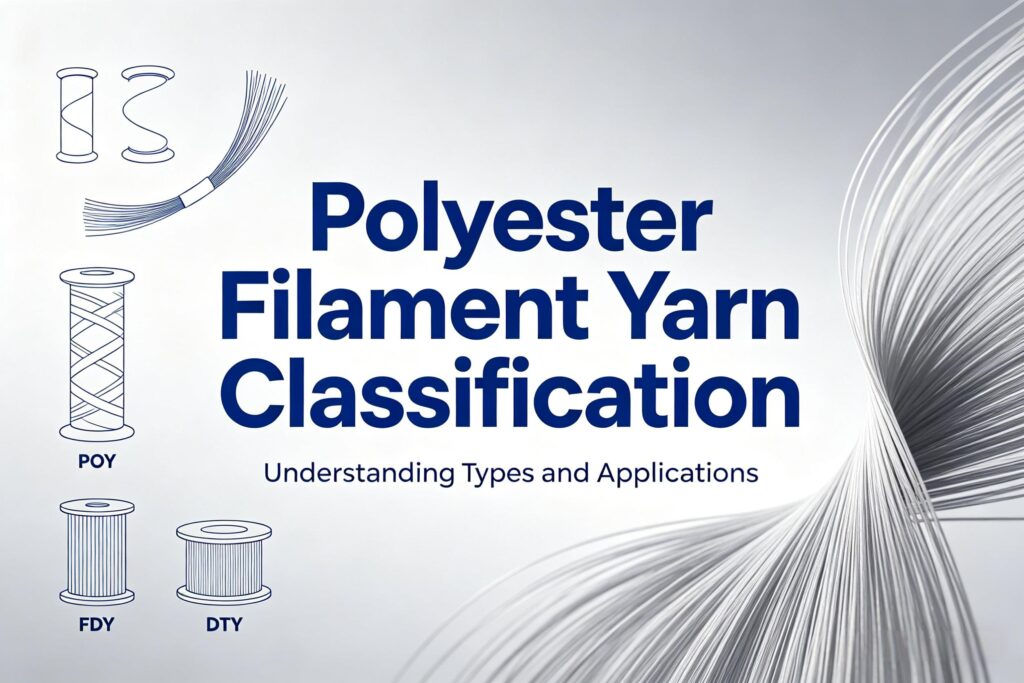
This is the most fundamental and commercial classification, dividing PFY into three major families based on the stage of drawing and texturing.
| Type | Acronym | Full Name | Key Process Characteristics | Primary Physical Traits | Common Applications |
|---|---|---|---|---|---|
| Pre-Oriented Yarn | POY | Partially Oriented Yarn | High-speed spun, only partially drawn. Requires further processing. | Smooth, high elongation, low tenacity. | Not used directly in fabrics. The precursor for making DTY or fully drawn into FDY. |
| Fully Drawn Yarn | FDY | Fully Drawn Yarn | Drawing is completed in a continuous, integrated process with spinning (one-step method). | Smooth, parallel filaments, high tenacity, low shrinkage, good luster. | Linings, lingerie, sheer fabrics, sewing thread, high-strength fabrics where a smooth hand is desired. |
| Drawn Textured Yarn | DTY | Drawn Textured Yarn | POY is first fully drawn and then** textured** (crimped) using methods like false-twist. | Bulky, crimped/coiled filaments, stretch, soft hand, excellent coverage, matte appearance. | Sportswear, casual wear, fleece, upholstery, bedding—any application requiring softness, bulk, or stretch without spandex. |
- Other Variants: The ecosystem includes Fully Oriented Yarn (FOY) and Highly Oriented Yarn (HOY), produced at ultra-high spinning speeds. Air-Textured Yarn (ATY), created by disrupting smooth filaments with a jet of air to create loops and tangles, offers a spun-yarn-like appearance for specific upholstery or outerwear applications.
5. Strategic Classification by Final Application and Performance
Moving beyond process, yarns are engineered and selected for target markets.
- 5.1 Apparel and Home Furnishing Filaments: This is the largest demand segment, consuming PFY for clothing (~52%) and home textiles (~33%). Yarns here prioritize aesthetics, comfort, and drape. This includes bright FDY for satins, semi-dull DTY for jersey knits, and super-dull yarns to mimic cotton’s matte finish.
- 5.2 Industrial and Technical Filaments: Accounting for about 15% of demand, these yarns are engineered for extreme performance. They feature very high tenacity, low elongation, and superior resistance to chemicals, heat, and UV exposure. Applications include tire cord, seat belts, driving belts, ropes, and geotextiles.
- 5.3 The Critical Role of Differentiated and Functional Filaments: This is the high-growth frontier. “Differentiated fibers” refer to yarns modified to break from standard properties. A prominent government-led project highlights the focus on producing “high-quality differentiated fiber”. Functionality is added through:
- Polymer Modification: Such as cationic-dyeable polyester for deeper, brighter colors.
- Additives: Incorporating masterbatches for properties like flame retardancy (crucial for protective clothing, home, and automotive textiles), anti-bacterial, UV-blocking, or moisture-wicking.
- Special Constructions: Including microfilament (<1 denier per filament) for ultra-soft, peach-skin fabrics, and hollow fibers for thermal insulation.
6. Detailed Classification by Physical and Structural Properties
Specifications here provide the granular details for precise ordering and quality control.
- 6.1 Luster: Controlled by adding titanium dioxide (TiO2) during polymerization. Ranges from Bright (sparkling, for evening wear), Semi-Dull (standard), to Full/Super-Dull (cotton-like, highly sought after for casual apparel).
- 6.2 Linear Density and Filament Count: The core specification. Linear density (fineness) is measured in denier (D) or decitex (dtex), indicating weight per unit length. Filament count (f) is the number of individual filaments in the yarn. A specification like “75D/72F” denotes a fine, multi-filament yarn suitable for lightweight fabrics.
- 6.3 Cross-Sectional Shape: Beyond the standard round, filaments can be engineered into shapes like trilobal (for sparkle and soil-hiding), hollow (for lightness and insulation), or flat ribbon (for unique visual effects).
- 6.4 Special Finishes: Includes intermingling (tangling nodes to improve cohesion without twisting), sizing, or specific lubricants to facilitate downstream weaving or knitting.
7. Market Dynamics, Industry Trends, and Sourcing Intelligence
- 7.1 Global and Chinese Supply Landscape: The industry is mature and concentrated. In China, the top five producers hold over 50% of the market share, with leaders like Tongkun Group and Xin Feng Ming Group possessing millions of tons of annual capacity. While the period of rapid expansion has slowed, the focus has shifted to efficiency, value, and upgrading capacity.
- 7.2 Key Market Drivers: Demand is ultimately driven by consumer spending on apparel and home goods, as well as industrial activity. China is also a major exporter, with PFY exports reaching 3.35 million tons in 2023.
- 7.3 Future Trends:
- Green and Sustainable Production: The shift toward using recycled PET (from bottles or textile waste) to produce filament yarn is accelerating, driven by brand commitments and regulations.
- Intelligent and Functional Manufacturing: Investments in smart, automated production lines to improve consistency, reduce waste, and enable mass customization.
- Vertical Integration and Product Differentiation: Leading producers are strengthening their position by integrating upstream into PTA and even refining, while relentlessly focusing on developing higher-margin, differentiated products to escape commodity cycles.
8. Conclusion: Making Informed Material Selection Decisions
The classification of polyester filament yarn is a multi-layered system that translates chemical and mechanical engineering into commercial product lines. For any professional in the textile chain—from procurement and product design to merchandising and strategy—fluency in this system is non-negotiable. It allows for precise communication with suppliers, informed cost/performance trade-offs, and strategic innovation in product development.
The future of PFY lies not in volume alone but in smart specialization. By leveraging the detailed classifications outlined here—whether selecting a super-dull, fine-denier DTY for a premium activewear line or a high-tenacity, low-shrinkage yarn for a technical textile application—businesses can build resilience, capture value, and lead in an increasingly sophisticated and competitive global market.
