
Table of Contents
- Introduction: The Rising Demand for Odor-Free Textiles
- Core Mechanisms: How Deodorizing Yarns Work
- 2.1 Adsorption: Capture and Neutralize
- 2.2 Catalytic Decomposition: Breaking Down Odors
- 2.3 Source Control: Antimicrobial Action
- 2.4 Odor Masking: A Sensory Override
- A Comprehensive Guide to Types of Deodorizing Yarns
- 3.1 Inherently Deodorizing Natural Fibers
- 3.2 Modified and Blended Synthetic Fibers
- 3.3 Advanced Composite and Functional Fibers
- Manufacturing Processes: From Concept to Yarn
- 4.1 Spinning Process Modification
- 4.2 Integration of Deodorants
- 4.3 Composite Spinning Technologies
- Applications and Market Trends
- 5.1 Key Application Sectors
- 5.2 Consumer Drivers and Future Outlook
- Selecting the Right Deodorizing Yarn: A Practical Framework
- Conclusion: Integrating Innovation into the Value Chain
1. Introduction: The Rising Demand for Odor-Free Textiles
In today’s hygiene-conscious world, the ability of textiles to remain fresh is no longer a luxury but a critical performance benchmark. Whether it’s activewear worn during high-intensity workouts, intimate apparel, daily casual wear, or specialized fabrics for healthcare and hospitality, controlling unpleasant odor has become a paramount concern for consumers and industries alike. This demand has propelled the development and innovation of deodorizing yarns—engineered threads that actively combat odor at the fiber level.
Unlike conventional fabrics that merely absorb or temporarily mask smells, deodorizing yarns are functionally designed to eliminate odor-causing compounds through advanced chemical and physical mechanisms. The shift from post-production fabric finishing to integrating deodorizing properties directly into the yarn represents a significant technological leap, offering more durable, effective, and skin-friendly solutions. This article provides a comprehensive exploration of deodorizing yarns, detailing their working principles, various types, manufacturing processes, and practical applications, serving as a valuable guide for product developers, procurement specialists, and industry decision-makers.
2. Core Mechanisms: How Deodorizing Yarns Work
The efficacy of deodorizing yarns stems from four primary scientific strategies. Understanding these mechanisms is key to selecting the right yarn for a specific application.
2.1 Adsorption: Capture and Neutralize
Adsorption is a physical-chemical process where odor molecules (like ammonia, acetic acid, and sulfur compounds) are trapped within the structure of the fiber or an additive. This is achieved through materials with high surface area and porosity.
- Activated Carbon & Minerals: Fibers integrated with activated carbon or specific inorganic minerals (like certain silicates) act as molecular sponges. These materials possess a vast network of micropores that physically adsorb a wide range of odoriferous molecules.
- Cyclodextrins: These are cyclic carbohydrate molecules with a unique hollow, truncated cone structure. Their hydrophobic interior cavity can form inclusion complexes with various organic odor molecules, effectively trapping them. This technology is particularly valued for its application in cellulose fibers like cotton.
2.2 Catalytic Decomposition: Breaking Down Odors
This method involves breaking down malodorous molecules into simpler, non-odorous substances like water and carbon dioxide. It often requires a catalyst.
- Metal Oxide Catalysts: Nanoparticles of titanium dioxide (TiO₂), zinc oxide (ZnO), or others can be embedded in fibers. Upon exposure to light (particularly UV), these catalysts generate reactive oxygen species that oxidize and decompose organic odor compounds.
- Photo- and Chemi-Catalysts: Advanced catalysts, including certain metal complexes and nanoparticles, facilitate the breakdown of odors under specific environmental conditions, providing a continuous deodorizing effect.
2.3 Source Control: Antimicrobial Action
Since many body odors are produced when skin bacteria metabolize sweat, inhibiting microbial growth is a direct and effective strategy.
- Antimicrobial Agents: Silver ions, zinc, copper, and natural extracts like chitosan (from shellfish) or phytochemicals are incorporated into fibers. They disrupt bacterial cell functions, preventing proliferation and thus stopping odor at its source.
- Advantage: This method addresses the root cause and provides long-lasting protection, often with additional benefits like preventing fabric degradation.
2.4 Odor Masking: A Sensory Override
This is a perceptual strategy where pleasant fragrances are used to cover or neutralize unpleasant odors. While not eliminating the odor molecules, it provides a immediate sensory improvement.
- Microencapsulation: Fragrance oils are encapsulated in microscopic polymer shells that are then bonded to the yarn. The capsules break gradually through friction or over time, releasing a fresh scent. This method’s longevity is a key focus of development.
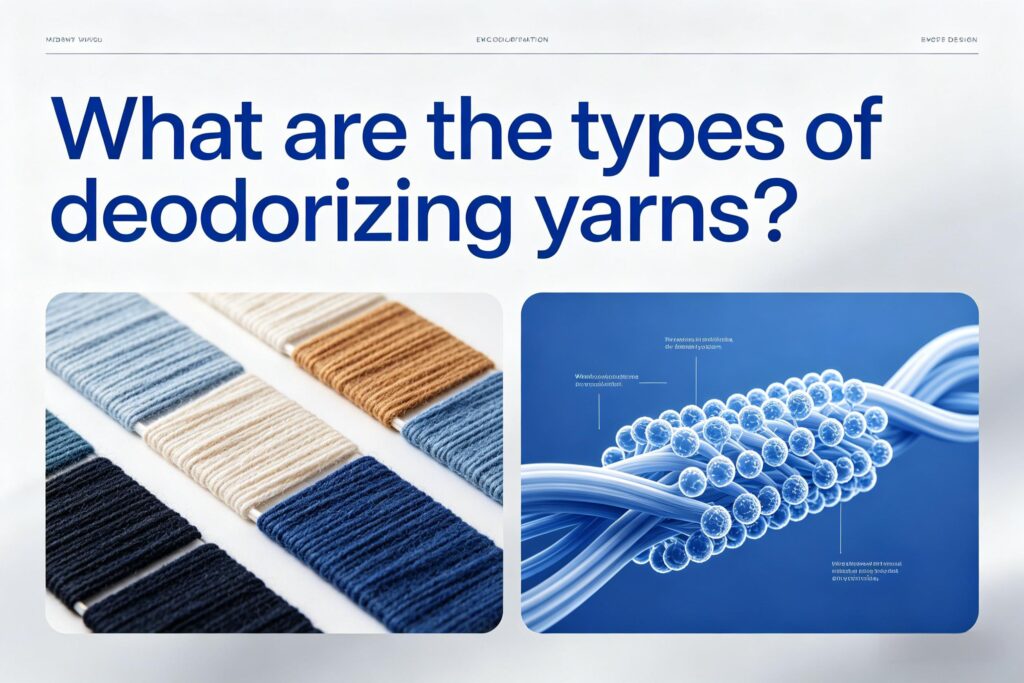
3. A Comprehensive Guide to Types of Deodorizing Yarns
Deodorizing yarns can be categorized based on their material origin and the method of imparting the function.
3.1 Inherently Deodorizing Natural Fibers
Some natural fibers possess inherent properties that offer a degree of odor resistance.
- Wool: Wool fibers have a natural scaly structure and can absorb a considerable amount of moisture vapor without feeling wet, which helps manage the environment where bacteria thrive. Studies have shown wool to have good natural deodorizing performance.
- Bamboo Charcoal & Hemp: Bamboo-based viscose fibers often exhibit natural bacteriostatic properties. Hemp fibers contain natural phenolic compounds that inhibit microbial growth, providing inherent antibacterial and odor-resistant qualities.
- Limitation: The deodorizing effect of pure natural fibers is often moderate and may not suffice for high-intensity scenarios without enhancement.
3.2 Modified and Blended Synthetic Fibers
This is the most prevalent and technologically diverse category, where functionality is engineered into synthetic polymers.
- Polyester Blends: A dominant player in the market. Deodorizing agents (like mineral powders or activated carbon) are added to the polymer melt before spinning. For instance, some patented polyester fibers can reduce ammonia and acetic acid by over 70% and maintain this performance after multiple washes. Brands market specialized polyester blends for sportswear and daily wear.
- Modified Acrylic: Research indicates that modified acrylic fibers, which incorporate specific amide and carbonyl groups, can exhibit outstanding deodorizing performance, sometimes surpassing that of natural fibers in tests.
- Bio-based Synthetics: Innovations like PHBV (polyhydroxyalkanoate)-based polyester blends are emerging. These use bio-derived antimicrobial masterbatches to create fibers that offer non-leaching, safe, and durable bacteriostatic and deodorizing functions.
3.3 Advanced Composite and Functional Fibers
These represent the high-end of functional yarns, combining multiple technologies.
- Chitosan Blends: Chitosan fiber, derived from crustacean shells, is renowned for its natural biocompatibility and potent antimicrobial efficacy against a broad spectrum of bacteria and fungi. It is frequently blended with cotton, modal, or other fibers to produce yarns for premium intimate wear, baby clothing, and medical textiles.
- Metal-Infused Fibers: Silver nanoparticle-infused yarns are highly effective for broad-spectrum, rapid antimicrobial action. Copper and other metal ions are also used. They are common in premium sportswear, socks, and healthcare textiles.
- Multi-Functional Composite Fibers: Utilizing “island-in-the-sea,” core-sheath, or other composite spinning techniques, manufacturers can create fibers that combine deodorizing (via adsorbents or antimicrobials) with other properties like moisture-wicking, cooling, or elasticity.
4. Manufacturing Processes: From Concept to Yarn
The durability of the deodorizing effect is heavily dependent on how the functional agent is integrated into the yarn.
| Process | Description | Key Advantages | Common Fiber Applications |
|---|---|---|---|
| Spinning Process Modification | Physically altering fiber shape (e.g., creating micro-grooves or porous surfaces) or chemically modifying polymer chains to enhance agent adhesion. | Creates a permanent foundation for functionality; improves natural adsorption. | Polyester, Acrylic, Nylon |
| Integration of Deodorants | Masterbatch Addition: Deodorizing agents in powder form are mixed into the polymer melt (for synthetics) or spinning dope (for viscose) before extrusion. | Even distribution of agent; excellent wash durability; suitable for mass production. | Polyester, Polypropylene, Viscose |
| Grafting & Finishing: Functional molecules (e.g., cyclodextrins, chitosan) are chemically grafted onto the surface of existing fibers or fabrics. | Can be applied to natural fibers (cotton, wool); precise chemical targeting. | Cotton, Wool, Polyester Blends | |
| Composite Spinning | Creating bi-component fibers (e.g., core-sheath) where one component carries the deodorizing function. | Protects active agents; allows combination of contradictory properties (e.g., strong sheath with soft core). | High-performance Synthetics |
5. Applications and Market Trends
5.1 Key Application Sectors
- Sportswear & Activewear: The largest application sector, demanding yarns that combine odor control with moisture management and elasticity.
- Casual & Everyday Apparel: Socks, underwear, T-shirts, and polo shirts are increasingly made with odor-resisting yarns for all-day freshness.
- Home Textiles: Bedding, towels, and upholstery fabrics use these yarns to maintain a clean and fresh home environment.
- Technical & Healthcare Textiles: Used in uniforms, medical linens, and elderly care products where hygiene is critical.
5.2 Consumer Drivers and Future Outlook
The market is driven by heightened health awareness, the popularity of athleisure, and demand for low-maintenance fabrics. Future trends point towards sustainable deodorizing technologies (like bio-based agents), multi-functional fibers (odor control + temperature regulation), and smart textiles with responsive odor management.
6. Selecting the Right Deodorizing Yarn: A Practical Framework
Choosing the optimal yarn requires balancing performance, cost, and end-use requirements. Consider this decision pathway:
- Define the Primary Odor Challenge: Is it sweat-based (requires antimicrobial/source control), environmental smoke (requires adsorption), or a need for perceived freshness (masking)?
- Set Performance Benchmarks: Determine required efficacy levels (e.g., >70% reduction against ammonia), durability (e.g., after 20+ home launderings), and any necessary industry certifications (e.g., ISO 17299, AATCC).
- Consider Fabric Compatibility and Handle: The yarn must be spinnable and weavable/knittable into the desired fabric with the right drape, weight, and hand feel.
- Evaluate Safety and Sustainability: Ensure the active agents are safe for direct skin contact and comply with regulations (e.g., OEKO-TEX). Increasingly, bio-degradable or naturally derived agents are preferred.
- Analyze Cost vs. Benefit: Advanced technologies like silver-infused or composite fibers command a premium. Assess whether the performance justifies the cost for your target market.
7. Conclusion: Integrating Innovation into the Value Chain
The world of deodorizing yarns is a dynamic intersection of material science, chemistry, and consumer needs. From the inherent properties of wool and hemp to the engineered precision of modified polyester and chitosan blends, the array of options available today allows designers and manufacturers to precisely tailor odor management solutions. Success lies in understanding the core mechanisms, carefully selecting the yarn type and manufacturing process that aligns with the product’s lifecycle demands, and staying attuned to evolving consumer expectations for efficacy, durability, and sustainability.
In this innovative landscape, specialized manufacturers play a crucial role. For instance, companies like Glyarn have established themselves as reliable partners by focusing on advanced functional yarns. By leveraging technologies such as masterbatch integration and composite spinning, Glyarn develops deodorizing yarn solutions that balance performance with practicality, serving brands looking to integrate lasting freshness into their textile products. Partnering with such focused producers can streamline development and ensure a supply of high-quality, functionally consistent yarns for the modern market.
