
Table of Contents
- Introduction: The Demand for Engineered Elastomeric Yarns
- 1.1. Defining Core and Cover: The Anatomy of Elastomeric Yarns
- 1.2. The Strategic Importance of Coverage: Beyond Basic Stretch
- Fundamental Concepts: Coverage, Structure, and Clarity in Terminology
- 2.1. Single-Covered Yarn (SCY): A Singular Helix
- 2.2. Double-Covered Yarn (DCY): A Balanced Symmetry
- 2.3. Clearing Common Confusion: Covered Yarn vs. Core-Spun Yarn
- 2.4. The Production Duality: Air-jet Covering (ACY) vs. Mechanical Covering (SCY)
- A Comparative Framework: Properties and Performance Metrics
- 3.1. Visual and Structural Comparison
- 3.2. Key Performance Indicator Analysis
- 3.3. Summary Table: Direct Comparison of SCY and DCY
- Advanced Production Technology: How Coverage is Achieved
- 4.1. Mechanical Covering (Hollow Spindle/Servo Technology)
- 4.2. Air-Jet Covering (Entanglement/Interlacing Technology)
- 4.3. Critical Process Parameters: Draft Ratio, Twist (TPM), and Fiber Selection
- Application Portfolio: Selecting the Right Yarn for the End-Use
- 5.1. Ideal Applications for Single-Covered Yarns
- 5.2. Ideal Applications for Double-Covered Yarns
- 5.3. Decision-Making Flowchart for Product Developers
- Supply Chain, Cost Analysis, and Emerging Trends
- 6.1. Cost Structure and Pricing Considerations
- 6.2. Quality Assurance and Supplier Evaluation
- 6.3. Future Directions: Sustainability, Functionality, and Smart Yarns
- Conclusion: Mastering the Selection for Competitive Advantage
1. Introduction: The Demand for Engineered Elastomeric Yarns
The modern textile industry is driven by a consumer demand for apparel and fabrics that offer not just aesthetics, but dynamic performance. At the heart of this trend lies elastomeric yarn—a specialized engineered product that imparts controlled stretch and recovery to fabrics. The most common and commercially significant form of elastomeric yarn is the Covered Spandex Yarn, a composite structure comprising a spandex (Lycra/elastane) core surrounded by one or more layers of covering fibers .
1.1. Defining Core and Cover: The Anatomy of Elastomeric Yarns
The structure is elegantly simple yet highly functional. The core is almost exclusively spandex, a synthetic fiber known for its exceptional elasticity (capable of stretching over 500% of its original length) and recovery. This core provides the fundamental power of stretch. However, naked spandex has limitations: it is difficult to process alone, has poor abrasion resistance, cannot be easily dyed to match surrounding fibers, and can degrade under UV light or chlorine. The covering is applied to protect the core and endow the final yarn with desired surface characteristics. The covering fibers, which can be nylon, polyester, cotton, or other filaments or staple yarns, are helically wrapped around the extended spandex core .
1.2. The Strategic Importance of Coverage: Beyond Basic Stretch
The choice of coverage is not trivial; it is the primary design variable that dictates the yarn’s performance profile, aesthetics, and suitability for an application. Single-covered and double-covered yarns represent two distinct solutions, each creating fabrics with unique tactile, visual, and mechanical properties. Understanding this distinction is critical for textile engineers, product developers, and sourcing professionals to make informed decisions that align with end-product goals, from luxury intimate apparel and athletic wear to medical bandages and technical composites.
2. Fundamental Concepts: Coverage, Structure, and Clarity in Terminology
2.1. Single-Covered Yarn (SCY): A Singular Helix
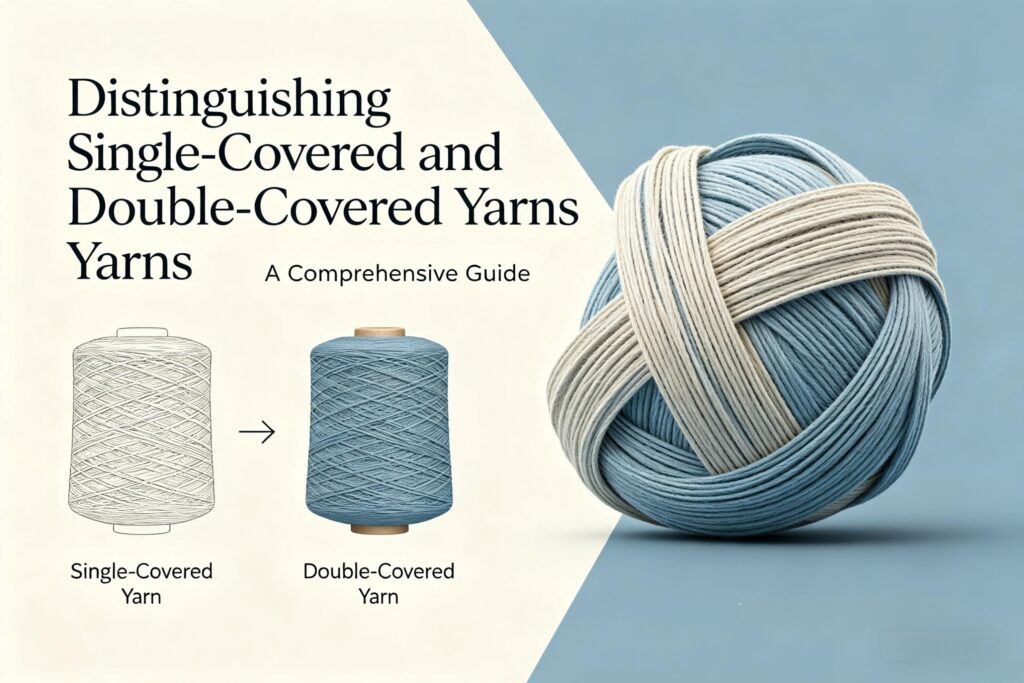
A Single-Covered Yarn (SCY) is the most fundamental structure. It consists of a single spandex filament as the core, around which one layer of covering yarn (typically a continuous filament like nylon or polyester) is wrapped in a constant helical path . This single-layer wrapping protects the core and provides a basic, workable yarn. However, because the covering is applied under tension and the spandex is in a stretched state, the degree of coverage is finite. When the yarn later relaxes, the spandex contracts, causing the helical wraps to separate slightly. This can lead to a phenomenon known as “grin-through” or “core exposure,” where the darker spandex core becomes intermittently visible, especially when the fabric is stretched . This makes single-covered yarns less suitable for dark-colored fabrics where such contrast would be undesirable.
2.2. Double-Covered Yarn (DCY): A Balanced Symmetry
A Double-Covered Yarn (DCY) represents a more advanced and complete encapsulation of the core. In this structure, two layers of covering yarns are applied onto the spandex core. Critically, these two layers are typically applied with opposite directions of twist (e.g., the first layer in an ‘S’ twist, the second in a ‘Z’ twist) . This symmetrical, counter-balanced wrapping achieves several key advantages:
- Complete Coverage: The double layer ensures the spandex core is almost entirely obscured, virtually eliminating grin-through, even under tension. This makes DCY ideal for dark and vivid colors.
- Torque Balance: The opposing twists neutralize the inherent torque or liveliness imparted by a single helical wrap. This results in a more stable yarn that lies flat and is less prone to snarling or causing fabric skewing during knitting or weaving.
- Enhanced Processing: The balanced structure often requires no additional heat setting (a process to stabilize twist) before proceeding to downstream knitting or weaving operations, simplifying the manufacturing process .
2.3. Clearing Common Confusion: Covered Yarn vs. Core-Spun Yarn
It is crucial to differentiate covered yarns from core-spun yarns, as the terms are often mistakenly used interchangeably. Both have a core, but the technology is fundamentally different. A core-spun yarn is produced on a ring spinning frame, where staple fibers (like cotton or polyester staple) are drafted and twisted around a continuous filament core (which can be spandex or a non-elastic filament like polyester). The covering is not a pre-made yarn but a sheath of staple fibers, resulting in a yarn with the surface characteristics of the staple fiber (e.g., a cotton hand-feel) . Covered yarns, conversely, are made on specialized covering machines (hollow spindle or air-jet) that wrap pre-existing continuous filaments around the core, resulting in a sleeker, more filament-like surface .
2.4. The Production Duality: Air-Jet Covering (ACY) vs. Mechanical Covering (SCY)
The method of applying the cover is another critical distinction that cuts across both single and double coverage.
- Air-jet Covered Yarn (ACY): This method feeds the spandex core and the covering filament(s) simultaneously through a high-pressure air jet nozzle. The turbulent air interlocks the filaments at intermittent “entanglement points” rather than creating a true, continuous helical wrap. The resulting yarn is softer, bulkier, and has a more natural drape but offers less complete core coverage and slightly lower strength .
- Mechanical Covered Yarn (MCY/SCY): In this method, a hollow spindle rotating at high speed precisely wraps the covering filament around the core in a controlled, consistent helical path. This creates a yarn that is stronger, with better coverage, and yields a fabric with a crisp, smooth, and more resilient hand-feel. The process is slower and more costly, with mechanically covered yarns typically priced significantly higher than their air-jet equivalents .
3. A Comparative Framework: Properties and Performance Metrics
3.1. Visual and Structural Comparison
The most immediate difference is visual. A single-covered yarn will reveal its darker spandex core when stretched, appearing as fine, intermittent dark lines against the color of the cover. A double-covered yarn maintains a uniform color appearance even under significant tension. Structurally, the double layer of DCY creates a slightly thicker, rounder, and more robust yarn compared to the leaner profile of SCY.
3.2. Key Performance Indicator Analysis
- Coverage & Aesthetics: DCY provides superior, near-perfect coverage, making it mandatory for applications where a clean, unblemished color is critical. SCY is acceptable for lighter colors or where a slight “grin” effect is tolerable or even part of the design .
- Torque & Stability: DCY is inherently torque-balanced and stable, leading to fewer production issues in high-speed knitting and weaving. SCY has residual torque that must be managed, often requiring heat setting before use .
- Elasticity & Recovery: While both derive their elasticity from the spandex core, the double-layer wrap in DCY can impose a minor, often negligible, restriction on the ultimate stretch and recovery speed compared to the less constrained SCY.
- Hand Feel & Drape: The single-layer SCY, especially in air-jet form, can produce a lighter, slightly softer fabric. The double-layer DCY imparts more body and a firmer, more structured hand.
- Durability & Abrasion Resistance: The double layer of covering in DCY provides enhanced protection for the spandex core against friction and wear during both manufacturing and garment use.
3.3. Summary Table: Direct Comparison of SCY and DCY
| Feature | Single-Covered Yarn (SCY) | Double-Covered Yarn (DCY) |
|---|---|---|
| Structure | One layer of covering yarn helically wrapped around the core. | Two layers of covering yarn wrapped in opposite directions around the core. |
| Core Visibility | Visible (“grin-through”) when stretched. | Minimized or invisible when stretched. |
| Torque | High residual torque, requires management. | Balanced, low torque, stable for processing. |
| Hand Feel | Generally softer, lighter (especially air-jet types). | Fuller, firmer, more structured. |
| Fabric Appearance | Can show core lines; best for light colors. | Clean, uniform color; ideal for all colors, especially dark. |
| Typical Cost | Lower (simpler process, less material). | Higher (more complex process, more material). |
| Key Applications | Lightweight lingerie, hosiery, casual socks, lightweight circular knits. | Swimwear, activewear, high-end legwear, medical supports, technical belts. |
4. Advanced Production Technology: How Coverage is Achieved
4.1. Mechanical Covering (Hollow Spindle/Servo Technology)
This traditional and precise method remains the gold standard for high-quality covered yarns. The spandex core is fed under precise draft (typically 3.0x to 4.0x) through the hollow center of a rapidly rotating spindle. The covering filament, fed from a package mounted on the spindle, is twisted around the core with each rotation. The Twists Per Meter (TPM) is a critical and controllable parameter. Higher TPM increases coverage and strength but can make the yarn stiffer; optimizing TPM for the yarn denier and end-use is essential . Modern machines use servo motors for exceptional control over draft and twist, ensuring consistency.
4.2. Air-Jet Covering (Entanglement/Interlacing Technology)
This faster, more economical method uses pneumatic force instead of mechanical twist. The core and cover filaments pass together through a venturi-type jet where compressed air creates vortexes that interlace them. The result is a series of coherent entanglement points rather than a continuous wrap. The process parameters—air pressure, jet design, and yarn speed—determine the frequency and strength of the entanglements. While less precise, it offers high production speeds and a uniquely soft yarn character .
4.3. Critical Process Parameters: Draft Ratio, Twist (TPM), and Fiber Selection
- Draft Ratio: The ratio by which the spandex is stretched during covering (e.g., 3.5x). It directly impacts the final yarn’s elasticity, recovery power, and spandex content percentage. A higher draft increases potential fabric stretch but requires careful balance to avoid over-stressing the spandex .
- Twist (TPM): For mechanical covering, TPM must be optimized. For a fine yarn like 40 denier nylon covering 20 denier spandex, a TPM of around 600 might be used, while a heavier yarn might use 480 TPM .
- Covering Fiber: Nylon offers excellent durability, dyeability, and a soft hand, making it dominant in apparel. Polyester provides high strength, UV and chlorine resistance, crucial for swimwear and outdoor gear. Specialized covers like cotton or rayon can be used for specific aesthetics.
5. Application Portfolio: Selecting the Right Yarn for the End-Use
5.1. Ideal Applications for Single-Covered Yarns
- Lightweight Lingerie and Underwear: Where softness, lightness, and comfort against the skin are paramount, and slight grin-through is acceptable.
- Hosiery and Sheer Tights: The thin profile and adequate stretch of SCY (often air-jet) are ideal for creating lightweight, sheer fabrics.
- Casual Socks and Lightweight Knits: For everyday wear where high durability and perfect color coverage are secondary to cost and comfort.
5.2. Ideal Applications for Double-Covered Yarns
- Performance Activewear and Sportswear: Demands durability, excellent recovery, and a clean appearance even during extreme stretching. DCY provides the necessary support and longevity.
- Swimwear: Requires complete core coverage to prevent ugly grin-through when wet and stretched, and must withstand chlorine/salt water. DCY, often with a polyester cover for chlorine resistance, is standard.
- Medical and Compression Garments: Requires consistent, reliable pressure and high durability. The stability and robustness of DCY are essential.
- High-Fashion Legwear and Shapewear: Where a flawless, opaque appearance and firm control are required.
5.3. Decision-Making Flowchart for Product Developers
To select the correct yarn, professionals should follow a logical sequence:
- Define Fabric Key Requirement: Is it Ultimate Softness/Drape or Durability/Clean Appearance?
- For Softness/Drape: Choose Single-Covered. Then decide: For lowest cost and bulkier hand, choose Air-Jet (ACY). For better strength and smoothness, choose Mechanical (SCY).
- For Durability/Clean Appearance: Choose Double-Covered. Then decide: For a balanced performance, choose standard Mechanical DCY. For specialized needs (e.g., chlorine resistance), specify cover fiber (e.g., Polyester).
6. Supply Chain, Cost Analysis, and Emerging Trends
6.1. Cost Structure and Pricing Considerations
The cost differential is substantial. Double-covered yarns are more expensive due to double the covering material and a more complex, slower production process. Furthermore, mechanically covered yarns command a significant premium over air-jet yarns; for certain fine deniers, the price difference can exceed RMB 10,000 per ton . Product developers must weigh this against performance requirements and final product price point.
6.2. Quality Assurance and Supplier Evaluation
Key quality checks include:
- Evenness of Coverage: Inspecting for bare spots or thick places.
- Core Exposure Test: Stretching the yarn over a black background to assess grin-through.
- Twist and Tension Consistency: Critical for trouble-free knitting/weaving.
- Elasticity and Recovery Testing: Ensuring it meets specified draft and power specifications.
6.3. Future Directions: Sustainability, Functionality, and Smart Yarns
The future of covered yarns lies in multi-functionality. Trends include using recycled polyester or bio-derived nylon as covering fibers, integrating phase-change materials or odor-control additives into the cover, and developing yarns with conductive elements for wearable electronics. The fundamental choice between single and double coverage will remain, but the capabilities embedded within that structure will continue to expand.
7. Conclusion: Mastering the Selection for Competitive Advantage
The distinction between single-covered and double-covered yarns is a foundational piece of knowledge in advanced textile manufacturing. It is not merely a technical detail but a strategic design choice that directly influences the aesthetics, performance, cost, and manufacturability of the final product. Single-covered yarns offer an economical path to softness and lightweight stretch, finding their niche in applications where ultimate coverage is not critical. Double-covered yarns represent the premium solution, delivering durability, stability, and a flawless appearance for demanding performance and high-fashion applications.
By understanding the structural principles, production technologies, and application landscapes outlined in this guide, professionals can move beyond guesswork. They can make precise, informed specifications, optimize their supply chain for quality and value, and ultimately develop textile products that truly meet the nuanced demands of the modern market. In an industry driven by innovation and differentiation, mastering this choice is a clear competitive advantage.
