
Table of Contents
- Introduction: The Strategic Imperative of Abrasion Resistance
- 1.1. Market Demands and Performance Benchmarks
- 1.2. Defining Abrasion Resistance and Its Measurement
- The Science of Wear: Mechanisms of Abrasion in Polyester Filament
- 2.1. Surface Morphology and Friction
- 2.2. Key Mechanical Properties: Tenacity, Elongation, and Work of Rupture
- 2.3. The Role of Yarn Structure and Fabric Construction
- Material Innovation: Polymer and Fiber-Level Strategies
- 3.1. High-Viscosity Polymer Chips and Molecular Weight Optimization
- 3.2. The Role of Inert Nanoparticle Additives (SiO₂, TiO₂, Al₂O₃)
- 3.3. Advanced Polymer Blends and Copolymers
- Process Engineering: Spinning and Drawing Optimization
- 4.1. Fine-Tuning the Spinning Process: Temperature, Throughput, and Quenching
- 4.2. The Critical Role of Draw Ratio and Heat Setting
- 4.3. Advanced Spin Finish Formulations with Lubricants and Anti-wear Agents
- Post-Production Enhancement: Finishing and Treatment Technologies
- 5.1. Plasma and Corona Surface Modification
- 5.2. Application of Durable Abrasion-Resistant Coatings
- 5.3. Cross-linking Treatments for Enhanced Surface Toughness
- Testing and Validation: Ensuring Performance and Compliance
- 6.1. Standard Test Methods (ASTM D3884, Martindale, Taber Abraser)
- 6.2. Correlation of Lab Results to Real-World Wear
- 6.3. Establishing a Quality Control Protocol
- Application-Specific Solutions and Future Outlook
- Conclusion: Building a Holistic Strategy for Superior Durability
1. Introduction: The Strategic Imperative of Abrasion Resistance
In the competitive landscape of technical textiles and high-performance apparel, durability is a non-negotiable attribute. Abrasion resistance—the ability of a fiber or fabric to withstand surface wear from rubbing, scraping, or friction—stands as a primary indicator of product quality, longevity, and value. For polyester filament yarn, a workhorse material used from fashion to automotive upholstery, enhancing this property unlocks premium market segments and strengthens brand reputation. This article provides a comprehensive, actionable guide to improving the abrasion resistance of polyester filament yarn, covering material science, process engineering, and finishing technologies to deliver tangible value to manufacturers and brands.
2. The Science of Wear: Mechanisms of Abrasion in Polyester Filament
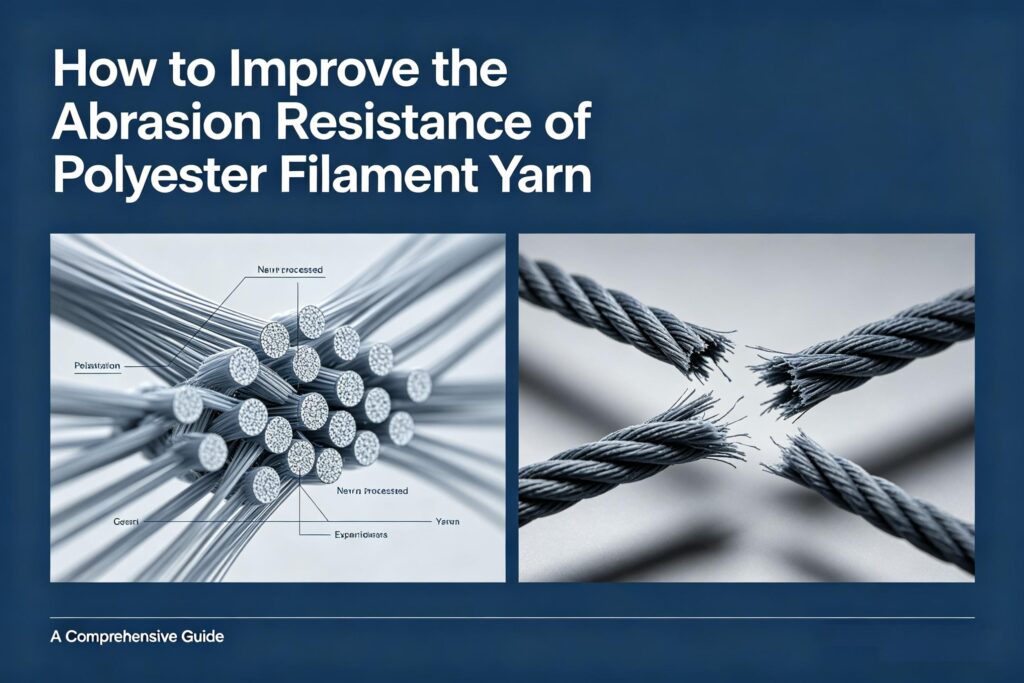
Abrasion is a complex process involving both physical and mechanical interactions. For a semi-crystalline polymer like polyester, wear typically initiates at surface asperities. Under repeated friction, these microscopic points generate heat and stress, leading to three primary failure modes: fiber fracture (breaking of individual filaments), fibrillation (splitting along the fiber axis), and fatigue from cyclic loading.
The yarn’s inherent properties dictate its response. High tenacity provides the force needed to resist initial crack propagation, while optimal elongation at break allows the fiber to absorb and dissipate energy without immediate rupture. The work of rupture (the area under the stress-strain curve) is perhaps the most comprehensive single indicator, representing the total energy a fiber can absorb before failure. Furthermore, a smooth, uniform filament surface reduces the coefficient of friction, a direct driver of abrasive wear.
3. Material Innovation: Polymer and Fiber-Level Strategies
The journey to a tougher yarn begins at the molecular and chip stage.
- High-Viscosity Polymer Chips: Starting with polymer chips of higher intrinsic viscosity (IV) directly results in yarn with higher molecular weight and longer polymer chains. These longer chains create a denser network of entanglements, significantly improving tensile strength and resistance to crack propagation under abrasive forces.
- Nanoparticle Additives: The incorporation of inert, ultra-fine nanoparticles like silicon dioxide (SiO₂) or alumina (Al₂O₃) during polymerization is a transformative strategy. These particles, uniformly dispersed at the nanoscale, act as physical reinforcing agents. They hinder the movement of polymer chains under stress, effectively increasing hardness and creating a more tortuous path for developing cracks. This nanocomposite approach strengthens the fiber bulk, not just the surface.
- Advanced Polymer Architectures: Modifying the base polymer chemistry can yield significant benefits. Copolymerizing with monomers that introduce bulkier side groups can increase glass transition temperature (Tg) and stiffness. Creating bicomponent fibers (e.g., a sheath-core structure with a harder polymer as the sheath) can engineer a protective outer layer specifically designed to endure surface wear.
4. Process Engineering: Spinning and Drawing Optimization
Precise control over the fiber formation process is where material potential is translated into performance.
- Spinning Process Control: A stable, optimized spinning process is foundational. Consistent polymer melt temperature is critical to prevent thermal degradation, which weakens the fiber. The quenching (cooling) rate must be uniform to ensure a homogeneous crystalline structure across the filament cross-section. Any inconsistency creates weak points prone to abrasion.
- Draw Ratio and Heat Setting: This is the most critical step for developing mechanical strength. The draw ratio determines the degree of polymer chain orientation along the fiber axis. A higher ratio, within optimal limits, increases tenacity and reduces elongation, directly enhancing resistance to abrasive forces. Subsequent heat setting under precise tension locks this oriented structure in place, relieves internal stresses, and improves dimensional stability, preventing performance degradation during use.
- Spin Finish Engineering: The spin finish is not merely a processing aid. Modern formulations are sophisticated coatings. Key components include lubricants to reduce inter-filament friction during processing and downstream weaving/knitting, and anti-wear agents that can form a protective molecular layer on the fiber surface. The even application of a high-performance finish is essential for consistent performance.
5. Post-Production Enhancement: Finishing and Treatment Technologies
Surface modifications can add a final, powerful layer of protection.
- Plasma Treatment: Low-pressure or atmospheric plasma treatment is a dry, eco-friendly technology. It physically etches the fiber surface at a nanometer scale, increasing surface area and roughness for better coating adhesion. More importantly, it can introduce polar functional groups, strengthening the fiber’s matrix in its outermost layer and improving its resistance to micro-fatigue.
- Protective Coatings: Applying thin-film coatings of durable polymers (e.g., polyurethanes, polyacrylates, or silicones) creates a sacrificial barrier. The coating bears the brunt of the frictional forces, protecting the underlying polyester filament. The key is ensuring the coating’s flexibility, adhesion, and durability through multiple wash cycles.
- Cross-linking Treatments: Chemical cross-linkers can be applied to create covalent bonds between polymer chains on the fiber surface. This “tying down” of the surface molecules dramatically increases surface toughness and hardness, making it more difficult for abrasive elements to pluck away material.
6. Testing and Validation: Ensuring Performance and Compliance
Claims of improved abrasion resistance must be quantifiable and reliable.
- Standardized Testing: Industry reliance on established methods such as the Martindale Abrasion Test (for fabrics) and the Taber Abraser (for heavier materials) is essential. For yarn, the ASTM D3884 Standard Guide for Abrasion Resistance of Textile Fabrics provides the framework. Testing should be conducted on both the yarn (e.g., using a filament-on-filament abrasion tester) and the final fabric to understand performance at all stages.
- From Lab to Real World: It is crucial to correlate accelerated lab test cycles (e.g., “50,000 rubs”) with actual end-use conditions (e.g., “two years of heavy-duty upholstery use”). Developing this correlation through field testing builds credibility and allows for accurate performance grading.
- Quality Control Protocol: Implementing routine abrasion testing as part of a statistical process control (SPC) program ensures production consistency. Monitoring key input parameters—like polymer IV, draw ratio, and finish add-on—and their correlation to abrasion test results allows for proactive process adjustment.
7. Application-Specific Solutions and Future Outlook
The optimal strategy varies by application. Seatbelt yarns prioritize ultra-high tenacity and specific spin finishes for metal-part abrasion. High-performance athletic wear may blend high-tenacity polyester with elastane, requiring finishes that protect both fibers. Heavy-duty industrial fabrics might combine nanoparticle reinforcement with a robust PU coating.
The future points towards intelligent, multi-functional fibers. Research is focused on self-healing polymeric coatings that can repair micro-scratches, and biomimetic surfaces that mimic the wear-resistant structure of natural materials. The integration of real-time wear sensors at the fiber level is also an emerging frontier.
8. Conclusion: Building a Holistic Strategy for Superior Durability
Improving the abrasion resistance of polyester filament yarn is not achieved through a single silver bullet. It requires a holistic, integrated approach that spans the entire value chain:
- Start with superior materials (high-IV polymer, strategic additives).
- Optimize the fiber formation process with precise control over drawing and heat setting.
- Consider advanced surface engineering (plasma, coatings) for demanding applications.
- Validate and ensure consistency through rigorous, standardized testing.
By systematically implementing strategies across these domains, fiber producers and textile manufacturers can engineer polyester filament yarn that delivers exceptional durability, meets the stringent demands of advanced applications, and provides tangible, long-term value to end-users. This commitment to performance engineering is what ultimately differentiates a commodity product from a premium, high-value material.
