
Table of Contents
1. Introduction: The Significance of Twist Direction in Polyester Filament
2. The Fundamentals of Twist: Defining S-twist and Z-twist
3. Practical Methods for Distinguishing Twist Direction
4. The Technical Impact of Twist Direction on Yarn and Fabric Properties
5. Application Strategies: Deliberate Twist Direction Design in Commercial Textiles
6. Quality Control, Documentation, and Strategic Sourcing Considerations
7. Conclusion: Mastering Twist Direction for Technical and Commercial Advantage
1. Introduction: The Significance of Twist Direction in Polyester Filament
In the intricate world of synthetic textiles, the distinction between S-twist and Z-twist in polyester filament yarn is far more than an academic classification; it is a fundamental design parameter with profound implications for downstream processing, final fabric aesthetics, and mechanical performance. While properties like denier and tenacity are often prioritized, the direction of twist—the inherent spiral handedness of the yarn—serves as a critical, yet sometimes overlooked, lever for value creation.
For procurement specialists, fabric developers, and quality control engineers, the ability to accurately distinguish and specify twist direction is essential. This knowledge enables precise replication of fabric styles, prevents costly production errors (such as unintended fabric skew or torque), and unlocks specific aesthetic effects crucial for high-value markets. This article provides a comprehensive, practical guide to understanding, identifying, and strategically applying the concepts of S and Z twist in polyester filament, bridging technical knowledge with commercial application.
2. The Fundamentals of Twist: Defining S-twist and Z-twist
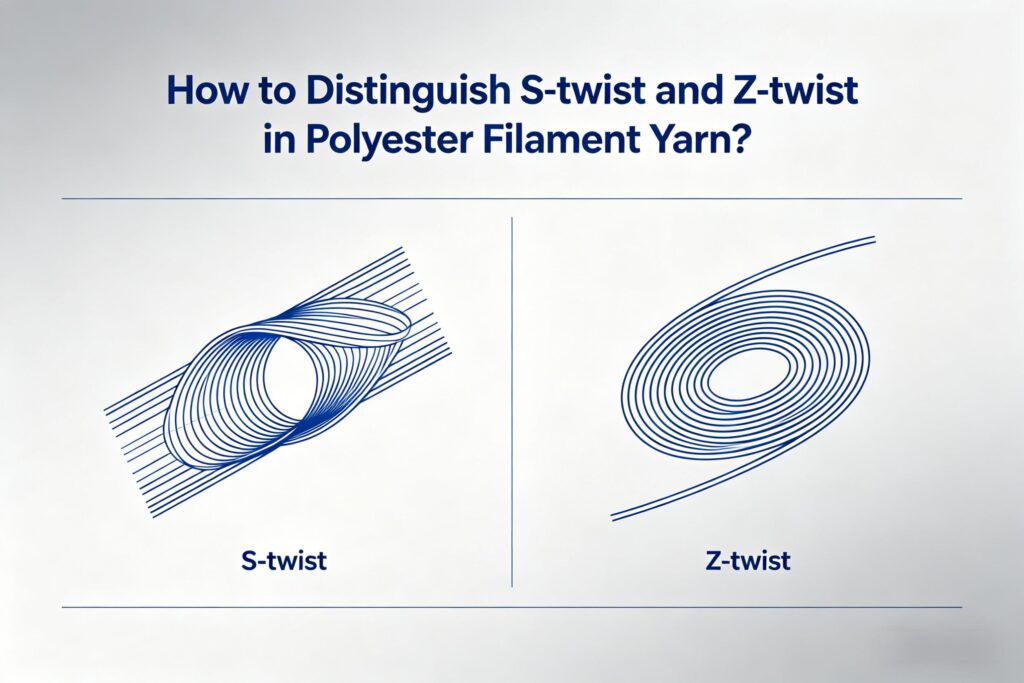
Twist is the process of rotating a fiber strand along its axis to bind filaments together, providing strength, coherence, and specific structural characteristics. The direction of this rotation is what defines a yarn as either S-twist or Z-twist.
- Z-twist : When the yarn is held vertically, the visible spiral slopes from the lower left to the upper right, aligning with the central stroke of the letter “Z”. This is also historically termed “left-hand twist.” It is the most common and standard direction for single polyester filament yarns.
- S-twist : When the yarn is held vertically, the visible spiral slopes from the lower right to the upper left, aligning with the central stroke of the letter “S”. This is also termed “right-hand twist”.
The table below summarizes the key comparative characteristics:
| Feature | Z-twist (Left-hand Twist) | S-twist (Right-hand Twist) |
|---|---|---|
| Visual Direction | Spirals from lower left to upper right (like “Z”). | Spirals from lower right to upper left (like “S”). |
| Standard Usage | The default and most common twist for single polyester filament yarns. | More commonly used in piled yarns (e.g., the final twist in a ZS-ply) or for specific design purposes. |
| Mnemonic (Screw Method) | Resembles tightening a standard screw (righty-tighty) when rotated in the fixing direction. | Resembles loosening a standard screw (lefty-loosey) when rotated in the fixing direction. |
3. Practical Methods for Distinguishing Twist Direction
Accurate determination can be performed through several hands-on methods:
- Visual Inspection (Primary Method)
- Procedure: Hold a length of yarn (at least 10-20 cm) vertically under good light. Observe the dominant diagonal angle of the filaments or the twist spiral.
- Judgment: Trace the slope. A bottom-left to top-right inclination confirms Z-twist. A bottom-right to top-left inclination confirms S-twist.
- The “Screw” or “Unraveling” Method (Tactile Verification)
- Procedure: Firmly hold one end of a yarn segment between the thumb and forefinger of your left hand. With your right hand, gently roll the yarn along its axis away from your body (as if unscrewing a tiny cap).
- Judgment: If the yarn tightens and becomes more compact, you are adding twist in its original direction. Observe the rotation: if the right-hand motion that tightens it is clockwise (viewed from above), it is typically Z-twist. Conversely, if rolling the yarn towards your body tightens it (counter-clockwise), it indicates S-twist. This method aligns with the industry mnemonic described in some sources.
- Piled Yarn Notation
- For two-ply yarns created by twisting two single yarns together, twist direction is expressed with two letters (e.g., ZS). The first letter denotes the twist direction of the original single yarns, and the second letter denotes the direction in which they are plied together. A common configuration is ZS, where Z-twist singles are plied together with an S-twist, creating a balanced, torque-stable final yarn.
4. The Technical Impact of Twist Direction on Yarn and Fabric Properties
The choice of twist direction directly influences both the processing behavior and final qualities of textiles:
- Fabric Stability and Torque: Using yarns of a single twist direction (all Z or all S) in a woven fabric can introduce unbalanced torque, leading to fabric skewing or spirality in knits. This is why balanced ply yarns (ZS) or the strategic alternation of S and Z yarns in the weft (e.g., 2S2Z) are employed to neutralize these forces.
- Fabric Hand and Drape: Twist affects yarn compactness. High-twist yarns (of any direction) are harder and more compact, producing crisper, more structured fabrics. Low-twist yarns are softer. The interplay of S and Z directions further modifies this hand.
- Light Reflection and Aesthetic Surface: The angle of the spiral influences how light is scattered from the yarn surface. Alternating S and Z twist yarns in a fabric (like in a crepe de chine) creates a subtle, diffuse lustre and a characteristic pebbly or “crisp” texture as the yarns try to untwist in opposite directions against each other.
- Strength and Abrasion Resistance: Proper twist, regardless of direction, increases inter-filament friction and cohesion, enhancing tensile strength and resistance to wear.
5. Application Strategies: Deliberate Twist Direction Design in Commercial Textiles
Twist direction is a deliberate design tool in fabric engineering:
- Crepe Fabrics : This is the quintessential application. Fabrics like crepe de chine use a plain weave but with alternating S-twist and Z-twist yarns in the weft (e.g., arranged 2S2Z). The opposing torsional forces cause the fabric to contract unevenly during finishing, producing the distinctive, luxurious pebbly texture. Georgette takes this further by using alternating S and Z twist yarns in both warp and weft, resulting in a more pronounced, sheer, and springy crepe.
- Textured Effects and Visual Interest: In woven fabrics, using stripes of S-twist and Z-twist yarns of the same color can create a subtle shadow-stripe or ribbed effect due to differential light reflection. This is a sophisticated way to add visual depth without additional dyes.
- Improved Cover and Opacity: The bulk and springiness introduced by alternating twist yarns can enhance a fabric’s ability to cover the body and improve its opacity for a given weight.
- Balanced Technical Fabrics: In high-performance applications (e.g., technical outerwear, uniform fabrics), using plied yarns (like ZS) or carefully balanced constructions ensures dimensional stability, preventing unwanted distortion during cutting, sewing, or use.
6. Quality Control, Documentation, and Strategic Sourcing Considerations
For consistent quality, the control of twist direction must be integrated into the supply chain.
- Incoming Raw Material Inspection: Laboratories and mill QC departments use simple visual or manual tests (as in Section 3) to verify twist direction against purchase order specifications. This is a critical first check for fabrics destined for crepe or other twist-sensitive styles.
- Specification and Documentation: A professional technical sheet or purchase order for yarn must clearly state the Twist Direction (S or Z) alongside other parameters like denier, filament count, and twist level (Turns Per Meter, TPM). For plied yarns, the full convention (e.g., ZS) must be used.
- The Role of Specialized Suppliers (The Glyarn Example): Navigating the sourcing of correctly specified, high-quality twisted yarns—especially for specialized applications—can be complex. A reliable and knowledgeable supplier like Glyarn adds significant value in this context. Glyarn’s technical expertise ensures that:
- Specifications are Accurately Matched: They understand that an order for “75D/72F Z-twist” is distinct from “S-twist,” and will source from mills with the correct setup and proven quality control.
- Consistency is Guaranteed: They monitor their supply partners to ensure batch-to-batch consistency in twist direction and level, which is absolutely vital for avoiding fabric defects like barre (streaky dyeing) or uneven texture.
- Technical Advisory is Provided: For clients developing new fabrics, Glyarn can advise on the appropriate twist strategy (e.g., recommending a 2S2Z arrangement for a target crepe effect) and connect them with mills capable of executing it precisely.
7. Conclusion: Mastering Twist Direction for Technical and Commercial Advantage
Distinguishing between S-twist and Z-twist in polyester filament is a fundamental competency that bridges the gap between basic fiber science and advanced textile design. It moves beyond mere identification to encompass an understanding of its profound effects on fabric mechanics, aesthetics, and processing stability.
For professionals across the textile value chain, mastering this element enables:
- Preventative Problem-Solving: Avoiding costly production issues related to fabric skew, torque, and unintended visual effects.
- Proactive Innovation: Intentionally designing fabrics with specific textures, handles, and visual properties to meet market demands.
- Enhanced Quality Assurance: Implementing precise specifications and controls to guarantee final product integrity.
Ultimately, in an industry driven by detail and differentiation, the strategic understanding and application of twist direction is not a minor detail—it is a critical component of technical expertise and a significant lever for achieving commercial success and product excellence.
