
Table of Contents
- Introduction: The Role of Polyester Filament Geotextiles
- Primary Classification by Manufacturing Process
- Non-Woven (Needle-Punched) Polyester Filament Geotextiles
- Woven Polyester Filament Geotextiles
- Comparison and Application Fit
- Understanding Product Models and Technical Specifications
- Key Specification Parameters: A Buyer’s Checklist
- Decoding Model Numbers and Product Codes
- Material and Performance Advantages
- Superior Mechanical and Physical Properties
- Long-Term Durability and Chemical Resistance
- Application Scenarios and Model Selection Guidelines
- Procurement, Quality Assurance, and Market Outlook
- Conclusion and Final Recommendations
1. Introduction: The Role of Polyester Filament Geotextiles
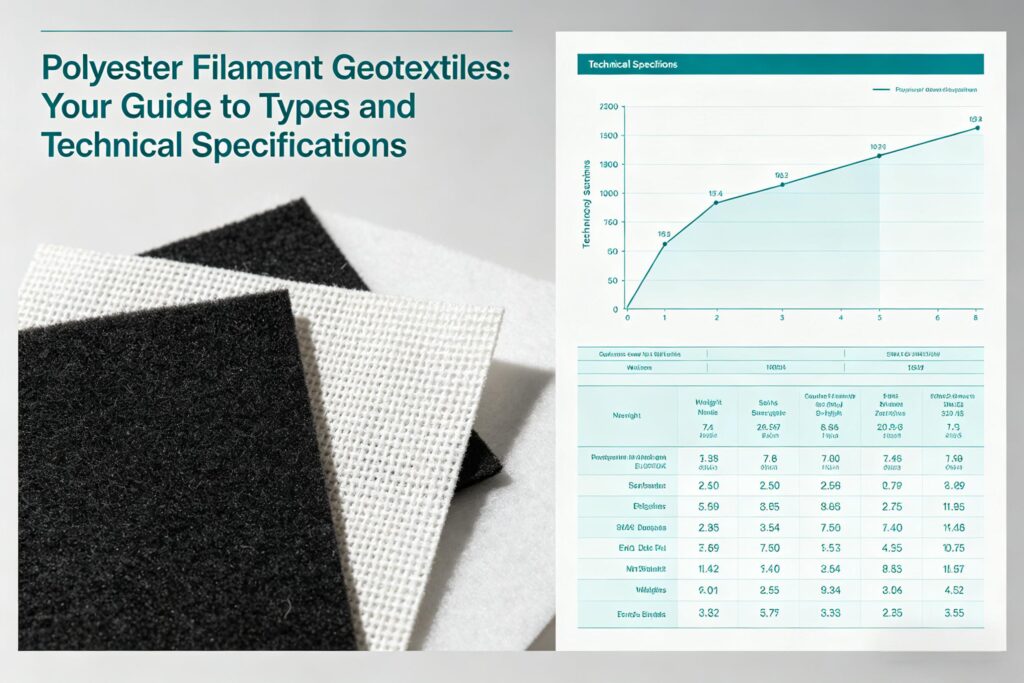
Polyester filament geotextiles, referred to in your query, are critical synthetic engineering materials used in civil and environmental construction projects worldwide. Unlike geotextiles made from staple fibers (short fibers), those manufactured from continuous polyester filaments offer enhanced tensile strength, uniformity, and durability.
These fabrics perform several essential functions in geotechnical engineering: separation (preventing the mixing of soil layers), filtration (allowing water flow while retaining soil particles), drainage (in-plane water transmission), reinforcement (improving soil strength), and protection (guarding against puncture of geomembranes). Their performance is a direct result of their manufacturing process and specifications, making the correct selection of “models” or types paramount to project success.
2. Primary Classification by Manufacturing Process
The most fundamental way to categorize polyester filament geotextiles is by their production method, which dictates their structure and core performance characteristics.
2.1 Non-Woven (Needle-Punched) Polyester Filament Geotextiles
This is the most common type for filtration, separation, and protection functions.
- Manufacturing Process: Continuous polyester filaments are spun, laid into a web, and then mechanically entangled through a needle-punching process. This creates a three-dimensional, felt-like structure.
- Key Characteristics: They are highly permeable, relatively thick, and excellent for filtration and drainage. They exhibit multidirectional strength properties and high elongation (typically 40-80%).
- Typical Model Specifications: These are primarily defined by their unit area mass (grams per square meter – g/m²). Common specification ranges are wide, typically from 100 g/m² to 800 g/m² or higher, with corresponding increases in thickness and strength. For example, a 400 g/m² fabric will have higher strength than a 200 g/m² fabric from the same product line.
2.2 Woven Polyester Filament Geotextiles
These are primarily used in applications requiring high tensile strength and low elongation for soil reinforcement and stabilization.
- Manufacturing Process: High-tenacity polyester filaments are woven on looms into a stable, grid-like or plain-weave structure.
- Key Characteristics: They offer very high tensile strength (often rated in kN/m) in specific directions (machine and cross-machine directions) but with lower elongation compared to non-woven types. Their permeability is more directional and dependent on the weave pattern.
- Typical Model Specifications: These are often categorized by their ultimate tensile strength. Models can range from standard strengths (e.g., 20 kN/m) to very high-strength fabrics exceeding 100 kN/m for demanding reinforcement projects.
2.3 Comparison and Application Fit
| Feature | Non-Woven (Needle-Punched) | Woven |
|---|---|---|
| Primary Function | Separation, Filtration, Protection | Reinforcement, Stabilization |
| Structure | 3D random, felt-like | 2D ordered, woven |
| Tensile Strength | Moderate, multi-directional | Very High, directional |
| Elongation at Break | High (e.g., 40-80%) | Low |
| Permeability | Very High | Moderate to Low, depends on weave |
| Typical Spec | Unit Area Mass (g/m²) | Tensile Strength (kN/m) |
3. Understanding Product Models and Technical Specifications
When evaluating a product model, you must look beyond the basic type to its detailed technical data sheet.
3.1 Key Specification Parameters: A Buyer’s Checklist
International standards like ASTM (USA), ISO (International), and regional equivalents (e.g., IRAM in Argentina) govern these tests.
- Physical Properties:
- Unit Area Mass: The weight per square meter (g/m²). It is a primary indicator of material density and often correlates with strength.
- Thickness: Measured under a specific pressure (mm).
- Mechanical Properties:
- Tensile Strength and Elongation: The force required to break a fabric strip (kN/m) and the strain at that point (%).
- CBR Puncture Resistance: Resistance to penetration by a plunger, simulating subgrade pressure (kN).
- Trapezoidal Tear Strength: Resistance to the propagation of a tear (N or kN).
- Hydraulic Properties:
- Apparent Opening Size (AOS): A measure of the largest effective pore size (mm), critical for filtration design.
- Permeability/Permittivity: The ability of water to flow through the fabric (s⁻¹ or l/s/m²).
- Vertical Water Flow Rate: The flow rate of water perpendicular to the fabric plane under specific conditions.
3.2 Decoding Model Numbers and Product Codes
Suppliers often use model numbers that encode key specs. For example:
- A non-woven product code like PET400 might denote a Polyester filament geotextile with a unit area mass of 400 g/m².
- A woven product code like WGR50 might denote a Woven Geotextile for Reinforcement with a tensile strength of 50 kN/m.
Always cross-reference the model number with the factory’s technical data sheet for the precise values of all critical parameters.
4. Material and Performance Advantages
Polyester (PET/PES) is the preferred polymer for many geotextile applications due to its balanced portfolio of properties:
- Excellent Mechanical Strength and Creep Resistance: Polyester filaments maintain long-term load-bearing capacity with minimal deformation, making them ideal for reinforcement.
- Superior Chemical and UV Resistance: Compared to polypropylene (PP), polyester exhibits better resistance to a wide range of soils, chemicals, and sunlight, ensuring a long design life.
- High Thermal Stability: Performance remains stable across a wide temperature range, even during short-term exposure to high temperatures during installation.
- Durability: Polyester offers excellent resistance to abrasion, puncture, and microbial degradation in soil.
5. Application Scenarios and Model Selection Guidelines
The right “model” is chosen based on the project’s primary geotechnical function.
- Road & Railway Base Stabilization: A medium-to-heavyweight non-woven geotextile (e.g., 200-400 g/m²) is typically used for separation and filtration between subgrade soil and aggregate base.
- Slope and Embankment Reinforcement: A high-strength woven geotextile (e.g., 50-100+ kN/m) is selected to provide tensile strength to the soil mass, improving stability.
- Landfill Liners and Caps: A non-woven geotextile (e.g., 300-500 g/m²) is used as a protective cushion above geomembranes and as a drainage/leachate collection layer.
- Drainage Systems: Lightweight to medium non-woven geotextiles wrap around aggregate or pipe drains to act as a filter.
- Erosion Control on Riverbanks/Coastlines: Heavyweight non-woven or composite fabrics are used for separation and protection under rip-rap or in revetment mattresses.
6. Procurement, Quality Assurance, and Market Outlook
The global geotextile market is growing, driven by infrastructure investment, particularly in Asia. China is a major producer and exporter. When sourcing, consider the following:
- Certifications: Require suppliers to provide products compliant with international standards (ASTM, ISO) or relevant national standards like China’s GB/T 17639 (for non-woven) and GB/T 17640 (for woven). Quality management certifications (e.g., ISO 9001) are also important.
- Supplier Due Diligence: Evaluate the supplier’s production capability, testing facilities, and project history. Reliable manufacturers will provide comprehensive, standardized test reports.
- Total Cost of Ownership: Consider not just the per-square-meter price but also durability, design life, and installation efficiency. Polyester’s longevity often makes it more cost-effective over the life of a project.
7. Conclusion and Final Recommendations
Selecting the correct model of polyester filament geotextile is a technical decision critical to the performance and longevity of your engineering project. The choice hinges on defining the primary function and then matching it with the appropriate manufacturing type and technical specifications.
Final Recommendations:
- Start with Function: Clearly define whether you need separation/filtration (leads to non-woven) or reinforcement (leads to woven).
- Demand Data: Always obtain and review the official technical data sheet for the specific model, verifying key mechanical and hydraulic properties against your design requirements.
- Prioritize Compliance: Source products that are certified to comply with recognized international or project-specified standards.
- Consider Lifecycle Value: Opt for quality-assured polyester filament geotextiles from reputable manufacturers. Their superior strength, durability, and chemical resistance provide reliable, long-term performance, reducing the risk of premature failure and associated costs.
By following this structured approach, you can confidently navigate the product landscape and select the optimal polyester filament geotextile “model” for your specific application.
