
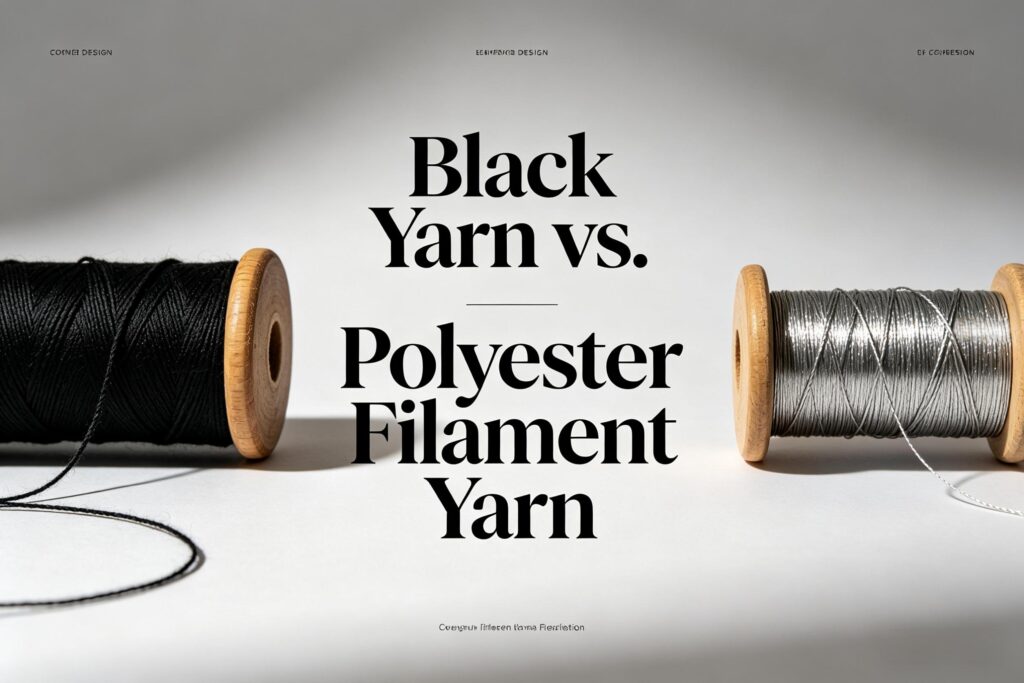
Abstract: The choice between black yarn and polyester filament yarn (PFY) is not about which is inherently better, but about which is optimally suited for a specific application, budget, and performance requirement. This guide provides a comprehensive, data-driven comparison, moving beyond generic labels to examine the core material properties, manufacturing processes, cost implications, and end-use performance of these two distinct categories. By clarifying common misconceptions and providing a clear selection framework, this article empowers designers, product developers, and sourcing professionals to make technically sound and commercially viable decisions for their textile projects.
Table of Contents
- Introduction: Beyond a Simple Choice – Defining the Terms
- Material Composition and Manufacturing: A Tale of Two Processes
- 2.1. What is “Black Yarn”? – A Clarification of Terms
- 2.2. Polyester Filament Yarn (PFY): The Engineered Synthetic
- 2.3. Key Differences in Production and Consistency
- Performance Showdown: A Data-Driven Comparison
- 3.1. Table 1: Core Performance Comparison
- 3.2. Color Fastness and Depth of Shade
- 3.3. Durability and Functional Properties
- 3.4. Sustainability and Environmental Impact
- Cost Analysis and Supply Chain Considerations
- 4.1. Initial Cost vs. Total Cost of Ownership (TCO)
- 4.2. Supply Chain Stability and the “glyarn” Assurance
- 4.3. Minimum Order Quantities (MOQs) and Lead Times
- Application-Based Selection Guide
- 5.1. Table 2: Recommended Applications
- 5.2. High-Fashion Apparel and Specialty Fabrics
- 5.3. Performance Activewear and Outdoor Gear
- 5.4. Technical Textiles and Industrial Uses
- 5.5. Home Furnishings and Upholstery
- Future Trends and Innovative Blends
- Conclusion: A Framework for Your Decision
1. Introduction: Beyond a Simple Choice – Defining the Terms
A common but misleading question in textile sourcing is: “Which is better, black yarn or polyester filament yarn?” This frames the decision incorrectly. “Black yarn” is not a fiber type; it is a description of color that can be applied to many fiber bases—cotton, wool, viscose, or indeed, polyester. The real, meaningful comparison lies between solution-dyed black polyester filament yarn (often what is implied by “black yarn” in an industrial context) and conventionally dyed polyester filament yarn.
Understanding this distinction is critical. Your choice fundamentally impacts aesthetics, performance, cost, and supply chain logistics. This guide will dissect the two primary options, providing the clarity needed to specify the right material for your project’s success.
2. Material Composition and Manufacturing: A Tale of Two Processes
2.1. What is “Black Yarn”? – A Clarification of Terms
In commercial textile production, “black yarn” typically refers to solution-dyed (or dope-dyed) yarn. For polyester, this means carbon black or other pigment is added to the polymer melt before it is extruded into filaments. The color is locked into the molecular structure of the fiber. This can be done with staple fiber (short fibers spun into yarn) or filament yarn (continuous fibers).
2.2. Polyester Filament Yarn (PFY): The Engineered Synthetic
Polyester filament yarn consists of continuous, synthetic polymer threads. It can be produced in a range of lusters (bright, semi-dull, full-dull) and textures. Its color is most commonly applied through conventional dyeing (piece-dyeing or yarn-dyeing) after the yarn or fabric is formed, where the dye bonds to the fiber’s surface.
2.3. Key Differences in Production and Consistency
This manufacturing difference has profound implications:
- Solution-Dyed (Black Yarn): Color is integral and uniform throughout the fiber cross-section. This leads to exceptional batch-to-batch color consistency, which is a paramount advantage for large orders or repeat production runs.
- Conventionally Dyed PFY: Color is applied later, making it more susceptible to minor shade variations between dye lots. It offers far greater flexibility for seasonal color changes without changing the base yarn.
3. Performance Showdown: A Data-Driven Comparison
3.1. Table 1: Core Performance Comparison
| Performance Characteristic | Solution-Dyed Black PFY | Conventionally Dyed PFY | Key Implication |
|---|---|---|---|
| Color Fastness to Washing | Excellent (4-5 on ISO scale) | Very Good to Excellent (3-4 on ISO scale) | Solution-dyed maintains vibrancy through repeated industrial laundering. |
| Color Fastness to Light | Superior (7-8 on Blue Wool Scale) | Good to Very Good (5-6 on Blue Wool Scale) | Critical for automotive interiors, outdoor furniture, and uniforms. |
| Color Fastness to Crocking (Rubbing) | Excellent | Good (depends on dye quality & process) | Solution-dyed resists color transfer to other surfaces. |
| Pilling Resistance | Similar (depends on yarn construction) | Similar (depends on yarn construction) | Not a differentiating factor. |
| UV Degradation Resistance | Generally Higher (pigments can block UV) | Standard | Important for long-term outdoor exposure. |
| Initial Yarn Cost | Higher (due to pigment integration) | Lower | Significant for cost-sensitive projects. |
3.2. Color Fastness and Depth of Shade
Solution-dyed black PFY is the undisputed champion of color permanence. The encapsulated pigment cannot be washed out or easily degraded by sunlight. This makes it the industry standard for applications where fading is unacceptable, such as automotive textiles, military uniforms, and outdoor performance apparel. Conventionally dyed black can achieve a rich shade, but its fastness, while very good with modern dyes, is inherently more vulnerable to environmental stressors over time.
3.3. Durability and Functional Properties
The core strength, moisture-wicking, and quick-drying properties of polyester are present in both types. The choice between them does not alter these fundamental attributes. Functional enhancements (e.g., moisture management, anti-microbial, UV protection) can be added to either through additives or finishes.
3.4. Sustainability and Environmental Impact
This is a significant differentiator. The solution-dyeing process is vastly more water-efficient and cleaner. It eliminates the need for post-production dye baths, reducing water consumption by up to 60%, energy use by up to 50%, and chemical effluent, according to industry analyses. For brands with strong sustainability mandates, solution-dyed yarns are a powerful tool to reduce the environmental footprint of their products.
4. Cost Analysis and Supply Chain Considerations
4.1. Initial Cost vs. Total Cost of Ownership (TCO)
While solution-dyed yarn commands a higher price per kilogram, its TCO can be lower for the right application. Savings manifest through:
- Eliminated Dyeing Costs: No payment for dyeing services, chemicals, or water treatment.
- Reduced Waste: Near-zero risk of dye lot mismatches, minimizing seconds and fabric waste.
- Longer Product Life: Superior colorfastness extends the usable life of the end-product.
4.2. Supply Chain Stability and the “glyarn” Assurance
For consistent black yarn, partnering with a specialized supplier is key. A supplier like glyarn, which focuses on engineered filament yarns, provides critical advantages:
- Color Consistency: Their controlled production process ensures the black shade you approve is the black shade you receive in every shipment, a non-negotiable for brand integrity.
- Technical Expertise: They can advise on the optimal yarn specification (denier, filament count, luster) to achieve the desired fabric hand and performance for your specific “black” application.
- Reliable Supply: Dependence on fluctuating dye-house capacity is removed, streamlining your production planning.
4.3. Minimum Order Quantities (MOQs) and Lead Times
Solution-dyed yarns typically have higher MOQs, as producing a dedicated colored melt is efficient only beyond a certain volume. Conventionally dyed PFY offers lower MOQs and faster turnaround for prototyping and small batches, as you can dye standard white yarn on demand.
5. Application-Based Selection Guide
5.1. Table 2: Recommended Applications
| Application Sector | Recommended Choice | Primary Reasoning |
|---|---|---|
| Automotive Interiors, Outdoor Furniture | Solution-Dyed Black PFY | Mandatory for extreme UV & abrasion resistance. |
| Workwear, Military & Safety Uniforms | Solution-Dyed Black PFY | Superior color retention through industrial laundering. |
| High-Performance Activewear | Solution-Dyed Black PFY | Prevents ugly fade lines from sweat and sun exposure. |
| Fast-Fashion Apparel, Seasonal Collections | Conventionally Dyed PFY | Lower cost, flexibility for changing color palettes. |
| Home Textiles (where frequent washing occurs) | Solution-Dyed Black PFY | Maintains appearance over the product’s lifetime. |
| Prototypes, Small Batch Production | Conventionally Dyed PFY | Lower MOQ and faster development cycle. |
6. Future Trends and Innovative Blends
The market is evolving beyond a binary choice. Key trends include:
- Recycled Content: Both solution-dyed and conventionally dyed PFY are increasingly available with recycled (rPET) content, combining sustainability benefits.
- Specialized Blacks: Developments in pigment technology allow for “cooler” or “warmer” black tones in solution-dyed yarns, offering more design subtlety.
- Hybrid Yarns: Blends of solution-dyed black filaments with other functional fibers (e.g., elastane for stretch, cotton for natural feel) are creating new fabric categories.
7. Conclusion: A Framework for Your Decision
Stop asking “Which is better?” and start asking these strategic questions:
- **What is the **primary performance requirement? Is absolute color permanence under stress (UV, wash, abrasion) the #1 priority? If yes, choose solution-dyed black PFY.
- **What is the **production volume and flexibility need? Are you producing a long-running, high-volume product where consistency is key? Choose solution-dyed. Is it a short-run, fast-changing fashion item? Choose conventionally dyed.
- **What is the **true total cost? Factor in dyeing costs, waste, and product lifespan, not just the yarn price tag.
- **What are the **sustainability goals? If reducing water and chemical impact is a core brand value, solution-dyed yarn presents a compelling story.
For projects where the unparalleled consistency and performance of solution-dyed black are required, partnering with a technical specialist like glyarn mitigates risk and ensures a premium result. For dynamic, cost-driven, or experimental projects, conventionally dyed PFY offers the necessary flexibility.
By applying this framework, you can transform a simple material question into a strategic decision that optimizes quality, cost, and brand value.
