
Table of Contents
- Introduction: Navigating the Material Choice for Performance
- Fundamental Definitions and Core Structures
- 2.1. What is a Polyester Monofilament?
- 2.2. What is a Polyester Multifilament?
- Comparative Analysis: A Head-to-Head Technical Breakdown
- 3.1. Mechanical Properties: Strength, Stiffness, and Flexibility
- 3.2. Surface Characteristics and Aesthetic Outcomes
- 3.3. Performance in Dyeing and Finishing Processes
- 3.4. Cost, Processability, and Application-Specific Efficiency
- The Application Matrix: Matching the Fiber to the Function
- 4.1. The Unquestionable Domain of Monofilaments
- 4.2. Where Multifilaments Reign Supreme
- 4.3. Hybrid Solutions and Blended Innovations
- Sourcing Strategy: Leveraging Expertise for Optimal Value
- 5.1. Defining Your Technical Specifications
- 5.2. The Value of a Specialist Partner: The Glyarn Case
- 5.3. Avoiding Common Pitfalls in Sourcing
- Future Trends and Conclusion: Making an Informed Choice
1. Introduction: Navigating the Material Choice for Performance
In the highly specialized world of technical textiles and industrial fabrics, the choice between polyester monofilament and multifilament yarns is not a matter of simple preference but a critical engineering decision. This choice directly dictates the final product’s performance, durability, aesthetics, and cost. Asking “which one is better?” is akin to asking whether a steel beam or a steel cable is better—the answer is entirely dependent on the application.
With the global market for technical textiles projected for sustained growth, driven by sectors like construction, automotive, and personal protection, making the correct foundational material choice is more vital than ever. This guide provides a comprehensive, data-driven comparison to empower product developers, engineers, and sourcing managers to move beyond generic assumptions and select the optimal fiber for their specific needs.
2. Fundamental Definitions and Core Structures
Understanding the fundamental physical difference is the first step to informed selection.
2.1. What is a Polyester Monofilament?
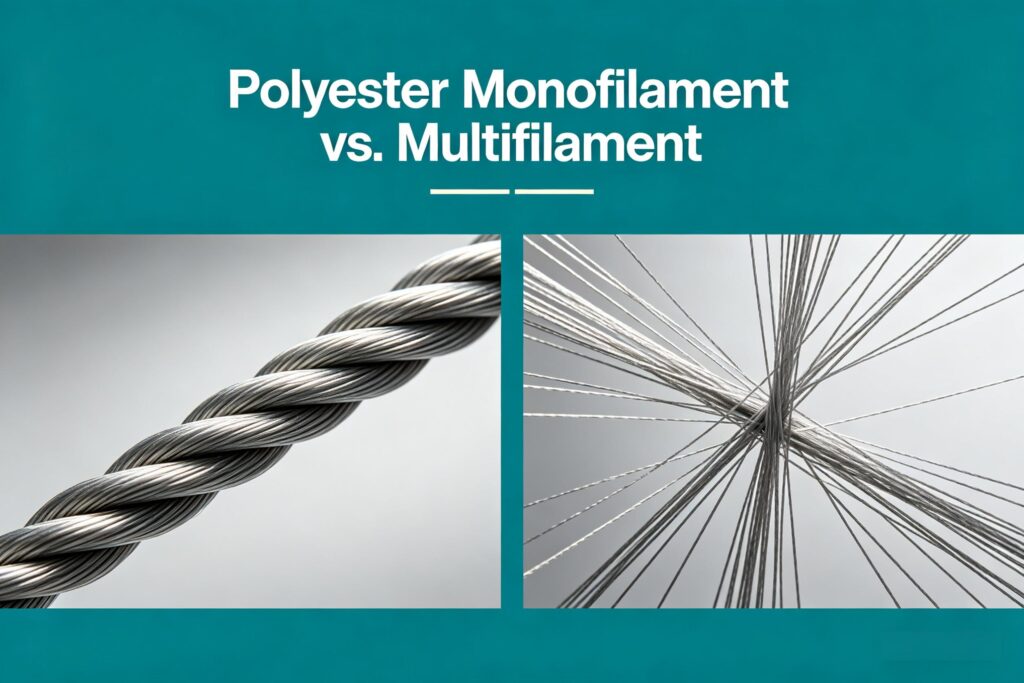
A monofilament is exactly what its name implies: a single, continuous strand of polyester. It is extruded through a spinneret to form a solitary, coarse fiber. Its diameter can vary widely, from fine threads measured in hundredths of a millimeter (like a robust hair) to thick strands of 2.0 mm or more. This single-filament structure makes it akin to a tiny, flexible rod. Common specifications emphasize its singular nature and linear density (e.g., a defined dtex value for a single fiber).
2.2. What is a Polyester Multifilament?
A multifilament yarn is composed of multiple, fine, continuous filaments bundled or twisted together. A single yarn is therefore a collection of many individual fibers. This structure is typically described by two numbers: the total linear density and the number of filaments (e.g., 165dtex/30f, meaning a 165-decitex yarn made of 30 individual filaments). This gives it a composite structure, where the collective behavior of the filaments determines the yarn’s properties.
3. Comparative Analysis: A Head-to-Head Technical Breakdown
3.1. Mechanical Properties: Strength, Stiffness, and Flexibility
- Monofilament: Exhibits high stiffness and dimensional stability due to its solid, single-component structure. It resists bending and holds its shape firmly, which is crucial for applications like screening or bristles. While it has good tensile strength, its lack of internal structure can make it more prone to catastrophic failure if a single defect (a “kink” or nick) forms. A typical high-tenacity industrial polyester monofilament can have a breaking strength of over 3.1 N and a high modulus.
- Multifilament: Offers superior flexibility, drape, and resilience. The many fine filaments can move independently, allowing the yarn to bend easily and absorb energy. Even if one filament breaks, the load is redistributed among the others, preventing immediate total failure. This makes it exceptionally durable under dynamic, multi-directional stress. Industrial multifilaments, such as those used for tire cord, are engineered for extreme strength (e.g., ≥8.00 cN/dtex).
3.2. Surface Characteristics and Aesthetic Outcomes
- Monofilament: Has a smooth, uniform, and often transparent or translucent surface. It produces fabrics with a distinct, sometimes plasticky handle, clear open spaces in meshes, and a characteristic “sheen.” It is less prone to pilling as there are no loose ends.
- Multifilament: Creates a softer, more textured, and opaque surface. The fabric hand can range from smooth (for flat, low-twist yarns) to bulky and cotton-like (for textured yarns). It is better at mimicking the aesthetics of natural fibers and provides more covering power.
3.3. Performance in Dyeing and Finishing Processes
This is a key differentiator. Research indicates that the morphology of the filament significantly impacts dye uptake.
- Monofilament: Has lower dye affinity due to its dense, crystalline structure and limited surface area relative to its volume. Achieving deep, vibrant colors can be more challenging and may require specialized dyeing conditions.
- Multifilament: Has inherently better dyeability. The collective surface area of all the fine filaments is vastly greater than that of a monofilament of the same weight. This allows for easier dye penetration, richer color development, and more uniform shades. Furthermore, innovations like bicomponent or modified cross-section filaments (e.g., tetra-channel shapes) are being developed specifically to enhance this property further.
3.4. Cost, Processability, and Application-Specific Efficiency
- Monofilament: Can be more cost-effective for simple, high-volume industrial items like fishing line, fruit bags, or rigid screening where its properties are a perfect match. However, its stiffness can make it trickier to weave on high-speed looms compared to more pliable multifilaments.
- Multifilament: While sometimes carrying a higher base material cost, it offers unmatched versatility. Its ability to be engineered—through filament count, twist, and texturing—makes it suitable for an enormous range of fabrics, from lightweight apparel linings to heavy-duty conveyor belts. Most modern textile machinery, especially high-speed water-jet and air-jet looms, are optimized for processing multifilament yarns.
4. The Application Matrix: Matching the Fiber to the Function
The following table summarizes the dominant application areas for each fiber type, based on their inherent properties.
| Application Sector | Recommended Fiber Type | Primary Reason & Key Property Utilized |
|---|---|---|
| Industrial Sieves, Filters, Screens | Monofilament | Precise pore size, rigidity, and smooth surface for accurate filtration and easy cleaning. |
| Fishing Line, Surgical Sutures, Bristles | Monofilament | High knot strength, uniformity, and controlled stiffness. |
| 3D Spacer Fabrics, Automotive Mesh | Monofilament | Ability to maintain structural loft and shape under compression. |
| Apparel & Fashion Fabrics | Multifilament | Soft hand, excellent drape, dye vibrancy, and comfort. The foundation of most clothing textiles. |
| Tire Cord, Seat Belts, Conveyor Belting | High-Tenacity Multifilament | Extreme tensile strength, dynamic fatigue resistance, and flexibility. |
| Coated Fabrics (Tarps, Tents) | Multifilament | Strong, stable fabric base (e.g., “Polyester spinning”) with excellent adhesion for coatings. |
| Geotextiles, Soil Stabilization Grids | Either (Designed Differently) | Monofilament for rigid grids; Multifilament for high-strength, flexible woven fabrics. |
5. Sourcing Strategy: Leveraging Expertise for Optimal Value
Navigating this complex landscape requires more than just a product catalog.
5.1. Defining Your Technical Specifications
Begin with the non-negotiable requirements of your end product. Is absolute dimensional stability under load the priority (leaning toward monofilament), or is tear resistance and softness more critical (leaning toward multifilament)? Quantify needs for tensile strength, elongation at break, modulus, abrasion resistance, and UV stability.
5.2. The Value of a Specialist Partner: The Glyarn Case
This is where partnering with a specialized supplier like Glyarn becomes a strategic advantage. For a buyer unsure of the precise specifications, a general trader might simply offer a standard option. In contrast, a technical partner like Glyarn engages in a consultative process:
- Technical Translation: They help translate your performance needs into exact fiber parameters—recommending, for instance, a specific monofilament diameter with a custom UV stabilization package for an outdoor screen, or a proprietary low-shrinkage multifilament for a precision-coated industrial fabric.
- Supply Chain Integrity: They ensure consistency in supply—a critical factor when a change in filament morphology can alter dyeing results or fabric performance.
- Innovation Access: They provide insights into advanced materials, such as bicomponent filaments that offer unique dyeing properties or enhanced elasticity.
5.3. Avoiding Common Pitfalls in Sourcing
Do not default to the lowest cost per kilogram without analyzing total cost-in-use. A cheaper monofilament that breaks during weaving or a multifilament that dyes unevenly will result in far greater losses. Always request and test production samples under real-world conditions before committing to a large order.
6. Future Trends and Conclusion: Making an Informed Choice
The future lies in increased specialization and smart hybridization. We will see more monofilaments engineered with nano-additives for specific functionalities (e.g., antimicrobial properties) and multifilaments with ever-finer filaments and novel polymer blends for unprecedented softness and performance.
Conclusion: There is no universal “better” option. The decision is a functional one:
- Choose Polyester Monofilament when your application demands rigidity, transparency, precise geometry, or a smooth, dense surface. It is the specialist tool for defined technical tasks.
- Choose Polyester Multifilament when your application requires flexibility, strength, durability, softness, or vibrant aesthetics. It is the versatile workhorse of the textile industry.
The most successful product developers treat this choice as the first and most critical step in the design process. By thoroughly understanding the material science behind each option and collaborating with expert partners like Glyarn, you can ensure your material selection is not a compromise but a deliberate driver of product excellence and market success.
