
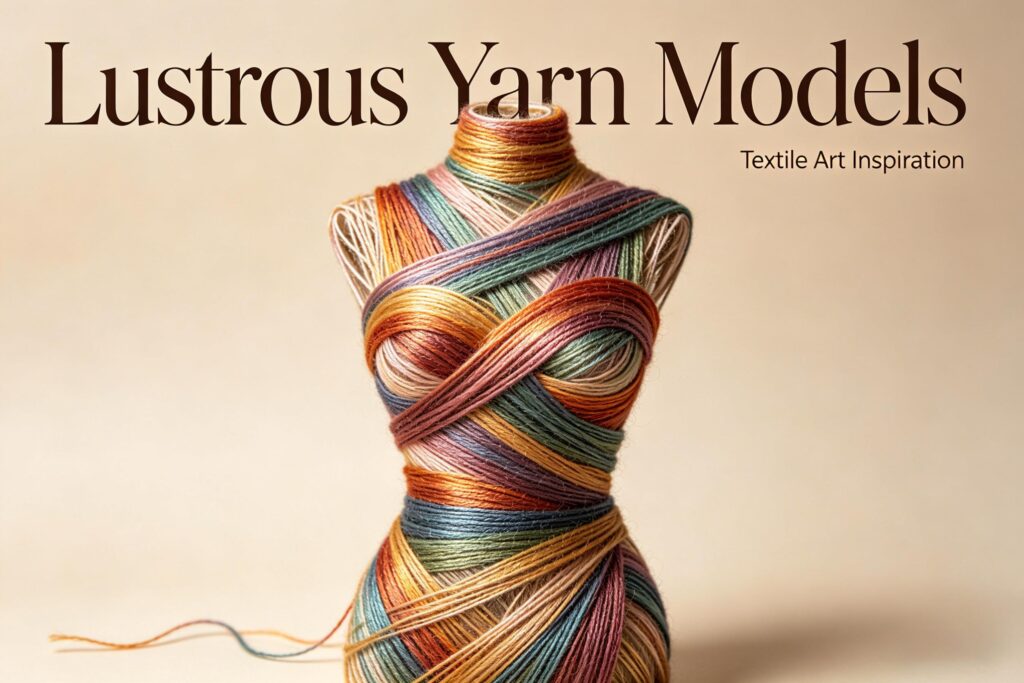
Abstract: This comprehensive technical guide explores the diverse world of lustrous yarn models, providing international buyers, textile engineers, and product developers with essential knowledge for material selection. We examine key specification systems, fiber-specific model classifications, technical parameters, and industry applications, supported by comparative data tables. Understanding these model distinctions enables professionals to precisely match yarn characteristics to project requirements in fashion, home textiles, and technical textiles, ultimately optimizing product performance and cost-efficiency in global supply chains.
Table of Contents
- Introduction: The Strategic Importance of Lustrous Yarn Specification
- Understanding Lustrous Yarn Classification Systems
- 2.1. Fiber-Based Classification Models
- 2.2. Luster Intensity Grading Systems
- 2.3. Industry-Specific Nomenclature
- Major Lustrous Yarn Model Categories by Fiber Type
- 3.1. Silk and Silk-Blend Lustrous Yarns
- 3.2. Synthetic Glitter Yarns (Polyester, Nylon, Acetate)
- 3.3. Metallic and Specialty Effect Yarns
- 3.4. Mercerized Cotton with Enhanced Luster
- Technical Specifications and Performance Parameters
- 4.1. Denier, Tex, and Yarn Count Systems
- 4.2. Twist Levels and Construction Methods
- 4.3. Luster Measurement and Standardization
- Application-Specific Model Selection
- 5.1. Fashion and Apparel Applications
- 5.2. Home Textiles and Upholstery
- 5.3. Technical and Industrial Uses
- Comparative Analysis of Lustrous Yarn Models
- 6.1. Performance Comparison Table
- 6.2. Cost-Performance Analysis
- 6.3. Sustainability Considerations
- Market Trends and Future Developments
- Practical Selection Guidelines for International Buyers
- Conclusion: Optimizing Lustrous Yarn Selection for Global Markets
1. Introduction: The Strategic Importance of Lustrous Yarn Specification
The global textile industry’s lustrous yarn segment represents a multibillion-dollar market with applications spanning luxury fashion, interior design, and technical textiles. Precise model specification is not merely an aesthetic consideration but a critical technical parameter affecting durability, care requirements, production efficiency, and final product performance. International buyers increasingly require detailed technical data to make informed sourcing decisions, particularly as supply chains become more specialized and quality expectations rise across global markets.
Modern lustrous yarns have evolved beyond traditional silk to include advanced synthetic fibers engineered for specific visual effects, performance characteristics, and cost parameters. According to textile industry reports, the global specialty yarn market is projected to grow at a CAGR of 5.8% from 2023 to 2030, with lustrous variants representing a significant portion of this expansion. This growth is driven by increasing demand from emerging markets, sustainable fiber innovations, and technological advancements in yarn manufacturing.
2. Understanding Lustrous Yarn Classification Systems
2.1. Fiber-Based Classification Models
Lustrous yarns are primarily categorized by their base fiber composition, which determines fundamental characteristics:
Natural Fiber Models:
- Silk yarns: Designated by Momme weight (mm) – a traditional Japanese system where higher numbers indicate thicker, heavier fabric. Common apparel grades range from 12-30mm.
- Mercerized cotton: Identified by yarn count (Ne, Nm, or Tex) and mercerization level (single or double). Double mercerization produces superior luster.
- Specialty hair fibers: Including lustrous varieties of mohair, camel, and alpaca, typically specified by micron count and staple length.
Synthetic and Manufactured Fiber Models:
- Polyester trilobal yarns: Engineered with triangular cross-sections that refract light. Models are specified by denier per filament (dpf), total denier, and filament count.
- Acetate and rayon: Often designated by standard industry codes indicating luster level (bright, semi-dull, dull) combined with denier and filament count.
- Nylon shimmer yarns: Typically classified by denier, luster type, and whether they’re partially oriented yarn (POY) or fully drawn yarn (FDY).
2.2. Luster Intensity Grading Systems
While no universal standard exists, most manufacturers employ proprietary grading scales, typically ranging from 1-5 or 1-10, with higher numbers indicating greater reflectivity. Some European manufacturers have begun adopting quantitative measurement systems using spectrophotometers to assign CIE Lab* values, particularly for color-matched lustrous effects.
2.3. Industry-Specific Nomenclature
Different sectors employ specialized terminology:
- Fashion/Apparel: Often uses descriptive terms (high shimmer, satin sheen, pearl essence) alongside technical specifications.
- Home Textiles: Tends toward performance-oriented designations indicating lightfastness and abrasion resistance alongside luster characteristics.
- Technical Textiles: Uses strictly standardized codes incorporating material, denier, twist, and specific finish information.
3. Major Lustrous Yarn Model Categories by Fiber Type
3.1. Silk and Silk-Blend Lustrous Yarns
Silk remains the benchmark for natural luster, with several specialized models:
Mulberry Silk Yarns:
- Grade A (6A being highest): International grading based on defects, consistency, and luster uniformity.
- Model designations: Often include country of origin, size (denier), and twist (e.g., Chinese 20/22 denier raw silk, 100/120 twill).
- Technical specifications: Average tenacity of 3.5-5.0 g/denier, elongation of 15-25%, moisture regain of 11%.
Tussah and Wild Silk Variants: Possess more textured luster, often designated by “type” rather than precise grading.
Silk Blends: Common combinations include silk/cotton (e.g., 60/40), silk/wool, and silk/bamboo, each with distinct model series indicating blend ratio and construction.
3.2. Synthetic Glitter Yarns (Polyester, Nylon, Acetate)
Synthetic fibers offer controlled, consistent luster at various price points:
Polyester Bright Yarns:
- FDY Bright Polyester: Designations like 75D/72F FDY BRIGHT indicate denier (75), filament count (72), process (fully drawn), and luster (bright).
- DTY Polyester with Intermingled Luster: Textured yarns combining stretch with shine, designated by denier, filament count, and intermingling nodes per meter.
- Specialty Cross-Sections: Including trilobal, pentagonal, and octagonal filaments that enhance light reflection, with specific model codes for each geometry.
Nylon Shimmer Yarns:
- Nylon 6 versus Nylon 6,6: Different polymer types with distinct luster profiles, clearly indicated in model numbers.
- Multi-lobal nylon: Engineered cross-sections creating specific optical effects, with designations indicating lobe count and configuration.
Acetate and Rayon Variants:
- Acetate “Bright” and “Extra Bright”: Designated by total denier and luster modifier codes.
- High-Wet-Modulus Rayon: Premium viscose with enhanced luster retention, with specific series numbers from major producers.
3.3. Metallic and Specialty Effect Yarns
These create dramatic visual effects through various technologies:
Laminated Metallic Yarns:
- Polyester film-based: Metallized PET film slit to specific widths (typically 0.25mm-1.0mm), often laminated between protective layers. Designations indicate width, color, and substrate.
- Core-wrapped metallics: Metallic thread wrapped around textile core, designated by core material, wrap density, and metallic composition.
Integrated Effect Yarns:
- Iridescent/chameleon yarns: Created through co-extrusion or specialized dyeing, with model numbers indicating color-shift range.
- Glow-in-the-dark and photochromic: Technical specifications include luminance intensity (mcd/m²) and activation wavelength.
3.4. Mercerized Cotton with Enhanced Luster
Through caustic treatment, cotton achieves permanent luster improvement:
Single versus Double Mercerized:
- Single mercerized: Conventional treatment, approximately 20-30% luster increase.
- Double mercerized: Treated in both yarn and fabric form, achieving 40-50% luster enhancement with improved strength.
Model Designations: Typically combine conventional cotton count (Ne) with mercerization indicator (e.g., 40/2 Mc for 2-ply mercerized 40 Ne cotton).
4. Technical Specifications and Performance Parameters
4.1. Denier, Tex, and Yarn Count Systems
Understanding linear density measurements is essential for specification accuracy:
Denier System: Weight in grams of 9,000 meters of yarn. Predominant for synthetic filaments.
- Fine apparel yarns: 20D-100D
- Heavier upholstery yarns: 150D-600D
Tex System: Weight in grams of 1,000 meters of yarn. Increasingly international standard.
- Direct conversion: 1 Tex = 9 Denier
Cotton Count (Ne): Number of 840-yard hanks per pound. Higher number indicates finer yarn.
- Fine lustrous cottons: Ne 60-100
- Standard qualities: Ne 30-40
Metric Count (Nm): Number of kilometers per kilogram. Common for wool and blends.
4.2. Twist Levels and Construction Methods
Twist significantly affects luster presentation:
Low Twist (2-8 TPI): Maximizes fiber exposure for optimal luster but reduces strength.
Medium Twist (8-15 TPI): Balance between luster and structural integrity.
High Twist (15-30 TPI): Creates crepe or pebbled effects, diffusing luster.
Construction variations: Including core-spun, plied, cabled, and fancy twist models each with distinct visual effects.
4.3. Luster Measurement and Standardization
Emerging quantitative approaches supplement visual assessment:
Spectrophotometric Analysis: Measures reflectance at specific angles (often 45°/0° or 0°/45° geometry).
Gloss Meter Readings: Provides numerical gloss units (GU) at standard angles (20°, 60°, 85°).
Industry Initiatives: Organizations like ASTM International are developing standardized test methods for textile luster quantification.
5. Application-Specific Model Selection
5.1. Fashion and Apparel Applications
Different garment types require specific lustrous yarn characteristics:
Eveningwear and Bridal:
- Premium silk (19-25mm) or micro-denier polyester (less than 1.0 dpf)
- High filament count for optimal drape and luminosity
- Lightweight constructions (20-50 denier)
Luxury Knitwear:
- Mercerized cotton (Ne 40/2 to 80/2)
- Silk/wool or silk/cashmere blends (typically 30-70% silk content)
- Twist levels optimized for stitch definition
Accessories and Trims:
- Metallic and lurex yarns (0.3-0.8mm width)
- High-twist lustrous yarns for embroidery
- Durable synthetics with abrasion-resistant finishes
5.2. Home Textiles and Upholstery
Performance requirements dictate specialized selections:
Drapery and Window Treatments:
- Lightfastness rating of 4-5 (ISO 105-B02)
- Medium-weight synthetics (150-300 denier)
- Soil-release and anti-static treatments
Upholstery Fabrics:
- High-abrasion resistance (Martindale 20,000+ cycles)
- Medium luster to minimize wear visibility
- Solution-dyed synthetics for color consistency
Bedding and Linens:
- Long-staple mercerized cotton (Ne 60-100)
- Sateen weaves for enhanced luster
- Easy-care finishes maintaining luster through washing
5.3. Technical and Industrial Uses
Functional applications with aesthetic components:
Automotive Interiors:
- UV-stabilized synthetics (500+ hours Xenon testing)
- Consistent color matching (ΔE < 1.0)
- Anti-soiling treatments
Technical Outerwear:
- Water-resistant yet breathable constructions
- Luster incorporated for safety visibility
- High-tenacity fibers with maintained aesthetics
Medical and Hospitality Textiles:
- Antimicrobial treatments compatible with luster
- High-wash durability (50+ industrial cycles)
- Chemical resistance to cleaning agents
6. Comparative Analysis of Lustrous Yarn Models
Table 1: Performance Characteristics of Major Lustrous Yarn Types
| Yarn Model Category | Typical Denier Range | Luster Intensity (1-10 Scale) | Average Tenacity (g/den) | Moisture Regain (%) | Relative Cost Index (Polyester=1.0) | Key Applications |
|---|---|---|---|---|---|---|
| Mulberry Silk | 20-300 | 9 | 3.5-4.5 | 11.0 | 8.5 | Luxury apparel, accessories |
| Mercerized Cotton | Equivalent to 30-80 Ne | 6 | 2.0-3.0 | 8.5 | 2.5 | Premium knitwear, bedding |
| FDY Bright Polyester | 20-600 | 8 | 4.0-5.5 | 0.4 | 1.0 | Fast fashion, home textiles |
| Trilobal Polyester | 50-300 | 9 | 4.0-5.0 | 0.4 | 1.8 | Eveningwear, specialty fabrics |
| Acetate Bright | 75-300 | 7 | 1.2-1.5 | 6.5 | 3.2 | Linings, drapery |
| Metallic Film Yarn | N/A (Width: 0.25-1.0mm) | 10 | 1.5-2.5* | 0.1 | 4.0 | Trim, decorative elements |
| Nylon 6,6 Bright | 70-600 | 8 | 4.5-6.0 | 4.5 | 1.5 | Activewear, upholstery |
*Tensile strength measured differently for film-based yarns
Table 2: Technical Specifications Comparison for Common Lustrous Yarn Models
| Specification Parameter | Silk (20/22 Denier) | Mercerized Cotton (Ne 50/2) | FDY Polyester (75D/72F) | Trilobal Nylon (70D/34F) | Acetate (120D/40F) |
|---|---|---|---|---|---|
| Filament Count | Monofilament | Staple spun | 72 | 34 | 40 |
| Typical Twist (TPI) | 8-12 | 12-16 | 0-5 | 0-5 | 0-5 |
| Elongation at Break (%) | 15-25 | 5-10 | 20-30 | 25-35 | 25-35 |
| Specific Gravity | 1.34 | 1.54 | 1.38 | 1.14 | 1.32 |
| Melting Point (°C) | Decomposes at ~150 | N/A (chars at 150+) | 255-260 | 260-265 | 230-260 |
| Colorfastness to Light | Good | Very Good | Excellent | Excellent | Fair |
| Recommended Care | Dry clean | Machine wash warm | Machine wash cool | Machine wash cool | Dry clean |
7. Market Trends and Future Developments
The lustrous yarn market is evolving in response to several global trends:
Sustainability Innovations:
- Recycled polyester with luster: Post-consumer PET transformed into bright yarns with equivalent performance to virgin materials.
- Closed-loop manufacturing: Processes that recover and reuse chemical inputs from mercerization and synthetic production.
- Traceability systems: Blockchain and digital tagging enabling supply chain transparency from raw material to finished yarn.
Technological Advancements:
- Nanostructured surfaces: Engineered at molecular level to enhance light interaction without chemical coatings.
- Smart luster effects: Yarns incorporating thermochromic or electrochromic elements for dynamic visual properties.
- Advanced coating technologies: Thin-film deposition creating metallic effects without laminated structures.
Market Dynamics:
- Asia-Pacific dominates production with 75% market share, but regional specialization exists (China: synthetic lustrous yarns; India: mercerized cottons; Vietnam: silk blends).
- The luxury sector shows 4-6% annual growth in lustrous yarn consumption despite economic fluctuations.
- Technical textiles represent the fastest-growing application segment at approximately 8% CAGR.
8. Practical Selection Guidelines for International Buyers
Step 1: Define Application Requirements
- Identify primary performance needs (durability, care, comfort)
- Determine aesthetic objectives (luster intensity, color effects)
- Establish regulatory and compliance requirements
Step 2: Technical Specification Development
- Select appropriate fiber type based on performance/cost balance
- Determine optimal yarn count/denier for intended construction
- Specify twist level and construction method
- Define luster intensity using available metrics
Step 3: Supplier Evaluation and Sampling
- Request detailed technical data sheets from potential suppliers
- Obtain physical samples for hands-on evaluation
- Verify testing certifications and quality control processes
- Assess manufacturing capabilities for consistency at scale
Step 4: Cost Optimization
- Consider total cost of ownership (including processing efficiency)
- Evaluate minimum order quantities and inventory implications
- Negotiate based on comprehensive technical specifications
- Explore blended options balancing premium and economical fibers
Step 5: Quality Assurance Planning
- Establish clear acceptance criteria for luster consistency
- Define testing protocols for key performance parameters
- Implement batch documentation and traceability systems
- Plan for regular supplier performance review
9. Conclusion: Optimizing Lustrous Yarn Selection for Global Markets
Selecting the appropriate lustrous yarn model requires balancing aesthetic objectives with technical performance, regulatory compliance, and economic considerations. The diverse range of available models—from traditional silk to engineered synthetics and specialty effects—provides designers and manufacturers with extensive creative possibilities while meeting functional requirements.
Successful international sourcing depends on developing precise technical specifications, understanding regional manufacturing specializations, and establishing strong partnerships with technically competent suppliers. As sustainability considerations become increasingly important, buyers should explore innovative options including recycled materials and cleaner production technologies without compromising visual appeal.
The continued evolution of measurement and standardization will further professionalize lustrous yarn specification, enabling more accurate communication between designers, manufacturers, and suppliers across global supply chains. By leveraging the comprehensive model information and selection guidelines presented here, international buyers can make informed decisions that enhance product value, optimize production efficiency, and create compelling textile products for diverse global markets.
The future of lustrous yarns lies at the intersection of aesthetic innovation and technical advancement, with growing opportunities for customized solutions that address specific brand requirements and market segment needs. Those who master the technical language of yarn specification while maintaining creative vision will be best positioned to capitalize on these opportunities in an increasingly competitive global marketplace.
