
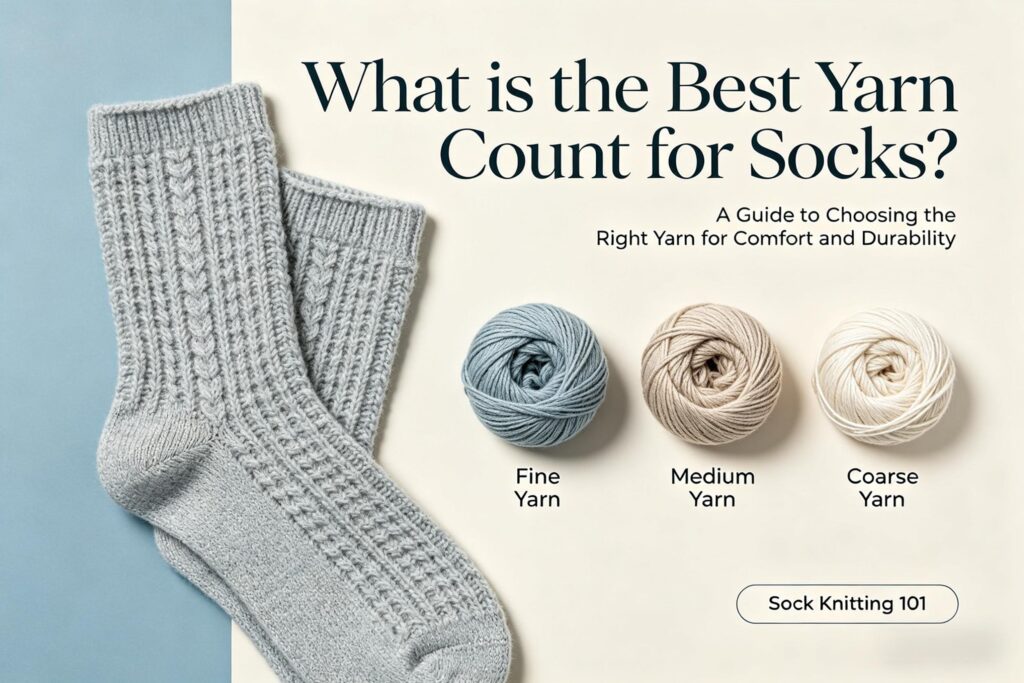
Introduction: The Weighty Question of a Sock’s Soul
For procurement managers, product developers, and manufacturers in the textile supply chain, selecting the correct yarn for a sock is a critical decision that balances cost, quality, performance, and market appeal. The seemingly simple question, “What is the best yarn count for socks?” is in fact a gateway to a complex technical landscape. A sock is not a monolithic textile; it is a sophisticated, multi-layered product where each component—the comfortable surface layer, the resilient structural core, and the elastic border—demands a specific yarn engineered for its unique function . This article will demystify yarn specifications for hosiery, providing a data-driven framework to empower your sourcing decisions and product development strategies. We will move beyond generic recommendations to explore how the interplay of yarn count, fiber type, and construction dictates the final characteristics of a sock, from the luxurious feel of a fine-gauge dress sock to the rugged durability of a heavy work sock.
Table of Contents
- Deconstructing the Sock: The Tripartite Yarn System
- 1.1. The Face Yarn: Defining Comfort, Aesthetics, and Hand Feel
- 1.2. The Core/Binding Yarn: The Engine of Strength and Structure
- 1.3. The Elastic (Elastane) Yarn: Ensuring Fit and Recovery
- Decoding Yarn Specifications: Count, Denier, and Blend
- 2.1. Understanding “Count” and “Denier” in Hosiery Context
- 2.2. The Critical Role of Fiber Selection and Blending
- Application-Driven Specifications: A Data-Backed Selection Matrix
- 3.1. Fine & Formal Socks: The Realm of High Counts
- 3.2. Everyday & Athletic Socks: The Balance of Durability and Comfort
- 3.3. Heavy-Duty & Specialty Socks: Prioritizing Bulk and Resilience
- From Yarn to Finished Product: Cost, Quality, and Production Considerations
- 4.1. Estimating Yarn Consumption and Cost Implications
- 4.2. Machine Compatibility: Linking Yarn Count to Needle Gauge
- 4.3. Navigating Industry Standards and Quality Benchmarks
- Strategic Sourcing Recommendations for Industry Buyers
1. Deconstructing the Sock: The Tripartite Yarn System
Understanding that a typical sock is built from distinct yarn systems is the first step to intelligent specification. Each system serves a non-negotiable purpose .
1.1. The Face Yarn: Defining Comfort, Aesthetics, and Hand Feel
This is the primary yarn, forming the outermost layer of the sock that contacts the skin. It is the most critical for wearer perception of softness, absorbency, and overall quality.
- Common Fibers: Primarily short-staple spun yarns like cotton (combed or carded), wool, bamboo, modal, or blends like cotton-polyester or wool-acrylic .
- Specification Focus: The yarn count (e.g., Ne 32/1, Ne 40/1) is the key determinant of fabric fineness, hand feel, and the sock’s ultimate classification (e.g., thin, medium, thick) .
1.2. The Core/Binding Yarn: The Engine of Strength and Structure
Often hidden within the structure, this component provides tensile strength, shape retention, and durability. It prevents the sock from over-stretching and losing its shape .
- Common Fibers: Primarily synthetic filament yarns, such as nylon (polyamide) or polyester .
- Specification Focus: Measured in Denier (D) (e.g., 20D, 70D, 100D), which defines linear density. A higher Denier indicates a thicker, stronger filament. These yarns are often combined with elastane to form a “core-spun” or “covered yarn” structure .
1.3. The Elastic (Elastane) Yarn: Ensuring Fit and Recovery
This component, typically spandex (Lycra®), is essential for the sock to hug the foot and ankle comfortably and return to its original shape after stretching .
- Integration: It is almost never used alone. It is either:
- Core-Spun: Encased within a sheath of cotton or other fiber as the face yarn.
- Covered (Cored Yarn): Wrapped with nylon or polyester filament to form the structural core yarn .
- Specification: Often specified alongside its covering, e.g., “3070” denotes a 30D spandex core covered by a 70D nylon filament .
2. Decoding Yarn Specifications: Count, Denier, and Blend
2.1. Understanding “Count” and “Denier” in Hosiery Context
The textile industry uses different measurement systems for spun and filament yarns. Precise communication requires fluency in both.
- Yarn Count (for Face Yarns): An indirect numbering system where a higher number indicates a finer, lighter yarn. For cotton and cotton-blend sock yarns, the English Cotton Count (Ne) is standard. It is defined as the number of 840-yard hanks per pound . Common hosiery counts range from coarse (Ne 10/1) to very fine (Ne 60/2) .
- Denier (for Core/Elastic Yarns): A direct numbering system where a higher number indicates a thicker, heavier yarn. Denier is the weight in grams of 9,000 meters of yarn. Nylon and spandex for socks commonly range from 15D to 220D .
- Blend Notation: A sock labeled as “Face Yarn: 80% Combed Cotton 20% Polyester, Core: Nylon, Elastane” is standard. Specifications like “75D/36F” for polyester further detail it as 75 Denier with 36 individual filaments (F), impacting softness .
2.2. The Critical Role of Fiber Selection and Blending
The choice of fiber within a count range drastically alters performance.
- Cotton (Ne 32/1): The benchmark. Offers good absorbency and comfort.
- Combed Cotton (Ne 32/1): A superior, more expensive process removing short fibers, resulting in a stronger, smoother, and more durable yarn with fewer impurities .
- Blends (e.g., Cotton/Polyester): Polyester adds significant strength, abrasion resistance, and reduces shrinkage. A 65/35 Cotton/Polyester blend in a Ne 21/1 count is common for durable athletic or work socks.
- Specialty Fibers (e.g., Merino Wool, Bamboo, Modal): Often used in finer counts (Ne 48/2 NM and above) for premium thermal regulation, moisture-wicking, or ultra-softness .
3. Application-Driven Specifications: A Data-Backed Selection Matrix
There is no single “best” count. The optimal specification is defined by the sock’s end-use. The following matrix synthesizes industry data into a practical selection tool .
Table 1: Sock Yarn Specification Matrix by Application
| Sock Category & Use Case | Target Consumer & Key Needs | Recommended Face Yarn (Count & Fiber) | Recommended Core/Binding Yarn | Resulting Sock Characteristics |
|---|---|---|---|---|
| Fine / Formal Dress Socks | Professionals; Style, comfort, breathability in dress shoes. | Ne 40/1 to Ne 60/2+ Combed Cotton, Fine Merino, Micro-Modal, Silk Blends. | 15D-20D Nylon/Elastane or 2070/1575 covered yarn. | Thin, smooth hand feel, elegant drape, excellent breathability. Prone to faster wear if not high-quality. |
| Medium-Weight / Everyday Casual | General daily wear; All-day comfort, durability, value. | Ne 21/1 to Ne 32/1 Carded or Combed Cotton, Cotton/Polyester (e.g., 80/20, 65/35), Acrylic Blends. | 20D-40D Nylon/Elastane or 2075/3070 covered yarn. | The “workhorse” category. Balanced comfort, good durability, cost-effective. Most common market segment. |
| Sport & Performance Socks | Athletes, active users; Moisture management, cushioning, blister prevention. | Ne 21/1 to Ne 32/1 (often in plied constructions) Technical blends (e.g., Coolmax® polyester, Wool/Synthetic), often with targeted cushioning zones. | 30D-70D Nylon/Elastane or 3075/4070 covered yarn. | Enhanced durability, structured fit, targeted padding, high wicking. Often uses functional fiber tech. |
| Heavy-Duty / Thermal Socks | Outdoor work, winter sports; Warmth, cushioning, extreme durability. | Ne 10/1 to Ne 20/1 (or 2-4 ply) Thick wool (e.g., 16-18 microns), Wool/Acrylic blends, heavy brushed cotton. | 70D-100D+ Nylon/Elastane or 4075/xxx covered yarn. | Thick, bulky fabric. High insulation, heavy cushioning, very high abrasion resistance. |
| Fashion & Novelty Socks | Trend-driven consumers; Visual texture, unique hand feel. | Varies widely. May use slub yarns (Ne 16/1-32/1), bouclé, or blends with specialty fibers (recycled, etc.). | Matched to face yarn weight; typically 2075-3075. | Prioritizes aesthetic texture, color vibrancy, and novel tactile experiences over pure durability. |
Key Insight from R&D: A 2020 research paper introduced the concept of Thousand Stitches Weight (TSW) to pre-calculate yarn consumption based on stitch file and knit structure. This allows for precise cost estimation and confirms that heavier yarn counts (lower Ne, higher Denier) directly correlate with higher material usage and weight .
4. From Yarn to Finished Product: Cost, Quality, and Production Considerations
4.1. Estimating Yarn Consumption and Cost Implications
Yarn cost is a primary driver of sock cost. The count has a direct, non-linear relationship with both material usage and price:
- A sock made with Ne 21/1 yarn will use substantially more kilograms of raw fiber per thousand pairs than one made with Ne 40/1, as the lower-count yarn is thicker .
- However, finer counts (Ne 40/1+) often require more expensive, longer-staple cotton and more intensive spinning processes (e.g., combing), raising the price per kilogram.
- Strategic sourcing requires calculating the cost-in-use, balancing the per-kilo yarn price with the required weight per pair for the desired fabric density.
4.2. Machine Compatibility: Linking Yarn Count to Needle Gauge
The yarn specification dictates the production machinery. Sock knitting machines are defined by their needle gauge (e.g., 168N, 200N), which is the number of needles per inch of the cylinder’s diameter .
- Fine Yarns (Ne 40+): Require high-gauge machines (e.g., 200N+) with more, finer needles to create a tight, smooth fabric without holes.
- Medium/Heavy Yarns (Ne 10 – Ne 32): Are produced on standard to low-gauge machines (e.g., 144N, 168N). Using a yarn that is too coarse on a high-gauge machine will cause excessive tension and breakage; a yarn that is too fine on a low-gauge machine will produce a loose, unstable fabric.
4.3. Navigating Industry Standards and Quality Benchmarks
For manufacturers, adherence to standards is critical for quality control and market access. Standards like China’s FZ/T 73001-2016 provide definitive test methods and tolerances for parameters like fiber content, dimensional stability, and colorfastness in finished socks .
- Yarn Verification: For precise count verification of incoming yarns, refer to test methods like ASTM D1059 (short-length specimen) or ASTM D1907 (skein method) . Global conversion standards like ASTM D2260-2024 ensure clarity when translating between different count systems (Ne, Nm, Tex, Denier) .
- Finished Product Compliance: Understanding and specifying compliance with relevant standards (e.g., OEKO-TEX® for chemical safety, national fiber labeling laws) is a non-negotiable part of the procurement process for responsible buyers.
5. Strategic Sourcing Recommendations for Industry Buyers
- Specify by Application, Not Just Count: Begin every sourcing brief with the sock’s end-use, target market, and price point. Use the matrix in Table 1 as a starting point for technical discussions with spinners and manufacturers.
- Demand Complete Component Breakdown: Move beyond “100% Cotton Sock.” Require full disclosure: Face yarn count/fiber (e.g., Ne 32/1, 100% Combed Cotton), Core yarn specification (e.g., 2075 Nylon/Spandex covered yarn), and Elastane content. This ensures accurate cost comparison and quality benchmarking.
- Prototype and Test: Never finalize a specification based on a yarn sample alone. Always knit prototype socks and subject them to relevant wear, pilling, and shrinkage tests. This reveals how the yarns interact in the final structure.
- Engage with Technical Spinners: Partner with suppliers who understand hosiery construction. They can advise on optimal twists for knitting, suggest blend alternatives for cost/performance, and ensure the yarn is engineered for the specific rigors of sock production, which differs from weaving or other knitting applications .
- Factor in Total Cost: Calculate cost based on estimated yarn consumption per pair and the final fabric weight (GSM), not just the quoted price per kilogram of yarn. A lower-priced, coarser yarn may end up costing more per pair if it results in a heavier sock.
Conclusion
Selecting the best yarn count for socks is a definitive exercise in precision engineering for a mass-market product. The optimal choice is a calculated intersection of desired consumer experience, functional requirement, production feasibility, and cost structure. By mastering the language of yarn systems—from the comfort-driven Ne count of the face yarn to the strength-defining Denier of the core—sourcing professionals can move from being passive price-takers to active specifiers of value. In a competitive global market, this technical knowledge transforms a basic commodity into a strategically developed product, ensuring that every stitch in the sock not only holds together but also delivers on a promised experience of comfort, durability, and quality.
