
Table of Contents
- Introduction: Reimagining Shelter in the Global Marketplace
- The Emergence of Polyester-Cotton Blends in Modern Tents
- Who This Guide Serves: Sourcing Managers and Product Developers
- A Note on Fiber Terminology: Understanding Filament vs. Staple
- Deconstructing the Material: The Science of the Blend
- Polyester Filament: The Engineered Backbone
- Cotton: The Natural Counterpoint
- The Synergistic Effect: How the Blend Creates a New Fabric Identity
- Section 1: The Advantages – Performance Under Pressure
- 1.1. Unmatched Strength and Durability
- 1.2. Superior Dimensional Stability and Low Shrinkage
- 1.3. Enhanced Water Resistance and Quick-Drying Performance
- 1.4. Excellent Resistance to Mildew, Rot, and UV Degradation
- 1.5. Aesthetic Versatility and Printability
- Section 2: The Drawbacks and Considerations
- 2.1. The Weight and Packability Trade-off
- 2.2. Breathability and Condensation Management
- 2.3. Long-Term Waterproofing Maintenance
- 2.4. Environmental Perception and Cost Analysis
- Section 3: Data-Driven Decision Making: Comparative Analysis and Specifications
- Table 1: Performance Comparison Matrix: Poly-Cotton vs. Standard Alternatives
- Understanding Key Fabric Specifications (Denier, Thread Count, Weave)
- Case Studies: Application in Different Market Segments
- Section 4: Sourcing and Manufacturing Insights
- Key Quality Control Checkpoints for Blended Tent Fabrics
- The Role of Finishes and Coatings
- Future Trends: Sustainable Innovations and Advanced Blends
- Conclusion: Strategic Recommendations for Procurement and Development
1. Introduction: Reimagining Shelter in the Global Marketplace
The tent, a fundamental form of shelter, has evolved from basic canvas to a high-tech product where material science is paramount. For procurement managers and product developers in outdoor gear, event supply, and even premium glamping, selecting the right fabric is a critical business decision. Enter the polyester filament and cotton blend—a material that strategically marries synthetic performance with natural aesthetics. This guide provides a deep, unbiased analysis of this hybrid fabric, moving beyond marketing claims to deliver the technical insights and comparative data necessary for informed sourcing and successful product development.
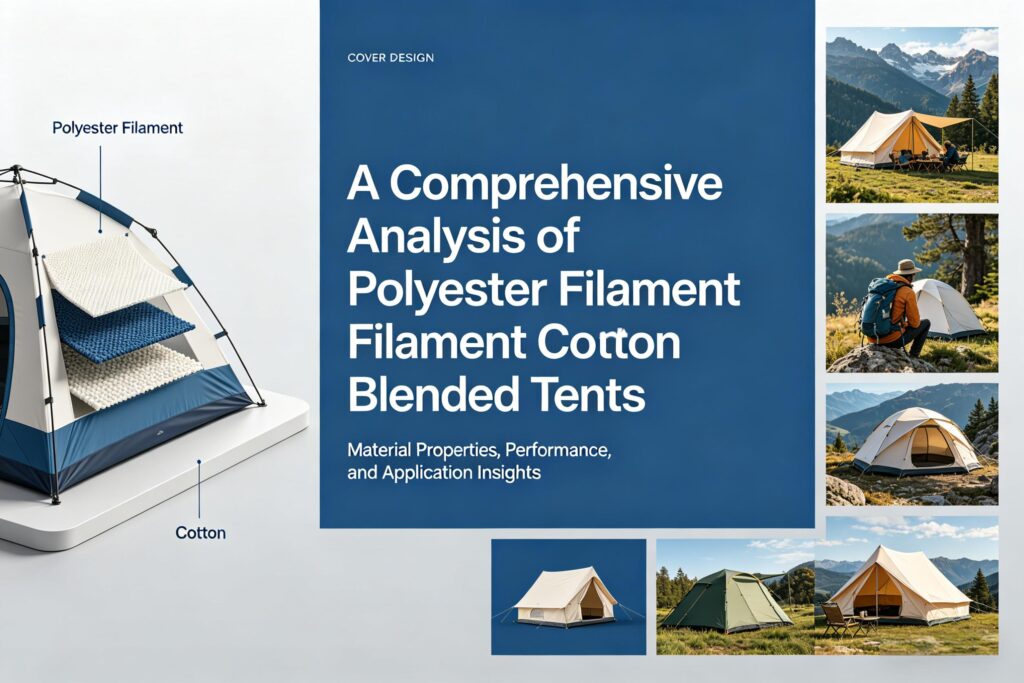
A Note on Terminology: “Polyester Filament Cotton” refers to a woven fabric where the warp yarns are continuous polyester filament (like FDY – Fully Drawn Yarn) and the weft yarns are spun cotton staple fibers. This construction is key to its unique properties.
2. Deconstructing the Material: The Science of the Blend
Understanding the blend requires examining its components:
- Polyester Filament (Warp): Provides high tensile strength, incredible abrasion resistance, and minimal stretch. It forms the durable, stable skeleton of the fabric. As a hydrophobic fiber, it naturally resists water absorption.
- Cotton (Weft): Contributes breathability, a soft, natural hand feel, and high moisture vapor transmission. It is hydrophilic, absorbing moisture but also providing comfort.
- The Synergy: The polyester warp carries the structural load and provides weather protection, while the cotton weft manages microclimate comfort. When treated with a durable water repellent (DWR) and often a urethane coating, the cotton’s voids are filled, creating a highly water-resistant yet breathable matrix.
3. Section 1: The Advantages – Performance Under Pressure
3.1. Unmatched Strength and Durability
Polyester filament boasts a tensile strength approximately 2-3 times greater than cotton of the same denier. In a blend, this translates to a fabric highly resistant to tearing from wind stress, abrasion from poles and guylines, and general wear and tear. Tents made from quality poly-cotton (e.g., 65% polyester/35% cotton) can last 15-20 years or more with proper care, far exceeding the lifespan of standard polyester taffeta tents.
3.2. Superior Dimensional Stability and Low Shrinkage
A major flaw of traditional cotton canvas is its propensity to shrink dramatically when wet (up to 10-15%), putting immense stress on seams and frames. Polyester filament has negligible shrinkage (<1-3%). In the blend, the polyester warp locks the fabric dimensions, reducing overall wet shrinkage to a manageable 2-4%. This means the tent maintains its taut pitch and structural integrity even after heavy rain.
3.3. Enhanced Water Resistance and Quick-Drying Performance
While 100% cotton must swell to become waterproof, the poly-cotton blend relies on its factory-applied coating. The hydrophobic polyester fibers prevent the fabric from becoming water-logged. After a rain, a poly-cotton tent will dry significantly faster than a pure canvas tent because the polyester does not hold water, reducing the risk of mildew.
3.4. Excellent Resistance to Mildew, Rot, and UV Degradation
Polyester is inherently resistant to biological attack. This protects the more vulnerable cotton component within the blend. Furthermore, polyester has superior resistance to ultraviolet radiation, which causes cotton fibers to become brittle and weak. A poly-cotton fabric will retain its strength and color far longer under sun exposure than pure cotton.
3.5. Aesthetic Versatility and Printability
The blend offers a premium, matte, and natural appearance favored in the safari, glamping, and boutique festival markets. The cotton face provides an excellent substrate for high-quality prints and branding, offering aesthetic advantages over slick synthetic fabrics.
4. Section 2: The Drawbacks and Considerations
4.1. The Weight and Packability Trade-off
This is the most significant disadvantage. A typical poly-cotton fabric (e.g., 260gsm) is 2 to 3 times heavier than a standard nylon or polyester tent fabric of equivalent strength. Packed volume is also larger. This makes it unsuitable for backpacking and severely limits its use in markets where weight is a primary concern.
4.2. Breathability and Condensation Management
While more breathable than a fully coated synthetic, a well-coated poly-cotton is less breathable than untreated canvas. In cold, humid conditions, condensation can form on the interior. Proper ventilation design in the tent is non-negotiable. Its condensation performance sits between that of a single-wall synthetic tent and a traditional canvas tent.
4.3. Long-Term Waterproofing Maintenance
The water resistance is entirely dependent on the factory coating (usually polyurethane or acrylic). This coating will degrade with UV exposure and abrasion over 3-7 years, requiring recoating to maintain full waterproof integrity—an additional cost and maintenance step not required for inherently waterproof materials like silicone-coated nylon.
4.4. Environmental Perception and Cost Analysis
- Perception: It uses less petroleum-based polyester than a 100% synthetic tent but more than pure organic cotton. Its long lifespan is an environmental positive, but the coating processes and end-of-life recyclability are challenges.
- Cost: The fabric and resulting tent carry a substantial price premium, often 50-150% more than a comparable-sized standard polyester tent. This positions it firmly in the premium market segment.
5. Section 3: Data-Driven Decision Making
Table 1: Tent Fabric Performance Matrix
| Performance Criteria | Poly-Cotton Blend (65/35) | Standard Polyester Taffeta (190T) | Silicone-Coated Nylon (30D) | Traditional Cotton Canvas |
|---|---|---|---|---|
| Weight (gsm) | 240 – 300 | 70 – 100 | 40 – 60 | 300 – 400 |
| Tear Strength | Excellent | Good | Very Good | Good (when dry) |
| Abrasion Resistance | Excellent | Good | Fair | Very Good |
| Hydrostatic Head (mm) | 1500 – 3000+ | 2000 – 5000 | 3000 – 5000+ | Relies on swell |
| Breathability (MVTR) | Moderate | Low | Low-Moderate | High (uncoated) |
| UV Resistance | Very Good | Excellent | Good | Poor |
| Wet Shrinkage | Low (2-4%) | Very Low (<1%) | Very Low (<1%) | Very High (10%+) |
| Packability | Poor | Good | Excellent | Very Poor |
| Typical Lifespan | 15-20+ years | 5-10 years | 10-15 years | 10-15 years (with care) |
Key Specifications:
- Blend Ratio: Common ratios are 65/35 and 50/50 (polyester/cotton). Higher polyester increases strength and water resistance; higher cotton increases breathability and hand feel.
- Fabric Weight: Ranges from 210gsm (lighter) to 340gsm (expedition weight). Heavier weights offer more durability and weather resistance.
- Weave: Typically a tight plain or twill weave. Thread count impacts strength, hand, and coating adhesion.
6. Section 4: Sourcing and Manufacturing Insights
- QC Checkpoints: Sourcing managers should verify: blend ratio consistency, coating uniformity (no pinholes), tear strength tests, and colorfastness. The quality of the polyester filament (e.g., high-tenacity) is critical.
- Finishes: A DWR (Durable Water Repellent) finish on the outer face causes water to bead and roll off. The PU (Polyurethane) coating on the fabric underside provides the primary waterproof barrier. Flame-retardant finishes are often required for commercial/event tents.
- Future Trends: Look for blends using recycled polyester filament and BCI (Better Cotton), and advancements in PFC-free DWR and more durable, eco-friendly waterproof coatings.
7. Conclusion: Strategic Recommendations
The polyester filament cotton blend is not a universal solution, but a premium, strategic choice for specific applications.
Choose Poly-Cotton When:
- Your market is premium camping, glamping, safari, or boutique festivals.
- Long-term durability and a classic aesthetic are primary selling points.
- The application is for semi-permanent base camps, family campsites, or event structures where weight is secondary to comfort and longevity.
- Your brand story values material heritage and perceived natural quality.
Avoid or Look Elsewhere When:
- Minimal weight and packed volume are the top priorities (e.g., backpacking, bikepacking).
- You are targeting the entry-level or budget-conscious market.
- The product requires maximum breathability in consistently cold/humid environments without active ventilation.
For the procurement professional, success lies in matching this fabric’s specific, high-performance profile to a product line that can leverage its strengths and justify its cost. By understanding its true advantages and inherent compromises, you can make confident sourcing decisions that lead to successful, differentiated products in the global outdoor and shelter marketplace.
