
Table of Contents
- Introduction: Why Accurate Fabric Identification is a Core Business Skill
- Fundamental Differences: The Natural vs. Synthetic Divide
- Method 1: The Burn Test – The Definitive Field Technique
- Method 2: Microscopic & Structural Analysis
- Method 3: Performance-Based Identification
- Method 4: Chemical and Solubility Tests
- Practical Application Scenarios for Industry Professionals
- Conclusion: Building a Reliable Identification Protocol
1. Introduction: Why Accurate Fabric Identification is a Core Business Skill
For textile sourcing managers, fabric developers, and quality control specialists, the ability to quickly and accurately distinguish between cotton and polyester filament fabric is not merely academic—it is a fundamental, practical skill with direct financial implications. In a global supply chain where material substitution, labeling errors, and supplier misrepresentation can occur, confidently identifying the base fiber of a fabric is the first line of defense for protecting product quality, cost, and brand reputation.
A mistake in identification can lead to a cascade of problems: a garment that shrinks unexpectedly, upholstery that pills prematurely, or industrial fabric that fails under stress. This guide provides a comprehensive, multi-method framework for professionals to verify fabric composition. We will explore techniques ranging from simple, on-the-spot tests to advanced laboratory methods, supported by technical data to ensure you can make informed decisions from the mill floor to the final inspection.
2. Fundamental Differences: The Natural vs. Synthetic Divide
Understanding the inherent properties of each fiber provides the context for all identification methods. These differences stem from their very origins.
Cotton: A natural cellulosic seed fiber. Its polymer is cellulose, a long-chain carbohydrate. Under a microscope, it resembles a flattened, twisted ribbon with a natural lumen (central canal). It is hydrophilic, meaning it has a strong affinity for water, leading to high moisture absorbency (around 8% moisture regain at standard conditions). Cotton is derived from an agricultural crop.
Polyester Filament Fabric: Made from synthetic, continuous filaments (most commonly Polyethylene Terephthalate, or PET). The filaments are produced by forcing molten polymer through a spinneret, creating smooth, rod-like fibers of consistent diameter. It is hydrophobic, meaning it repels water, resulting in very low moisture absorbency (about 0.4% regain). Polyester is a product of the petrochemical industry.
This core dichotomy—natural, absorbent, and irregular vs. synthetic, water-resistant, and uniform—is the key to unlocking every identification technique that follows.
3. Method 1: The Burn Test – The Definitive Field Technique
The burn test is the most reliable and widely used quick-identification method. It requires only a small swatch, a flame source, and careful observation. Always conduct this test in a well-ventilated, safe area with water nearby.
Procedure:
- Pull a few yarns from the fabric’s warp or weft.
- Hold them with tweezers over a non-flammable surface.
- Carefully bring a small flame (lighter, match) to the edge of the yarns.
- Observe the behavior in the flame, the odor, and the residue.
Interpretation:
| Observation | Cotton (Cellulosic Fiber) | Polyester Filament (Synthetic Fiber) |
|---|---|---|
| Approach to Flame | Ignites quickly and burns rapidly. | Melts first, then shrinks away from flame before igniting. |
| In Flame | Burns with a quick, yellow flame. Burns freely. | Burns with a slow, sputtering, smoky (sooty) yellow-orange flame. |
| Odor After Removal | Distinct smell of burning paper or wood. | Sharp, chemical, sweet or fruity odor, often compared to vinegar or burning plastic. |
| Residue/Ash | Light, feathery, gray ash that crumbles easily. | Hard, black, round bead that cannot be crushed easily. It may be slightly tacky when hot. |
| Self-Extinguishing? | No. Continues to glow after flame is removed. | Often self-extinguishes when removed from the flame. |
Why It Works: The burn test analyzes the thermal decomposition products of the polymer. Cotton (cellulose) decomposes to levoglucosan and other volatile compounds that smell like paper. Polyester (PET) undergoes ester pyrolysis, producing acetaldehyde and other compounds that create its characteristic sweet smell. The bead forms because the polyester melts before burning.
4. Method 2: Microscopic & Structural Analysis
Visual and microscopic examination reveals the inherent physical structure of the fibers.
Macroscopic/Hand Feel:
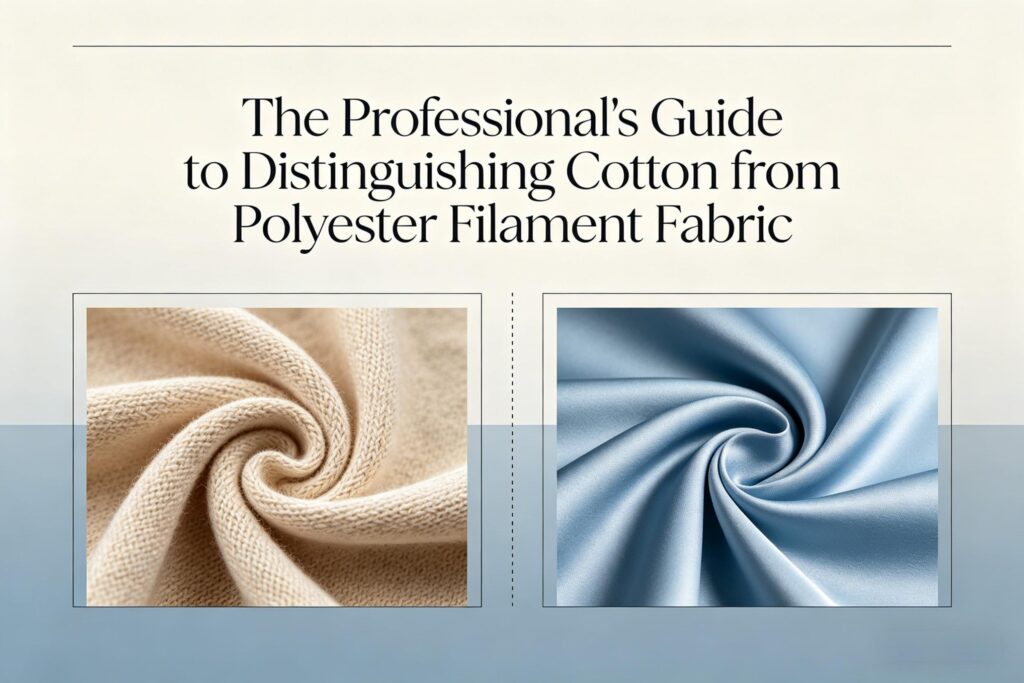
- Cotton Fabric: Has a matte, soft, sometimes slightly fuzzy surface. It wrinkles easily and feels cool to the touch. When crumpled in the hand, it may not spring back immediately.
- Polyester Filament Fabric: Has a smooth, often shiny or sleek surface. It feels slightly “slippery” or crisp. It is highly wrinkle-resistant and springs back quickly when crumpled.
Microscopic View (100-400x magnification):
- Cotton: Appears as a flattened, twisted ribbon with frequent convolutions. The lumen may be visible. The fiber diameter is irregular along its length.
- Polyester Filament: Appears as a smooth, straight, rod-like cylinder with no markings. The diameter is perfectly consistent along its entire length. In cross-section, it is usually round, but can be engineered into trilobal, octagonal, or other shapes for specific luster and feel.
5. Method 3: Performance-Based Identification
Leveraging the fundamental property differences, simple performance tests can provide strong indicators.
The Water Drop Test:
- Procedure: Place a small drop of water on a flat, clean section of the fabric. Observe for 10-15 seconds.
- Cotton Result: The water droplet will immediately be absorbed, spreading into the fabric. The spot will feel wet and cool.
- Polyester Result: The water droplet will bead up and sit on the surface of the fabric. It may roll off if the fabric is tilted. The spot underneath will feel dry.
Drying Rate & Wrinkle Recovery:
- Drying: A wet cotton swatch will take significantly longer to air-dry than a polyester swatch.
- Wrinkle Test: Crumple a swatch tightly in your fist for 30 seconds, then release.
- Cotton: Will remain heavily wrinkled.
- Polyester: Will show wrinkles but will recover significantly, appearing much smoother.
6. Method 4: Chemical and Solubility Tests
For laboratory-grade confirmation, chemical tests offer definitive results. (Caution: These require proper lab safety protocols, including gloves, goggles, and fume control.)
The Sulfuric Acid (H₂SO₄) Test:
Cotton (cellulose) is soluble in 70% concentrated sulfuric acid. Polyester is resistant.
- Place a few fibers in a small test tube.
- Add a few drops of 70% sulfuric acid.
- Cotton: Will dissolve/disintegrate within a few minutes.
- Polyester: Will remain intact, unaffected.
The Phenol Test:
Polyester (PET) has a specific reaction with phenol (carbolic acid).
- Place fibers in a test tube and cover with molten phenol.
- Heat gently in a water bath for 5-10 minutes.
- Polyester: The fibers will swell and partially dissolve.
- Cotton: Will be unaffected.
7. Practical Application Scenarios for Industry Professionals
- Sourcing Manager at a Garment Factory: Receives a “100% Cotton Poplin” roll from a new supplier. Before cutting 10,000 units, perform a quick burn test on a selvage thread. The smell of burning plastic and a hard bead immediately flags a potential polyester blend, preventing a costly production error.
- Procurement Agent for a Carpet Mill: Evaluating two seemingly identical velour samples for contract upholstery at different price points. A microscopic analysis can confirm if the luxurious “cotton-like” hand is truly from fine cotton fibers or from a high-quality, micro-denier polyester filament engineered to mimic it, explaining the price difference.
- Quality Auditor for a Plush Toy Brand: Verifying that the outer fabric of a premium toy meets the safety and feel specifications. A combination of hand feel (softness vs. slickness) and the water drop test (for drool absorption) can quickly differentiate between a cotton velour and a polyester velour, ensuring the product meets its intended use.
8. Conclusion: Building a Reliable Identification Protocol
No single test should be used in isolation, especially when high-value contracts are at stake. The most robust approach is a sequential protocol:
- Start with Non-Destructive Tests: Begin with hand feel and the water drop test. These provide instant clues without damaging the material.
- Apply the Burn Test: For a conclusive field result, the burn test is your most powerful tool. Its combination of visual, olfactory, and tactile evidence is highly reliable.
- Seek Definitive Laboratory Confirmation: When absolute certainty is required (e.g., for legal disputes, certification, or high-stakes sourcing), submit samples for microscopic analysis or standardized chemical testing (like AATCC Test Method 20). Reputable third-party labs can provide a certified fiber content analysis.
By integrating these methods into your quality assurance and sourcing workflows, you transform fabric identification from a guess into a science. This knowledge protects your business from fraud, ensures your products perform as promised, and builds a foundation of trust and expertise in the complex global textile market. Remember, in textiles, what you see and feel is important, but knowing why it behaves that way is the mark of a true professional.
