
Table of Contents
- Introduction: Understanding the “Non-Woven + Yarn” Paradigm
- Core Concepts: What Non-Wovens Are (and Are Not)
- The Fusion Technologies: Methods for Integrating Yarn with Non-Wovens
- Strategic Applications: Where and Why to Use Yarn-Reinforced Non-Wovens
- Sourcing and Specification: A Guide for Industrial Buyers
- Conclusion: Future Trends and Strategic Recommendations
1. Introduction: Understanding the “Non-Woven + Yarn” Paradigm
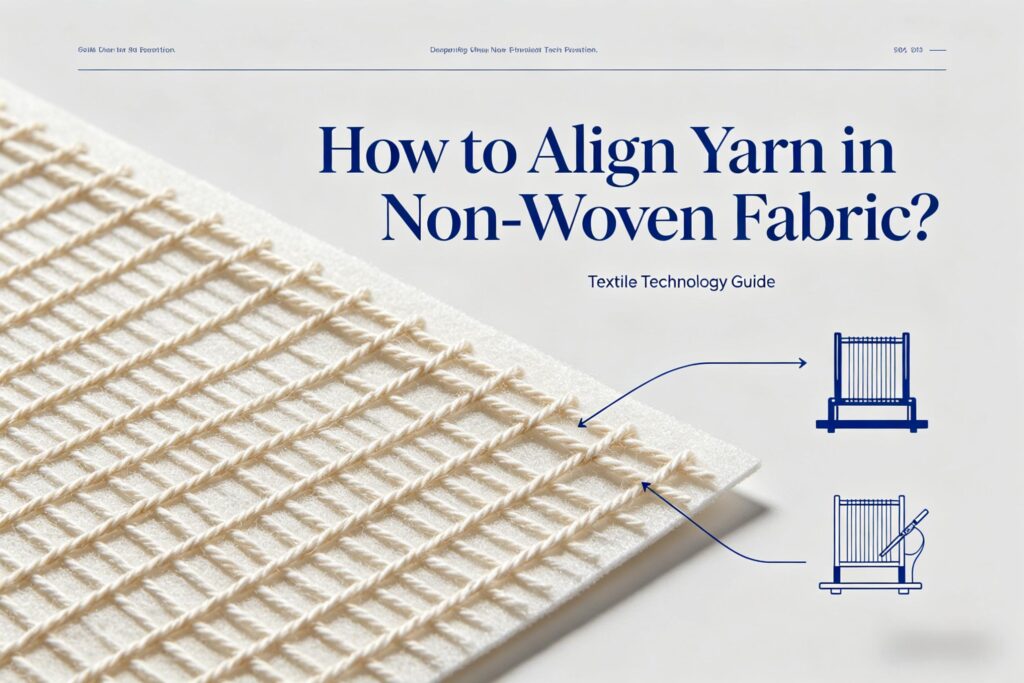
For procurement managers and technical directors across textiles, the term “How to align yarn in non-woven fabric” might initially seem like a contradiction. Traditional non-woven fabrics are, by definition, not woven or knitted; they are webs of fibers bonded together without a conventional yarn-based structure. However, this question opens the door to one of the most innovative and functional areas in modern textile engineering: the creation of composite materials that combine the efficiency of non-wovens with the directional strength and functionality of yarns.
This integration is not about “threading a needle” through a non-woven but about strategically embedding, laminating, or stitching yarns to create superior fabrics. This guide will explore the methods, applications, and commercial rationale behind these advanced textiles, providing the insights needed to source and specify materials that offer enhanced performance for apparel, home goods, technical textiles, and more.
2. Core Concepts: What Non-Wovens Are (and Are Not)
To understand the integration, we must first define the base materials.
- Non-Woven Fabrics: These are engineered sheets or webs made directly from fibers (or filaments) that are bonded together through mechanical (needle-punching), thermal (melting), or chemical means. They are typically isotropic (having uniform properties in all directions) and are prized for their high-speed, cost-effective production, filtration capabilities, and specific functionalities like absorbency or barrier properties.
- Yarns: These are continuous strands of fibers (natural or synthetic) twisted or spun together, providing tensile strength, elongation, and directional properties.
The challenge and opportunity lie in merging these two worlds: adding the anisotropic, high-strength characteristics of yarns to the versatile, web-like structure of non-wovens.
3. The Fusion Technologies: Methods for Integrating Yarn with Non-Wovens
Several industrial processes are used to combine yarns with non-woven substrates. The choice depends on the desired performance, cost, and end-use.
3.1. Stitch-Bonding (Maliwatt, Mali, Arachne)
This is perhaps the most direct method of “aligning” yarn with a non-woven.
- Process: A non-woven web is fed into a modified warp knitting machine. Yarns (typically fine polyester or polyamide) are used on the knitting elements to stitch through the web, binding it together. The yarns can be laid in a straight 0° orientation (warp direction) or formed into tricot or chain stitches.
- Result: Creates a dimensionally stable, fabric-like material. The yarn provides the primary tensile strength, while the non-woven web provides bulk, cover, and other functional properties.
- Key Metrics: Stitch density (stitches per cm), yarn type and denier.
3.2. Composite Lamination (Hot Melt, Adhesive, Ultrasonic Bonding)
This method creates a layered structure.
- Process: A layer of oriented yarns (unidirectional, bidirectional, or a woven/knitted fabric) is laminated to one or both sides of a non-woven web. Bonding is achieved through heat-activated films, adhesive sprays, or ultrasonic welding.
- Result: A true composite where the yarn layer handles tensile and shear forces, and the non-woven layer provides cushioning, filtration, or a cosmetic surface. Common in automotive interiors, geo-textiles, and premium luggage.
- Key Metrics: Adhesive peel strength (N/in), lamination temperature/pressure.
3.3. Direct Incorporation During Web Formation
This method integrates yarn during the non-woven manufacturing process itself.
- Process: In processes like spunbond or wet-laid, continuous filament yarns can be laid down onto the moving fiber web before the bonding stage (thermal or chemical). The yarns become embedded and bonded within the final sheet.
- Result: Excellent integration and a unified structure. Often used to create reinforced substrates where the yarns act as a skeleton, such as in coated fabrics or flexible composites.
- Key Metrics: Yarn spacing, web consolidation strength.
3.4. Needle-Punching with Yarn Inlay
A specialized form of needle-punching.
- Process: Yarns are placed in a specific orientation (usually 0° and 90°) between two lightweight non-woven webs. The assembly is then needle-punched, whereby barbed needles punch thousands of fibers from the top and bottom webs through the yarn layer, mechanically entangling everything into a single, coherent fabric.
- Result: A heavy, dense, and incredibly strong fabric, iconic in products like synthetic leather substrates, heavy-duty felts, and industrial filtration media.
- Key Metrics: Punch density (punches/cm²), yarn areal weight (g/m²).
Comparative Analysis of Integration Methods
| Technology | Typical Yarn Used | Bonding Mechanism | Primary Fabric Characteristics | Common Industry Applications |
|---|---|---|---|---|
| Stitch-Bonding | Fine filament (e.g., 50-100 Denier PES) | Mechanical (Knitting) | Stable, drapeable, fabric-like. Anisotropic strength. | Shoe linings, interlinings, mattress tickings, wall coverings. |
| Composite Lamination | Multifilament, UD tapes, Woven cloths | Thermal/Adhesive | Layered, high strength-to-weight, customizable. | Automotive headliners, luggage, protective gear, geo-composites. |
| Direct Incorporation | Continuous filament tows | Thermal/Chemical (from web) | Unified, excellent yarn embedment, good for coating. | Reinforced substrates for tarps, banners, flexible tanks. |
| Needle-Punch w/ Inlay | Staple or heavy filament yarns | Mechanical (Fiber Entanglement) | Very dense, heavy, high bulk, excellent durability. | Synthetic leather, industrial felts, piano hammer felt, filtration. |
4. Strategic Applications: Where and Why to Use Yarn-Reinforced Non-Wovens
The decision to use these composites is driven by performance and cost-benefit analysis.
- Apparel & Fashion:
- Use Case: Reinforced interlinings, structured collar components, insulating quilted layers.
- Why: Stitch-bonded or laminated composites provide shape memory and durability without the bulk of a traditional woven, improving garment drape and reducing labor in fusible applications.
- Home Textiles & Upholstery:
- Use Case: High-performance mattress tickings, durable upholstery backings, decorative wall fabrics.
- Why: The yarn reinforcement provides the necessary tensile strength and tear resistance for furniture applications, while the non-woven base offers consistency, cost control, and noise reduction.
- Technical & Industrial Textiles (The Largest Segment):
- Use Case: Geotextiles for soil stabilization, filtration media for baghouses, synthetic leather substrates, automotive interiors (trunk liners, parcel shelves).
- Why: This is where the synergy is most powerful. For example, in a needle-punched geo-textile with yarn inlay, the non-woven provides filtration and separation, while the yarn grid provides the critical tensile modulus to reinforce slopes and embankments. Data shows such composites can achieve multi-axial tensile strengths exceeding 50 kN/m, a performance unattainable by standard non-wovens.
- Carpet & Flooring:
- Use Case: Secondary backings, pre-needle punched primary backings for tufted carpets.
- Why: Yarn-reinforced non-woven backings provide dimensional stability, preventing carpet buckling and delamination, which is critical for contract installations.
5. Sourcing and Specification: A Guide for Industrial Buyers
When sourcing these advanced materials, your technical data sheet (TDS) must be exceptionally detailed.
- Define the Core Need: Start with the required function: Is it tensile reinforcement, shape stability, surface effect, or a combination?
- Specify the Construction:
- Base Non-Woven: Fiber type (PP, PES, etc.), weight (gsm), bonding type.
- Yarn Component: Material, denier/filament count, orientation (UD, cross-laid, etc.), and spacing.
- Integration Method: Stitch-bond, laminate, needle-punch.
- Require Performance Data: Insist on test reports for:
- Tensile Strength (MD & CD): ASTM D5034 or ISO 13934.
- Tear Strength: ASTM D5734 or ISO 13937.
- Peel/Bond Strength (for laminates): ASTM D2724.
- Dimensional Stability: After washing or heat exposure.
- Partner with Specialists: These are not commodity items. Work with converters and manufacturers who have expertise in composite textiles and can provide prototyping and technical support.
6. Conclusion: Future Trends and Strategic Recommendations
The fusion of yarn and non-woven technology represents the future of engineered textiles. Trends point towards increased use of recycled content in both the non-woven web and the reinforcement yarns, driven by circular economy mandates. Furthermore, integration with smart yarns (conductive, phase-change) will create non-woven composites with sensing and adaptive thermal properties.
Strategic Recommendations for Buyers:
- Reframe the Question: Move from “how to align” to “how to engineer.” Identify the precise weakness in a standard non-woven that a yarn component can solve.
- Think in Layers: Consider the composite as a system where each layer has a dedicated function (strength, cushioning, barrier, surface).
- Invest in Testing: Never finalize a material based on a data sheet alone. Conduct in-house or third-party performance tests under conditions that simulate real-world use.
- Engage Early: Involve potential suppliers in the product development phase. Their expertise in composite structures can lead to more efficient and cost-effective solutions.
