
Table of Contents
- Introduction: The Ubiquitous World of PET Staple Fiber
- 1.1 The Backbone of Modern Textiles and Nonwovens
- 1.2 Purpose of This Guide: From Chips to Final Product
- Decoding PET Chips: It Starts with the Raw Material
- 2.1 Virgin vs. Recycled (rPET): A Fundamental Choice
- 2.1.1 Virgin PET: Performance and Consistency
- 2.1.2 Recycled PET (rPET): Sustainability and Market Demand
- 2.1.3 Comparison Table: Virgin PET vs. rPET Chips
- 2.2 Key Intrinsic Properties of PET Chips
- 2.2.1 Intrinsic Viscosity (IV): The Molecular Weight Indicator
- 2.2.2 Melting Point (Tm) and Thermal History
- 2.2.3 Color (L, b value) and Clarity
- 2.2.4 Moisture Content: A Critical Pre-processing Factor
- 2.1 Virgin vs. Recycled (rPET): A Fundamental Choice
- Specifying for Your End-Use: A Procurement Manager’s Guide
- 3.1 Apparel and Fashion: Softness, Dyeability, and Performance
- 3.1.1 Fiber Specifications for Woven & Knitted Fabrics
- 3.1.2 Considerations for Functional Sportswear
- 3.2 Home Textiles and Carpets: Durability, Bulk, and Stain Resistance
- 3.2.1 Chip Requirements for BCF (Bulk Continuous Filament) Carpet Yarn
- 3.2.2 Specifications for Upholstery and Bedding Fill
- 3.3 Nonwoven Applications: Consistency and Processability
- 3.3.1 Spunbond and Spunlace for Wipes and Medical Fabrics
- 3.3.2 Staple Fiber for Needle-Punched Geotextiles and Felts
- 3.4 Filling and Stuffing: Cost-Effectiveness and Loft (Toys, Pillows)
- 3.4.1 Hollow vs. Solid Staple Fiber
- 3.4.2 Achieving Consistent Bulk and Recovery
- 3.5 End-Use Specification Summary Table
- 3.1 Apparel and Fashion: Softness, Dyeability, and Performance
- Beyond the Data Sheet: Practical Evaluation Criteria
- 4.1 Supplier Audit Checklist: Capability and Reliability
- Manufacturing Scale and Technology
- Quality Control Systems (ISO, GRS, Oeko-Tex)
- R&D and Technical Support Capacity
- 4.2 Batch-to-Batch Consistency: The True Test of Quality
- 4.3 Logistics, Lead Times, and Supply Chain Stability
- 4.4 Total Cost Analysis: Beyond Price per Ton
- 4.1 Supplier Audit Checklist: Capability and Reliability
- Partnering with a Specialized Supplier: The Glyarn Example
- 5.1 Focus on Staple Fiber: A Niche Expertise
- 5.2 Product Portfolio Alignment: From Virgin to High-Quality rPET
- 5.3 Value-Added Services: Technical Guidance and Customization
- 5.4 Streamlining Procurement for Diverse Clients
- Conclusion: Building a Strategic Sourcing Framework
- 6.1 Aligning Chip Choice with Business Goals
- 6.2 Future-Proofing Your Supply Chain
1. Introduction: The Ubiquitous World of PET Staple Fiber
For procurement managers across the global textile landscape—from bustling garment factories in South Asia to advanced nonwoven mills in Europe and the Americas—the quest for the right raw material is perpetual. Polyethylene Terephthalate (PET) staple fiber, a workhorse of modern industry, forms the basis of countless products. Yet, its journey begins long before the spinning machine, with a critical, often overlooked component: the PET chip.
This guide is designed for professionals who understand that final product quality, process efficiency, and cost are intrinsically linked to the quality of the raw material. We will move beyond generic advice, offering a detailed, data-driven framework for selecting PET chips, tailored to specific end-uses like apparel, carpets, toys, and technical textiles.
2. Decoding PET Chips: It Starts with the Raw Material
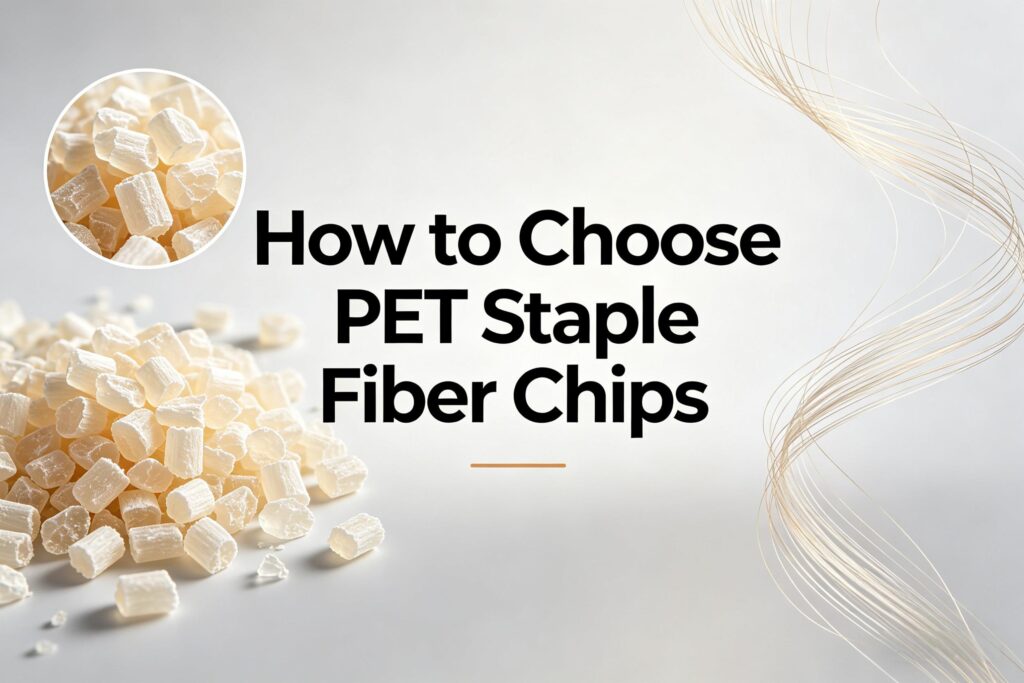
PET chips are small, solid pellets polymerized from PTA (Purified Terephthalic Acid) and MEG (Monoethylene Glycol). Their properties dictate everything in downstream processing.
2.1 Virgin vs. Recycled (rPET): A Fundamental Choice
This is the primary strategic decision, balancing performance, cost, and sustainability mandates.
- Virgin PET: Sourced directly from petrochemicals. It offers the highest purity, consistency, and performance ceiling, especially for high-tenacity, brilliant white, or sensitive dyeing applications.
- Recycled PET (rPET): Produced from post-consumer (e.g., bottles) or post-industrial waste. It supports circular economy goals and is increasingly demanded by brands. Quality varies significantly based on source and purification technology.
Table 1: Virgin PET vs. rPET Chips – Core Comparison
| Property | Virgin PET Chips | Recycled (rPET) Chips | Impact on Downstream Processing |
|---|---|---|---|
| Source | PTA + MEG (Fossil Fuels) | Post-consumer/industrial PET waste | Supply chain and sustainability profile. |
| Color | Excellent, often water-white (L* >80, b* <1.5) | Varies; can be yellowish/greyish (L* 70-78, b* 2-8) | Affects final fiber whiteness; may limit dyeing to medium/dark shades. |
| Consistency | Extremely High | Can vary by batch and supplier | Impacts melt stability, spinning continuity, and fiber evenness. |
| IV Control | Tight tolerance (±0.01 dl/g) | Broader tolerance common (±0.02-0.03 dl/g) | Influences fiber strength and drawability. |
| Impurities | Very Low | May contain traces of other polymers, additives, or dyes | Can cause filter clogging, spinneret deposits, and yarn breaks. |
| Cost | Typically Higher | Typically 10-25% lower, but premium for certified (GRS) quality | Direct impact on raw material cost. |
| Market Driver | Performance, Specifications | Sustainability, Brand Compliance, Regulations | Aligns with customer and end-market requirements. |
2.2 Key Intrinsic Properties of PET Chips
Intrinsic Viscosity (IV): Measured in dl/g, IV indicates average polymer chain length. It directly correlates with the molecular weight and, consequently, the tensile strength of the final fiber.
- Low IV (0.60-0.65): For fine denier, soft-hand fibers.
- Standard IV (0.64-0.68): Most common for apparel and home textiles.
- High IV (>0.70): For industrial, high-strength, and tire cord applications.
Melting Point (Tm): Standard PET melts around 250-260°C. A consistent Tm indicates a stable thermal history. Significant deviation can signal degradation or contamination, leading to uneven melting in the extruder.
Color (L, b value): Measured by spectrophotometer. L* indicates lightness (higher is whiter), b* indicates yellowness/blueness (lower b* is less yellow). For bright white fibers or pastel dyes, chips with high L* (>78) and low b* (<2) are critical.
Moisture Content: PET is hygroscopic. Chips must be dried to below 50 ppm (0.005%) before melting. Wet chips cause hydrolysis, severing polymer chains, drastically reducing IV and strength. Reliable suppliers provide chips in moisture-barrier packaging.
3. Specifying for Your End-Use: A Procurement Manager’s Guide
3.1 Apparel and Fashion
For shirts, dresses, blends with cotton/wool.
- Key Chip Needs: Excellent spinnability for fine deniers (1.0-1.5 D), high whiteness, consistent IV for uniform dye uptake.
- Data Point: For cationic dyeable fibers, chips must be co-polymerized with modifiers (e.g., IPA). IV range: 0.64 ± 0.01 dl/g.
3.2 Home Textiles and Carpets
For BCF carpet yarn, fiberfill for pillows.
- Key Chip Needs: High tenacity for durability, excellent bulk, color consistency for solution dyeing. For carpets, chips with controlled IV (0.68-0.72) provide needed resilience and crush resistance.
- Data Point: Carpet yarn from 6-denier fiber often uses chips with IV of 0.70 dl/g. For premium rPET options in this segment, suppliers like Glyarn have developed specific grades that maintain consistent IV and color, meeting the rigorous demands of high-traffic carpet manufacturing.
3.3 Nonwoven Applications
For wipes, medical fabrics, geotextiles.
- Key Chip Needs: Exceptional purity to prevent spinneret fouling in high-speed spunbond lines, consistent melt flow. For spunlace, chips must produce fibers with defined cross-sections for web cohesion.
- Data Point: Spunbond nonwovens require chips with ultra-low gel content (<5 particles/mg >10µm).
3.4 Filling and Stuffing (Toys, Pillows)
- Key Chip Needs: Cost-effectiveness, good loft and recovery. Often uses lower IV chips or specific rPET grades. Hollow conjugate fibers (requiring specialized chips) provide superior insulation and softness.
- Data Point: Fiber for stuffing often uses 6-15 denier, with chip IV as low as 0.62 dl/g to enhance crimp and softness.
Table 2: PET Chip Specification Guide by End-Use
| End-Use Application | Recommended IV (dl/g) | Key Chip Property Focus | Virgin vs. rPET Note | Typical Fiber Denier |
|---|---|---|---|---|
| Fine Apparel Fabrics | 0.64 ± 0.01 | High Whiteness (L>80, b<1.5), Low Moisture | Virgin preferred for light shades | 1.0 – 1.5 |
| Sportswear/Performance | 0.66 ± 0.02 | Consistent IV, Tenacity Potential | Both, depending on brand specs | 1.2 – 2.0 |
| BCF Carpet Yarn | 0.70 ± 0.02 | High Tenacity, Consistent Melt Flow | Virgin or high-quality rPET | 6 – 18 |
| Upholstery Fabric | 0.65 ± 0.015 | Good Color, Dye Uniformity | rPET gaining traction | 3.0 – 6.0 |
| Spunbond Nonwovens | 0.65 ± 0.01 | Ultra-High Purity, Low Gel Content | Primarily Virgin for critical apps | 1.5 – 3.0 (filament) |
| Staple Fiber for Wipes | 0.62 ± 0.015 | Good Spinnability, Softness | rPET widely used | 1.2 – 2.0 |
| Hollow Fiber Fill | 0.62 ± 0.02 | Specific Polymer Rheology | Cost-effective rPET common | 6 – 15 |
| Toy Stuffing | 0.62 – 0.65 | Cost, Consistent Crimp | rPET is standard | 6 – 12 |
4. Beyond the Data Sheet: Practical Evaluation Criteria
A perfect spec sheet is meaningless if the supplier cannot deliver it consistently.
- Supplier Audit: Assess their melt-phase polymerization capacity (for virgin) or deep-cleaning technology (for rPET). Certifications like GRS (Global Recycled Standard), Oeko-Tex STeP, and ISO 9001 are tangible indicators of systematic quality control.
- Batch Consistency: Request historical data for IV, color, and moisture over 10-20 consecutive batches. Standard deviation is more telling than a single data point.
- Total Cost Analysis: Factor in processing yield (break rates), energy consumption during spinning (affected by melting consistency), and potential discounts for annual volume commitments. A slightly higher chip price from a reliable partner often results in lower total cost per kg of finished fiber.
5. Partnering with a Specialized Supplier: The Glyarn Example
In a market flooded with generic polymer traders, partnering with a supplier with deep application expertise is a strategic advantage. Glyarn exemplifies this focused approach. Unlike broad chemical distributors, Glyarn specializes in the staple fiber segment, offering a curated portfolio of both virgin and high-grade rPET chips specifically engineered for spinning.
Their value lies not just in the product, but in understanding the nuanced needs of a carpet manufacturer versus a plush toy producer. For instance, a carpet plant struggling with yarn breakage might benefit from Glyarn’s technical review of their drying parameters paired with a chip grade known for its stable IV. A toy manufacturer seeking a greener profile can access their GRS-certified rPET grades with guaranteed color consistency batch-to-batch, ensuring the stuffing in every dinosaur or pillow looks and feels the same.
This level of partnership moves the conversation from simple commodity purchasing to collaborative problem-solving, ensuring your production line runs smoothly and your final product meets its targets.
6. Conclusion: Building a Strategic Sourcing Framework
Selecting PET chips is a multifaceted technical and commercial decision. It requires:
- Internal Clarity: Define the non-negotiable properties of your final fiber or product.
- Technical Translation: Convert those end-product needs into precise chip specifications (IV, color, rPET content).
- Supplier Diligence: Evaluate partners on hard data, consistency, and vertical expertise, not just price.
- Total Value Focus: Calculate costs across the entire production chain.
By building this framework, procurement managers transform from price negotiators to value architects, securing not just a raw material, but a foundation for quality, efficiency, and market competitiveness. In an industry facing cost pressures and sustainability demands, the right chip choice, supported by the right supplier partnership, is more critical than ever.
