
Table of Contents
- The Essential Question of Converting Denier to Length
- Why “Meters per Jin” Matters for Production Efficiency and Costing
- Target Audience: From Procurement to Production Planners
- Demystifying Denier (D): The Core Unit for Filament Yarns
- Technical Definition and Standard Measurement (grams per 9,000 meters)
- Why Denier is the Primary System for Polyester, Nylon, and Filaments
- Visualizing 630D: A Robust Yarn for Heavy-Duty Applications
- The Foundational Formula: Calculating Length from Weight and Denier
- Deriving the Universal Conversion Formula
- Step-by-Step Calculation for 630D Polyester Filament
- The “Golden Constant” in Denier Calculations
- Market-Specific Adaptation: Converting “Jin” to Standard Units
- Addressing the China-Specific Unit (“Jin” = 500g)
- The Two-Step Calculation for Global Procurement Professionals
- Why Direct Kg-Based Calculations Reduce Errors
- Comparative Data: Length-to-Weight Ratios of Key Industrial Yarns (Table)
- Table: Length per 500g and per 1kg for Common Denier Counts
- Practical Implications: From 70D to 1260D
- Strategic Sourcing Applications: When Length Calculation is Critical
- For Carpet Manufacturers: Calculating Pile Yarn Coverage and Tufting Requirements
- For Industrial Textile Producers: Sizing for Webbing, Straps, and Conveyor Belts
- For Tarpaulin & Awning Makers: Estimating Fabric Yield and Roll Planning
- For Plush Toy Makers: Managing Faux Fur Yarn for Large-Scale Production
- Beyond the Calculation: Factors That Affect Usable Length
- Impact of Yarn Twist (Turns Per Meter) on Effective Length
- Manufacturing Tolerances in Denier (±2-5% Industry Standard)
- Practical Wastage Allowances During Weaving, Knitting, or Tufting
- Case Study: Cost-Per-Meter Analysis for 630D Polyester Filament
- Scenario: Procuring a 5-Ton Order for Tarpaulin Production
- Converting Bulk Price ($/Ton) to Actionable $/Meter Metric
- Total Project Estimation: Integrating Length Data into Material Budgets
- Mastering Conversion as a Tool for Procurement Precision
- Key Takeaways for Supply Chain and Production Managers
- Integrating Technical Data into Commercial Decision-Making
- Frequently Asked Questions (FAQs)
The Strategic Guide to Converting Denier to Length: A Focus on 630D Polyester Filament
1. The Essential Question of Converting Denier to Length
For procurement managers and production planners across industries utilizing heavy-duty textiles, a question like “How many meters are in one jin of 630D polyester filament?” is far from trivial. It represents the critical intersection of raw material specification, production planning, and cost control. Accurately converting the yarn’s thickness (denier) into a usable length metric is fundamental for calculating material coverage, optimizing machine set-ups, preventing costly overruns or shortages, and ultimately, determining the true cost per finished product. This guide provides a comprehensive, technical, and practical framework for mastering this essential conversion, with a specific focus on the widely used 630D polyester filament and its applications in sectors such as carpet manufacturing, industrial textiles, and beyond.
2. Demystifying Denier (D): The Core Unit for Filament Yarns
Denier is a direct mass-per-length measurement system, predominantly used for synthetic filament yarns like polyester and nylon. Its formal definition is: the mass in grams of 9,000 meters of yarn. Unlike indirect count systems (like Ne or Nm), a higher denier number indicates a thicker, heavier yarn.
- Standard Reference: 1 Denier = 1 gram per 9,000 meters.
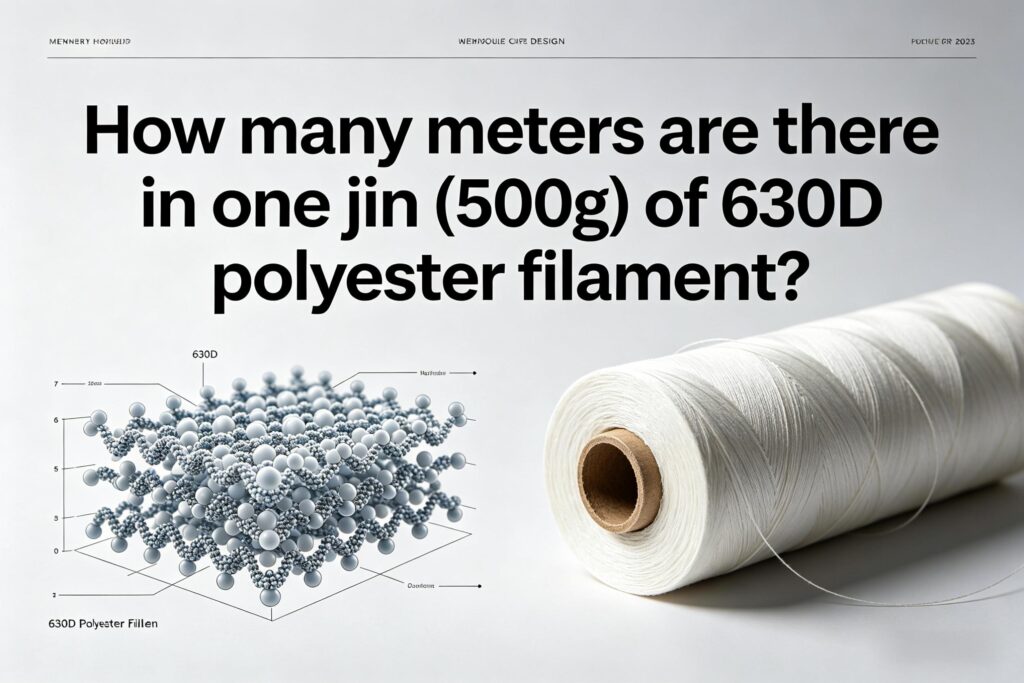
- Visualizing 630D: A 630D yarn is substantial. It signifies that 9,000 meters of this yarn weighs 630 grams. This places it in the category of medium-to-heavy industrial yarns, offering an excellent balance of strength, durability, and manageability. It is a workhorse in applications demanding resilience, such as backpack straps, heavy-duty luggage, industrial fabrics, and certain types of carpet backing or primary tufting.
3. The Foundational Formula: Calculating Length from Weight and Denier
The conversion is governed by a direct mathematical relationship derived from the denier definition.
- The Universal Formula:
Length (meters) = [Weight (grams) * 9,000] / Denier (D) - Step-by-Step Calculation for 630D:
To find the length in 1 gram of 630D yarn:- Length per gram = 9,000 meters / 630 Denier = 14.2857 meters per gram.
This “length per gram” factor is the key to all subsequent calculations.
- Length per gram = 9,000 meters / 630 Denier = 14.2857 meters per gram.
4. Market-Specific Adaptation: Converting “Jin” to Standard Units
The term “jin” (斤) is a traditional Chinese unit equal to 500 grams. For global professionals, clarity is achieved by converting to kilograms first.
- Two-Step Calculation for 1 Jin (500g):
- Length per gram (from above) = 14.2857 meters.
- Length for 500g = 14.2857 meters/gram * 500 grams = 7,142.85 meters.
- Standardized Approach (Recommended):
Working directly in grams or kilograms minimizes error. For 1 kilogram (1,000g):Length = (1,000g * 9,000) / 630D = 9,000,000 / 630 = **14,285.7 meters per kilogram.**
This kg-based figure is the most reliable benchmark for international trade and production planning.
5. Comparative Data: Length-to-Weight Ratios of Key Industrial Yarns
Understanding where 630D sits relative to other common deniers aids in material selection and substitution analysis.
Table: Length per Unit Weight for Standard Polyester Filament Deniers
| Denier (D) | Common Application | Length per 500g (1 Jin) | Length per 1 kg | Relative Thickness (vs. 630D) |
|---|---|---|---|---|
| 70D | Lightweight luggage, lining | ~64,285 meters | ~128,571 meters | ~9x finer |
| 210D | Mid-weight bags, tactical gear | ~21,428 meters | ~42,857 meters | ~3x finer |
| 420D | Robust backpacks, soft luggage | ~10,714 meters | ~21,428 meters | ~1.5x finer |
| 630D | Heavy-duty bags, industrial fabric, carpet | ~7,143 meters | ~14,286 meters | Benchmark |
| 840D | Premium luggage, heavy straps | ~5,357 meters | ~10,714 meters | ~1.33x thicker |
| 1000D | Extreme-duty gear, tool belts | ~4,500 meters | ~9,000 meters | ~1.6x thicker |
| 1260D | Heaviest industrial uses, webbing | ~3,571 meters | ~7,143 meters | ~2x thicker |
6. Strategic Sourcing Applications: When Length Calculation is Critical
- For Carpet Manufacturers: In tufted carpets, yarn consumption is calculated by pile weight per square meter. Knowing the length per kg of 630D backing yarn or specific pile yarns allows precise calculation of how many square meters a yarn lot will cover, directly impacting roll yields and cost per square meter.
- For Industrial Textile Producers (Webbing, Straps): Products are often sold by the meter. Calculating the meters per kilogram of 630D yarn is the first step in determining the raw material cost for each meter of finished webbing, essential for accurate pricing.
- For Tarpaulin & Awning Makers: Fabric yield (meters of fabric per kg of yarn) depends on the weave density (ends/picks per inch). The length calculation provides the maximum possible warp length from a given yarn weight, a critical input for loom planning and waste minimization.
- For Plush Toy Makers: While finer yarns are typical for fur, 630D may be used for supportive backing fabrics or heavy-duty toy components. Length calculations ensure efficient material allocation across production runs.
7. Beyond the Calculation: Factors That Affect Usable Length
The theoretical length is a perfect-lab-condition number. Real-world production must account for variances.
- Yarn Twist: Adding twist (e.g., for piled yarns like 630D/2) contracts the filaments, slightly reducing the delivered length per kilogram (by 1-4%, known as twist take-up).
- Manufacturing Tolerance: Denier specification has a standard tolerance, often ±2% to ±5%. A 630D yarn could practically be between 598.5D and 661.5D, altering the actual length per kg by a corresponding margin.
- Process Wastage: Weaving, warping, and tufting inevitably generate waste (unused cones, loom set-up ends, trial runs). Industry planning typically adds a 2-5% wastage factor to theoretical yarn requirements.
8. Case Study: Cost-Per-Meter Analysis for 630D Polyester Filament
Scenario: A tarpaulin manufacturer needs to price a large order. They source 630D polyester filament at $1.80 per kilogram.
- Step 1: Find Length per Kg. As calculated: 14,285.7 meters/kg.
- Step 2: Calculate Cost per Meter.
Cost per meter = Price per kg / Length per kg
= $1.80 / 14,285.7 meters ≈ $0.000126 per meter, or $0.126 per kilometer. - Step 3: Project Estimation. For a project requiring 50,000 kg of yarn:
Total yarn cost = 50,000 kg * $1.80/kg = $90,000.
Total theoretical yield = 50,000 kg * 14,285.7 m/kg = ~714,285,000 meters of yarn.
This granular data allows for precise fabric cost modeling and competitive bidding.
9. Mastering Conversion as a Tool for Procurement Precision
Converting “630D per jin” to meters is more than arithmetic; it is a fundamental competency for cost-effective and efficient manufacturing. By internalizing the formula Length = (Weight * 9000) / Denier and applying it within the context of real-world tolerances and wastage, procurement and production professionals transform a technical specification into a powerful tool for budgeting, sourcing, and production planning. This precision directly contributes to leaner operations, reduced material waste, and sharper, more competitive product costing.
10. Frequently Asked Questions (FAQs)
- Q: Is the formula the same for nylon filament?
A: Yes, absolutely. The denier system is fiber-agnostic. It measures linear density, so the formulaLength = (Weight * 9000) / Denierapplies identically to nylon, polyester, or any filament yarn specified in denier. - Q: How do I calculate for a 630D/2 ply yarn?
A: For a plied yarn, use the total denier. “630D/2” typically means two strands of approximately 315D yarn plied together to form a final yarn of about 630D. Therefore, the length calculation remains the same. The ply twist will cause a minor reduction (1-3%) in actual delivered length. - Q: My supplier quotes price per ton. How do I use that?
A: First, convert price per ton to price per kg (e.g., $2,000/MT = $2.00/kg). Then, use the formula with the kg price to find cost per meter, as shown in the Case Study. - Q: What’s the difference between Denier and Decitex (dtex)?
A: They are similar direct systems. Denier is grams per 9,000m; Decitex is grams per 10,000m. To convert: 1 Denier = 0.9 * Decitex. So, 630D = approximately 567 dtex. - Q: How does filament cross-section (round, trilobal) affect this?
A: Cross-section affects yarn properties like luster, cover, and hand feel, but not its linear density (denier). A 630D round and a 630D trilobal filament will have the same length per kilogram, but different volumes and appearances. - Q: Why is 630D a common specification?
A: It hits a sweet spot: high tensile strength (often 8-10+ grams/denier), good abrasion resistance, and manageable thickness for weaving, knitting, and tufting processes. It offers durability without being overly rigid or difficult to process. - Q: Can I use this for spun polyester yarn?
A: Spun yarns are typically measured in count systems (Ne, Nm). If a spun yarn’s equivalent denier is known or estimated, the formula can be applied, but denier is not the standard specification for spun yarns. - Q: What’s a quick mental estimate for meters per kg of 630D?
A: Remember that 900D gives 10,000 m/kg. Since 630D is finer, you’ll get more length. A good estimate is slightly over 14,000 m/kg. Precisely, it’s about 14,286 m/kg.
