
Article Outline
- The Apples and Oranges of Yarn Selection
- Beyond “Better”: Understanding the Inherently Different Worlds of T400 vs. T80
- The Core Question: Application Fit, Not Universal Superiority
2.Decoding the Nomenclature: The Fundamental Language of Linear Density
- “T” as Tex: The Universal Metric for Yarn Mass
- T400 Explained: 400 grams per 1,000 meters (≈3,600 Denier)
- T80 Explained: 80 grams per 1,000 meters (≈720 Denier)
- Table 1: Basic Specification Comparison at a Glance
3.Material Universe: Fiber Choices in Each Category
- T400’s Domain: Industrial Polymers (Nylon 6/6.6, High-Tenacity PET, Specialty Fibers)
- T80’s Domain: Textile & Apparel Fibers (Cotton, Polyester, Acrylic, Wool Blends, Filament Silks)
- The Performance Implications of Material Selection in Each Class
4.Manufacturing Processes: From Heavy-Duty Spinning to Fine Yarn Production
- T400 Production: High-Tenacity Filament Extrusion, Precision Drawing, and Industrial Plying
- T80 Production: Ring Spinning, Open-End Spinning, and Fine Count Processing
- Table 2: Manufacturing Process & Focus Comparison
5.Technical Performance Profile: A Side-by-Side Data Analysis
- Table 3: Performance Parameter Comparison: T400 vs. T80
- Breaking Strength & Tenacity: Orders of Magnitude Difference
- Abrasion Resistance and Durability
- Flexibility, Drape, and Hand Feel
- Moisture Management and Comfort Properties
6.Cost Structures and Economic Realities
- T400 Economics: Cost per Kilogram vs. Performance Density
- T80 Economics: Cost per Kilogram and the Importance of Fiber Content
- Analyzing Total Cost of Ownership for Different Applications
7.Application-Specific Analysis: Where Each Yarn Excels
- The Undisputed Realm of T400:
- Lifting & Rigging Slings
- Safety Harnesses and Fall Protection
- Heavy-Duty Conveyor Belts
- Marine & Towing Ropes
- The Natural Domain of T80:
- Apparel Fabrics (Shirting, Blouses, Lightweight Knits)
- Home Textiles (Bed Sheets, Curtains)
- Fine-Gauge Hosiery and Socks
- Embroidery and Decorative Threads
- Grey Areas & Potential Overlap: (e.g., Lightweight Bags, Certain Upholstery Fabrics)
8.The Decision Framework: How to Choose Correctly
- Step 1: Define the Primary Function (Load-Bearing vs. Aesthetic/Comfort)
- Step 2: Quantify Performance Requirements (Required Tensile Strength, Abrasion Cycles)
- Step 3: Consider the Manufacturing Process (Weaving, Knitting, Sewing Compatibility)
- Step 4: Evaluate Total Cost & Value (Including Processing Efficiency and Product Lifespan)
- Flowchart: Visual Yarn Selection Pathway
9.Common Misconceptions and Selection Pitfalls
- Myth: “A Thicker Yarn (T400) is Always More Durable.”
- Pitfall: Using T80 for a Load-Bearing Application Due to Lower Cost.
- Pitfall: Using T400 for Apparel and Expecting Good Comfort.
10.Future Trends: Evolution in Both Categories
- T400 Trends: Sustainable High-Strength Fibers, Smart Yarn Integration
- T80 Trends: Microfibers, Sustainable Blends, Enhanced Functional Finishes
11.Embracing the Right Tool for the Job
- Summarizing the Distinct Value Propositions
- Final Recommendations for Strategic Sourcing
12.Frequently Asked Questions (FAQ)
T400 vs. T80 Yarn: A Strategic Comparison for Industrial Buyers and Textile Sourcers
1. The Apples and Oranges of Yarn Selection
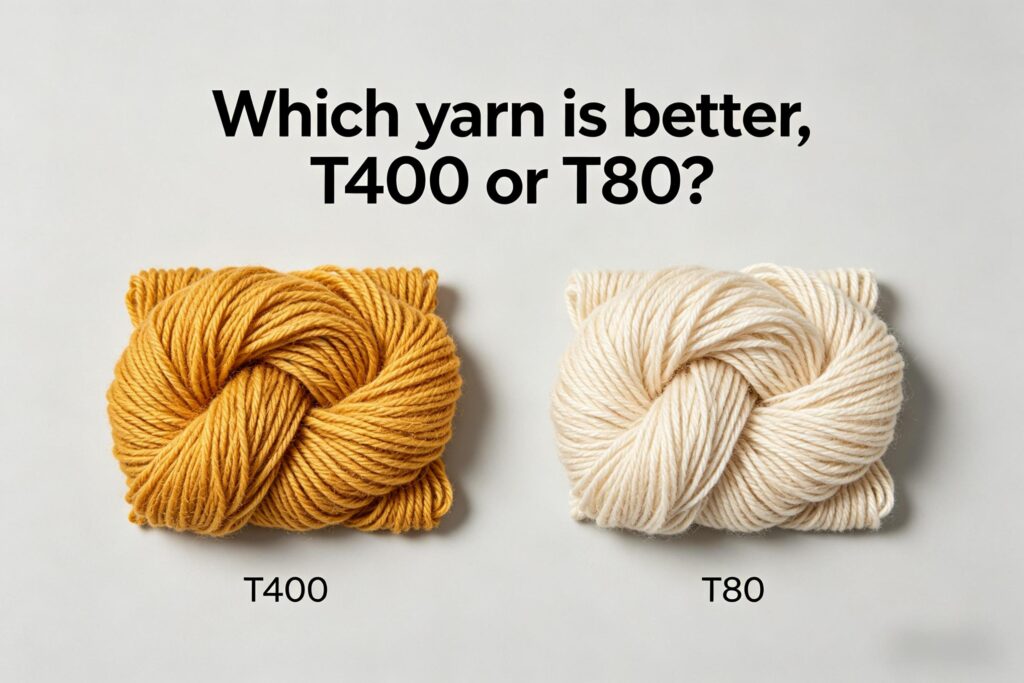
In the vast landscape of textile materials, few questions can lead to as fundamental a misunderstanding as asking whether T400 or T80 yarn is “better.” For sourcing professionals across industries—from heavy manufacturing to fashion apparel—this query highlights a critical need for application-specific knowledge. The truth is, T400 and T80 exist in entirely different universes of performance, cost, and purpose. Comparing them directly is akin to comparing the utility of a steel crane cable to a silk ribbon. This guide dismantles the myth of a simple “better or worse” answer and provides a comprehensive, data-driven framework for understanding these two distinct yarn classes. The goal is to empower you to make flawless material selections by aligning yarn capabilities with precise end-use requirements, thereby optimizing performance, safety, and cost-efficiency.
2. Decoding the Nomenclature: The Fundamental Language of Linear Density
The “T” in both designations is the key. It stands for “Tex,” the international standard unit of linear density: the mass in grams of 1,000 meters of yarn. This number defines the yarn’s primary physical scale.
- T400: A linear density of 400 Tex. This means 1,000 meters of this yarn weighs 400 grams. In the Denier system commonly used for filaments, this is approximately 3,600 Denier (1 Tex ≈ 9 Denier). This places it firmly in the heavy industrial and technical yarn category.
- T80: A linear density of 80 Tex. Accordingly, 1,000 meters weighs 80 grams, equating to about 720 Denier. This falls into the medium-fine count range, squarely within the domain of apparel, home textiles, and general-purpose fabrics.
Table 1: Basic Specification Comparison at a Glance
| Parameter | T400 Yarn | T80 Yarn |
|---|---|---|
| Linear Density | 400 Tex | 80 Tex |
| Approx. Denier | 3,600 D | 720 D |
| Yarn Category | Heavy Industrial / Technical | Medium-Fine Textile / Apparel |
| Typical Diameter | Very Thick (> 0.5 mm) | Fine (0.1 – 0.2 mm) |
| Visual Analogy | Thin Paracord / Small Rope | Typical Sewing Thread / Fine Knitting Yarn |
The takeaway is immediate: T400 is 5 times heavier per unit length than T80. This fundamental difference dictates everything that follows.
3. Material Universe: Fiber Choices in Each Category
The “T” designation defines mass, but the fiber content defines character and capability.
- T400’s Material World: Engineered for maximum performance under stress.
- Nylon 6 & 6.6: The workhorse. Chosen for exceptional toughness, fatigue resistance, and abrasion resistance.
- High-Tenacity Polyester (HT PET): Selected for high strength, low elongation, and superior UV/chemical resistance.
- Specialty Fibers: Aramids (heat/cut resistance), UHMWPE (extreme strength-to-weight), etc., for niche, high-spec applications.
- T80’s Material World: Engineered for aesthetics, comfort, and processability.
- Natural Fibers: Cotton (comfort, breathability), Wool (warmth, resilience), Silk (luster, drape).
- Standard Synthetic Fibers: Polyester (durability, wrinkle-resistance), Acrylic (wool-like aesthetics), Viscose (softness, drape).
- Blends: Cotton/Polyester, Wool/Acrylic, etc., to balance properties and cost.
The Implication: A T400 yarn is inherently a high-strength synthetic filament yarn. A T80 yarn can be made from almost any textile fiber, with properties varying wildly based on that choice.
4. Manufacturing Processes: From Heavy-Duty Spinning to Fine Yarn Production
The production methods further underscore their different worlds.
- T400 Manufacturing: Focused on molecular alignment for strength.
- Polymer Chips: Start with high-grade, high molecular weight polymer.
- Melt Extrusion: Polymer is melted and forced through a spinneret to form filaments.
- High-Ratio Drawing: The most critical step. Filaments are stretched (drawn) 4-7 times their original length under heat, aligning polymer chains to maximize tenacity.
- Heat-Setting & Plying: Stabilizes the structure; multiple filaments or singles are plied for balance.
- T80 Manufacturing: Focused on evenness, softness, and blend consistency.
- Fiber Preparation: Carding and combing (for staples like cotton/wool) to align fibers.
- Drafting & Spinning: Fibers are drawn out and twisted (via Ring Spinning, Rotor Spinning, etc.) to form a cohesive yarn.
- Winding & Clearing: Yarn is wound onto packages, with defects removed.
Table 2: Manufacturing Process & Focus Comparison
| Aspect | T400 Production | T80 Production |
|---|---|---|
| Primary Input | Polymer Chips (for synthetics) | Staple Fibers or Filament Tow |
| Core Technology | High-Tenacity Filament Spinning & Drawing | Staple Fiber Spinning (Ring, Open-End, Air-Jet) |
| Process Focus | Maximizing Tensile Strength & Consistency | Achieving Evenness, Softness, and Desired Twist |
| Typical Output Form | Continuous Filament Yarn (Often Plied) | Spun Staple Yarn (Single or Plied) |
5. Technical Performance Profile: A Side-by-Side Data Analysis
This is where the functional divergence becomes numerically clear. We’ll compare a standard Nylon T400/2 with a standard Combed Cotton T80.
Table 3: Performance Parameter Comparison: T400 vs. T80
| Performance Parameter | T400/2 (Nylon, HT) | T80 (Combed Cotton) | Implication for Selection |
|---|---|---|---|
| Breaking Force | 600 – 720 Newtons (≈61-73 kgf) | 15 – 25 Newtons (≈1.5-2.5 kgf) | T400 is 25-40x stronger. Critical for load-bearing. |
| Tenacity | 7.5 – 8.5 cN/dtex | 1.5 – 2.5 cN/dtex (for cotton) | T400 material is inherently 3-5x stronger per unit weight. |
| Abrasion Resistance | Extremely High (100,000+ cycles on Martindale) | Moderate (10,000 – 25,000 cycles) | T400 is built for high-wear environments. |
| Elongation at Break | 15% – 22% | 5% – 10% | T400 stretches more under load, absorbing energy. |
| Primary Function | Mechanical Load-Bearing, Durability | Aesthetics, Comfort, Drape, Breathability | Defines their core purpose. |
| Typical Fabric Weight | Very Heavy (> 400 g/m²) | Light to Medium (100 – 200 g/m²) | Impacts final product weight and hand feel. |
6. Cost Structures and Economic Realities
- T400 Cost: Priced by the kilogram. While the per-kg cost of nylon or PET is relatively low, the specialized high-tenacity manufacturing commands a premium. Value is derived from performance density—the immense strength packed into each meter.
- T80 Cost: Also priced by the kilogram, but the fiber content drastically affects price (e.g., Egyptian Cotton T80 >> Polyester T80). Value is derived from aesthetic quality, comfort, and brand perception.
- Analysis: Comparing a $5/kg T80 cotton yarn to a $6/kg T400 nylon yarn is meaningless. The cost per unit of performance (e.g., per Newton of strength) is astronomically lower for T400. Conversely, the cost per unit of comfort is what matters for T80 applications.
7. Application-Specific Analysis: Where Each Yarn Excels
This is the ultimate decision matrix.
- T400 is Non-Negotiable For:
- Life-Safety Gear: Fall arrest lanyards, safety harnesses (where failure = injury/death).
- Heavy Lifting: Web slings, roundslings, lifting straps (WLL often tons).
- Severe Abrasion: Conveyor belt weft, log choker ropes.
- Critical Securement: Tie-downs for cargo, marine mooring lines.
- T80 is The Ideal Choice For:
- Next-to-Skin Apparel: T-shirts, dress shirts, blouses, lingerie (where comfort is king).
- Home Comfort: Bed linens, pillowcases, lightweight curtains.
- Fine-Gauge Knitwear: Socks, lightweight sweaters, baby clothes.
- Decorative Embellishment: Embroidery thread, decorative trims.
- Potential Overlap (Requires Careful Engineering):
- Lightweight Bags: A heavy-duty bag body might use T400 webbing for handles, but the main fabric could be a tightly woven T80 nylon for a balance of strength and packability.
- Upholstery: Heavy-duty contract furniture might use T400 in high-stress seams, while the main fabric is a T80-grade velvet or tapestry.
8. The Decision Framework: How to Choose Correctly
Follow this logical sequence to eliminate error:
- Define Primary Function: Ask: “Is this product’s primary job to bear a mechanical load or force?” If YES → Immediately lean towards T400-class yarns. If the answer is to provide comfort, aesthetic appeal, or moderate durability → T80-class is your starting point.
- Quantify Requirements: For load-bearing: Calculate the required Minimum Breaking Strength (MBS) and apply a safety factor (e.g., 5:1). This will instantly disqualify T80. For comfort: Define needs for moisture-wicking, softness, drape, or insulation.
- Process Compatibility: Can your looms or knitting machines handle the thickness and tension of T400? Will T80 provide enough stability and durability for your sewing or weaving process?
- Total Cost of Ownership: For a safety sling, the slightly higher material cost of T400 is irrelevant compared to the catastrophic cost of failure. For a high-volume t-shirt, the cost efficiency of T80 cotton is paramount.
9. Common Misconceptions and Selection Pitfalls
- Myth: “Thicker = More Durable in All Contexts.” A T400 yarn dragging on asphalt will outlast T80. However, a T80 polyester yarn in a shirt will resist pilling and abrasion from washing far better than a coarse, heavy yarn would against skin.
- Pitfall: Cost-Driven Downgrading. Substituting a T80-class yarn for a T400 in a load-bearing application to save money is dangerously negligent and invites product liability.
- Pitfall: Ignoring Comfort. Using a T400-type yarn in a garment will result in a stiff, heavy, and uncomfortable product, regardless of its strength.
10. Future Trends
- T400: The push is towards green strength—recycled nylon and polyester achieving virgin-like tenacity. Integration of conductive elements for wearer monitoring in safety gear is emerging.
- T80: Evolution is in fiber refinement (microfibers for silk-like feel), advanced sustainable blends (organic cotton with recycled polyester), and durable functional finishes (permanent odor control, enhanced moisture management).
11. Embracing the Right Tool for the Job
The question is not whether T400 or T80 yarn is better. The imperative question is: “What is the job?” T400 is the specialized tool for strength and survival in industrial and safety-critical realms. T80 is the versatile medium for expression, comfort, and everyday performance in textiles and apparel. The expert sourcing professional masters the specifications of both to make impeccable matches between material capability and product destiny. By dismissing the notion of a universal “better” and embracing this application-centric framework, you secure not just materials, but performance, safety, and customer satisfaction.
12.Frequently Asked Questions (FAQ)
- Q: Can I substitute multiple strands of T80 to match the strength of one T400 strand?
A: In theory, you could bundle many T80 yarns. However, in practice, this is inefficient, creates bulk, and the load distribution is never perfectly even. The engineered structure, consistency, and material of a single T400 yarn are far superior for predictable, high-strength performance. It’s not a practical substitute. - Q: Is T80 always softer than T400?
A: Effectively, yes. The fibers used in T80 (e.g., fine cotton, merino wool) and its finer diameter inherently provide a softer hand feel. T400, made from thick, hard-oriented synthetic filaments, is designed to be tough, not soft. - Q: Which yarn is more expensive?
A: On a per-kilogram basis, they can be similar, with high-quality T80 natural fibers (e.g., long-staple cotton) often costing more than standard T400 nylon. However, on a per-meter basis or per-unit-of-strength basis, T400 provides vastly more economical performance for its intended heavy-duty tasks. - Q: Can T400 be used in a sewing machine?
A: Only on heavy-duty industrial machines designed for thick threads (e.g., for sewing leather, sails, or webbing). It is completely unsuitable for standard garment sewing machines, which are built for threads in the T20-T80 range. - Q: My fabric needs to be both strong and breathable. Can a blend help?
A: You are likely describing two different needs in different parts of the product. Use T400 for structural, load-bearing components (straps, stress points). Use a breathable T80 fabric (like cotton) for the main body. They are combined in the final product assembly, not blended into a single yarn. - Q: What does the “/2” mean in T400/2? Does T80 have this?
A: The “/2” denotes a 2-ply yarn—two T400 singles twisted together. This is common for industrial yarns to improve balance and durability. T80 yarns can also be plied (e.g., T80/2 for sewing thread), but it’s a separate specification from the linear density. - Q: For a heavy-duty tote bag, which should I use?
A: This requires a hybrid approach. Use T400 or similar in the webbing for handles and shoulder straps where the load is concentrated. The main bag body can be made from a tightly woven or heavy-duty fabric made from T80 or T100-class yarns (like a dense nylon or polyester canvas) for a balance of durability, weight, and cost. - Q: Are there environmental differences?
A: The impact depends on the fiber, not the “T” number. A T400 yarn made from recycled nylon has a different footprint than one from virgin polyester. Similarly, a T80 organic cotton yarn differs from a T80 conventional polyester. Sustainability must be assessed based on the specific fiber content and production practices.
