
Table of Contents
- Setting the Stage for a Nuanced Comparison
- Defining the Terms: Cashmere as a Specific Fiber, Yarn as a Broad Category
- The Environmental Profile of Cashmere: A Fiber Under Scrutiny
- 3.1. Land Use and Desertification: The Grazing Impact
- 3.2. Water Consumption: Beyond Thirsty Goats
- 3.3. Greenhouse Gas Emissions: The Methane Factor
- 3.4. Animal Welfare and Social Responsibility
- The Environmental Spectrum of Yarns: From Fossil Fuels to Forests
- 4.1. Conventional Yarns (Virgin Synthetic & Generic Cotton)
- 4.2. Improved Conventional Yarns (Better Cotton, Recycled Synthetics)
- 4.3. Leading-Edge Sustainable Yarns (Organic, Regenerative, Next-Gen)
- Comparative Life Cycle Assessment (LCA): A Data-Driven Perspective
- Table 1: Key Environmental Impact Indicators – Cashmere vs. Yarn Categories
- Application-Based Analysis: Choosing the Right Fiber for the End-Use
- 6.1. Luxury Apparel & Knitwear: The Cashmere Dilemma
- 6.2. High-Volume Apparel & Fast Fashion: The Yarn Imperative
- 6.3. Home Textiles & Carpets: Durability vs. Perception
- 6.4. Toys and Plush: Safety and Sustainability Crossroads
- The Verdict: It’s Not a Simple Dichotomy
- 7.1. When Cashmere Can Be the More Sustainable Choice
- 7.2. When Specific Yarns Are Unquestionably Superior
- Strategic Procurement Guidelines for Decision-Makers
- Innovation in Cashmere and Yarn Production
- Making an Informed, Context-Aware Sourcing Decision
- Frequently Asked Questions (FAQ)
1. Setting the Stage for a Nuanced Comparison
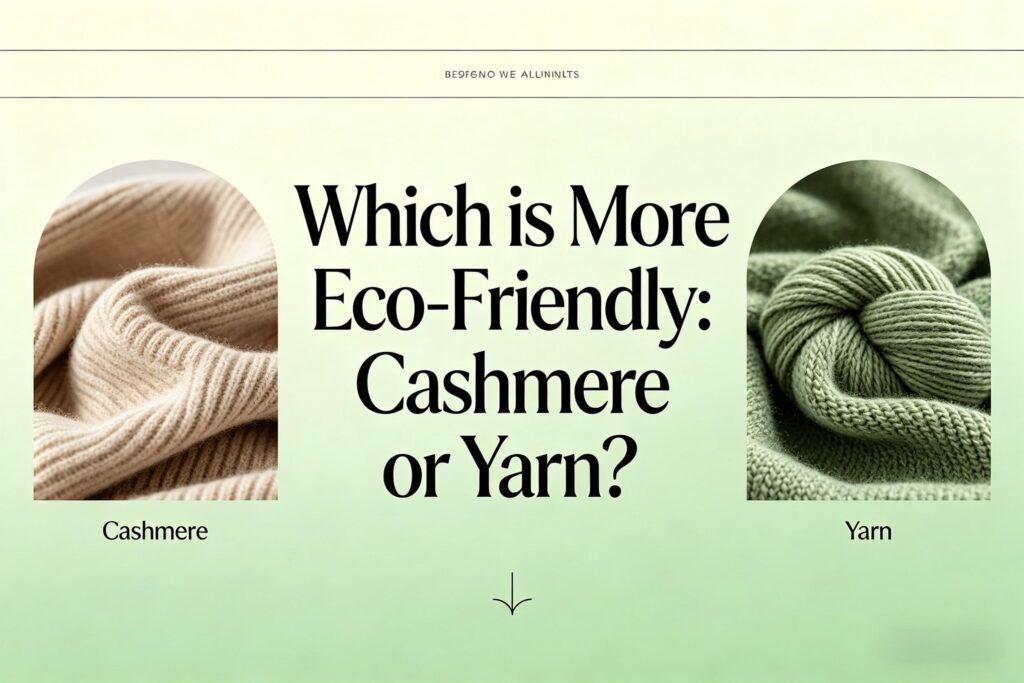
For procurement professionals in the global textile industry, the question “Which is more eco-friendly: cashmere or yarn?” is both provocative and overly simplistic. It compares a specific, luxury animal fiber with an entire universe of materials. The true inquiry is more complex: Under what conditions, and for which applications, can cashmere represent a responsible choice compared to various yarn alternatives? This article moves beyond superficial comparisons to provide a detailed, evidence-based analysis for manufacturers, wholesalers, and brand managers. We will dissect the environmental and social impacts across life cycles, equipping you to make nuanced sourcing decisions that align with both sustainability goals and product integrity.
2. Defining the Terms: Cashmere as a Specific Fiber, Yarn as a Broad Category
First, we must clarify the terms. Cashmere is a specific fiber: the soft undercoat produced by Capra hircus laniger goats, primarily reared in the grasslands of Mongolia, China, Iran, and Afghanistan. It is valued for its exceptional softness, warmth, and lightness.
Yarn is a generic term for a continuous strand of textile fibers used in knitting, weaving, or tufting. The category “yarn” encompasses:
- Natural Fibers: Cotton, wool, alpaca, linen, hemp, silk.
- Synthetic Fibers: Polyester, nylon, acrylic, polypropylene (primarily from fossil fuels).
- Cellulosic Regenerated Fibers: Viscose, modal, lyocell (from wood pulp).
- Recycled/Reclaimed Fibers: From post-consumer plastic bottles (rPET) or textile waste.
- Blends: Any combination of the above.
Therefore, comparing cashmere to “yarn” is like comparing a specific breed of dog to the entire category of “pets.” A meaningful comparison must pit cashmere against specific types of yarns in defined contexts.
3. The Environmental Profile of Cashmere: A Fiber Under Scrutiny
Traditional cashmere production carries significant environmental burdens, largely due to the expansion of goat herds to meet global demand.
3.1. Land Use and Desertification: The Grazing Impact
Cashmere goats are hardier than sheep but are aggressive foragers. They pull plants up by the roots, damaging grassland ecosystems. Overgrazing, driven by increased herd sizes, is a primary cause of desertification in Mongolia and Northern China. The sustainable carrying capacity of these fragile grasslands is often exceeded, leading to soil degradation and loss of biodiversity.
3.2. Water Consumption: Beyond Thirsty Goats
While the goats’ direct drinking water is a factor, the dominant water impact is virtual water – the water required to grow the vegetation the goats consume. Studies suggest cashmere has a high water footprint per kilogram of fiber, primarily through this grassland consumption. Processing (scouring) the greasy cashmere also requires significant water, though this is comparable to other animal fibers.
3.3. Greenhouse Gas Emissions: The Methane Factor
Ruminant animals like goats produce methane (CH₄), a potent greenhouse gas with 25-28 times the global warming potential of CO₂ over 100 years. Per kilogram of fiber, cashmere’s methane emissions from enteric fermentation contribute substantially to its carbon footprint, though overall volume is lower than beef production due to lower global herd numbers.
3.4. Animal Welfare and Social Responsibility
The ethical dimension is crucial. Responsible cashmere involves humane combing (not shearing) of the goats, ensuring their welfare. Furthermore, traceability to ensure fair wages and conditions for herders is a growing concern. Initiatives like the Sustainable Fibre Alliance (SFA) standard aim to address land management, animal welfare, and social fairness.
4. The Environmental Spectrum of Yarns: From Fossil Fuels to Forests
The impact of “yarn” varies astronomically depending on its source.
4.1. Conventional Yarns (Virgin Synthetic & Generic Cotton)
- Virgin Polyester/Nylon: Derived from petroleum, energy-intensive to produce, non-biodegradable, and sheds microplastics. Its primary environmental cost is fossil fuel depletion and plastic pollution.
- Generic (Conventional) Cotton: Notoriously thirsty, accounting for about 2.4% of the world’s arable land and using 6% of global pesticides. High water consumption and chemical pollution are its major drawbacks.
4.2. Improved Conventional Yarns (Better Cotton, Recycled Synthetics)
- Better Cotton Initiative (BCI) Cotton: Reduces water, pesticide, and fertilizer use compared to conventional cotton, but is not organic. It represents a step toward improvement.
- Recycled Synthetics (e.g., rPET): Diverts plastic waste from landfills/oceans, reduces reliance on virgin petroleum, and uses less energy (up to 50% less) than virgin polyester. However, it still sheds microplastics and recycling is not infinite.
4.3. Leading-Edge Sustainable Yarns (Organic, Regenerative, Next-Gen)
- GOTS Organic Cotton: Prohibits toxic pesticides and GMOs, uses less water (primarily through rain-fed systems), and builds soil health.
- Regenerative Wool: Goes beyond organic, using holistic grazing practices to improve soil carbon sequestration, biodiversity, and water cycle health. This can create a net-positive environmental impact.
- TENCEL™ Lyocell: Made from sustainably sourced wood in a closed-loop process that recycles >99% of solvent and water. Biodegradable and compostable.
- Recycled Organic Cotton: Gives new life to post-industrial or post-consumer cotton waste, minimizing virgin resource use and waste.
5. Comparative Life Cycle Assessment (LCA): A Data-Driven Perspective
Table 1: Key Environmental Impact Indicators – Cashmere vs. Yarn Categories (Per Kg of Fiber)
| Fiber Type | GHG Emissions (CO2-eq) | Water Consumption (Litres) | Land Use & Biodiversity Impact | Key Pollution Concerns | Biodegradability |
|---|---|---|---|---|---|
| Conventional Cashmere | High (Methane) | Very High (Virtual water) | Severe (Desertification risk) | Chemical processing effluent | Yes |
| SFA-Certified Cashmere | Moderate-High | High | Managed/Improved | Reduced chemical use | Yes |
| Virgin Polyester | High (Fossil fuels) | Low | Low | Microplastics, fossil depletion | No (100s of years) |
| Recycled Polyester (rPET) | Lower (~50% less than virgin) | Very Low | Low | Microplastics | No |
| Conventional Cotton | Moderate | Extremely High (Irrigation) | High (Pesticides, soil deg.) | Pesticide/fertilizer runoff | Yes |
| Organic Cotton | Moderate | High (but often rain-fed) | Moderate (Soil positive) | Minimal | Yes |
| Regenerative Wool | Potentially Net-Negative (Carbon sequestration) | Moderate | Positive (Ecosystem restore) | Minimal | Yes |
| TENCEL™ Lyocell | Low | Low (Closed-loop) | Low (Sust. forestry) | Minimal solvent (captured) | Yes |
Note: Data is indicative and varies by geography, farming practices, and processing. Sources include Higg MSI, LCA databases, and industry reports.
6. Application-Based Analysis: Choosing the Right Fiber for the End-Use
6.1. Luxury Apparel & Knitwear: The Cashmere Dilemma
For durable, long-life luxury items, certified cashmere (SFA) can be defensible if the product is designed to last decades and be recycled. However, high-quality, regenerative wool or alpaca often provides similar warmth and luxury with a demonstrably lower or positive environmental footprint, making it a compelling alternative.
6.2. High-Volume Apparel & Fast Fashion: The Yarn Imperative
Here, cashmere is almost never the answer. The land and water constraints are prohibitive. Organic cotton, recycled blends, or lyocell are far more scalable and responsible choices for high-volume production, balancing performance with reduced impact.
6.3. Home Textiles & Carpets: Durability vs. Perception
For high-traffic carpets, durability is key. Recycled nylon or polyester offer performance and recycled content. A cashmere blend in a luxury rug is a niche product; its sustainability hinges entirely on the certification of the cashmere and the backing materials used.
6.4. Toys and Plush: Safety and Sustainability Crossroads
For toys, safety (non-toxic, hypoallergenic) and washability are paramount. Cashmere is delicate and often requires dry cleaning (chemicals). GOTS organic cotton or OEKO-TEX certified recycled polyester are safer, more durable, and easier to maintain sustainably.
7. The Verdict: It’s Not a Simple Dichotomy
7.1. When Cashmere Can Be the More Sustainable Choice
Only in a very narrow context: when it is SFA-certified or equivalent, sourced for an ultra-durable, timeless product that will be cared for and eventually recycled, and when compared to a conventional, non-recycled synthetic yarn used in a disposable garment. Its biodegradability is an advantage over synthetics.
7.2. When Specific Yarns Are Unquestionably Superior
In the vast majority of commercial scenarios, other yarns are more eco-friendly:
- Against conventional cotton: Recycled polyester or lyocell win on water and land use.
- For warmth and luxury: Regenerative wool or alpaca outperform on holistic environmental metrics.
- For circular economy goals: Recycled or bio-based synthetics and recycled/organic cotton are superior choices.
8. Strategic Procurement Guidelines for Decision-Makers
- Demand Certification: For cashmere, insist on SFA or similar. For yarns, seek GOTS, OCS, GRS, RCS, FSC (for lyocell).
- Prioritize Durability: The most sustainable fiber is in a garment that lasts. Choose fiber and construction appropriate for the product’s intended lifespan.
- Consider Blends Strategically: A small percentage of cashmere in a blend with regenerative wool can enhance softness while mitigating overall impact.
- Evaluate End-of-Life: Opt for fibers that fit your company’s take-back or recycling pathways—biodegradable natural fibers or recyclable monomaterials.
- Look Beyond CO2: Assess water, land use, and biodiversity impacts specific to your product’s region of origin.
9. Innovation in Cashmere and Yarn Production
- Cashmere: Advances in regenerative grazing practices and land stewardship programs aim to make cashmere a restorative resource. Traceability tech (blockchain) will improve supply chain transparency.
- Yarns: Growth in chemical recycling will improve circularity for synthetics and blends. Bio-fabricated fibers (grown from microbes) and next-gen recycled cotton will offer new low-impact alternatives.
10. Making an Informed, Context-Aware Sourcing Decision
“Cashmere vs. Yarn” is not a fair fight. The more pertinent question is: What is the most appropriate, lowest-impact fiber for my specific product’s performance, price point, and lifecycle? For most procurement scenarios, especially in volume-driven industries like apparel, toys, and home textiles, specific sustainable yarns—recycled, organic, regenerative, or next-gen—offer a clearer, more scalable path to reducing environmental harm. Cashmere remains a niche luxury fiber whose justification requires rigorous certification, a commitment to durability, and full supply chain transparency. By moving beyond fiber fetishization to a holistic impact assessment, buyers can drive genuine sustainability in their supply chains.
11. Frequently Asked Questions (FAQ)
- Q: Is recycled polyester more eco-friendly than cashmere?
A: For most impact categories (water, land use, desertification), yes, especially if the cashmere is uncertified. rPET reduces waste and fossil fuel use. However, cashmere is biodegradable, while rPET sheds microplastics. - Q: Can cashmere ever be considered a sustainable fiber?
A: Yes, but only under stringent conditions: certified by the Sustainable Fibre Alliance (SFA) or similar, which ensures holistic grassland management, animal welfare, and fair labor. - Q: What is the single biggest environmental issue with cashmere?
A: Desertification caused by overgrazing due to increased herd sizes to meet global demand. This degrades land, releases soil carbon, and destroys biodiversity. - Q: Are there any yarns that are objectively better for the environment than all others?
A: No. It depends on the metrics. TENCEL™ Lyocell scores very well on water/chemicals. Regenerative wool can sequester carbon. Recycled polyester tackles plastic waste. The “best” choice is application-specific. - Q: For a luxury knitwear brand, what is the most responsible alternative to traditional cashmere?
A: Regenerative alpaca or wool is a top-tier alternative. Also, consider SFA-certified cashmere or innovative blends using recycled cashmere combined with other sustainable fibers. - Q: How does the microplastic issue factor into this comparison?
A: It’s a major point against synthetic yarns (virgin or recycled). Natural fibers like cashmere, wool, and cotton do not shed persistent microplastics, though they may shed biodegradable microfibers. - Q: Is organic cotton always better than cashmere?
A: On water stress and land degradation issues, generally yes. However, a durable, certified cashmere sweater that lasts 30 years may have a lower per-wear impact than an organic cotton sweater that pills and is discarded quickly. - Q: What question should I ask my cashmere supplier immediately?
A: “Can you provide third-party certification (like SFA) for this batch, and what is your traceability system back to the herding community?” - Q: How relevant is biodegradability at end-of-life?
A: Increasingly so, as landfill diversion becomes critical. Natural fibers like cashmere, wool, and cotton will decompose, while synthetics will not. This is a key advantage for natural fibers in a circular model. - Q: In terms of pure carbon footprint, what’s the lowest-impact option?
A: Regenerative wool can have a net-negative carbon footprint due to soil sequestration. Next would be recycled synthetic yarns (low energy to recycle), followed by lyocell. Conventional cashmere and virgin synthetics have high footprints.
