
Table of Contents
- The Crucial Role of Twist Direction in Textile Engineering
- Fundamentals of Yarn Twist: Definitions and Physical Principles
- 2.1. What is Twist Direction? Defining ‘S’ and ‘Z’ Twist
- 2.2. The Mechanics of Twisting: How Direction Affects Fiber Alignment
- 2.3. Historical and Global Standards for Twist Notation
- Visual and Tactile Identification Methods
- 3.1. The ‘Held Yarn’ Method: A Step-by-Step Visual Guide
- 3.2. Microscopic Examination: Fiber Helix Angle Analysis
- 3.3. Untwist-Retwist Technique for Laboratory Confirmation
- Instrumental and Laboratory Analysis
- 4.1. Twist Tester Operation and Data Interpretation
- 4.2. Optical and Digital Image Analysis Systems
- 4.3. Standardized Test Methods: ASTM D1422, ISO 2061, and Others
- Impact of Twist Direction on Downstream Processing
- 5.1. Weaving Preparations: Warping, Sizing, and Loom Performance
- 5.2. Knitting Efficiency: Spirality, Torque, and Defect Prevention
- 5.3. Plying Operations: Balancing Twist for Cord and Rope Making
- Twist Direction in Final Product Performance
- 6.1. Fabric Hand, Drape, and Surface Texture
- 6.2. Dimensional Stability and Skew/Bow Control in Finished Fabrics
- 6.3. Strength, Abrasion Resistance, and Pilling Behavior
- Application-Specific Guidelines and Industry Practices
- 7.1. Apparel Fabrics: Single vs. Double Jersey, Wovens, Denim
- 7.2. Home Textiles: Towels, Bedding, and Upholstery
- 7.3. Technical Textiles: Industrial, Geotextile, and Composite Applications
- Twist Direction in Specialty and Blended Yarns
- 8.1. Effect/Purpose Yarns: Slub, Bouclé, and Chenille
- 8.2. Multi-Component Yarns: Core-Spun, Covered, and Fancy Twists
- 8.3. Blended Fiber Yarns: Interaction of Different Fiber Properties
- Quality Control and Production Management
- 9.1. In-Line Monitoring and Process Control Systems
- 9.2. Documentation and Traceability in Global Supply Chains
- 9.3. Corrective Actions for Twist Direction Non-Conformity
- Future Trends and Technological Developments
- Integrating Twist Direction Knowledge into Sourcing Strategy
- Frequently Asked Questions (FAQ)
1. The Crucial Role of Twist Direction in Textile Engineering
For textile professionals, from spinners to garment manufacturers, understanding yarn twist direction is not merely an academic exercise—it is a fundamental requirement for product consistency, manufacturing efficiency, and final product quality. The choice between ‘S’ and ‘Z’ twist, seemingly a binary decision, has cascading effects through every stage of the textile pipeline. Misidentification or inconsistent application can lead to spirality in knits, torque in woven fabrics, poor plying performance, and ultimately, customer dissatisfaction and financial loss.
2. Fundamentals of Yarn Twist: Definitions and Physical Principles
2.1. What is Twist Direction? Defining ‘S’ and ‘Z’ Twist
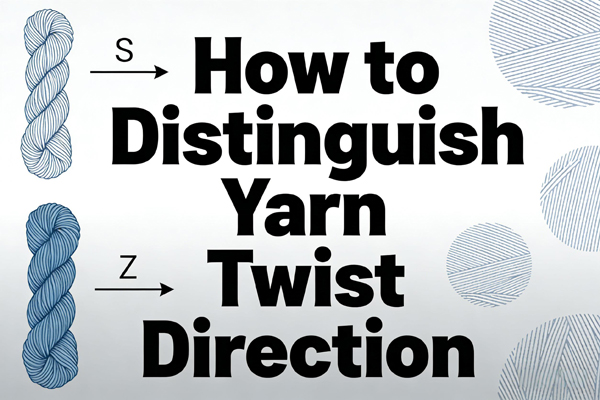
Twist direction describes the helical orientation of fibers around the yarn’s central axis. The international standard uses the letters ‘S’ and ‘Z’, based on the slope of the central portion of these letters when aligned with the yarn axis.
- ‘Z’ Twist (Right-Hand Twist): When the yarn is held vertically, the spirals conform to the central slope of the letter ‘Z’ — ascending from lower left to upper right. This is the most common direction for single yarns in global production.
- ‘S’ Twist (Left-Hand Twist): When the yarn is held vertically, the spirals conform to the central slope of the letter ‘S’ — ascending from lower right to upper left. This is less common for singles but is standard for the final ply twist in folded yarns and is often used for specific effect yarns.
2.2. The Mechanics of Twisting: How Direction Affects Fiber Alignment
The twist direction imparts a specific torsional energy into the yarn. In ‘Z’ twist yarns, fibers are wound in a clockwise helix (when looking along the yarn from origin to end). This orientation influences:
- Fiber Migration: The path fibers take from the yarn core to the surface.
- Torsional Balance: The inherent tendency of the yarn to untwist or torque.
- Surface Character: The angle at which fiber ends protrude, affecting hairiness and luster.
2.3. Historical and Global Standards for Twist Notation
While ‘S’ and ‘Z’ are universal, regional preferences exist. Continental European texts may reference “right” (rechts) for ‘Z’ and “left” (links) for ‘S’. Consistency in documentation is paramount for global trade. Purchase orders and technical data sheets must unequivocally state the required twist direction.
3. Visual and Tactile Identification Methods
3.1. The ‘Held Yarn’ Method: A Step-by-Step Visual Guide
This is the primary field method used by quality inspectors and mill technicians.
- Isolate a Segment: Hold a length of yarn (15-30 cm) in a vertical position under good light. It is critical that the yarn is not under tension.
- Observe the Helix: Closely examine the angle of the fibers or strands spiraling around the yarn core.
- Match the Letter Slope:
- If the spirals ascend left-to-right like the central part of ‘Z’, it is ‘Z’ twist.
- If the spirals ascend right-to-left like the central part of ‘S’, it is ‘S’ twist.
- Confirm with Rotation (Optional): Gently roll the yarn between thumb and forefinger. The perceived tightening direction can offer secondary confirmation.
3.2. Microscopic Examination: Fiber Helix Angle Analysis
For fine or complex yarns, a low-power microscope or magnifying glass (10-30x) provides definitive visualization. The helix angle (typically 20-45°) can also be measured, providing quantitative data beyond mere direction.
3.3. Untwist-Retwist Technique for Laboratory Confirmation
This destructive test removes all doubt:
- Clamp one end of a known yarn length in a twist tester.
- Untwist the yarn completely until the constituent fibers are parallel.
- The direction you had to rotate the clamp to untwist the yarn is its original twist direction. If you turned the clamp counter-clockwise (viewed from the fixed end) to untwist it, the yarn had ‘Z’ twist.
4. Instrumental and Laboratory Analysis
4.1. Twist Tester Operation and Data Interpretation
Modern electronic twist testers (e.g., from Zweigle, Uster) automate the untwist-retwist method. They provide not only the direction but also the precise Twist Per Inch/Meter (TPI/TPM) and twist level CV%. Reports will explicitly state “S” or “Z”.
4.2. Optical and Digital Image Analysis Systems
Advanced QC systems use high-resolution cameras and software algorithms to analyze the yarn surface and automatically determine and document twist direction as part of inline inspection, ideal for high-speed spinning lines.
4.3. Standardized Test Methods
Adherence to standards ensures reproducibility:
- ASTM D1422 / D1423: Standard Test Method for Twist in Yarns.
- ISO 2061: Textiles — Determination of twist in yarns — Direct counting method.
- BS EN 2061: British/European adoption of the ISO method.
These standards prescribe the apparatus and methodology, leaving no room for subjective interpretation.
5. Impact of Twist Direction on Downstream Processing
5.1. Weaving Preparations: Warping, Sizing, and Loom Performance
- Warp Yarns: Consistent twist direction across all warp ends is critical. Mixed directions can cause differential shrinkage during sizing and irregular tension on the loom, leading to streaks and stops.
- Weft Yarns: Direction can affect packing density and fabric cover. For most standard weaves, direction is less critical than consistency within a lot.
5.2. Knitting Efficiency: Spirality, Torque, and Defect Prevention
This is where twist direction has its most pronounced effect.
- Single Jersey Fabrics: Yarn with ‘Z’ twist tends to cause spirality—where the wale lines slant to the left after washing. Using ‘S’ twist yarn can cause wales to slant to the right. For critical applications, balanced plied yarns or specific twist direction mixes are used to neutralize this effect.
- Torque: Single-knit garments (like T-shirts) made from highly twisted singles can exhibit torque, causing side seams to twist around the body. Direction influences the direction of this twisting.
5.3. Plying Operations: Balancing Twist for Cord and Rope Making
The golden rule: Ply twist is opposite to single yarn twist.
- A 2-ply yarn made from two ‘Z’ twist singles will be plied with an ‘S’ twist.
- This balanced construction counteracts the torsional energy of the singles, resulting in a torque-stable, stronger yarn.
- In cordage (3-ply, cable twist), this principle is layered to create balanced, high-strength structures.
6. Twist Direction in Final Product Performance
6.1. Fabric Hand, Drape, and Surface Texture
- The interaction of twist direction in warp and weft can subtly influence the fabric’s stiffness and drape coefficient.
- Surface light reflection differs slightly, which can be a factor in lustrous fabrics like satin or taffeta.
6.2. Dimensional Stability and Skew/Bow Control
- Fabric Skew (Twisting off Grain): A major concern for cut-and-sew operations. Improperly managed twist direction in woven fabrics, especially twills and satins, is a primary cause of skew. Mills often use a combination of ‘S’ and ‘Z’ twist yarns in the warp or weft to mechanically balance the fabric.
- Spirality in Knits: As mentioned, this is a direct function of single yarn twist direction and twist level.
6.3. Strength, Abrasion Resistance, and Pilling
- While twist level is the primary driver of these properties, direction can interact with the direction of abrasive forces in end-use. There is no inherent strength difference between ‘S’ and ‘Z’.
7. Application-Specific Guidelines and Industry Practices
Table 1: Standard Twist Direction Practices by Application
| Application / Yarn Type | Standard Single Yarn Twist | Standard Ply Twist | Key Rationale | Common Issues if Incorrect |
|---|---|---|---|---|
| Ring-Spun Cotton Carded (Apparel) | Z | S (if plied) | Global convention, machine setup. | Knit spirality, weaving tension issues. |
| Open-End Cotton (OE) | Z | S (if plied) | Convention, compatibility with ring-spun. | Mixing with ring-spun can cause visual defects. |
| Woolen/Worsted Knitting Yarn | Z or S (varies) | Opposite to single | Brand/region specific; balanced ply for knit stability. | Severe garment torque, skewed seams. |
| Denim Warp (Twill) | Often a mix of S & Z | N/A | To balance twill line torque and prevent fabric skew. | Pronounced leg twisting, off-grain cutting. |
| Industrial Sewing Thread | Z (single) then S (ply) | Often final ‘Z’ for 3-ply | Maximum balance and strength for high-speed sewing. | Thread snarling, skipped stitches, breakage. |
| Filament Yarn (Polyester/Nylon) | Usually No Twist or ‘Z’ | N/A | Processing ease; twist added only for texture or cohesion. | May not apply. |
| Plied Carpet Yarn | Z | S | Creates a balanced, bulky yarn that tufts well. | Tufting defects, uneven carpet surface. |
7.2. Home Textiles
- Towels: Piled yarns are standard. Balanced ‘Z/S’ construction ensures loops remain upright and the fabric absorbs evenly.
- Bed Linens: For percale, consistent direction is key for smoothness. For sateen, mills carefully manage direction to optimize luster and prevent slippage.
7.3. Technical Textiles
- Direction is engineered for specific load-bearing or interaction characteristics (e.g., conveyor belts, drive sleeves).
8. Twist Direction in Specialty and Blended Yarns
8.1. Effect Yarns:
- Slub Yarns: The base twist direction affects the prominence of the slub.
- Bouclé and Chenille: These involve complex plying operations with multiple twist directions to trap effect fibers. Direction sequencing is proprietary and crucial to the aesthetic.
8.2. Multi-Component Yarns:
- Core-Spun: The core (often filament) may have zero twist, while the sheath (staple fibers) has a ‘Z’ or ‘S’ twist.
- Covered Spandex: The hard yarn covering the spandex core has a specific direction to optimize coverage and elasticity.
9. Quality Control and Production Management
9.1. In-Line Monitoring: Modern spinning frames can be equipped with sensors to detect and flag any accidental reversal of twist direction during doff changes or maintenance.
9.2. Documentation: The Certificate of Analysis (COA) from a spinner must include Twist Direction. This is a critical line item for fabric mills to check upon receipt of yarn.
9.3. Corrective Actions: If the wrong direction is discovered, the entire lot is typically segregated. Depending on the application, it may be used for a different product line, re-spun (costly), or scrapped.
10. Future Trends and Technological Developments
Automation and AI in vision systems will make 100% inspection for twist direction (and other parameters) more feasible, further reducing the risk of non-conforming material entering production.
11. Integrating Twist Direction Knowledge into Sourcing Strategy
Distinguishing yarn twist direction is a fundamental skill with high-stakes implications. For procurement, it is a key specification to be demanded and verified. For production, it is a variable that must be controlled to ensure smooth manufacturing and premium product quality. Moving beyond simple identification to understand why direction matters empowers professionals to make better decisions, solve problems proactively, and foster clearer communication across the global textile supply chain. Always specify, always verify, and understand the consequences—this is the mark of a sophisticated textile buyer or producer.
12. Frequently Asked Questions (FAQ)
Q1: Which twist direction is more common, ‘S’ or ‘Z’?
A1: ‘Z’ twist is overwhelmingly the standard for single yarns in global staple fiber spinning. This is largely due to historical machine configuration and convention. ‘S’ twist is standard for the final plying twist.
Q2: Can I determine twist direction on a dyed or dark-colored yarn?
A2: Yes, but it can be more challenging. Use strong, oblique lighting to create shadows that highlight the helix. The untwist-retwist method in a lab is foolproof regardless of color.
Q3: Does twist direction affect the yarn’s strength?
A3: No, not directly. Tensile strength is determined by twist level (TPI) and fiber properties. An ‘S’ and a ‘Z’ twist yarn with identical TPI and fiber content will have the same strength. The direction of applied force does not interact with the helix direction to change breaking point.
Q4: What happens if we weave with a warp that has mixed ‘S’ and ‘Z’ twist yarns?
A4: This will almost certainly cause visible defects. The yarns may react differently to moisture (during sizing) and tension, leading to warp streaks or bars in the finished fabric. It is considered a major fault.
Q5: How do I specify twist direction in a purchase order?
A5: Be explicit and use standard notation. Example: “100% Cotton, Ne 30/1, Ring-Spun, Carded, ‘Z’ Twist, 22 TPI ±5%”. For plied yarns: “Ne 40/2, Made from two ‘Z’ twist singles, plied with ‘S’ twist”.
Q6: Is spirality in a knit garment always due to twist direction?
A6: It is the primary cause, but not the only one. Spirality is caused by the released torsional energy in a single yarn. While the direction of that energy (and thus the slant direction) is set by the twist direction (‘Z’ twist usually slants left), the severity of the spirality is determined by the twist level (TPI), yarn count, stitch structure, and fabric finishing. High twist singles in a loose knit structure will exhibit severe spirality.
Q7: Can twist direction be changed after the yarn is made?
A7: Not practically. To change from ‘Z’ to ‘S’, you would have to completely untwist the yarn and then retwist it in the opposite direction. This would damage fibers, change the twist level, and be cost-prohibitive. It is a fundamental property set during spinning.
Q8: Do filament yarns have a twist direction?
A8: Most filament yarns for weaving and knitting are produced with zero or very low twist. When twist is applied (e.g., for texturing, creping, or cohesion), it will have an ‘S’ or ‘Z’ direction, which should be specified for applications where it matters (like in sheer woven fabrics).
Q9: Why is the final ply twist usually opposite to the single yarn twist?
A9: To achieve torque balance. A single ‘Z’ twist yarn wants to untwist. Plying two ‘Z’ singles together with an ‘S’ twist locks them together. The opposing torsional forces neutralize each other, creating a stable yarn that won’t snarl or cause fabric distortion.
Q10: How can I quickly check twist direction on a yarn cone without unrolling much?
A10: Use the “pull a strand” method. Gently pull a 20-30 cm length of yarn from the side of the cone, keeping it connected. Hold this segment vertically near the cone to observe. Ensure the pulled strand is not twisted upon itself from the pulling action. This gives a good representative sample.
