
Table of Contents
- A Specialized Path for Specialized Fibers
- Dispelling the Myth: Wet Spinning is NOT Standard for Commodity PET
- Defining the Niche: When and Why Polyester Chooses a Solvent-Based Route
- Strategic Relevance for Advanced Material Sourcing
- Chemical Foundations: The Solvent-Polymer Interaction
- The Challenge with PET: High Melting Point and Limited Solubility
- Key Solvent Systems: Trifluoroacetic Acid (TFA), Dichloroacetic Acid (DCA), and Complex Solvents
- The Role of Coagulation Bath Chemistry: Non-Solvent Induced Phase Separation
- The Wet Spinning Process: A Step-by-Step Technical Breakdown
- Stage 1: Dope Preparation – Achieving True Molecular Solution
- Stage 2: Filtration and Degassing – Ensuring Spinnability
- Stage 3: Extrusion through the Spinneret – Into the Coagulation Bath
- Stage 4: Coagulation & Initial Fiber Formation – Solidification Dynamics
- Stage 5: Washing, Drawing, and Heat Setting – Developing Final Structure & Properties
- Process Flow Diagram: From Polymer to Finished Fiber
- Critical Process Parameters and Their Control
- Dope Concentration and Viscosity: The Balance of Economics and Mechanics
- Coagulation Bath Composition, Temperature, and Flow Dynamics
- Spinneret Design: Hole Geometry, L/D Ratio, and Arrangement
- Take-up Speed and Tension Control in the Bath
- Table 1: Key Wet Spinning Process Parameters and Their Impact on Fiber Properties
- Microstructural Development: Forming a Unique Fiber Architecture
- Skin-Core Morphology: A Hallmark of Wet-Spun Fibers
- Porosity and Void Formation: Mechanisms and Control
- Crystallinity and Molecular Orientation: Comparison to Melt-Spun PET
- Cross-Sectional Shapes: Beyond the Round – Engineering through Diffusion
- Property Profile of Wet-Spun Polyester Fibers
- Mechanical Properties: Typically Lower Tenacity, Higher Elongation vs. Melt-Spun
- Surface Characteristics: High Surface Area, Matteness, and Tactile Softness
- Sorption and Wicking: Enhanced Moisture Handling Capability
- Dyeability: Superior Depth and Uniformity of Color Uptake
- Table 2: Comparative Properties: Wet-Spun vs. Conventional Melt-Spun PET Filament
- Primary Commercial and Technical Applications
- Synthetic Paper and Nonwovens: Utilizing High Surface Area and Opacity
- Specialty Filters (Liquid/Gas): Leveraging Controlled Porosity
- Artificial Leather and Suede (Microfiber): The Key to Ultra-Fine Deniers
- High-Tech Wipes and Medical Textiles: Softness and Fluid Management
- Functional Apparel Layers: Where Moisture Management is Paramount
- Economic and Environmental Considerations
- Cost Drivers: Solvent Recovery vs. Energy for Melting
- The Solvent Recovery Imperative: Closed-Loop Systems
- Environmental, Health, and Safety (EHS) Challenges
- Comparative Carbon Footprint Analysis (Theoretical)
- Future Trends and Advanced Developments
- Bio-based and Recycled PET in Wet Spinning
- Solvent-Free or Green Solvent Alternatives (Ionic Liquids, Supercritical CO2)
- Additive Incorporation for Smart and Functional Fibers
- Integration with Electrospinning and Other Novel Spinning Methods
- The Precision Tool in the Fiber Spinning Arsenal
- Recapping the Strategic Value Proposition
- Decision Framework: When to Consider Wet-Spun Polyester
- Frequently Asked Questions (FAQs)
1. A Specialized Path for Specialized Fibers
For procurement managers and product developers seeking advanced textile solutions, understanding manufacturing processes is key to unlocking material potential. When one thinks of polyester (PET) fiber production, the dominant image is melt spinning—a highly efficient, solvent-free process that yields strong, versatile filaments. However, a more nuanced and technically sophisticated route exists: wet spinning. It is crucial to clarify that standard textile-grade PET fibers (e.g., for apparel, home furnishing) are not made via wet spinning. This article delves into the specialized wet spinning principle as applied to Polyester, exploring its unique chemistry, complex process dynamics, and the resulting fiber properties that make it invaluable for niche, high-performance applications. This knowledge is critical for sourcing managers in technical textiles, filtration, artificial leather, and advanced nonwovens, where conventional melt-spun fibers may not meet specific functional demands.
2. Chemical Foundations: The Solvent-Polymer Interaction
The core distinction of wet spinning lies in its use of a solvent to dissolve the polymer, rather than heat to melt it. This presents an immediate challenge for PET.
- The PET Challenge: Polyethylene terephthalate has a high melting point (~260°C) and is not readily soluble in common, benign solvents at room temperature. Its semi-crystalline, highly polar structure requires aggressive solvents.
- Key Solvent Systems: Historically, halogenated acids like Trifluoroacetic Acid and Dichloroacetic Acid have been used. These are powerful solvents that disrupt PET’s intermolecular forces, creating a true, viscous polymer solution called “dope.” Modern research also explores complex solvent mixtures to improve process safety and efficiency.
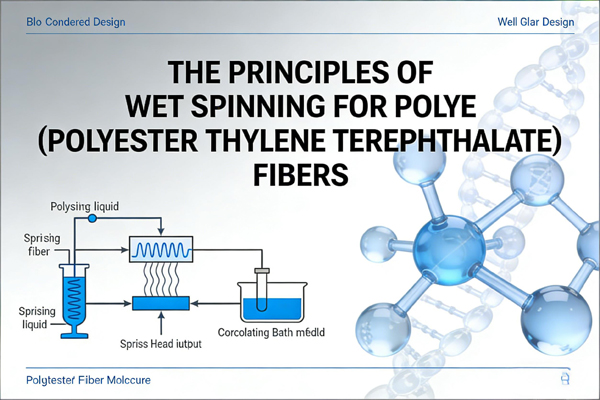
- Coagulation Chemistry: The dope is extruded into a coagulation bath containing a non-solvent (typically water or a water/alcohol mixture). This triggers Non-Solvent Induced Phase Separation. The solvent diffuses out of the extruded stream into the bath, while the non-solvent diffuses in. This rapid exchange causes the polymer to precipitate, forming a gel-like filament that solidifies into a fiber. The kinetics of this diffusion-precipitation process are fundamental to defining the fiber’s final microstructure.
3. The Wet Spinning Process: A Step-by-Step Technical Breakdown
- Stage 1: Dope Preparation: PET polymer chips or powder are dissolved in the selected solvent under controlled temperature and agitation. The goal is a homogeneous, bubble-free dope with a precisely controlled concentration (e.g., 15-25% polymer by weight). Higher concentrations increase productivity but raise viscosity, making extrusion difficult.
- Stage 2: Filtration & Degassing: The dope is passed through series of increasingly fine filters (down to ~10 µm) to remove any gel particles or impurities that could clog the spinneret. It is then degassed under vacuum to eliminate microbubbles that could cause filament breaks.
- Stage 3: Extrusion: The purified dope is metered by a precision pump and forced through a spinneret—a metal plate with dozens to thousands of fine holes (e.g., 50-100 µm diameter). The emerging liquid threads enter the coagulation bath directly.
- Stage 4: Coagulation: This is the heart of the process. As described, phase separation occurs. The bath’s composition, temperature (often 10-40°C), and flow pattern (cross-flow, counter-current) are meticulously controlled to manage the solidification rate and fiber morphology.
- Stage 5: Post-Treatment: The nascent, gel-like fiber is weak. It passes through a series of baths: Washing to remove residual solvent, Drawing (stretching) in hot water or steam to orient polymer chains and increase strength, and finally Heat Setting to stabilize the structure and reduce shrinkage.
4. Critical Process Parameters and Their Control
Table 1: Key Wet Spinning Process Parameters and Their Impact on Fiber Properties
| Parameter | Typical Range/Description | Primary Impact on Fiber |
|---|---|---|
| Dope Concentration | 15% – 25% (w/w) | ↑ Conc. = Higher productivity, denser fiber, higher tenacity (if processable). |
| Dope Viscosity | 100 – 5,000 Poise (highly temp. dependent) | Governs extrusion pressure, spinnability, and initial filament shape stability. |
| Coagulation Bath Temp. | 10°C – 40°C | ↓ Temp. = Faster coagulation, denser “skin,” potential for macro-voids. |
| Bath Composition | Water, Water/Methanol, with additives | Controls diffusion rates, fiber cross-section, and surface morphology. |
| Spinneret L/D Ratio | (Length/Diameter of hole) = 1-4 | Affects die swell, shear history, and initial orientation of the dope. |
| Take-up Speed | 10 – 200 m/min (much slower than melt spin) | Influences orientation and tension during solidification. |
5. Microstructural Development: Forming a Unique Fiber Architecture
The diffusion-precipitation mechanism creates a distinctive internal structure not found in melt-spun fibers.
- Skin-Core Morphology: Rapid precipitation at the filament surface forms a dense, relatively impermeable “skin.” Precipitation in the core happens more slowly, often leading to a more porous, open structure. This can be modulated by bath conditions.
- Porosity and Voids: Wet-spun fibers are often inherently more porous. By carefully controlling the rate of solvent outflow vs. non-solvent inflow, engineers can create micro-voids and channels, leading to high surface area and low density fibers.
- Crystallinity & Orientation: As-spun fibers have low crystallinity. The drawing and heat-setting stages are where most molecular orientation and crystallization occur. The final crystallinity is generally lower than in melt-spun PET, contributing to different mechanical and thermal properties.
- Cross-Sectional Shapes: Unlike melt spinning where holes are round, the diffusion anisotropy in a wet bath can be harnessed. Using non-circular spinneret holes (e.g., trilobal, serrated) or adjusting bath chemistry can produce fibers with lobed, irregular, or highly porous cross-sections that enhance properties like opacity, wicking, or filtration.
6. Property Profile of Wet-Spun Polyester Fibers
Table 2: Comparative Properties: Wet-Spun vs. Conventional Melt-Spun PET Filament
| Property | Wet-Spun Polyester | Conventional Melt-Spun PET | Implication for Applications |
|---|---|---|---|
| Tenacity | Moderate (2.0 – 4.5 g/den) | High (4.0 – 9.0 g/den) | Wet-spun is not for high-strength uses (e.g., tire cord). |
| Elongation at Break | Higher (30% – 100%) | Lower (15% – 40%) | More ductile, less brittle feel. |
| Initial Modulus | Lower | Higher | Softer, more flexible hand feel. |
| Surface Area | Very High (porous, rough) | Low (smooth) | Excellent for filtration, adhesion, wicking. |
| Density | Lower (can be <1.2 g/cm³) | ~1.38 g/cm³ | Lightweight materials possible. |
| Dyeability | Excellent (porous structure) | Good (but requires carriers/high temp) | Deeper, more uniform dyeing at lower temperatures. |
| Opacity | High | Low to Medium | Good covering power, matte appearance. |
| Moisture Regain | Slightly Higher (~0.8%) | Very Low (~0.4%) | Slightly improved comfort perception. |
7. Primary Commercial and Technical Applications
- Synthetic Paper & Nonwovens: The high opacity, bulk, and matte finish make wet-spun polyester staple fibers ideal for durable synthetic papers, tea bags, and high-performance nonwoven substrates.
- Specialty Filters: The controllable micro-porosity is perfect for precision liquid filtration (e.g., oil, chemicals) and certain gas filtration applications where surface capture is key.
- Artificial Leather/Suede (Microfiber): This is a flagship application. Wet spinning is the primary method to produce ultra-fine denier polyester fibers (often <0.1 denier per filament). These microfibers are processed into a nonwoven, treated with polyurethane, and buffed to create the luxurious, breathable material known as “microfiber suede.”
- High-Tech Wipes & Medical Textiles: The soft hand, high absorbency (via wicking, not absorption), and strength make them suitable for industrial wipes, medical drapes, and hygiene products.
- Functional Apparel: While not for main fabrics, wet-spun micro-denier PET can be used in insulating layers or linings where its high surface area and softness provide enhanced thermal regulation and comfort.
8. Economic and Environmental Considerations
- Cost Drivers: The process is capital and operational-cost intensive due to: 1) Expensive, corrosive solvents, 2) Mandatory solvent recovery systems (distillation), which are essential for economic viability and EHS compliance, 3) Lower production speeds compared to melt spinning.
- EHS: Handling aggressive halogenated acids requires stringent safety protocols, corrosion-resistant equipment, and careful management of emissions and waste streams.
- Carbon Footprint: A complex trade-off. Melt spinning uses significant thermal energy. Wet spinning uses less thermal energy but involves chemical processing and solvent recovery. The net impact depends heavily on the efficiency of solvent recovery and the source of process energy.
9. Future Trends and Advanced Developments
- Sustainable Feedstocks: Integrating rPET or bio-based PET (e.g., from plant-based MEG) into the wet spinning process is an active area of development.
- Green Solvents: Research focuses on finding less toxic, biodegradable, or recyclable solvent alternatives (e.g., certain ionic liquids) to improve the environmental profile.
- Multifunctional Fibers: The dope stage allows for incorporation of additives (nanoparticles, phase-change materials, antimicrobials) directly into the fiber matrix, creating smart textiles.
- Hybrid Processes: Combining wet spinning principles with other techniques (like electrospinning for nano-fibers) opens new possibilities for advanced material architectures.
10. The Precision Tool in the Fiber Spinning Arsenal
Wet spinning for polyester is not a challenge to the dominance of melt spinning; it is a complementary, precision engineering tool. Its value lies in its ability to create fibers with unique microstructures and property sets—high surface area, fine deniers, enhanced dyeability, and soft tactility—that are difficult or impossible to achieve via thermal melting. For the technical buyer, understanding this principle enables targeted sourcing for applications where performance trumps pure cost-per-kilogram. The decision to specify wet-spun polyester should be driven by a clear functional need rooted in its distinctive porous morphology and superior aesthetic qualities, often justifying its premium in highly specialized markets.
11. Frequently Asked Questions (FAQs)
Q1: Is wet-spun polyester cheaper than regular polyester?
A: No, it is significantly more expensive. The complex chemistry, solvent handling, recovery systems, and slower production speeds result in a higher cost fiber, used only where its special properties are essential.
Q2: Can wet spinning produce continuous filament yarn like melt spinning?
A: Yes, it can. The process can be configured to produce either continuous filament or staple fiber, depending on the post-coagulation handling (cutting or continuous drawing/winding).
Q3: Why is wet spinning crucial for microfiber production?
A: Melt spinning has physical limits to how fine a filament can be drawn before it breaks. The solvent-based process allows extrusion of much finer liquid streams that solidify into ultra-fine filaments, enabling the sub-0.1 denier per filament range essential for microfiber leather.
Q4: Are wet-spun polyester fibers recyclable?
A: Technically, yes, as they are still PET. However, the specialized nature of the products (often in composites like artificial leather) and potential solvent residues make post-consumer recycling in standard PET streams challenging. Chemical recycling back to monomers may be a more viable path.
Q5: Does the solvent remain in the final fiber?
A: No. Rigorous washing and drying steps remove virtually all residual solvent, which is recovered and reused. Finished fibers must meet strict regulatory limits for solvent residues.
Q6: What is the biggest technical challenge in wet spinning PET?
A: Managing the kinetics of phase separation to produce a fiber with consistent morphology (avoiding large voids or a too-dense skin) at an economically viable speed.
Q7: Can you get high-tenacity fibers from wet spinning?
A: Not in the conventional sense. While drawing improves strength, wet-spun fibers will generally not reach the ultra-high tenacity levels (>7 g/den) possible with high-oriented melt-spun PET used for tire cord or seat belts. Their strength is adequate for their intended applications.
Q8: Is this process used for other synthetic fibers?
A: Yes, extensively. Wet spinning is the primary method for fibers that decompose before melting, such as Acrylic, Rayon (viscose), Spandex (Lyocell is a variant), and Aramid (e.g., Kevlar). For these polymers, it’s not a specialty but the standard route.
Q9: How does fiber luster compare?
A: Wet-spun polyester fibers are inherently dull or matte due to their porous, irregular surface which scatters light. A high-gloss finish is not achievable, which is often desirable in its applications.
Q10: Where can I source wet-spun polyester fibers?
A: They are produced by a limited number of specialized chemical fiber manufacturers, often as part of their “advanced materials” or “performance fibers” division, rather than their bulk textile filament divisions. Suppliers of microfiber for artificial leather are key players.
