
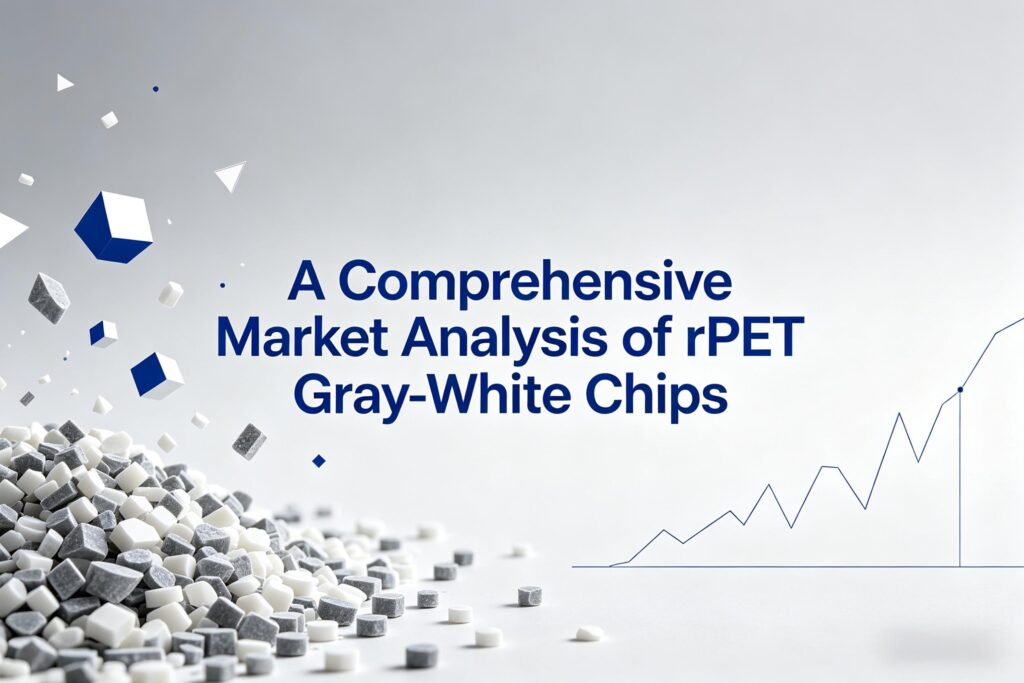
Abstract: This report provides a detailed analysis of the global market for rPET (Recycled Polyethylene Terephthalate) gray-white chips, addressing the core question of pricing while exploring the market’s underlying dynamics. The analysis covers current price ranges, key drivers of cost fluctuation, major regional markets, applications, and a forward-looking perspective on industry trends. Special attention is given to critical factors such as supply chain dynamics, quality certifications, and how selecting a competent supplier like Glyarn can mitigate procurement risks and ensure value in a volatile market.
Table of Contents
- Introduction: Understanding rPET Gray-White Chips
- 1.1. Product Definition and Key Characteristics
- 1.2. Primary Applications and End-Use Markets
- 1.3. The Importance of Quality and Certification (GRS, FDA)
- Current Price Analysis for rPET Gray-White Chips
- 2.1. Global Price Range Overview (2025)
- 2.2. Price Benchmark: China as a Major Supply Hub
- 2.2.1. Reference Price for Virgin PET Bottle Chips
- 2.2.2. Price Indicators for Recycled PET Flakes and Chips
- 2.3. Decoding Price Discrepancies: Factors Behind the Range
- Market Dynamics and Price Drivers
- 3.1. Supply-Side Factors
- 3.1.1. Raw Material (Post-Consumer Bottle) Availability and Cost
- 3.1.2. Production Capacity and Operational Rates
- 3.2. Demand-Side Factors
- 3.2.1. Off-Season vs. Peak Season Demand in Key Industries
- 3.2.2. Demand from Fiber and Packaging Sectors
- 3.3. Macro and Related Market Influences
- 3.3.1. Impact of Virgin PET Resin Prices
- 3.3.2. Policy, Trade, and Sustainability Mandates
- 3.1. Supply-Side Factors
- Global Market Landscape and Regional Insights
- 4.1. Asia-Pacific: The Manufacturing and Consumption Powerhouse
- 4.2. Europe and North America: Regulation-Driven Demand
- 4.3. Emerging Markets: Growing Import Demand
- Selecting a Supplier: Beyond Price – The Case for Glyarn
- 5.1. Core Supplier Selection Criteria
- 5.2. Integrated Manufacturing and Quality Assurance
- 5.3. The Value of Certifications and Technical Support
- Procurement Strategies and Future Outlook
- 6.1. Effective Sourcing and Negotiation Strategies
- 6.2. Market Forecast and Price Trend Projections
- 6.3. Long-Term Industry Trends and Strategic Recommendations
1. Introduction: Understanding rPET Gray-White Chips
rPET Gray-White Chips are a specific grade of recycled plastic raw material produced from post-consumer PET bottles. The “gray-white” color results from the recycling of mixed-color bottles, making it a cost-effective solution for applications where optical clarity is not required. These chips are a cornerstone of the circular economy, transforming waste into valuable feedstock for new products.
The primary applications for this material are in the textile and fiber industry (for producing polyester staple fiber for clothing, carpets, and filling) and the packaging sector (for non-food contact containers, strapping tapes, and sheets). A key differentiator in the market is the quality grade. While standard chips serve many purposes, suppliers like Glyarn offer food-grade rPET chips, which undergo rigorous cleaning and processing to meet stringent international safety standards, such as the U.S. FDA (Food and Drug Administration) approval for food contact and the GRS (Global Recycled Standard) certification. These certifications are critical for buyers targeting high-value, brand-sensitive markets in Europe and North America.
2. Current Price Analysis for rPET Gray-White Chips
Providing a single price per ton is challenging due to market volatility, but current data points to a range and provides a framework for evaluation.
2.1 Global Price Range Overview
As of late 2025, the price for rPET gray-white chips is highly sensitive to quality, region, and order volume. Globally, prices can range from $700 to $1,200 per metric ton CFR (Cost and Freight) to major ports. Chinese-origin material typically anchors the lower end of this scale, while European-produced chips with full traceability command a premium.
2.2 Price Benchmark: China as a Major Supply Hub
China is the world’s largest producer and a key price setter for rPET. Understanding its domestic market offers crucial benchmarks.
- Virgin PET Reference: As a baseline, the price of virgin PET bottle chips in China was around ¥6,300 per ton ($880-$900/ton) in early 2025.
- Recycled Flake and Chip Indicators: The price for recycled materials is intrinsically linked. In July 2025, the average price for “washed white flakes” in East China was approximately ¥4,858 per ton ($680-$700/ton). Processed gray-white chips, which incur additional manufacturing costs, are priced higher than flakes. For instance, market analysis from mid-2025 noted price fluctuations for recycled PET chips, with trends showing a tendency for weaker prices during seasonal demand lulls.
Table: Key Chinese rPET Market Price Indicators (2025)
| Product | Approx. Price (¥/ton) | Approx. Price (USD/ton) | Time Period | Source/Note |
|---|---|---|---|---|
| Virgin PET Bottle Chips | 6,300 | ~880 | April 2025 | Market reference |
| Washed White Flakes | 4,858 | ~680 | July 2025 Average | |
| rPET Gray-White Chips | 5,200 – 6,000+ | ~730 – 840+ | H2 2025 Estimate | Derived from flake price + processing premium. |
2.3 Decoding Price Discrepancies
The wide price range stems from several factors:
- Quality & Purity: Higher intrinsic viscosity (IV), lower contamination levels, and consistent color lead to higher prices.
- Certifications: GRS, FDA, or ISCC PLUS certification adds a significant premium (often 10-25%) due to the audited supply chain and compliance costs.
- Order Volume and Payment Terms: Large, long-term contracts often secure better prices than spot purchases.
- Logistics: Incoterms (FOB, CFR, CIF) and destination port significantly affect the final landed cost.
3. Market Dynamics and Price Drivers
The rPET market is influenced by a complex interplay of supply, demand, and external forces.
3.1 Supply-Side Factors
The foundation of the supply chain is the collection of post-consumer PET bottles. Seasonal variations greatly impact this; for example, collection volumes typically increase during hot summer months. However, operational challenges like weather can disrupt supply, leading to tightness and supporting prices. Furthermore, the operating rates of washing and pelletizing plants directly affect market availability. When prices are low and profit margins are squeezed, some plants may reduce output, constricting supply.
3.2 Demand-Side Factors
Demand is cyclical. The textile sector, a major consumer, experiences traditional low seasons (e.g., Q2/Q3), during which procurement slows, putting downward pressure on prices. Conversely, performance in the packaging and bottle-to-bottle recycling sector provides more stable, premium-driven demand. The overall economic sentiment also plays a role; in periods of weaker downstream demand, manufacturers maintain low raw material inventories and exert strong pressure to control costs.
3.3 Macro and Related Market Influences
The price of virgin PET, derived from petroleum, sets a ceiling for rPET. When the price gap between virgin and recycled PET narrows, the cost-advantage of rPET diminishes, dampening demand. Crucially, government policies are the most powerful long-term driver. Mandatory recycled content laws in the EU, Canada, and several U.S. states are creating structural, policy-driven demand that supports market growth and prices.
4. Global Market Landscape and Regional Insights
The market is geographically segmented with distinct characteristics:
- Asia-Pacific: Dominates in production and consumption, with China at its core. The region supplies both its vast domestic market (textiles, packaging) and export markets worldwide. Competition is intense, and prices are generally the most competitive globally.
- Europe & North America: These are high-value, regulation-driven markets. Local production is supplemented by imports, but buyers strongly prioritize certified, traceable material. Prices here are consistently higher than Asian export prices, reflecting the cost of compliance, labor, and strong sustainability commitments from brands.
- Emerging Markets: Countries like India, Southeast Asian nations, and those in Latin America are showing growing import demand as local recycling infrastructure develops and consumer goods manufacturing expands. Trade data shows consistent shipments of PET chips from China to India, highlighting this flow.
5. Selecting a Supplier: Beyond Price – The Case for Glyarn
While price is critical, the lowest offer can entail high risk regarding quality consistency, delivery reliability, and documentation. A supplier like Glyarn represents the type of partner that mitigates these risks and delivers long-term value. Key selection criteria include:
- Backward Integration: Suppliers with control over their own washing and flake production (like Glyarn, which operates large-scale recycling facilities) ensure better control over raw material quality and supply stability.
- Production Capability and Certification: Evaluate the plant’s annual capacity, technology, and, most importantly, recognized certifications. Glyarn’s production of food-grade rPET chips that meet FDA and GRS standards is a testament to its advanced process control and commitment to quality. This is essential for serving global brand owners.
- Technical Support and Consistency: A reliable supplier provides stable product specifications, complete documentation (lifecycle assessments, certification audits), and technical support for product development, which is invaluable for buyers integrating rPET into their products.
6. Procurement Strategies and Future Outlook
6.1 Effective Sourcing Strategies
Buyers should:
- Diversify Sources: Maintain a blend of long-term agreements with key suppliers like Glyarn for baseline supply and spot purchases for flexibility.
- Conduct Total Cost Analysis: Consider landed cost, including logistics, potential yield loss from poor-quality material, and the administrative cost of verifying uncertified supplies.
- Build Partnerships: Move beyond transactional relationships to collaborative partnerships with top-tier suppliers to gain insights, innovation, and supply security.
6.2 Market Forecast and Price Trends
In the short term (6-12 months), the market is expected to experience continued volatility with a potential for softness during traditional demand off-seasons. However, the long-term trajectory is firmly upward, driven not by cyclical factors but by structural ones:
- Policy Momentum: More regions will implement recycled content laws.
- Corporate Commitments: Major brands have public, time-bound goals for using recycled plastic.
- Supply Constraints: Building new recycling infrastructure is capital-intensive and slow, likely leading to supply-demand tightness in the coming years.
6.3 Conclusion and Strategic Recommendations
The question “How much per ton?” is the starting point, not the end. The price of rPET gray-white chips is a reflection of a dynamic global market shaped by raw material supply, downstream demand, and powerful policy tailwinds.
For strategic buyers, the recommendation is clear: Look beyond the price tag. Invest time in vetting suppliers on their technical capability, quality systems, and certifications. Partnering with established, integrated producers like Glyarn provides a hedge against quality risk and supply disruption. In the accelerating transition to a circular economy, securing a reliable, high-quality supply of rPET is not just a procurement activity—it is a strategic imperative for sustainable growth.
