
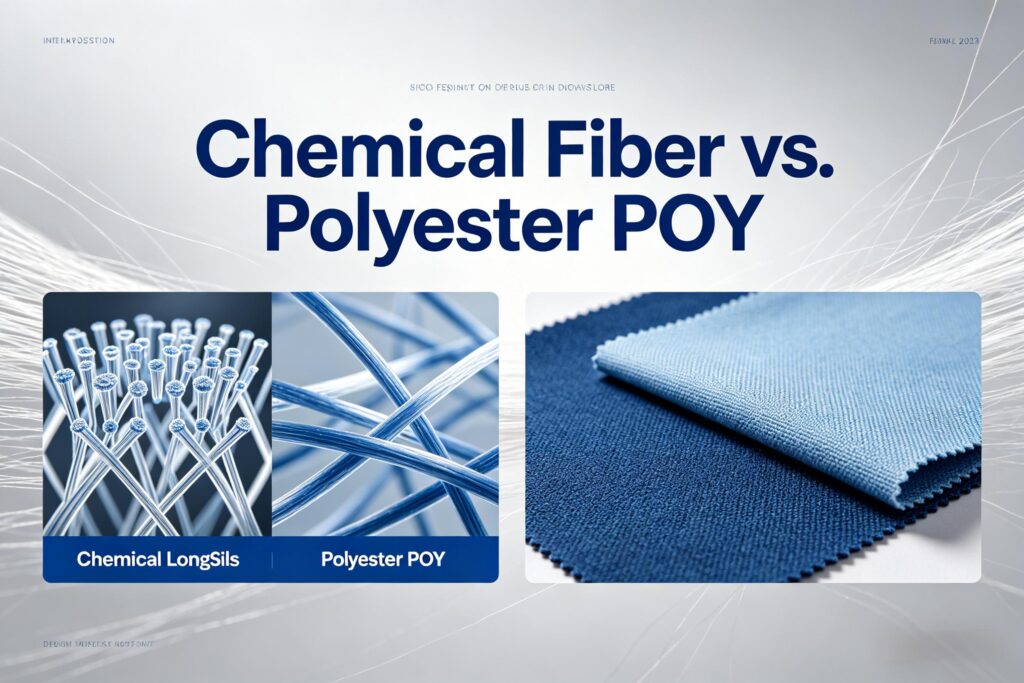
For professionals navigating the global textile supply chain, precise terminology is the foundation of successful sourcing, product development, and quality assurance. A common point of confusion arises from the relationship between broad categorical terms like “chemical fiber” and specific product forms like “Polyester POY.” Understanding this distinction is not academic—it is crucial for making informed decisions that affect cost, quality, and application suitability. This article will clarify these concepts, focusing on the pivotal role of Polyester Pre-Oriented Yarn (POY) within the synthetic fiber industry, providing actionable insights for buyers and product developers worldwide.
Table of Contents
- Introduction: Beyond the Jargon – Why Precision Matters in Global Sourcing
- Understanding the Umbrella: What Are Chemical Fibers?
- 2.1. Definition and Manufacturing
- 2.2. Major Categories and Common Types
- 2.3. Key General Properties
- Focusing on a Giant: The World of Polyester (PET)
- 3.1. From PTA to Polymer: The Chemistry of Polyester
- 3.2. Why Polyester Dominates: A Summary of Performance
- Decoding the Production Stage: The Polyester Filament Family Tree
- 4.1. The Filament Production Spectrum: From UDY to FDY
- 4.2. Defining the Intermediate: What is POY?
- 4.3. The Birth of Textured Yarns: POY’s Primary Destiny as DTY
- Head-to-Head Comparison: Chemical Fiber vs. Polyester POY
- 5.1. Comparative Analysis Table
- 5.2. Making the Right Choice: Application-Based Guidance
- Technical Deep Dive: Specifications and Quality Assessment of POY
- 6.1. Key Physical and Mechanical Properties
- 6.2. Industry Standards and Testing
- Conclusion: Strategic Sourcing in a Complex Market
1. Introduction: Beyond the Jargon – Why Precision Matters in Global Sourcing
In international trade, a request for “chemical fiber” is as vague as asking for a “vehicle”—it could mean anything from a bicycle to a truck. This lack of specificity leads to miscommunication, mismatched expectations, and costly errors. “Chemical fiber” is a vast category, while “Polyester POY” is a specific, intermediate product form with unique characteristics and purposes. Clarity in differentiating between the general category and the specific product enables buyers to target suppliers accurately, negotiate based on precise specifications, and select the material perfectly suited for their final product, whether it’s a sleek athletic shirt or a durable upholstery fabric.
2. Understanding the Umbrella: What Are Chemical Fibers?
2.1. Definition and Manufacturing
Chemical fibers, also known as man-made fibers, are textiles whose primary chemical composition, structure, and properties are engineered by industrial processes. Unlike natural fibers (cotton, wool, silk), they are not found in nature. They are produced by converting natural or synthetic polymers into a fiber form through processes like melt spinning (for synthetics) or solution spinning (for some regenerated fibers).
2.2. Major Categories and Common Types
The chemical fiber family is broadly divided into two branches:
- Synthetic Fibers: Made from polymers synthesized from petrochemicals. Key members include:
- Polyester (PET): The most produced synthetic fiber globally.
- Nylon (PA): Known for high strength and elasticity.
- Polypropylene (PP), Acrylic, Spandex (PU).
- Regenerated/Cellulosic Fibers: Made from natural polymer sources (like wood pulp) reconstituted chemically. Examples include Viscose (Rayon), Lyocell, and Acetate.
2.3. Key General Properties
As a group, chemical fibers offer engineered advantages over many natural fibers, such as high strength, excellent durability, resistance to mildew and insects, and consistent quality and supply. However, properties like moisture absorption, heat sensitivity, and hand feel vary dramatically between types.
3. Focusing on a Giant: The World of Polyester (PET)
3.1. From PTA to Polymer: The Chemistry of Polyester
Polyester, specifically Polyethylene Terephthalate (PET), is synthesized from purified terephthalic acid (PTA) and monoethylene glycol (MEG). This polymer is then melted and extruded to form fibers. Its molecular structure, featuring a rigid benzene ring and a flexible chain, grants it a exceptional balance of strength and stability.
3.2. Why Polyester Dominates: A Summary of Performance
Polyester’s market dominance is no accident. Its profile offers compelling value:
- High Strength & Durability: Excellent tenacity and abrasion resistance.
- Dimensional Stability: Excellent resilience and low shrinkage, leading to wrinkle resistance.
- Versatile Processing: Can be engineered into many filament and staple forms.
- Cost-Effectiveness: Scalable production from widely available petrochemicals.
4. Decoding the Production Stage: The Polyester Filament Family Tree
Polyester filament is not a single product but a series of forms defined by their degree of molecular orientation and crystallization achieved during spinning and drawing.
4.1. The Filament Production Spectrum
Filaments are categorized by their production stage:
- Undrawn Yarn (UDY): Very low orientation, unstable, not directly usable.
- Pre-Oriented Yarn (POY): The focal point of this article.
- Fully Drawn Yarn (FDY): Fully oriented and crystallized, ready for direct use in weaving/knitting.
- Draw Textured Yarn (DTY): The primary product made from POY, given stretch and bulk.
4.2. Defining the Intermediate: What is POY?
Polyester POY is a partially oriented yarn produced via high-speed spinning (3,000-6,000 m/min). It is an intermediate product, not a final consumer yarn.
- Structure: It has moderate molecular orientation (birefringence 0.025-0.060) but low crystallinity (<5%).
- Key Traits: High elongation at break (100-150%), relatively low strength, and excellent storage stability. It is designed for further processing.
- The Bottom Line: POY is not typically used directly in fabrics. Its core purpose is to serve as the superior feedstock for the next stage.
4.3. The Birth of Textured Yarns: POY’s Primary Destiny as DTY
Over 95% of POY is destined to become Draw Textured Yarn (DTY). In the texturing process, POY is simultaneously drawn to complete its orientation and subjected to false-twisting to create crimps and coils. This gives DTY its characteristic stretch, bulk, and softness, making it ideal for knitwear, sportswear, and upholstery. Research confirms that POY offers better processability and often yields higher-quality textured yarn compared to using fully oriented feed yarns.
5. Head-to-Head Comparison: Chemical Fiber vs. Polyester POY
The following table crystallizes the fundamental difference between these two terms:
Table 1: Conceptual and Practical Comparison
| Aspect | Chemical Fiber (Synthetics like Polyester, Nylon) | Polyester POY |
|---|---|---|
| Definition Level | Broad Category (Class of materials). | Specific Product Form (A stage of production). |
| Analogy | “Fruit” or “Vehicle.” | “A green, unripe banana” or “A car engine block.” |
| Relationship | The overarching family. | A specific member and a specific state of that member. |
| Primary Use | Direct use in final products (as FDY, staple fiber, etc.) or as raw material for other forms. | Exclusively an intermediate material for producing other yarns (mainly DTY). |
| Purchasing Context | A final product for a fabric manufacturer or consumer. | A raw material for a yarn texturing plant. |
| Key Properties | Varies wildly: Nylon is elastic, Polyester is stable, PP is hydrophobic. | Defined by processability: High elongation, low crystallinity, stability for drawing. |
5.2. Making the Right Choice: Application-Based Guidance
- You are looking for CHEMICAL FIBER (Polyester) if: You need yarn to weave or knit directly into fabric. You would source FDY for smooth, strong fabrics (e.g., linings, shirtings) or DTY for soft, stretchy fabrics (e.g., fleece, jerseys).
- You are looking for POLYESTER POY if: You operate a texturing facility to produce DTY. Your specifications focus on consistent denier, elongation, and uniformity to ensure smooth, high-speed texturing with minimal breaks.
6. Technical Deep Dive: Specifications and Quality Assessment of POY
For buyers of POY, understanding technical specs is critical for quality control.
6.1. Key Physical and Mechanical Properties
- Linear Density & Uniformity: Measured in denier (D) or decitex. Low denier variation is crucial for even dyeing later.
- Elongation at Break: Typically 100-150%. Must be uniform to allow for consistent drawing during texturing.
- Tenacity: While lower than FDY, it must be sufficient to withstand downstream processing.
- Inter-filament Uniformity: Essential for preventing breaks and ensuring a uniform final yarn texture.
6.2. Industry Standards and Testing
Quality is assessed against standards like GB/T 4146.2 and specific industry norms. Key tests include:
- Line Density Deviation Rate
- Breaking Strength and Elongation
- Boiling Water Shrinkage Rate
- Oil Content
- Uniformity (Uster Statistics)
7. Conclusion: Strategic Sourcing in a Complex Market
The distinction between “chemical fiber” and “Polyester POY” is the difference between a blueprint and a specific component. For global buyers, precision in language translates directly to efficiency and success.
- Chemical Fibers represent the vast, engineered material base of modern textiles.
- Polyester is the dominant, versatile champion within that base.
- Polyester POY is the critical, semi-finished engine that drives the production of the textured yarns that fill our world.
Understanding this hierarchy allows sourcing professionals to bypass vague inquiries and engage in expert dialogues. It ensures that procurement strategies align with actual production needs, whether you are sourcing the final yarn for a cutting-edge fashion line or the optimal intermediate feed for a high-throughput texturing mill. In the intricate dance of global supply chains, such clarity is not just helpful—it is indispensable.
