
Table of Contents
- Introduction: The Language of Fiber – Why Understanding “D” is Crucial for Sourcing
- Breaking Down “150D”: Denier and Its Relationship to Filament Count
- From Numbers to Performance: How Denier and Filament Count Define Fabric Characteristics
- Choosing the Right 150D Configuration: A Guide for Product Applications
- Sourcing 150D Polyester: Technical Specifications and Quality Verification
- Conclusion: Making Informed Decisions with a Technical Edge
1. Introduction: The Language of Fiber – Why Understanding “D” is Crucial for Sourcing
In the global textile supply chain, precise communication is the foundation of successful sourcing and product development. For professionals sourcing or using polyester filament yarn (PFY), encountering a specification like “150D” is inevitable. This simple notation is not just a random model number; it is a precise technical descriptor that reveals fundamental information about the yarn’s physical properties, performance potential, and ideal applications. Misunderstanding it can lead to sourcing the wrong material, resulting in products that fail to meet performance expectations, disappoint customers, and harm your brand’s reputation.
This article serves as a definitive guide for international buyers, designers, and product developers. We will decode the meaning of “150D” and its critical relationship with filament count, translating technical jargon into actionable business intelligence. You will learn how these two numbers directly dictate a fabric’s weight, strength, hand feel, drape, and end-use, empowering you to make data-driven sourcing decisions and communicate effectively with suppliers worldwide.
2. Breaking Down “150D”: Denier and Its Relationship to Filament Count
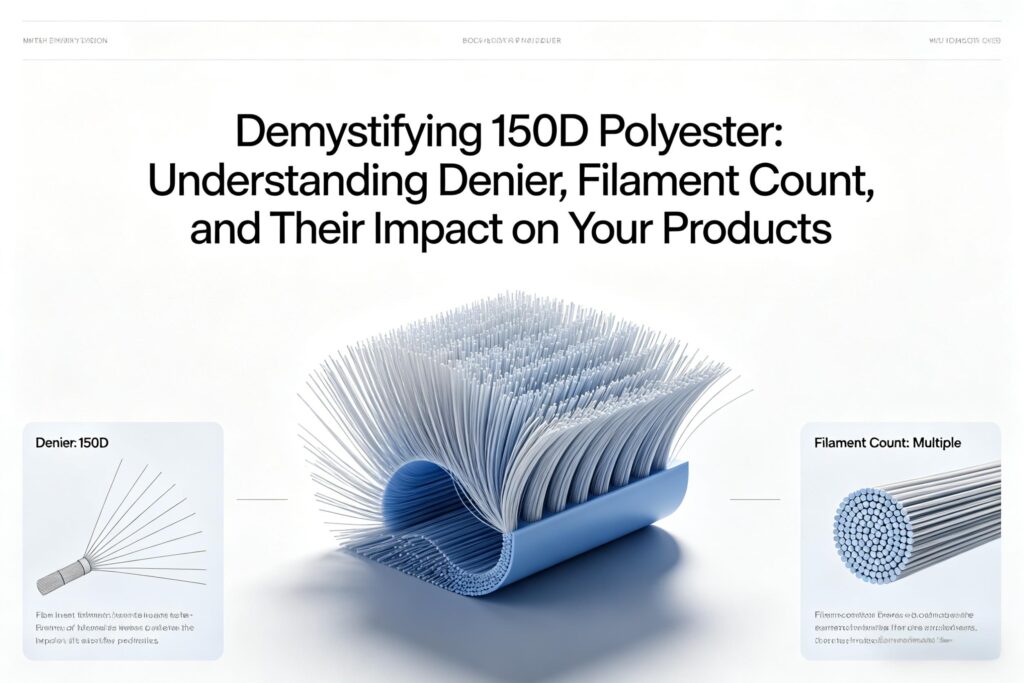
The term “150D” specifically refers to the yarn’s denier (D). Denier is a direct mass measurement unit for linear density, defined as the mass in grams of 9,000 meters of yarn. Therefore, 150D means that 9,000 meters of this particular yarn weighs 150 grams.
However, denier alone tells only half the story. A 150D yarn can be constructed in vastly different ways, and this is where filament count (F) enters the equation. Polyester filament yarn is not a single strand but a bundle of many ultra-fine continuous filaments twisted or assembled together. The filament count is the number of these individual filaments that make up the 150D yarn bundle.
The Core Relationship: dpf (Denier per Filament)
The link between total yarn denier (D) and the number of filaments (F) is expressed through a crucial derived metric: denier per filament (dpf).dpf = Total Denier (D) / Number of Filaments (F)
This formula reveals everything:
- A 150D/48F yarn has a dpf of 150/48 = 3.125. This is a relatively thick individual filament.
- A 150D/288F yarn has a dpf of 150/288 = ~0.52. This is a very fine individual filament.
Table 1: Comparing Different 150D Configurations
| Yarn Specification | Total Denier (D) | Filament Count (F) | Denier per Filament (dpf) | General Characterization |
|---|---|---|---|---|
| 150D/48F | 150 | 48 | 3.125 | Coarse filament, heavier hand, higher stiffness. |
| 150D/96F | 150 | 96 | 1.56 | Medium filament, balanced hand. Common workhorse yarn. |
| 150D/144F | 150 | 144 | 1.04 | Fine filament, softer hand, better drape. |
| 150D/288F | 150 | 288 | 0.52 | Microfilament or superfine filament, very soft, silky hand. |
3. From Numbers to Performance: How Denier and Filament Count Define Fabric Characteristics
The dpf, determined by the F in a 150D yarn, is the primary driver of the final fabric’s sensory and functional properties.
- Fabric Hand Feel and Drape: This is the most immediate difference. A low dpf (high filament count) means more fine filaments are packed into the same yarn weight. These fine filaments create a softer, smoother, more luxurious hand feel and superior drape. A 150D/288F fabric will feel silky and fluid, while a 150D/48F fabric will feel crisper, drier, and more structured.
- Strength and Durability: While total denier (150D) gives a general indication of overall yarn strength, the dpf influences abrasion resistance. Coarser filaments (high dpf) like those in 150D/48F can be more resistant to surface abrasion in some applications, but the bundled strength of many fine filaments in a 150D/288F yarn often provides excellent overall durability with much better flexibility.
- Coverage and Opacity: Yarns with higher filament counts provide better coverage because the many fine filaments create a denser, more cohesive web of fibers. A fabric woven from 150D/288F will generally be more opaque and have a richer visual appearance than one from 150D/48F at the same weave density.
- Moisture Management and Wicking: Fabrics made from microfilament yarns (e.g., 150D/288F) have a greater total surface area. This can enhance capillary action, potentially improving moisture-wicking performance in activewear applications.
- Dyeing and Luster: Fine filaments dye to deeper, richer shades due to increased surface area for dye absorption. They also tend to produce a softer, more subdued luster compared to the brighter, sometimes glittery shine of fabrics made with coarser filaments.
4. Choosing the Right 150D Configuration: A Guide for Product Applications
Selecting the correct 150D/F combination is a strategic decision that aligns technical specifications with product goals.
- High-Filament, Low-dpf Yarns (e.g., 150D/144F to 150D/288F):
- Applications: High-quality fashion apparel (blouses, dresses, linings), luxury lingerie, premium shirts, high-thread-count lightweight performance apparel, and fabrics requiring a silk-like aesthetic.
- Why: They deliver exceptional softness, beautiful drape, rich color depth, and a high-quality perceived value.
- Medium-Filament Yarns (e.g., 150D/72F to 150D/96F):
- Applications: The “workhorse” category. Ideal for everyday apparel (shirts, blouses, skirts), durable linings, technical shells, umbrellas, and mid-market home textiles (like some curtain fabrics).
- Why: They offer an excellent balance of durability, manageable production costs, good hand feel, and reliable performance. The 150D/96F specification is one of the most common and versatile in the global market.
- Low-Filament, High-dpf Yarns (e.g., 150D/36F, 150D/48F):
- Applications: Technical and industrial textiles (backpacks, luggage, tactical gear), certain types of canvas, heavier upholstery fabrics, and fabrics where a crisp, structured hand or maximum stiffness is desired.
- Why: They provide high tensile strength, excellent abrasion resistance, and a firm hand. They are also generally less expensive to produce than high-filament yarns.
Table 2: Application-Based Selection Guide for 150D Polyester
| Target Application | Recommended Filament Count (F) Range | Key Rationale |
|---|---|---|
| Luxury Fashion / Lingerie / Silky Linings | 144F – 288F+ | Prioritizes ultra-soft hand, superior drape, and premium aesthetic. |
| Everyday Fashion & Apparel | 72F – 144F | Balances cost, durability, and a pleasant, comfortable hand feel. |
| Technical Outerwear & Shell Fabrics | 48F – 96F | Focuses on strength, wind resistance, and durable performance. |
| Industrial & Heavy-Duty Fabrics | 36F – 72F | Maximizes strength, abrasion resistance, and structural integrity. |
5. Sourcing 150D Polyester: Technical Specifications and Quality Verification
When sourcing, “150D” is an insufficient specification. You must specify the full D/F combination.
- Complete Your Tech Pack: Your sourcing document should clearly state: “Polyester Filament Yarn, 150 Denier / 96 Filament, Semi-Dull Luster” (or Bright, as required).
- Request and Analyze Technical Data Sheets (TDS): A professional supplier will provide a TDS with key data beyond D/F:
- Tenacity & Elongation: Measured in cN/dtex (e.g., ≥3.8 cN/dtex).
- Thermal Shrinkage: Boiling water shrinkage % (e.g., ≤8%).
- Oil Content: Critical for smooth weaving/knitting.
- Yarn Evenness (Uster CV%): Lower is better; indicates production quality.
- Order Physical Swatches: Always evaluate the actual fabric made from the specified yarn. Test the hand, drape, and appearance against your benchmark. A supplier’s willingness to provide tailored fabric samples is a mark of professionalism.
- Understand the Cost Drivers: Higher filament counts (e.g., 288F) require more advanced spinning technology, finer spinnerets, and often more precise process control, making them 10-30% more expensive than a standard 150D/96F yarn. This cost reflects the enhanced performance and premium feel.
6. Conclusion: Making Informed Decisions with a Technical Edge
The question “What does 150D mean?” opens the door to a critical aspect of textile sourcing. It represents not just a weight, but a spectrum of possibilities defined by the often-overlooked filament count. Understanding the relationship between 150D and the F number—encapsulated in the dpf—is what allows you to move from guessing to specifying.
As a strategic buyer, you are no longer at the mercy of a supplier’s generic offer. You can now:
- Specify with Precision: Confidently request the exact D/F combination that meets your product’s functional and aesthetic needs.
- Predict Fabric Behavior: Anticipate the hand feel, drape, and performance of your final fabric based on yarn specifications.
- Optimize Cost vs. Value: Make informed decisions about where to invest in a higher-filament count for premium quality and where a standard count provides the best value.
- Communicate Effectively: Use the correct technical language with mills and suppliers, ensuring you get the material you designed for.
In the complex global textile market, this knowledge transforms you from a passive purchaser into an expert specifier, ensuring product integrity, customer satisfaction, and a stronger bottom line. Remember, the right specification is the first and most important step in building a successful product.
