
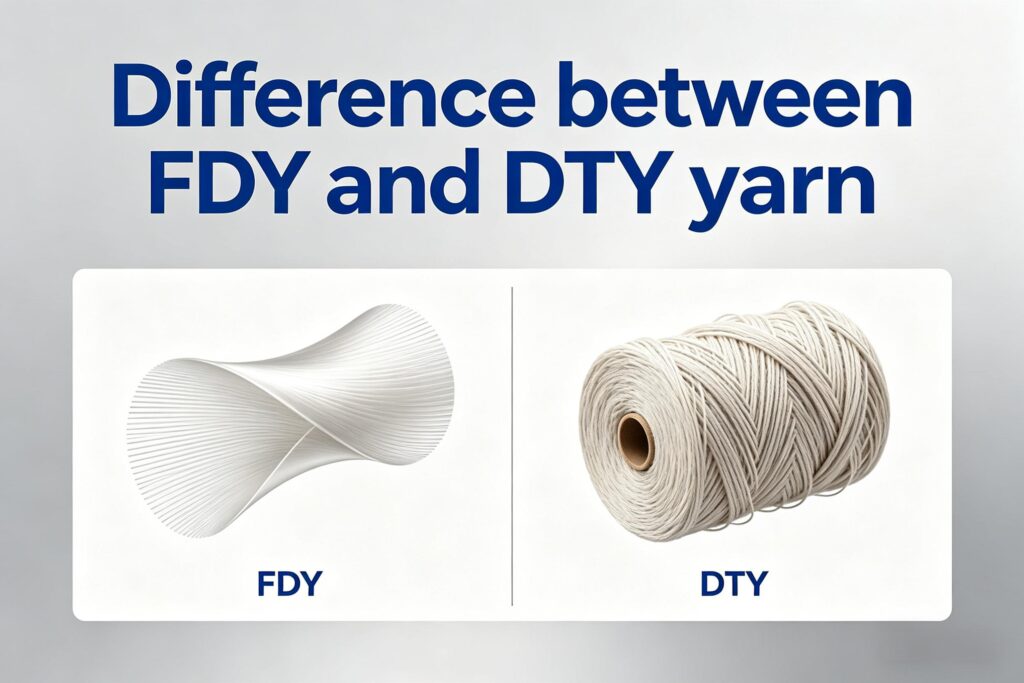
The Distinct Paths of Polyester: Unraveling the Difference Between FDY and DTY Yarn
In the intricate world of synthetic textiles, FDY and DTY represent two of the most prevalent forms of polyester filament yarns. While both begin from the same raw material, their manufacturing processes diverge, resulting in finished products with distinct physical properties, aesthetics, and end-use applications. Understanding the difference between them is fundamental to selecting the right material for any textile product.
The core distinction lies in their production journey, particularly what happens after the creation of the intermediate yarn known as POY (Partially Oriented Yarn). Both FDY and DTY use POY as their starting point, but they process it in fundamentally different ways.
FDY (Fully Drawn Yarn) undergoes a process focused on achieving maximum strength and smoothness. In a continuous, integrated operation, the POY is drawn—meaning it is stretched to its maximum potential at a specific, controlled temperature. This high-temperature drawing fully aligns the polymer molecules along the filament’s axis, crystallizing the structure. The yarn is then wound onto bobbins. This process results in a filament that is smooth, sleek, and highly lustrous. FDY has high tenacity (strength) and low elongation, meaning it does not stretch significantly. Its molecular structure is fully set, making it dimensionally stable.
In contrast, DTY (Drawn Textured Yarn) undergoes a process designed to introduce bulk and stretch. In a single machine called a texturing machine, the POY is simultaneously drawn (to improve strength) and textured. The texturing process, often using false-twist technology, crimps the filaments by twisting, heating, and then cooling them rapidly. This sets permanent tiny coils, loops, and crimps into the individual filaments. The result is a yarn that is bulky, fuzzy, and opaque with a soft, cotton-like hand-feel. Its most defining property is its high elasticity and significant stretch, a direct result of the introduced crimps.
These structural differences dictate their separate applications in the textile industry. FDY’s smoothness, strength, and shine make it ideal for woven fabrics where a sleek appearance and stability are required. It is the yarn of choice for linings, umbrella cloth, sewing threads, high-quality shirting fabrics, and taffeta. Its inability to stretch is an advantage in these applications, providing structure and durability.
DTY, with its bulk and elasticity, is the quintessential yarn for the knitting industry. Its stretch provides excellent comfort and freedom of movement, making it perfect for apparel such as t-shirts, polo shirts, sportswear, hosiery, and intimate apparel. The bulk also creates more opaque fabrics with better coverage and a warmer feel, making it suitable for fleece and home furnishings like upholstery.
In summary, the choice between FDY and DTY is a choice between structure and comfort. FDY represents the path of refinement towards strength and smoothness, resulting in stable, lustrous woven fabrics. DTY represents the path of transformation towards bulk and elasticity, resulting in soft, stretchy knitted fabrics. Recognizing this fundamental difference allows designers and manufacturers to precisely select the yarn that best fulfills the functional and aesthetic demands of their final product.
