
Table of Contents
- Introduction: The Era of Intelligent Blending
- The Question Every Smart Buyer Asks
- Why Blend? The Core Philosophy Behind Modern Fabrics
- Deconstructing the Blend: Core Fiber Properties
- The Natural Trio: Inherent Qualities of Cotton, Linen, and Wool
- The Synthetic Powerhouse: Polyester’s Defining Characteristics
- A Property Comparison Table: The Science Behind the Synergy
- Yes, They Can: Common Blends and Their Strategic Purposes
- Cotton/Polyester: The Workhorse of Modern Textiles
- Linen Blends (Linen/Cotton/Polyester): Enhancing Performance
- Wool Blends (Wool/Polyester): Durability Meets Luxury
- Multi-Fiber Blends (e.g., Cotton/Polyester/Spandex): The Pinnacle of Function
- Navigating Blends: A Buyer’s Strategic Decision Matrix
- Table: Application-Driven Guide to Fiber Blends
- Cost-Benefit Analysis: Premium Natural vs. High-Performance Synthetic
- The Critical Role of Blend Ratios and Yarn Structure
- From Fiber to Fabric: How Blending Transforms Performance
- Case Study: The Mechanics of a Cotton/Polyester/Linen Yarn
- Impact on Key Metrics: Strength, Wrinkle Resistance, Moisture Management
- The Sustainability and End-of-Life Challenge
- The “Monstrous Hybrid” Dilemma and Recycling Realities
- Innovations in Separation and Processing
- Making Responsible Sourcing Decisions
- Specification and Sourcing: Asking the Right Questions
- How to Decode a Fabric Composition Label
- Verifying Claims: The Importance of Certifications and Testing
- Future Trends: Next-Generation Blends and Smart Fabrics
- Conclusion: Building a Strategic, Performance-Driven Fabric Portfolio
- FAQ: Frequently Asked Questions
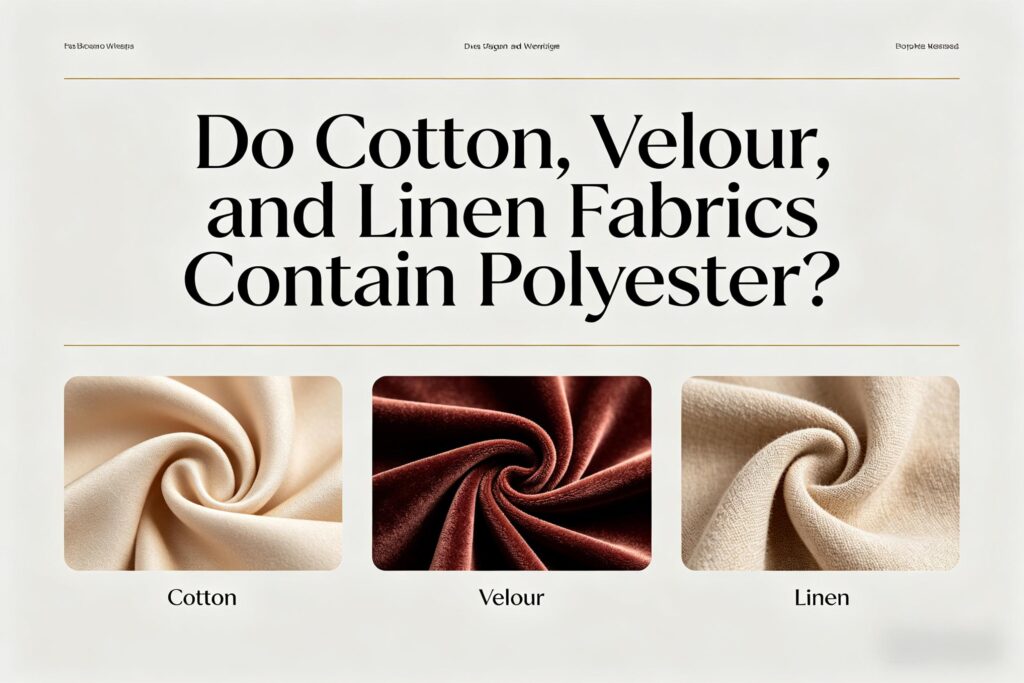
Do Cotton, Velour, and Linen Fabrics Contain Polyester? A Strategic Sourcing Guide
1. Introduction: The Era of Intelligent Blending
For textile and product sourcing professionals, a fabric’s composition is its blueprint. When evaluating cotton, velour (often a plush knit made from cotton or blends), or linen, the question isn’t merely “Is it 100% natural?” but rather “What is the optimal material mix to achieve my target cost, performance, and sustainability goals?” The modern answer frequently includes polyester.
The global textile industry has moved far beyond pure fibers. Today, blending is a precise science of combining natural comfort with synthetic performance. Polyester, as the most produced synthetic fiber globally, is a key ingredient in this alchemy. This guide will provide you with the technical depth and commercial insight needed to navigate this blended landscape, ensuring your sourcing decisions are informed, strategic, and value-driven.
2. Deconstructing the Blend: Core Fiber Properties
Understanding why fibers are blended starts with their innate strengths and weaknesses.
- The Natural Trio:
- Cotton: Prized for its softness, breathability, and excellent moisture absorption (it can absorb up to 8-10% of its weight in moisture). However, it wrinkles easily, can shrink, and loses strength when wet.
- Linen (from Flax): Renowned for its exceptional coolness, crisp texture, and high tensile strength (about twice as strong as cotton). Its drawbacks include stiffness, low elasticity, and a propensity to wrinkle severely.
- Wool: Offers superior warmth, resilience, and flame resistance. It can absorb a significant amount of moisture without feeling wet. It can be scratchy, requires careful care, and may felt or shrink.
- The Synthetic Powerhouse: Polyester
Polyester brings a set of engineered properties that directly compensate for natural fiber shortcomings:- High Strength & Durability: Excellent resistance to abrasion, stretching, and shrinking.
- Dimensional Stability: Fabrics maintain their shape and are less prone to wrinkling.
- Quick-Drying: As a hydrophobic fiber, it absorbs very little moisture, allowing water to evaporate quickly from its surface.
- Cost-Effectiveness: Generally lower and more stable in price than many natural fibers.
Table 1: Core Fiber Property Comparison
| Property | Cotton | Linen | Wool | Polyester |
|---|---|---|---|---|
| Strength (Wet) | Low | Very High | Low (weakened) | High |
| Moisture Absorption | Very High | High | Very High | Very Low |
| Wrinkle Resistance | Low | Very Low | Medium | Very High |
| Durability/Abrasion | Good | Good | Good | Excellent |
| Typical Hand Feel | Soft, Comfortable | Crisp, Cool | Warm, Coarse | Smooth, Can be Stiff |
| Cost Profile | Moderate | Moderate-High | High | Low-Moderate |
3. Yes, They Can: Common Blends and Their Strategic Purposes
Blends containing cotton, linen, or wool with polyester are not only common but are often industry standards for specific applications.
- Cotton/Polyester: The Universal Workhorse
This is arguably the most prevalent blend. A classic 65%/35% Polyester/Cotton (T/C) ratio leverages polyester for strength, wrinkle resistance, and easy care, while cotton provides breathability and comfort. The balance shifts in CVC (Chief Value Cotton) fabrics, where cotton is the majority (e.g., 60%/40%), offering a more natural feel with enhanced durability. These blends dominate in shirts, uniforms, bed linens, and casual wear. - Linen Blends: Making Luxury Practical
Pure linen’s wrinkles are part of its charm but a barrier for many applications. Blending linen with polyester (e.g., 20-30%) dramatically improves wrinkle recovery, reduces shrinkage, and adds durability without completely sacrificing linen’s distinctive texture and coolness. Research shows linen/polyester/PTT blends achieve excellent anti-pilling and tensile strength. Linen/cotton blends are also popular for a softer hand. - Wool Blends: Performance in Tailoring
In suiting and outerwear, adding 15-30% polyester to wool creates fabrics that are more durable, retain sharp pleats and shape, resist wrinkles, and are often more affordable. The polyester reinforces the wool, making the garment more resilient to daily wear. - Multi-Fiber Blends: Engineering Specific Functions
The real engineering happens with three or more fibers. A Cotton/Polyester/Spandex blend combines moisture management, durability, and essential stretch for activewear. A T/R (Polyester/Rayon) blend with a small amount of spandex offers a drapey, soft hand with improved durability for dresses and blouses.
4. Navigating Blends: A Buyer’s Strategic Decision Matrix
Choosing the right blend is a strategic calculation. The following table provides a data-driven starting point for your sourcing discussions.
Table 2: Application-Driven Guide to Fiber Blends
| Target Application & Goal | Recommended Blend (Example) | Key Performance Benefits Achieved | Ideal For: |
|---|---|---|---|
| Durable Workwear / Uniforms | 65% Polyester / 35% Cotton | High abrasion resistance, shape retention, easy wash-and-wear, reduced shrinkage. | Hospitality, manufacturing, corporate uniforms. |
| Premium Casual Shirts (Wrinkle-Free) | 60% Cotton / 40% Polyester (CVC) or 55% Polyester / 42% Cotton / 3% Spandex | Softer hand than T/C, excellent wrinkle recovery, some stretch for comfort. | Branded men’s & women’s shirting. |
| Summer Apparel (Cool & Crisp) | 70% Linen / 30% Cotton or 55% Linen / 45% Polyester | Linen’s coolness with improved softness (cotton) or drastically reduced wrinkling (polyester). | Dresses, trousers, lightweight jackets. |
| Performance Activewear | 88% Polyester / 12% Spandex or 50% Cotton / 45% Polyester / 5% Spandex | Moisture-wicking, stretch, recovery, durability (high-poly). Comfortable, absorbent, stable (cotton-mix). | Sportswear, leggings, athletic tops. |
| Plush Toys & Upholstery | 80% Acrylic / 20% Polyester or 100% Polyester (velour type) | Cost-effective bulk, durability, colorfastness. Soft, dense pile that withstands handling. | Stuffed animals, furniture fabric, blankets. |
| Formal Suiting / Blazers | 75% Wool / 25% Polyester | Luxurious appearance and feel of wool with enhanced durability, wrinkle resistance, and lower cost. | Business attire, school blazers. |
Cost-Benefit Analysis: The inclusion of polyester almost always reduces material cost and improves durability/ease of care. The trade-off can be a reduction in perceived luxury (in high-end wool or linen), breathability (in dense cotton blends), or complicating end-of-life recycling.
5. From Fiber to Fabric: How Blending Transforms Performance
The benefits are not merely additive; they are synergistic. A detailed case study from a textile mill producing an 11.7 tex x 2 yarn composed of 62% Cotton, 20% Polyester, and 18% Linen (CJ/T/L) illustrates the precision involved.
- Process: To handle the coarse, stiff linen fibers, the mill pre-blended the polyester and linen via fiber mixing before combining them with cotton at the drawing frame (sliver mixing). This ensured even distribution.
- Resulting Fabric Properties: The final knit fabric was described as “sleek, smooth, sweat-absorbent, anti-bacterial, and comfortable to wear”. Here’s the synergy:
- Polyester provided the strength and wrinkle resistance that linen and cotton lack.
- Linen compensated for polyester’s low moisture absorption, adding coolness and moisture-wicking.
- Cotton softened the rough hand of the linen, improving overall comfort.
This precise engineering resulted in a product with higher profitability than a comparable pure cotton yarn.
6. The Sustainability and End-of-Life Challenge
This is the most critical and complex chapter for modern sourcing. Blends of natural and synthetic fibers create a significant recycling hurdle, famously dubbed “monstrous hybrids” because they are difficult to separate and process conventionally.
- The Reality: Traditional mechanical recycling (shredding) of a cotton/polyester blend results in a downcycled, lower-quality material. The fibers are entangled and cannot be cleanly reclaimed for high-value uses.
- The Innovation Frontier: Solutions are emerging but are not yet ubiquitous. Chemical recycling technologies are being developed to dissolve the cotton component of a blend into cellulose pulp and recover polyester as pellets, both suitable for reuse in new textiles. Enzymatic processes are also being researched to selectively degrade one fiber component.
- Sourcing Responsibility: For buyers, this means:
- Prioritize Durability: Specifying a durable blend that extends the product’s life is a primary form of sustainability.
- Demand Transparency: Ask suppliers about the recyclability of their blends and any take-back programs.
- Consider End-of-Life: For products with short lifecycles (e.g., fast fashion, some promotional items), mono-material fabrics (100% cotton, 100% polyester) are easier to recycle.
7. Specification and Sourcing: Asking the Right Questions
Move beyond the label. Engage your fabric suppliers with technical precision:
- “For this 55% linen/45% polyester shirting, what is the yarn structure? Is it an intimate blend or a core-spun yarn?”
- “Can you provide test reports for pilling resistance (e.g., Martindale) and wrinkle recovery angle for this blend?”
- “Is the recycled polyester content in this blend certified (e.g., GRS)? What is the specific separation technology planned for its end-of-life?”
- “How do you ensure consistent blend ratio control from batch to batch?”
8. Future Trends: Next-Generation Blends
The future lies in bi-component fibers (single fibers with a polyester core and natural sheath), bio-based polyesters, and intelligent blends with built-in phase-change materials or conductive properties. The goal remains the same: to combine the best of nature and engineering with increasing regard for circularity.
9. Conclusion: Building a Strategic, Performance-Driven Fabric Portfolio
The question “Do cotton, velour, and linen fabrics contain polyester?” opens the door to strategic sourcing. Polyester is not merely a cost-saving filler; it is a performance modulator. By understanding the property matrix, application drivers, and sustainability implications outlined in this guide, you can specify blends that deliver superior value, meet precise performance benchmarks, and align with evolving environmental expectations. Your expertise in decoding the blend is what will differentiate your products in a competitive global market.
10. FAQ: Frequently Asked Questions
Q1: If a fabric is labeled “linen,” can it legally contain polyester?
A: Labeling regulations (like the Textile Fiber Products Identification Act in the US) require fibers comprising 5% or more by weight to be listed in descending order. A fabric can be called “linen” in the product name (e.g., “Linen-Blend Shirt”), but the label must accurately state the full composition, like “55% Linen, 45% Polyester.”
Q2: What blend ratio is best for a balance of comfort and durability in daily wear?
A: For everyday apparel like chinos or casual shirts, a 55% Cotton / 45% Polyester or 60% Cotton / 40% Polyester (CVC) blend is an excellent benchmark. It favors the soft, breathable hand of cotton while gaining substantial wrinkle resistance and durability from polyester.
Q3: Why does my “wrinkle-free” cotton shirt still contain polyester?
A: True “wrinkle-free” or “non-iron” performance in cotton garments is typically achieved through a chemical resin treatment applied to a cotton/polyester blend. The polyester fibers provide inherent resilience, while the resin helps the cotton fibers “remember” their shape. A 100% cotton shirt, even with treatment, will not recover as well.
Q4: Are there any downsides to adding polyester to wool for a suit?
A: The primary trade-off is a potential reduction in the luxurious hand, drape, and breathability associated with high-quality pure wool. Some purists argue it can feel slightly less “natural.” However, for everyday business wear, the benefits of durability, shape retention, and reduced cost often outweigh these concerns.
Q5: How does blending affect dyeing?
A: It adds complexity. Cotton and linen (cellulosic) are dyed with one class of dyes, while polyester requires different dyes at high temperatures. In a blend, two-bath or sophisticated one-bath dyeing processes are needed to ensure both fiber types color evenly and with good fastness. This can affect cost and minimum order quantities.
Q6: Can blended fabrics be as sustainable as 100% natural ones?
A: It depends on the metric. In terms of end-of-life compostability, 100% natural fibers are superior. However, a durable blend that lasts three times as long as a delicate pure linen garment has a strong sustainability argument via longevity and reduced replacement rate. The least sustainable option is often a low-quality blend in a disposable product.
Q7: Is velour always made from cotton?
A: No. Historically, velour was a cotton pile fabric. Today, velour is a structural description (a cut-pile knit) and can be made from 100% cotton, cotton/polyester blends, or even 100% polyester. Polyester velour is extremely common for upholstery, robes, and toys due to its durability, color vibrancy, and lower cost.
