
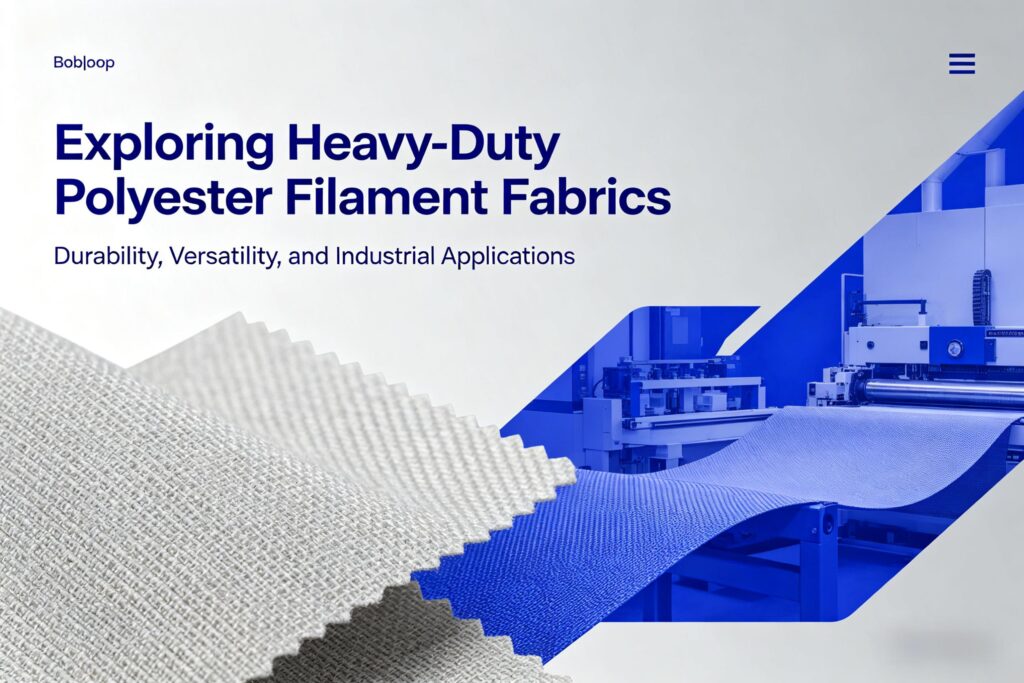
Introduction: The Quest for Durability and Substance
In the versatile world of textiles, the demand for fabrics that offer not just coverage but also enhanced durability, structure, and functionality is ever-present. This is where fabrics constructed from heavy-duty or thickened polyester filament yarns come to the fore. These materials move beyond the realm of lightweight apparel, finding their purpose in applications where resilience, strength, and substantial hand-feel are paramount. This comprehensive guide explores the various types of fabrics made from thickened polyester filaments, delving into their specific construction methods, inherent properties, and the diverse sectors they serve. Understanding these fabrics is crucial for designers, engineers, and procurement specialists who require materials to perform under demanding conditions.
1. The Foundation: Understanding the Yarn and the Concept of “Thickening”
Before examining fabrics, one must understand the yarn that builds them. The “thickening” or heavy-duty nature of these fabrics can be achieved through two primary avenues:
- Yarn-Level Thickening (High Linear Density): This is the most direct method. It involves using polyester filament yarns with a high denier (D) or decitex (dtex). While standard apparel yarns may range from 20D to 150D, heavy-duty fabrics utilize yarns from 300D up to 3000D or more. A higher denier indicates a thicker, heavier, and inherently stronger yarn, forming a robust foundation for the fabric. Common specifications for base fabrics include 300D, 420D, 600D, 900D, 1200D, and 1680D.
- Fabric-Structure Thickening: This involves using standard or moderately thick yarns but constructing the fabric in a way that increases its mass, density, and bulk. This can be achieved through high-density weaving, pile constructions, or chemical/mechanical finishing processes.
The most common and impactful fabrics often combine both approaches: they are woven from already high-denier yarns in dense constructions.
2. Key Types of Heavy-Duty Polyester Filament Fabrics
The market offers a range of specialized fabrics, each with a unique structure and purpose.
2.1 High-Density Woven Fabrics (Oxford, Taffeta, Twill)
These are workhorses of durability, made by weaving high-denier yarns tightly together.
- Oxford Cloth: Recognizable by its basket-weave pattern (2×1 or 2×2), Oxford cloth is a premier choice for luggage, heavy-duty backpacks, tool bags, and outdoor gear. Its construction provides excellent abrasion resistance, dimensional stability, and a characteristic textured appearance. Common weights are 300D, 420D, 600D, and the very heavy-duty 1680D ballistic nylon (often a nylon-polyester blend).
- Polyester Taffeta: Woven in a plain weave, it is known for its smooth, crisp hand-feel and fine, uniform surface. High-density taffetas (e.g., 190T, 210T, 230T, where “T” stands for thread count per inch) are extensively used as the base fabric for polyurethane (PU) or polyvinyl chloride (PVC) coatings and laminations, which drastically enhance thickness and functionality.
- Twill Weave Fabrics (e.g., Taslan): The diagonal rib (twill line) provides a drapable yet durable fabric. It often has a softer hand than Oxford and is used in jackets, workwear, and heavy-duty uniforms.
2.2 Pile and Fleece Fabrics (Creating Bulk with Loops)
These fabrics create thickness and insulation by integrating loops or cut piles.
- Velvet/Plush: Made by weaving an extra set of warp yarns to form loops (which may be cut) on the surface. When made from polyester filament, it creates a dense, luxurious, and thick fabric for upholstery, curtains, and high-end apparel.
- Polar Fleece: This is a quintessential “thickened” fabric, though typically made from spun polyester yarn. It’s worth noting as a key end-use for fine-denier polyester filament. The process involves knitting a fabric, brushing its surface to raise fine fibers, and then shearing it to create an incredibly soft, thick, and insulating material for jackets, blankets, and cold-weather gear.
2.3 Coated and Laminated Fabrics (The Ultimate in Added Substance)
This is a transformative category where a base woven fabric (often taffeta or Oxford) is combined with a polymer layer to add thickness, impermeability, and new properties.
- PU-Coated Polyester: A layer of polyurethane is applied to create a waterproof, windproof, and flexible fabric. It is widely used in rainwear, sportswear, military garments, and lightweight tents. Different application methods (transfer coating, direct coating) allow for varying levels of thickness and performance.
- PVC-Coated Tarpaulin: This is the ultimate heavy-duty material. A heavy polyester filament base fabric (e.g., 600D, 1000D) is coated with a thick layer of PVC plastic, creating an extremely tough, waterproof, and flame-retardant sheet used for truck covers, industrial shelters, inflatable boats, and stadium roofing.
- TPU (Thermoplastic Polyurethane) Laminates: TPU films are laminated to fabrics, offering superior elasticity, abrasion resistance, and welding/bonding capabilities for technical applications like inflatable products, protective cases, and medical equipment.
2.4 Specialty Industrial Fabrics
- Webbing and Strapping: While not a “fabric” in the traditional sheet form, these are dense, narrow textiles woven from very high-tenacity polyester filaments. They are the embodiment of strength in a thickened form, used for load-bearing applications like tie-downs, cargo straps, and safety harnesses.
- Technical Composites: Polyester filament fabrics serve as reinforcement scrims in composite materials. They are embedded in rubber (for conveyor belts, hoses) or polymers to add tremendous tensile strength and tear resistance, forming the thick, structural heart of these products.
3. Properties and Performance Advantages
The collective advantages of these thickened polyester filament fabrics make them indispensable:
- Exceptional Mechanical Strength: High resistance to tearing, bursting, and abrasion.
- Dimensional Stability: Minimal stretching or shrinkage, crucial for technical applications.
- Chemical and Mildew Resistance: Inherent to polyester, making them suitable for harsh environments.
- Customizable Functionality: Through coatings, finishes (water-repellent, UV-resistant, flame-retardant), and dyeing, properties can be tailored precisely.
- Cost-Effectiveness: Polyester offers a superior balance of performance and price compared to many natural or specialty synthetic fibers.
4. Application Sectors: Where These Fabrics Excel
- Luggage and Bags: The largest sector, utilizing Oxford, ballistic, and coated fabrics for durability.
- Outdoor and Sports Equipment: Tents, backpacks, sleeping bags, awnings, and apparel rely on coated and high-density woven fabrics.
- Functional Workwear and Uniforms: For military, industrial, and safety applications requiring durability and protection.
- Transportation and Geotechnical: Tarpaulins, truck covers, container liners, and geotextiles for soil stabilization.
- Home and Commercial Furnishings: Upholstery for heavy-use furniture, curtains, wall coverings, and PVC-backed carpets.
5. Innovation and Future Trends
The sector is not static. Key trends include:
- Sustainability: Development of heavy-duty fabrics using Recycled Polyester (rPET) from post-consumer bottles, meeting brand eco-goals without sacrificing performance.
- Lightweighting: Engineering fabrics to be stronger and more functional at a lower weight, using advanced high-tenacity yarns and constructions.
- Smart Integration: Incorporating conductive yarns or coatings for sensing, heating, or data transmission into heavy-duty fabrics for next-generation technical applications.
Conclusion: The Fabric of Resilience
Thickened polyester filament fabrics represent a critical segment where textile engineering meets practical demand. From the trusted Oxford bag to the colossal PVC tarpaulin covering a stadium, these materials solve problems of protection, durability, and structure. Their variety—from densely woven cloths to coated composites—offers a solution for nearly every industrial and heavy-duty commercial need. As innovation drives them toward greater sustainability and smarter functionality, their role as the durable backbone of the material world is set to expand even further. For specifiers, understanding this family of fabrics is key to selecting the optimal material that is not just thick, but intelligently engineered for the task at hand.
