
Table of Contents
- Introduction: A Core Question for Strategic Sourcing
- Defining the Players: Understanding Filament and Staple
- The Direct Price Comparison: What the Data Reveals
- 3.1. Price Benchmark Table: A Snapshot
- 3.2. Understanding the Pricing Hierarchy
- Deconstructing the Cost Drivers: Why Is Filament More Expensive?
- 4.1. The Production Process: Complexity and Value Addition
- 4.2. Market Structure and Pricing Strategies
- Application-Based Value Analysis: Matching Fiber to Function
- Navigating a Dynamic Market: Sourcing Strategies for Stability
- Conclusion: Price as an Indicator of Engineered Value
1. Introduction: A Core Question for Strategic Sourcing
For global apparel brands, textile manufacturers, and sourcing managers, the question “Which is more expensive, polyester filament or staple fiber?” is far from academic. It is a fundamental inquiry that directly impacts cost sheets, product development, and profit margins. The straightforward answer is that, gram for gram, polyester filament yarn commands a significant price premium over staple fiber. However, simply knowing this fact is not enough for strategic decision-making. The real value lies in understanding the why behind this price difference and translating that knowledge into smarter sourcing and product design. This guide delves into the technical, economic, and market-driven factors that shape this pricing landscape, empowering you to make informed choices that balance cost, performance, and value for your end products.
2. Defining the Players: Understanding Filament and Staple
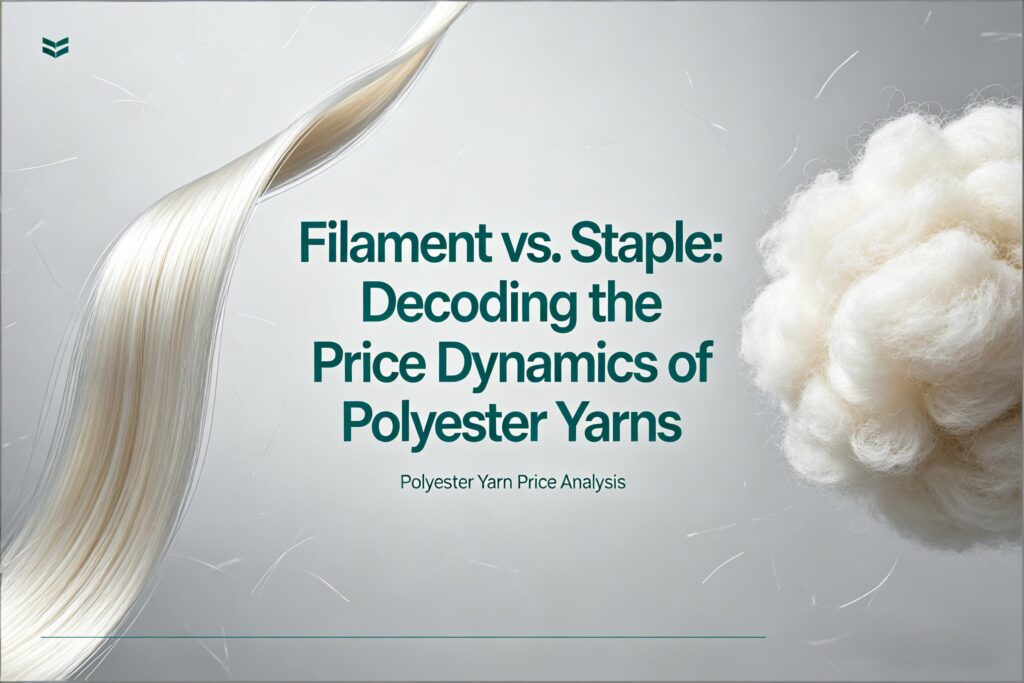
To understand the price, one must first understand the product. Both filament and staple originate from the same raw material—polyethylene terephthalate (PET) polymer—but their physical forms and production journeys diverge dramatically.
- Polyester Filament consists of continuous, unbroken fibers that can stretch for kilometers. These fibers are extruded, drawn to align the polymer molecules for strength, and wound onto bobbins. Filament yarns are inherently smooth, strong, and uniform. They are the primary material for woven fabrics like linings, sportswear, lingerie, and technical textiles where a sleek finish and high durability are required. Filament is further categorized into types like POY (Partially Oriented Yarn), FDY (Fully Drawn Yarn), and the higher-value DTY (Drawn Textured Yarn), which undergoes an additional texturing process for bulk and stretch.
- Polyester Staple Fiber is made by spinning a bundle of filaments and then cutting them into short, discrete lengths, typically 32mm or 38mm. This loose mass of short fibers must then be carded and spun—much like cotton or wool—to create a spun yarn. This process gives staple fiber fabrics their characteristic soft, cotton-like, and breathable hand-feel, making them ideal for knitted apparel, fleece, home textiles (bedding, upholstery), and non-woven applications.
The difference in form is the root of the difference in price.
3. The Direct Price Comparison: What the Data Reveals
Recent market data provides a clear picture of the consistent price gap between these two fiber types. The following table summarizes benchmark prices for standard white (“bright”) products in the Chinese market, a key global production hub.
3.1. Price Benchmark Table (Q4 2025, RMB/ton)
| Product Category | Example Specification | Approximate Price Range (RMB/Ton) | Key Characteristics |
|---|---|---|---|
| Staple Fiber | 1.4D, 38mm (Cotton type) | 6,380 – 6,530 | Base commodity grade for spinning. Price is for virgin, melt-spun fiber. |
| Filament – POY | 75D/36F | 6,750 – 7,650 | Base filament, requires further processing by downstream weavers. |
| Filament – FDY | 75D/36F | 6,750 – 7,200 | Ready-to-use filament for weaving/knitting, stronger and more stable than POY. |
| Filament – DTY | 75D/36F | 8,350 – 8,850 | Textured yarn with bulk and elasticity. Highest value among common apparel filaments. |
3.2. Understanding the Pricing Hierarchy
The data is conclusive: staple fiber operates in the lowest price tier. The price for standard filament (POY/FDY) is typically 5-20% higher than staple. However, the most significant premium is for value-added filament like DTY, which can be 30-40% more expensive than staple fiber.
Furthermore, prices for specialized products diverge further. For instance, “black filament” for specific apparel uses commands a premium of 300-800 RMB/ton over standard white filament. International trade data also shows that processed staple fiber for export can have a unit price significantly higher than domestic commodity prices, reflecting grades, logistics, and branding.
4. Deconstructing the Cost Drivers: Why Is Filament More Expensive?
Several interconnected factors justify and sustain filament’s price premium.
4.1. The Production Process: Complexity and Value Addition
The journey from polymer chip to final yarn is more capital and technology-intensive for filament.
- Precision Engineering: Filament production requires extremely precise control over extrusion, high-speed drawing, and winding to produce consistent, defect-free continuous fibers. Staple fiber production, while not simple, tolerates more variance before the cutting and spinning stages.
- Additional Processing Steps: DTY, the most expensive common type, requires an entire additional manufacturing step—texturing—where the yarn is heated, twisted, and set to create its bulky, stretchable structure. This adds equipment, energy, and labor costs directly into the product.
- Intrinsic Property Advantage: Filament yarns deliver superior strength, uniformity, and abrasion resistance directly from the bobbin. These engineered properties command a higher market price.
4.2. Market Structure and Pricing Strategies
The industrial dynamics of the two sectors also differ.
- Industry Coordination: The filament industry has seen more effective coordination among major producers to manage supply and support prices. In mid-2024, leading filament manufacturers successfully shifted to a “cost-plus” pricing model, tying their prices more firmly to raw material costs (PTA and MEG) plus a protected processing fee. This move, supported by prior production discipline, has helped maintain healthier profit margins and price stability.
- Supply Discipline: Major filament producers have shown a willingness to collectively adjust operating rates to prevent inventory buildup, which has historically supported prices during demand softness.
- Staple Fiber’s Catch-Up: The staple fiber sector, facing prolonged margin pressure, began adopting a similar “cost-plus” model only more recently in 2024. While this has helped lift prices from troughs, the sector’s overall structure and intense competition in downstream spinning often limit its pricing power compared to the more consolidated filament sector.
5. Application-Based Value Analysis: Matching Fiber to Function
Choosing between filament and staple should not be based on price alone, but on Total Cost-in-Use and fitness for purpose. A cheaper material that causes production inefficiencies or fails in the end-product is ultimately more expensive.
- Choose Polyester Filament When:
- Performance is Critical: For high-strength fabrics (e.g., lightweight outerwear, backpacks, technical uniforms), smooth linings, or moisture-wicking sportswear, filament’s inherent properties are irreplaceable.
- Efficiency Matters: Filament yarns produce less lint and have higher tenacity, leading to fewer breaks in high-speed weaving and knitting, reducing downtime.
- Aesthetic is Key: For fabrics requiring a silky, lustrous, or consistently smooth appearance, filament is the only choice.
- Choose Polyester Staple Fiber When:
- Softness and Drape are Priorities: For T-shirts, sweaters, blankets, and furnishings where a soft, breathable, natural hand-feel is desired.
- Blending is Required: Staple fiber is essential for blending with other staple fibers like cotton (poly-cotton blends) or wool.
- Cost is the Primary Constraint: For high-volume, basic commodity textiles where premium performance is not required.
6. Navigating a Dynamic Market: Sourcing Strategies for Stability
Given the price volatility of raw materials like PTA, securing a stable supply at a predictable cost is paramount. This is where the role of your yarn supplier becomes strategic.
A knowledgeable and reliable supplier acts as your market intelligence and risk mitigation partner. For example, a supplier like Glyarn provides more than just transaction; they provide supply chain stability. They don’t merely react to daily price ticks but leverage long-term relationships with top-tier mills to ensure consistent access to quality filament, even during periods of tight supply or price surges. For a brand developing a new line of premium travel jackets, Glyarn’s experts wouldn’t just source DTY; they would identify the optimal specification for durability and packability, secure allocation from a quality mill, and provide the technical data and consistency needed to prevent costly production issues. This partnership transforms a volatile commodity purchase into a managed component of your product’s value.
7. Conclusion: Price as an Indicator of Engineered Value
The persistent price premium of polyester filament over staple fiber is not an anomaly; it is a direct reflection of higher intrinsic value, more complex manufacturing, and a more disciplined market structure. For the informed buyer, understanding this breakdown turns a simple price comparison into a strategic tool.
The key takeaway is to source with intention. Evaluate your needs based on the final application’s performance requirements. If your product demands the strength, efficiency, and premium aesthetics of continuous filament, its higher cost is a justifiable investment in quality and performance. Conversely, for applications centered on softness, breathability, and blendability, staple fiber offers exceptional value. By partnering with a technical supplier who understands this landscape deeply, you can navigate price dynamics effectively, ensuring that your material choices strengthen both your product and your bottom line.
