
Table of Contents
1. Introduction: The Transformative Journey of PET
2. Chapter 1: The Raw Material – Deconstructing PET for Rebirth
3. Chapter 2: The Heart of the Process – Melt Spinning Demystified
4. Chapter 3: Giving it Strength – The Critical Drawing Stage
5. Chapter 4: Creating Diversity – Texturing and Modifying the Yarn
6. Chapter 5: The End of the Line – Applications and Performance
7. Chapter 6: The Business of Transformation – Quality, Sourcing, and Sustainability
8. Conclusion: PET’s Continuous Loop – A Testament to Innovation
1. Introduction: The Transformative Journey of PET
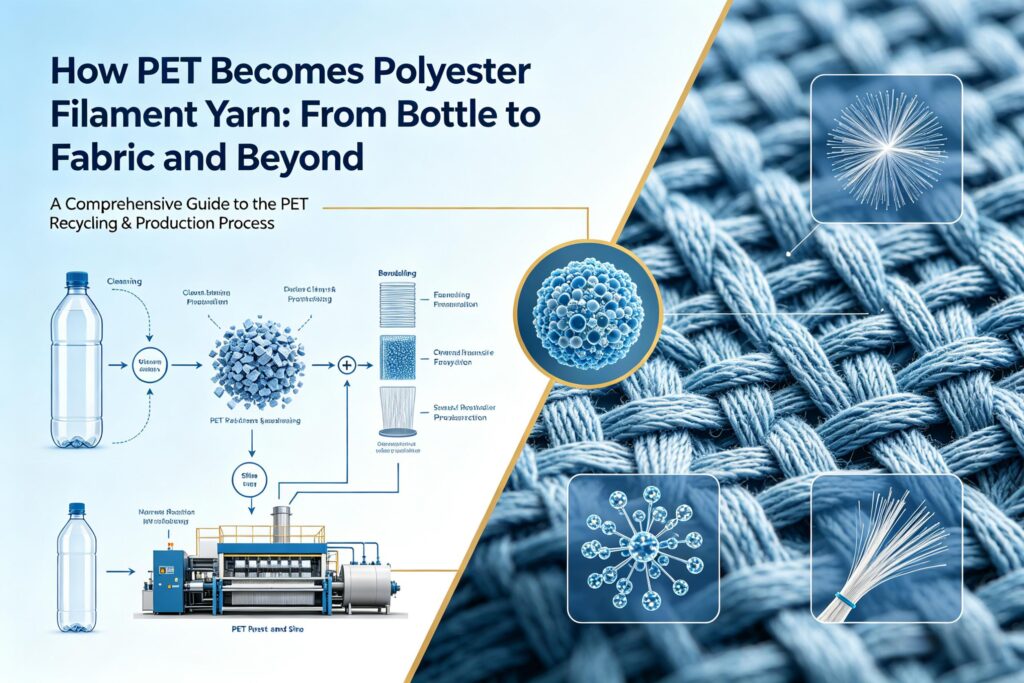
Polyethylene Terephthalate, or PET, is one of the most versatile and ubiquitous polymers on the planet. We recognize it as the clear, sturdy plastic of our water bottles and food containers. Yet, through a remarkable feat of industrial alchemy, this same material is transformed into the soft, durable, and flexible filaments that weave the fabric of modern life—polyester filament yarn. This journey from a solid, amorphous chip or a recycled flake to a continuous, strong, and fine thread is not merely a manufacturing process; it is a narrative of material science, precision engineering, and global supply chains. Understanding this transformation is crucial for anyone involved in textiles, fashion, manufacturing, or sustainability, as it reveals the levers of quality, cost, and environmental impact that define the industry.
2. Chapter 1: The Raw Material – Deconstructing PET for Rebirth
The journey begins with the raw PET material, which comes in two primary forms:
- Virgin PET Chips: These are small, uniform pellets polymerized directly from petrochemical precursors—Purified Terephthalic Acid (PTA) and Monoethylene Glycol (MEG). Their molecular chains are long, uniform, and of a controlled Intrinsic Viscosity (IV), which is a key indicator of future strength. These chips are the premium feedstock for high-performance yarns.
- Recycled PET (rPET) Flakes: Sourced from post-consumer bottles or industrial waste, these flakes are washed, sorted, and shredded. Their path is more complex. They contain impurities, dyes, and have undergone thermal and hydrolytic degradation, leading to shorter, uneven polymer chains. To become viable for spinning, rPET flakes often undergo solid-state polycondensation (SSP), a process that re-lengthens the polymer chains in a controlled, heated environment under vacuum or inert gas, effectively raising their IV to spin-able levels.
Regardless of origin, the PET must be meticulously dried before melting. PET is hygroscopic, and any residual moisture will cause catastrophic hydrolytic degradation during the high-temperature melt phase, severing polymer chains and ruining the yarn’s integrity.
3. Chapter 2: The Heart of the Process – Melt Spinning Demystified
The dried PET enters the spinning mill’s central nervous system:
- The Extruder: Chips or flakes are fed into a giant screw extruder. As they are conveyed forward, they are subjected to intense, precisely controlled heat (typically 280-300°C), becoming a viscous, honey-like melt.
- Filtration: This molten polymer is then forced through a series of progressively finer metal filter packs. This step is non-negotiable; it removes any unmelted gels, carbonized particles, or solid contaminants that would otherwise cause filament breaks later. For rPET, this filtration stage is even more critical and complex.
- The Spinneret: The purified melt is metered by a precision pump to the spinneret—a stainless-steel disc akin to a high-tech showerhead, pierced with dozens, hundreds, or even thousands of microscopic holes. The diameter and profile of these holes are engineered with extreme precision. As the melt is extruded through them, it forms a nascent vertical curtain of liquid threads.
- Quenching: These hot, liquid filaments immediately descend into a long, vertical chimney called the quenching chamber. Here, a precisely conditioned crossflow of cool air rapidly solidifies them into solid, continuous filaments. The speed, temperature, and humidity of this air are meticulously controlled to set the initial, amorphous structure of the yarn, now called Undrawn Yarn (UDY).
4. Chapter 3: Giving it Strength – The Critical Drawing Stage
UDY is weak, highly elastic, and useless for most applications. Its polymer chains are randomly coiled. To unlock PET’s inherent strength, the yarn must be drawn.
- The Drawing Frame: The UDY is wound onto a godet, then passed through a series of rollers operating at successively higher speeds. This speed differential stretches the yarn, typically by 3 to 6 times its original length.
- Molecular Alignment: This physical stretching forces the disordered polymer chains to align themselves parallel to the axis of the filament. This orientation dramatically increases intermolecular forces, transforming the yarn from a weak, plastic material into a strong, fibrous one. The process also induces crystallization, locking the chains in their new, strong configuration.
- Heat Setting: Drawing is almost always accompanied by heat. The yarn may pass over heated rollers or through a hot chest. This heat relaxes internal stresses, stabilizes the newly formed crystalline structure, and sets the yarn’s final denier and mechanical properties. The output is now a fully oriented, high-tenacity Fully Drawn Yarn (FDY), ready for use in weaving or warp knitting.
5. Chapter 4: Creating Diversity – Texturing and Modifying the Yarn
Not all filament yarn is smooth FDY. A vast portion of the market demands bulk, stretch, and a more natural feel. This is achieved through texturing, most commonly via the false-twist method.
- The Texturing Machine: FDY (or more commonly, an intermediate Partially Oriented Yarn – POY) is fed into a texturer.
- Twist, Heat, Set, Untwist: The yarn is twisted tightly, heated to a critical temperature to “set” the twist into its molecular structure, and then cooled. Finally, the twist is removed. However, the memory of the twist remains, causing the filament to coil into tiny springs. This creates Draw Textured Yarn (DTY), which is voluminous, stretchy, and soft, ideal for apparel fabrics like jersey and fleece.
- Other Modifications: The base process can be engineered to create:
- Air-Textured Yarn (ATY): Uses air jets to entangle filaments, creating bulk without stretch.
- Solution-Dyed Yarn: Pigments are added to the polymer melt before spinning, creating fibers with exceptional color fastness.
- Microfilament: Spinnerets with extremely fine holes produce filaments finer than silk.
6. Chapter 5: The End of the Line – Applications and Performance
The type of yarn produced dictates its destiny in the global market:
- FDY: With its smooth surface and high strength, it is the workhorse for linings, sheer fabrics, sewing threads, and industrial applications where stability is key.
- DTY: Its bulk and comfort make it the king of apparel: activewear, casual wear, lingerie, and home textiles like blankets and upholstery.
- Specialty Yarns: High-tenacity yarns go into tire cord, conveyor belts, and safety harnesses. Microfilaments create luxury suede-like fabrics and high-performance wiping cloths.
7. Chapter 6: The Business of Transformation – Quality, Sourcing, and Sustainability
This technical transformation exists within a commercial and ethical landscape.
- Quality Gatekeeping: Consistent yarn requires controlling hundreds of variables: chip IV, moisture content, melt temperature, quench air profile, draw ratios, and heater temperatures. A deviation in any can cause defects like dye barre, broken filaments, or uneven strength.
- The Sourcing Imperative: For brands and manufacturers, navigating this complex supply chain is daunting. This is where expert partners prove invaluable. A company like Glyarn operates as a crucial nexus. They don’t just source yarn; they provide technical partnership. For a client needing a specific performance—say, a 75D/72F DTY with exceptional uniformity for a high-speed knitting mill—Glyarn translates that need into factory specifications, audits producers for their process control capabilities, and conducts rigorous pre-shipment testing for tenacity, evenness, and shrinkage. They manage the critical path from the spinneret to the client’s loading dock, mitigating risk and ensuring the transformed PET meets its intended purpose flawlessly.
- The Sustainability Loop: The rPET-to-yarn pathway is a cornerstone of the circular economy. It diverts plastic from landfills and reduces reliance on virgin petrochemicals. However, it introduces complexities in sorting, cleaning, and IV restoration, making the role of knowledgeable intermediaries who can guarantee the quality and integrity of recycled content even more critical.
8. Conclusion: PET’s Continuous Loop – A Testament to Innovation
The transformation of PET into polyester filament yarn is a continuous symphony of chemistry, physics, and engineering. It is a process that turns simplicity—a basic polymer—into limitless complexity and application. From the athletic kit that wicks away sweat to the airbag that saves a life, the journey of PET is foundational to our material world. As the industry evolves under pressures of sustainability and performance, understanding this journey is no longer just for engineers. It is essential knowledge for savvy business leaders, designers, and sourcing professionals. By appreciating the science behind the thread and partnering with experts who master this transformation, such as Glyarn, businesses can innovate with confidence, ensure quality, and contribute to a more efficient and circular future for textiles. The story of PET is ultimately one of potential, continuously spun into reality.
