
Table of Contents
Introduction: Navigating the World of Yarn Sizing
1. Chapter 1: Understanding the Core – What is Yarn Size?
* 1.1 The Definition of Linear Density and Yarn Count
* 1.2 Why Accurate Yarn Sizing is Non-Negotiable for Your Business
2. Chapter 2: The Yarn Sizing Toolbox – Global Standards & Systems
* 2.1 Direct vs. Indirect Systems: The Fundamental Division
* 2.2 Decoding Common Count Systems: Ne, Nm, and Tex/Denier
* 2.3 The Role of International and Regional Standards (ASTM, EN, ISO, GB)
3. Chapter 3: The Testing Bench – How to Measure Yarn Size Correctly
* 3.1 The Hank Method (ASTM D1907 & ISO 2060): The Reference Standard
* 3.2 The Short-Length Specimen Method (ASTM D1059): For Fabric Analysis
* 3.3 Advanced & Alternative Measurement Techniques
* 3.4 Beyond Size: Essential Companion Tests
4. Chapter 4: From Yarn to Fabric – Analyzing Size in Finished Products
* 4.1 Determining Yarn Density in Woven Fabrics (EN 1049-2 / ISO 4602)
* 4.2 Calculating Fabric Weight (GSM): The Ultimate Validation
* 4.3 Interpreting the Data: What Deviations Mean for Your Product
5. Chapter 5: A Practical Guide for Industry Professionals
* 5.1 Decision Flowchart: Choosing the Right Test Method for Your Need
* 5.2 Specification Sheet Essentials: What to Demand from Suppliers
* 5.3 Case Studies: Applying Standards in Apparel, Home Textiles, and Technical Fabrics
6. Chapter 6: Strategic Implementation and Future Outlook
* 6.1 Building a Cost-Effective QA Strategy: In-House vs. Third-Party Lab
* 6.2 The Future of Yarn Sizing: Digitalization and AI-Driven QC
Introduction: Navigating the World of Yarn Sizing
For a procurement manager in a garment factory, a production lead in a carpet mill, or a quality assurance specialist at a plush toy manufacturer, few specifications are as critical—and as frequently misunderstood—as yarn size. The question, “How to determine yarn size standards?” is not merely technical; it is fundamentally economic. A miscalculation or an unclear specification can cascade into a series of costly failures: fabric that is too heavy or too sheer, inconsistent pile height in carpets, filling material that lacks the desired loft in toys, or simply a product that fails to meet the contractual obligations with your international clients.
This guide cuts through the complexity. It is designed not for academics, but for decision-makers and practitioners. We will translate the language of “linear density,” “yarn count,” and “conversion factors” into actionable knowledge. You will learn the established, standardized methods to measure yarn size, how to verify it within a finished fabric, and how to leverage this data to de-risk your supply chain, ensure product consistency, and uphold your brand’s reputation for quality. In a global market where precision is profitability, mastering yarn sizing is no longer optional—it is essential.
Chapter 1: Understanding the Core – What is Yarn Size?
At its most basic, “yarn size” refers to its thickness or fineness. However, in the technical and commercial textile world, we avoid subjective terms like “thick” or “thin.” Instead, we rely on a precise, measurable property called Linear Density.
1.1 The Definition of Linear Density and Yarn Count
Linear density is the mass per unit length of a yarn. It is the cornerstone of all yarn sizing systems . This property is expressed through various “yarn count” or “yarn number” systems, which fall into two main categories:
- Direct Systems: The weight of a fixed length of yarn is measured. A higher number means a heavier, coarser yarn (e.g., Tex, Denier).
- Indirect Systems: The length of yarn in a fixed weight is measured. A higher number means a finer, lighter yarn (e.g., Ne, Nm).
1.2 Why Accurate Yarn Sizing is Non-Negotiable
The linear density of the yarn directly dictates:
- Fabric Weight and Drape: A 40 Ne yarn will produce a lighter, more fluid fabric than a 20 Ne yarn, all else being equal.
- Product Performance: In carpets, yarn size affects pile density, wear resistance, and foot feel. In apparel, it influences durability, opacity, and thermal properties.
- Production Efficiency: Consistent yarn size is vital for smooth knitting, weaving, and tufting processes. Variations cause breaks, defects, and machine downtime.
- Cost Control: Yarn is often purchased by weight, but used to cover an area. Knowing the exact size allows for accurate yield calculations and prevents over-specification.
Chapter 2: The Yarn Sizing Toolbox – Global Standards & Systems
Navigating different count systems is key to global trade. Below is a summary of the most critical ones.
2.2 Decoding Common Count Systems
Table 1: Key Yarn Count Systems and Their Applications
| System Name | Type | Calculation Principle | Common Use Cases | Example & Meaning |
|---|---|---|---|---|
| English Cotton Count (Ne) | Indirect | Length (yd) per pound (lb). Number of 840-yard hanks per pound. | Staple fiber yarns: Cotton, wool, blends. Ubiquitous in the US, UK, and Asian markets for apparel. | Ne 30/1: A single yarn where 30 hanks (25,200 yards) weigh 1 pound. |
| Metric Number (Nm) | Indirect | Length (meters) per kilogram (km/kg). | Woolen/Worsted yarns, linen, hemp. Common in European and technical contexts. | Nm 50/2: A 2-ply yarn made from two Nm 50 singles; 50,000 meters of the single yarn weigh 1 kg. |
| Tex | Direct | Weight (grams) per 1,000 meters of yarn. | Universal & Technical. The ISO-preferred SI unit. Used for all fiber types, especially in industrial applications. | 25 Tex: 1,000 meters of this yarn weighs 25 grams. |
| Denier | Direct | Weight (grams) per 9,000 meters of yarn. | Filament yarns: Silk, nylon, polyester filaments (e.g., lingerie, hosiery, technical fabrics). | 75 Denier: 9,000 meters of this filament yarn weighs 75 grams. |
2.3 The Role of International Standards
Professional measurement requires adhering to published standards to ensure repeatability and global acceptance. Key standards include:
- ASTM D1907: The definitive standard for the skein (hank) method to determine linear density.
- ISO 2060: The international equivalent to the skein method.
- ASTM D2260: The critical standard providing official conversion factors between different numbering systems (e.g., converting Ne to Tex). The 2024 edition ensures up-to-date accuracy.
- ASTM D1059: Standard for testing yarn number from short-length specimens, often used for fabric analysis.
Chapter 3: The Testing Bench – How to Measure Yarn Size Correctly
3.1 The Hank Method (ASTM D1907 & ISO 2060): The Reference Standard
This is the most accurate and widely accepted method for determining the linear density of yarn from a package. The process involves:
- Winding: A skein (hank) of precisely measured length (e.g., 120 yards for Ne calculation) is wound under controlled, low tension.
- Conditioning: The skein is conditioned in a standard atmosphere (e.g., 65% RH, 20°C) to achieve moisture equilibrium.
- Weighing: The conditioned skein is weighed on a precision balance.
- Calculation: The yarn count is calculated using the standard formula for the desired system (Ne, Nm, Tex).
3.2 The Short-Length Specimen Method (ASTM D1059): For Fabric Analysis
This method is designed for taking short yarn specimens directly from finished fabrics to approximate their size.
- Process: A bundle of yarn (at least 10 strands) is carefully removed from the fabric, straightened without stretching, cut to a precise short length (e.g., 2-3 cm), and weighed.
- Key Consideration: As noted in the standard, this method yields an approximate value. It measures the yarn as it exists in the fabric, which may have been altered by weaving, finishing, or dyeing processes. It is excellent for verification and troubleshooting but is not the primary method for acceptance testing of raw yarn.
3.4 Beyond Size: Essential Companion Tests
Yarn size never exists in isolation. A complete quality profile includes:
- Twist (Turns per meter/in): Affects strength, hand, and porosity.
- Tenacity & Breaking Strength: The force required to break the yarn, indicating durability.
- Evenness (CVm %): Measures variation in thickness. High variation leads to fabric defects.
- Moisture Regain: The official moisture content, critical for correct weight measurement.
Chapter 4: From Yarn to Fabric – Analyzing Size in Finished Products
Your fabric is the ultimate test report for the yarn. Two key analyses confirm if the correct yarn was used as specified.
4.1 Determining Yarn Density (EN 1049-2 / ISO 4602)
This standard defines how to count the number of yarns per unit length (ends/cm for warp, picks/cm for weft) in a woven fabric. It offers three methods:
- Method A (Fabric Dissection): The most thorough, involving unravelling and counting. Suitable for all fabrics, especially complex weaves.
- Method B (Counting Glass): Uses a magnifying lens with a scale. Best for fabrics with over 50 yarns per centimeter.
- Method C (Travelling Microscope): Uses a movable microscope.
4.2 Calculating Fabric Weight (GSM): The Ultimate Validation
The relationship between yarn size, yarn density, and fabric structure determines the final weight in grams per square meter (GSM). A significant deviation between the calculated GSM (based on your yarn and density specs) and the actual measured GSM of the produced fabric is a major red flag indicating potential substitution or process error.
Table 2: Interpreting Deviations in Yarn Size Analysis
| Scenario | Potential Causes | Impact on Final Product |
|---|---|---|
| Yarn size matches spec, but fabric GSM is low. | Lower fabric density (fewer ends/picks) than specified. Loom set-up error. | Lighter, less durable fabric. Possible breach of contract specs (e.g., for upholstery or workwear). |
| Yarn size is finer than spec, but fabric GSM meets target. | Fabric density was increased to compensate. | Fabric may be stiffer, have a different drape, and the mill used more yarn (in length) to meet weight, altering yield. |
| High variation (CV%) in yarn size within a lot. | Poor spinning process control. Blending issues. | Streaky fabric, uneven dyeing, weak points leading to tears or pile inconsistency in carpets/toys. |
Chapter 5: A Practical Guide for Industry Professionals
5.1 Decision Flowchart: Choosing the Right Test Method
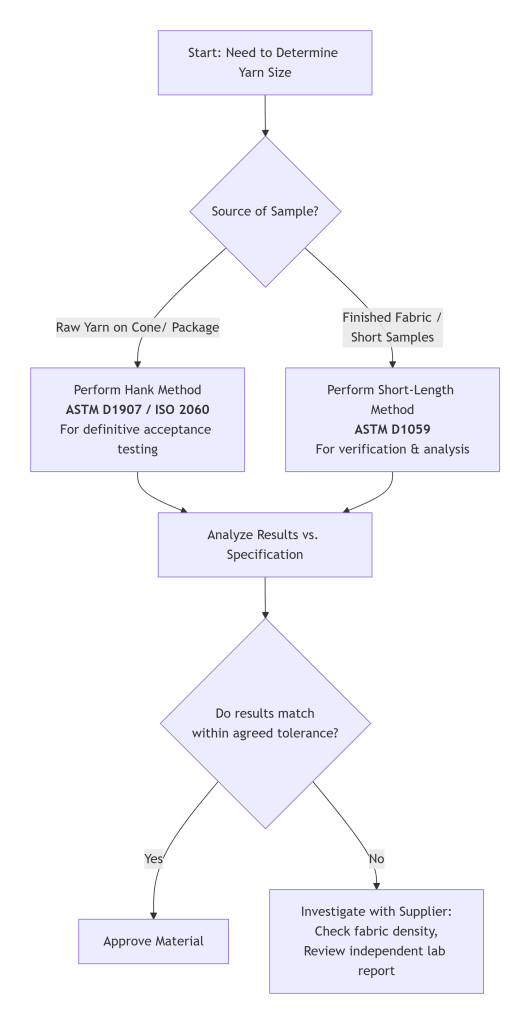
5.2 Specification Sheet Essentials
When ordering yarn, your technical data sheet must state:
- Linear Density: The core spec (e.g., Ne 30/1 or 150 Denier).
- Tolerance: The acceptable deviation (e.g., Count: Ne 30/1 ±3%).
- Test Standard: The agreed method for arbitration (e.g., “As per ASTM D1907, Option 1 [conditioned skein]”).
- Companion Specs: Include twist, strength minimums, and evenness (CVm) requirements.
5.3 Case Studies
- Apparel (T-Shirt): A buyer specifies Ne 30/1 combed cotton, CVm < 2.5%. Fabric mill reports high knitting breakage. Short-length tests (ASTM D1059) on the delivered fabric reveal the yarn is actually Ne 28. The coarser, weaker yarn caused the production issues.
- Carpet Manufacturing: A contract specifies a 1200 Denier Nylon 6,6 BCF yarn for a heavy-duty commercial carpet. A pile weight check shows the product is underweight. Dissecting the carpet (EN 1049-2 Method A) and weighing the tufts confirms the use of a lighter denier yarn, constituting a material breach.
Chapter 6: Strategic Implementation and Future Outlook
6.1 Building a Cost-Effective QA Strategy
Not every company needs a full textile lab. A strategic approach involves:
- In-House Basics: Equip your team with a simple microscope, a precision cutter, and a good analytical balance. They can perform the short-length method (ASTM D1059) for rapid incoming checks.
- Third-Party Partnership: Contract an accredited laboratory (with ISO 17025 certification) to perform the official hank method (ASTM D1907) and full suite of tests on a regular audit schedule or to resolve disputes. The reports from these labs carry significant weight in commercial disagreements.
6.2 The Future of Yarn Sizing
The field is moving towards digitization and predictive quality control. Computer vision systems can now analyze yarn diameter and defects in real-time on the production line. Furthermore, research into novel methods, such as calculating count through weight and geometry without direct length measurement, points to a future of even faster and more integrated process control. For the modern manufacturer or buyer, combining a solid grasp of traditional standards with an openness to these technological advancements will be the key to maintaining a competitive edge.
Conclusion
Determining yarn size is not a mystery; it is a disciplined application of international standards. From the definitive ASTM D1907 hank test to the verification-friendly ASTM D1059 short-length method and the fabric-focused EN 1049-2 density analysis, a clear toolkit exists. By specifying clearly, testing strategically, and understanding the direct link between yarn linear density and final product performance, you transform yarn sizing from a potential liability into a lever for quality, efficiency, and trust in your global supply chain.
