
Table of Contents
- The Core Dichotomy in Polyester Filament – DTY vs. FDY
- Beyond Acronyms: Why Understanding the Distinction is a Fundamental Sourcing Skill
- Target Audience: Strategic Decision-Makers in Manufacturing and Procurement
- Deconstructing the Manufacturing Process: From Polymer to Yarn
- The FDY (Fully Drawn Yarn) Pathway: Integrated Spinning-Drawing for Maximum Orientation
- The DTY (Draw Textured Yarn) Pathway: A Two-Step Dance of Drawing and Texturizing
- Process Flow Diagrams and Their Impact on Final Fiber Morphology
- Morphological & Structural Analysis: A Microscopic View
- FDY: Parallel Filaments, Smooth Surface, High Crystallinity
- DTY: Helical Crimps, Entangled Structure, Air-Intermingled Nodes
- The Science of Bulk: How Crimp and Loft are Engineered into DTY
- Physical & Mechanical Properties: A Side-by-Side Technical Comparison
- Table 1: Head-to-Head Property Benchmarking of DTY vs. FDY
- Tenacity, Elongation, Elastic Recovery, and Thermal Stability
- Covering Power, Moisture Wicking, and Drape Characteristics
- Tactile and Aesthetic Properties: The “Hand Feel” and Visual Impact
- FDY: The Sleek, Lustrous, and Formal Foundation
- DTY: The Soft, Dry, Wool-Like, and Bulky Alternative
- Implications for Fabric Drape, Luster, and Surface Texture
- End-Use Applications: Mapping Yarn Type to Market Sector
- FDY-Dominated Applications: Linings, Lightweight Shells, Sewing Thread, High-Strength Technical Fabrics
- DTY-Dominated Applications: Apparel Knits (Jersey, Fleece), Hosiery, Upholstery, Bedding, Plush Toys
- Convergence Zones: Where Both Are Used and Why (e.g., Sportswear, Automotive Interiors)
- Cost Structure and Production Economics
- Raw Material, Energy, and Capital Cost Analysis for Each Process
- Production Speed, Yield, and Efficiency Comparisons
- The Total Cost of Ownership (TCO) for Different Product Lines
- The Blending Strategy: Combining DTY and FDY for Hybrid Performance
- Technical Rationale for Blending in Weaving and Warp Knitting
- Achieving Specific Fabric Hand, Dimensional Stability, and Aesthetic Effects
- Sourcing, Specification, and Quality Control
- Key Questions to Ask Suppliers: Denier, Filament Count, Crimp Characteristics, Intermingling
- Essential Lab Tests for Verification: Crimp Contraction, Crimp Stability, Tensile Testing
- Avoiding Common Pitfalls in Yarn Selection for New Product Development
- Strategic Yarn Selection as a Value-Creation Tool
- Synthesizing Technical Knowledge for Optimal Product Design and Cost Management
- Final Decision Matrix for Procurement and Product Development Teams
- Frequently Asked Questions (FAQs)
The Strategic Guide to Distinguishing and Selecting Between DTY and FDY Yarns
1. The Core Dichotomy in Polyester Filament – DTY vs. FDY
In the vast ecosystem of synthetic textiles, two polyester filament yarns form the backbone of countless products: Fully Drawn Yarn (FDY) and Draw Textured Yarn (DTY). For procurement managers and product developers, the ability to distinguish between them is not academic—it is a core commercial competency. Choosing incorrectly can lead to fabrics with the wrong hand feel, insufficient durability, or poor processing performance, resulting in costly rework and wasted inventory. This guide provides a comprehensive, engineering-focused breakdown of DTY and FDY.
2. Deconstructing the Manufacturing Process: From Polymer to Yarn
The fundamental differences between FDY and DTY are irrevocably set during their production.
- The FDY (Fully Drawn Yarn) Process: This is a high-speed, continuous, and integrated process. Melt-spun polyester filaments are simultaneously drawn (stretched) and heat-set in a single, inline operation. This fully orients the polymer chains, maximizes crystallinity, and locks the filaments in a straight, parallel configuration before winding. The result is a yarn with its final, stable tensile properties set directly from the spin line.
- The DTY (Draw Textured Yarn) Process: This is a sequential, two-stage process. It begins with POY (Partially Oriented Yarn), an intermediate product with low orientation. The POY is then fed through a texturing machine (typically a false-twist texturer). Here, it is first drawn to achieve orientation and then subjected to high-temperature twisting and untwisting. This revolutionary step implants permanent, helical crimps or loops into the filaments. Finally, the filaments are often air-intermingled to create cohesion without the need for twist. The process transforms a sleek POY into a voluminous, stretchy DTY.
3. Morphological & Structural Analysis: A Microscopic View
Under magnification, the distinction is stark.
- FDY Structure: The filaments are perfectly parallel, straight, and smooth. They lie neatly alongside each other like uncooked spaghetti. The cross-section is uniform, and the surface has minimal defects, leading to high light reflection (luster).
- DTY Structure: The filaments exhibit a three-dimensional, helical crimp—imagine a microscopic spring or corkscrew. These crimps are not uniform, creating a bulky, highly entangled structure. Intermingling nodes (tiny, localized tangles created by air jets) are visible along the yarn length, binding the filaments together. This structure traps a significant volume of air.
4. Physical & Mechanical Properties: A Side-by-Side Technical Comparison
The structural differences manifest in measurable performance gaps.
Table 1: Head-to-Head Property Benchmarking of Standard 150d/48f DTY vs. FDY
| Property | Draw Textured Yarn (DTY) | Fully Drawn Yarn (FDY) | Practical Implication for Buyers |
|---|---|---|---|
| Tenacity (Strength) | Moderate (3.0 – 4.0 g/d) | High (4.5 – 5.5 g/d) | FDY is superior for high-stress applications (sewing thread, technical belts). DTY is adequate for most apparel. |
| Elongation at Break | High (20% – 30%) | Lower (15% – 25%) | DTY is more forgiving and elastic. FDY is more dimensionally stable under load. |
| Elastic Recovery | Excellent (from crimp stretch) | Poor (primarily material elasticity) | DTY fabrics recover from stretching better (e.g., in knit cuffs). FDY can sag. |
| Bulk / Covering Power | Very High (traps air in crimps) | Low (dense, parallel filaments) | DTY provides more fabric coverage per kg, a warmer hand, and better opacity. |
| Moisture Wicking | Good (capillary action along crimps) | Fair (smooth surface offers less capillary flow) | DTY is preferred for sportswear and activewear base layers. |
| Thermal Insulation | Good (trapped air) | Poor | DTY is used in fleece, blankets, and warm apparel. FDY offers none. |
| Abrasion Resistance | Good (crimps absorb some friction) | Very Good (smooth, strong filaments) | FDY lasts longer in high-wear areas like luggage or workwear. |
5. Tactile and Aesthetic Properties: The “Hand Feel” and Visual Impact
This is where the choice directly impacts consumer perception.
- FDY (The Smooth Performer): Fabrics made from FDY are sleek, cool to the touch, and have a pronounced, often shiny luster. They drape fluidly and feel lightweight and smooth against the skin. The visual effect is clean, formal, and technical.
- DTY (The Soft Specialist): Fabrics made from DTY are soft, dry, and have a warm, wool-like hand. They are dull or matte in appearance due to light scattering from the crimped structure. The fabric has more body and loft, feeling fuller and cozier. The drape is less fluid and more structured.
6. End-Use Applications: Mapping Yarn Type to Market Sector
- FDY is the Unrivaled Choice for:
- Linings: Its smoothness allows garments to slide on easily.
- Lightweight Woven Shell Fabrics: For shirts, blouses, and rainwear where a sleek look is desired.
- Sewing Thread: Requires maximum tenacity and smoothness.
- High-Strength Technical Fabrics: Conveyor belts, tarpaulins, and industrial sewing threads.
- DTY is the Preferred Choice for:
- Apparel Knits: Jersey, fleece, and sweater knits rely on DTY for softness, bulk, elasticity, and warmth.
- Hosiery & Socks: The stretch and recovery from crimp are essential.
- Home Textiles: Upholstery fabrics, blankets, and bedding benefit from its bulk, cover, and cozy hand feel.
- Plush Toys & Artificial Fur: DTY is the industry standard for creating a soft, full, and durable pile that mimics fur.
- Convergence Zones (Strategic Blending):
- Sportswear: FDY may be used in smooth, moisture-wicking outer shells, while DTY is used in warm, soft inner layers.
- Automotive Upholstery: FDY provides durability and a clean look for seat centers, while DTY blends add softness to bolsters.
7. Cost Structure and Production Economics
- FDY Economics: The integrated process is high-speed and capital-intensive. It offers excellent raw material yield and efficiency, making it generally the lower-cost option on a per-kilogram basis for standard deniers.
- DTY Economics: The two-step process adds complexity, energy use (for texturing), and reduces line speed. The texturing process also adds about 5-10% to the weight of the POY through crimp (increasing coverage), but the processing cost makes DTY typically 10-25% more expensive per kg than FDY of the same denier/filament count. Its value is in the performance properties per unit of fabric area, not per unit of yarn weight.
8. The Blending Strategy: Combining DTY and FDY for Hybrid Performance
Savvy fabric developers often blend DTY and FDY in warp or weft to engineer specific attributes.
- Example: A 70% DTY / 30% FDY blend in a woven fabric can combine the softness and bulk of DTY with the strength, dimensional stability, and smoother surface contributed by FDY. This can improve abrasion resistance and reduce pilling compared to 100% DTY, while maintaining a soft hand.
9. Sourcing, Specification, and Quality Control
When sourcing, move beyond “150D DTY.” Specify:
- For DTY: Crimp Level (e.g., high, medium, low), Crimp Stability, Intermingling Level (nodes/meter).
- For FDY: Degree of Drawing (shrinkage properties), Luster (bright, semi-dull, full-dull).
- For Both: Uster Statistics for evenness, and insist on physical test reports for tenacity, elongation, and, for DTY, crimp contraction.
10. Strategic Yarn Selection as a Value-Creation Tool
Choosing between DTY and FDY is a foundational decision that ripples through fabric development, manufacturing, and end-product success. FDY delivers strength, sleekness, and efficiency. DTY delivers softness, bulk, warmth, and stretch. There is no universal “better” option—only the optimally engineered choice for a specific application. By understanding the deep technical and economic distinctions outlined here, procurement and R&D teams can transition from reactive ordering to proactive material engineering. This knowledge empowers you to control cost, guarantee performance, and create products that precisely meet the tactile and functional demands of your market.
Frequently Asked Questions (FAQs)
- Can you visually tell DTY and FDY apart?
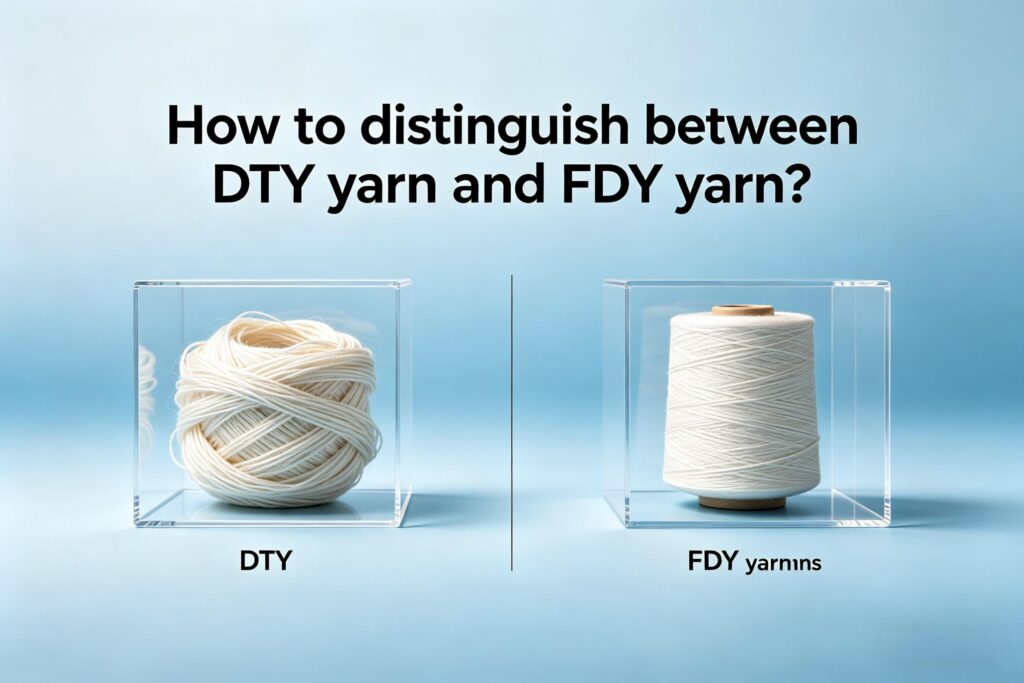
Often, yes. DTY looks duller, fuzzier, and more voluminous on a bobbin. If you pull a strand, DTY will stretch and spring back noticeably. FDY looks sleek, shiny, and lies flat. A simple stretch test is very telling. - Which is more durable, DTY or FDY?
In terms of pure tensile strength and abrasion resistance, FDY is more durable. However, DTY’s elastic recovery can make garments more resistant to deformation and bagging in applications like knitwear, which is a different kind of durability. - Is DTY always used for knitting and FDY for weaving?
No, this is a common oversimplification. While DTY is dominant in knits, it is also woven (e.g., in taffeta for down jackets). FDY is primarily woven but is also used in warp-knit linings and some fine-gauge knit structures. The end-use property dictates the choice, not the machine type. - What is the difference between DTY and “air-textured yarn”?
DTY uses false-twist mechanical deformation to create crimp. Air-textured yarn (ATY) uses high-pressure air jets to tanglingly loop the filaments, creating bulk but without the regular, spring-like crimp of DTY. ATY is often bulkier but less elastic. - Does DTY or FDY dye better?
They dye differently. The crimped structure of DTY can sometimes lead to slightly richer, deeper shades due to light scattering, giving a perceived color depth. FDY’s smooth surface can give a brighter, more reflective color. Both achieve excellent colorfastness with modern dyes. - Can you make FDY from DTY, or vice versa?
No. The processes are irreversible. You cannot “un-crimp” DTY to make FDY. You cannot add permanent, bulk-inducing crimp to FDY without running it through a texturing machine, which is not done commercially. They are distinct products from distinct processes. - For a new fleece product, which yarn should I choose?
DTY is the unequivocal choice for traditional fleece. Its crimp provides the essential bulk, softness, and ability to be napped (brushed) to create the characteristic fuzzy surface. FDY would produce a flat, thin, and slick fabric unsuitable for fleece. - How does yarn choice affect minimum order quantity (MOQ)?
FDY, being a high-volume commodity, often has lower MOQs (e.g., 1-ton) for standard types. Specialty DTY (specific crimp, intermingling) may have higher MOQs (e.g., 3-5 tons) as it is produced in batch processes on texturing machines. Always confirm with the spinner. - Are there different environmental impacts?
FDY production is generally more energy-efficient per kg of yarn produced due to its integrated, high-speed process. DTY’s two-step process consumes more energy, primarily in the texturing stage. However, the superior insulating properties of DTY products can lead to energy savings during the use phase (e.g., in warmer clothing).
