
Article Outline
- Introduction: Navigating the Market – Why Precise Fabric Identification Matters
- The Business Implications of Misidentification: Cost, Quality, and Reputation
- Washed Cotton vs. Polyester Filament: A Tale of Two Philosophies (Natural vs. Engineered)
- Beyond the “Hand Feel”: A Systematic, Technical Approach for Professionals
- Fundamental Fiber Science: From Polymer to Fabric
- Cotton: The Natural Cellulosic Fiber – Structure, Properties, and the “Washed” Process
- Polyester Filament: The Synthetic Polymer Powerhouse – Molecular Orientation and Fiber Formation
- Inherent Differences: A Comparison of Core Properties at the Molecular and Fiber Level
- Comparative Analysis: A Side-by-Side Technical Profile
- Table 1: Core Physical & Chemical Property Comparison
- Density, Moisture Regain, Tensile Strength, Elastic Recovery, Thermal Behavior
- Table 2: Performance & Aesthetic Characteristics in Application
- Drape, Wrinkle Recovery, Pilling Tendency, Dyeability, Color Fastness, Static Buildup
- Table 1: Core Physical & Chemical Property Comparison
- Practical Identification Methods: From Quick Field Tests to Lab Analysis
- Visual & Tactile Inspection: Luster, Grain, Wrinkle Patterns, and “Cool/Warm” Feel
- The Burn Test: The Definitive Field Method – Step-by-Step Guide, Flame/Smoke/Ash Analysis
- Microscopic Examination: Longitudinal and Cross-Sectional Views Under Magnification
- Chemical & Solubility Tests: Using Specific Agents to Confirm Fiber Type
- Advanced Laboratory Methods: FTIR Spectroscopy and DSC Analysis for Unambiguous Results
- Market Context and Application-Based Selection
- Table 3: Strategic Selection Guide – Choosing the Right Fabric for the Job
- Apparel: Casual Wear (Washed Cotton) vs. Performance/Activewear (Polyester)
- Home Textiles: Bedding & Towels vs. Curtains & Upholstery
- Industrial & Specialized Uses: Filters, Geotextiles, Medical Fabrics, Toys, and More
- The “Blend” Scenario: Understanding and Identifying Polyester-Cotton Mixes
- Cost, Sustainability, and Supply Chain Considerations
- Table 4: Total Value Analysis – Beyond the Price Per Meter/Yard
- Raw Material Volatility (Cotton) vs. Petrochemical Dependency (Polyester)
- Water/Energy Footprint, Durability, Care Requirements, and End-of-Life
- The Role of Certifications (GOTS, GRS, OEKO-TEX) in Verification
- The Future of Fabrics: Bio-based Polyesters and Enhanced Cottons
- Conclusion & Key Takeaways: Building a Discerning Eye and a Reliable Process
- FAQ: Frequently Asked Questions
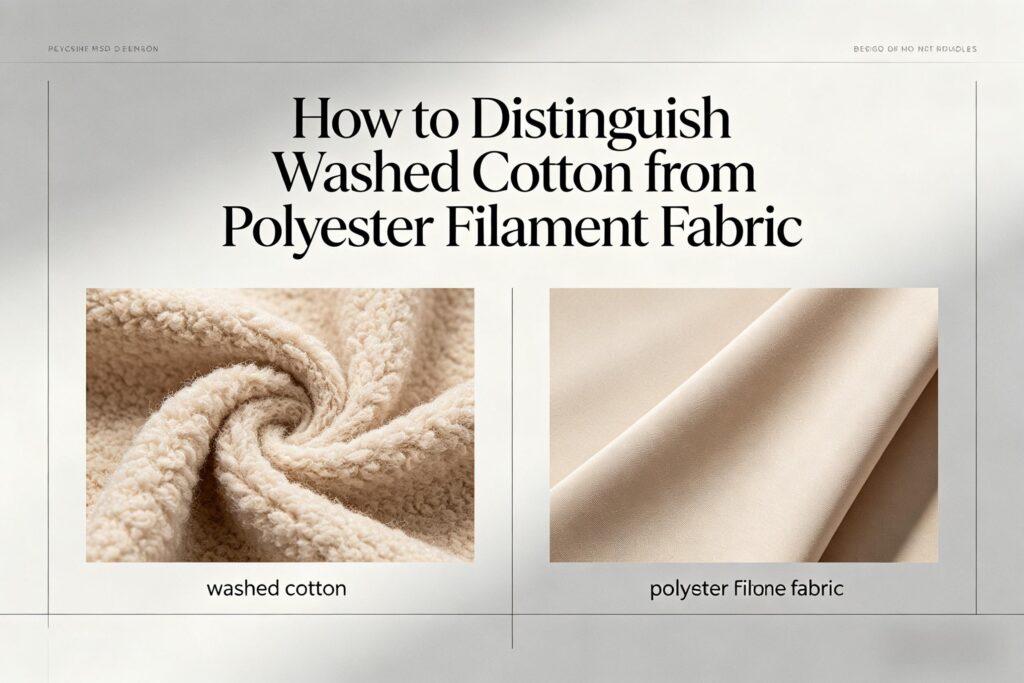
How to Distinguish Washed Cotton from Polyester Filament Fabric: A Technical Guide for Industry Buyers
1. Introduction: Navigating the Market – Why Precise Fabric Identification Matters
For procurement managers and product developers, the ability to accurately distinguish between washed cotton and polyester filament fabric is not merely an academic exercise—it is a critical business competency. A misidentification can lead to catastrophic supply chain errors: ordering a synthetic fabric priced as a premium natural one, or worse, delivering a product that fails to meet performance or sustainability promises to your end customer. The reputational and financial risks are substantial.
While both fabrics can be engineered to achieve a soft hand or casual aesthetic, they originate from fundamentally different sources and possess distinct intrinsic properties. Washed cotton offers the breathable, biodegradable comfort of nature, while polyester filament provides unparalleled strength, consistency, and functional performance. This guide provides a comprehensive, technical framework for reliable identification and informed decision-making, moving beyond subjective touch to objective analysis.
2. Fundamental Fiber Science: From Polymer to Fabric
Understanding the origin is key to identifying the outcome.
- Washed Cotton: Derived from the seed hair of the Gossypium plant, cotton is a natural cellulosic fiber. Its structure is a twisted ribbon of microfibrils, with a central lumen (canal). The “washed” process is a mechanical and chemical finishing treatment applied to woven cotton fabric to impart a pre-shrunk, softened, and slightly puckered texture with a lived-in, vintage appeal. It does not change cotton’s core fiber chemistry.
- Polyester Filament: Polyester is a synthetic polymer—specifically, polyethylene terephthalate (PET)—derived from petrochemicals. “Filament” refers to continuous strands of fiber extruded, drawn, and wound, as opposed to short “staple” fibers. These filaments are exceptionally strong, smooth, and uniform, with a round or engineered cross-section. They are woven or knitted into fabrics known for their durability and stability.
3. Comparative Analysis: A Side-by-Side Technical Profile
The inherent properties of the fibers dictate fabric behavior. The data below is based on industry-standard testing (ASTM, ISO).
Table 1: Core Physical & Chemical Property Comparison
| Property | Washed Cotton (Fiber Base) | Polyester Filament (Fiber Base) | Identification & Application Insight |
|---|---|---|---|
| Chemical Nature | Natural Polymer (Cellulose) | Synthetic Polymer (PET) | Fundamental difference driving all tests. |
| Moisture Regain | High (~8.5% at 70°F, 65% RH) | Very Low (~0.4% under same conditions) | Cotton feels absorbent, polyester feels hydrophobic. A key tactile clue. |
| Density | 1.54 g/cm³ | 1.38 g/cm³ | Polyester is lighter for a given volume. |
| Tenacity (Dry) | 3.0 – 4.9 g/den (Medium) | 4.5 – 7.0 g/den (High) | Polyester is significantly stronger, more resistant to tearing. |
| Elastic Recovery | Poor (74% at 2% extension) | Excellent (100% at 2% extension) | Polyester recovers from stretching; cotton wrinkles and bags. |
| Reaction to Heat | Decomposes at ~150°C, chars/burns. | Melts at ~250-260°C, then burns. | The Burn Test is conclusive (see Section 4). |
Table 2: Performance & Aesthetic Characteristics in Application
| Characteristic | Washed Cotton Fabric | Polyester Filament Fabric | Practical Implication for Buyers |
|---|---|---|---|
| Hand Feel | Soft, warm, dry, slightly textured/“grippy”. | Smooth, cool, slick, can feel “plastic” if not finished well. | Tactile inspection is a first indicator. |
| Drape | Softer, more fluid drape. | Crisper, more structured drape. | Affects garment silhouette and movement. |
| Wrinkle Recovery | Poor – wrinkles easily, requires ironing. | Excellent – resists wrinkling. | Major care and performance differentiator. |
| Pilling Tendency | Low to moderate (fibers break away). | Moderate to high (strong fibers hold pills). | Impacts long-term aesthetic durability. |
| Static Buildup | Low (hydrophilic). | High (hydrophobic), especially in dry conditions. | Polyester may cling or attract dust. |
| Dyeability & Color | Easy to dye, yields matte, soft colors. | Requires disperse dyes, yields bright, sharp colors. | Affects color palette and design options. |
4. Practical Identification Methods: From Quick Field Tests to Lab Analysis
A hierarchical approach from simple to definitive is most efficient.
A. Visual & Tactile Inspection (Preliminary)
- Luster: Cotton is generally matte. Polyester filament can range from bright to dull, but often has a characteristic subtle sheen.
- Grain & Texture: Washed cotton shows a slight, irregular puckering across the grain from the washing process. Polyester fabrics are typically very uniform and smooth.
- Thermal Sensation: Grab a fold of fabric and hold it to your cheek. Cotton will feel neutral or slightly warm. Polyester feels distinctly cool to the touch due to its low moisture regain and high thermal conductivity.
B. The Burn Test (Definitive Field Method)
WARNING: Conduct with care in a safe, ventilated area with water and fire extinguisher present.
- Pull a few yarns from the fabric’s selvage.
- Observe as you bring them to a flame.
- Cotton: Ignites quickly. Burns with a steady, yellow flame like paper. Smells like burning paper or leaves. Leaves behind fine, gray, fluffy ash that crumbles easily.
- Polyester: Melts first, then burns. Flame is orange-yellow, often sputters. Smells distinctly sweet, chemical, or like vinegar. Leaves a hard, dark, round bead of melted polymer that does not crush.
C. Microscopic Examination
A standard 100-400x microscope reveals clear differences:
- Cotton: Longitudinal view shows a flattened, twisted ribbon with a visible lumen. Cross-section is kidney-bean shaped.
- Polyester Filament: Longitudinal view is smooth, straight, and cylindrical. Cross-section is typically perfectly round (or as engineered, e.g., trilobal).
D. Advanced Laboratory Methods
For absolute certainty, especially with blends or treated fabrics:
- Fourier-Transform Infrared (FTIR) Spectroscopy: Identifies the unique molecular “fingerprint” of cellulose vs. PET.
- Differential Scanning Calorimetry (DSC): Measures thermal transitions. PET shows a sharp melting peak (~250°C), while cotton decomposes without melting.
5. Market Context and Application-Based Selection
Knowing what to use and when is as important as identification.
Table 3: Strategic Selection Guide – Choosing the Right Fabric for the Job
| Application | Primary Choice & Why | Key Specs to Verify | Potential Pitfalls |
|---|---|---|---|
| Premium T-Shirts, Loungewear | Washed Cotton: Superior breathability, moisture absorption, and natural comfort for skin contact. | Fabric weight (gsm), shrinkage residual, GOTS certification for organic. | Ensure it’s not a cheap polyester imitation with a “cotton feel” finish. |
| Performance Sportswear, Outer Shells | Polyester Filament: Strength, moisture-wicking, quick-dry, excellent shape retention. | Denier, filament type (e.g., microfilament), moisture management finish. | Can feel clammy if not properly engineered for breathability. |
| Bed Linens, Towels | Washed Cotton: High absorbency and breathability crucial for sleep comfort and drying. | Thread count, yarn quality (long-staple), color fastness to washing. | Polyester lacks absorbency, making it unsuitable for true towels. |
| Upholstery, Drapery | Context-Dependent: Cotton for natural aesthetics; Polyester for sun-resistance & durability. | For polyester: UV stability rating, abrasion resistance (Martindale cycles). | Cotton may fade and degrade faster in direct sunlight. |
| Plush Toys, Stuffed Animals | Polyester Filament (for pile): Holds shape, is durable, and can be made very soft (fine denier). | Fiber safety (Oeko-Tex), crush resistance, flame retardancy if required. | Ensure fill is also safe and non-allergenic. |
6. Cost, Sustainability, and Supply Chain Considerations
The choice involves a complex value equation.
Table 4: Total Value Analysis – Beyond the Price Per Meter/Yard
| Factor | Washed Cotton | Polyester Filament | Strategic Consideration |
|---|---|---|---|
| Raw Material Cost Volatility | High – Tied to agricultural yields, weather, and commodity markets. | Moderate/Linked to Oil – More predictable, but subject to petrochemical cycles. | Polyester offers more predictable costing for long-term contracts. |
| Production Water Footprint | Extremely High (~10,000 liters/kg of fiber). | Low (primarily process cooling water). | A major driver for sustainability-focused brands. |
| Durability & Care | Ages gracefully but can wear, shrink, and wrinkle. Often requires more energy to launder (hot water, ironing). | Extremely durable, retains shape, easy-care (cold wash, line dry). | Polyester’s longevity and low-care needs can offset initial cost over product life. |
| End-of-Life | Biodegradable in right conditions. | Not biodegradable, but recyclable (mechanically or chemically). | rPET (recycled polyester) is a major growth area, closing the loop. |
7. The Future of Fabrics
The lines may blur with innovation. Bio-based polyesters (e.g., from corn) offer synthetic performance with a partially renewable origin. Genetically modified or specially processed cottons are being developed for enhanced strength, wrinkle resistance, or even natural coloration.
8. Conclusion & Key Takeaways
- Never Rely on Feel Alone: Subjective touch can be deceived by finishes. Always employ at least one objective test—the burn test is the most accessible and definitive.
- Understand the Core Dichotomy: Cotton = Absorbent, Natural, Comfort-First. Polyester = Strong, Durable, Performance-First. Let the application guide your need.
- Think in Terms of Total Value: Factor in durability, care costs, and sustainability goals, not just unit price. Recycled polyester (rPET) is a compelling, eco-conscious option.
- Build a Verification Protocol: For critical shipments, incorporate a simple burn test or microscopic check into your receiving QA process.
Mastering this distinction empowers you to source accurately, specify confidently, and deliver products that truly meet your design and quality objectives.
9. FAQ: Frequently Asked Questions
Q1: I have a fabric that feels like soft cotton but passes the burn test as polyester. What is it?
A: This is almost certainly a micro-denier or ultra-fine polyester filament fabric (e.g., <1.0 denier per filament). Through advanced spinning and finishing (like sanding or enzyme washing), it can achieve an exceptionally soft, cotton-like hand. The burn test reveals its true synthetic nature. This is common in premium activewear and affordable “cotton-feel” bedding.
Q2: Is there a simple “drop of water” test to see if it’s cotton or polyester?
A: Yes, it’s a good quick check. Place a small drop of water on the fabric.
- Cotton: The water will spread rapidly and be absorbed into the fibers, creating a damp spot.
- Polyester: The water will bead up and sit on the surface for a long time, as the fiber is hydrophobic. You can often blot it off completely.
Q3: Can a fabric be a blend of both? How do I identify the blend ratio?
A: Yes, poly-cotton blends (e.g., 65/35, 50/50) are extremely common. In a burn test, it will exhibit characteristics of both: it will burn with a flame (cotton) but also melt and form a hard bead (polyester). The ash will be less fluffy. Accurate blend ratio determination requires laboratory chemical analysis (e.g., using sulfuric acid to dissolve the cotton, leaving the polyester for weighing).
Q4: Does “wrinkle-free” or “permanent press” cotton mean it has polyester in it?
A: Not necessarily. While blending with polyester is one way to achieve wrinkle resistance, 100% cotton can be made wrinkle-free with a chemical resin finish (like DMDHEU). The burn test will still show pure cotton characteristics. However, the fabric may have a slightly stiffer hand than untreated washed cotton.
Q5: For plush toys, why is polyester almost always used instead of cotton for the outer fabric?
A: Polyester filament is preferred for its durability, color retention, and shape-holding ability. It withstands repeated hugging, washing, and abrasion far better than cotton. Its fibers are less likely to break and shed, and it can be produced in very consistent, vibrant colors that won’t fade quickly. Cotton is more prone to wear, tearing, and staining.
