
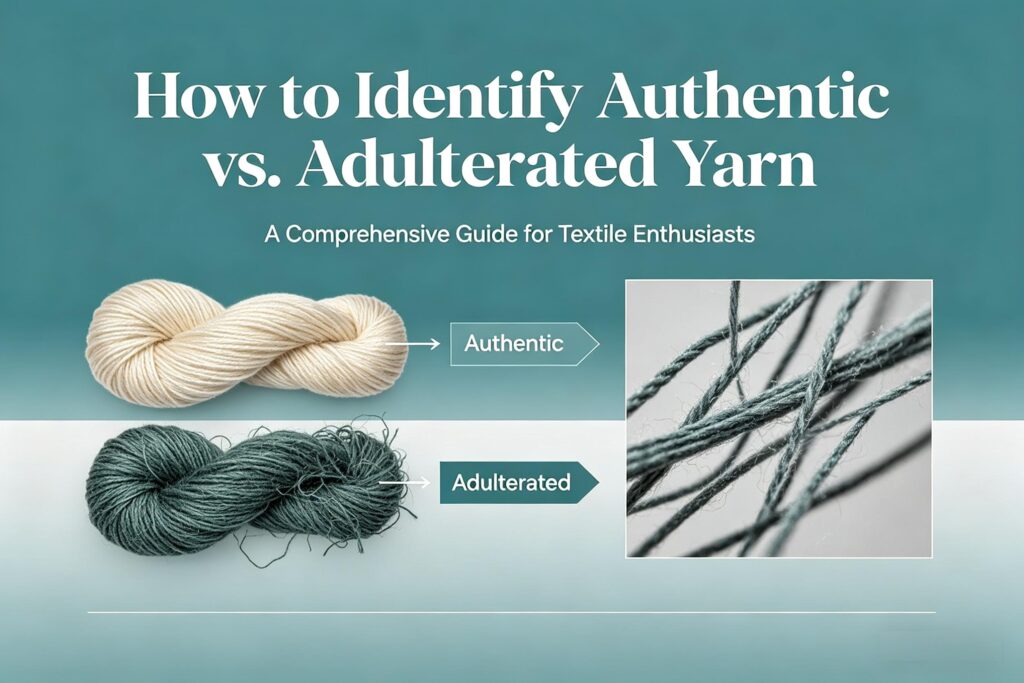
Table of Contents
- Introduction: The High Cost of Counterfeit Yarns in the Global Supply Chain
- Section 1: Foundational Knowledge – Understanding Yarn Specifications and Labeling
- Section 2: Preliminary Inspection – Sensory and Visual Identification Techniques
- Section 3: Destructive Testing Methods for On-Site Verification
- Section 4: Laboratory Analysis – The Definitive Proof
- Section 5: Building a Fraud-Resistant Supply Chain
- Conclusion: A Proactive Framework for Authenticity Assurance
1. Introduction: The High Cost of Counterfeit Yarns in the Global Supply Chain
For textile procurement managers, the integrity of raw materials is the cornerstone of product quality, cost control, and brand reputation. The deliberate mislabeling or adulteration of yarn—whether substituting a lower-grade cotton, blending in recycled content without disclosure, or falsely claiming a luxury fiber like cashmere—poses a severe and costly risk. The International Textile Manufacturers Federation (ITMF) estimates that 5-7% of global textile trade by value involves some form of mis-specification, translating to billions in annual losses from rejected shipments, production downtime, and compromised end products.
Understanding how to verify yarn authenticity is not merely a quality control step; it is a critical supply chain risk management and financial safeguard. This comprehensive guide provides a multi-tiered framework, from quick field checks to definitive lab tests, empowering buyers across apparel, home textiles, and industrial sectors to protect their investments and ensure product integrity.
2. Section 1: Foundational Knowledge – Understanding Yarn Specifications and Labeling
Authentication begins with knowing what you should be receiving. A precise purchase order and understanding standard labels are your first defense.
- Yarn Count/Number (Ne, Nm, Tex, Denier): This specifies fineness. A supplier claiming “40s Ne combed cotton” must deliver yarn of that exact linear density. A significant deviation is a red flag.
- Fiber Content: This must be declared accurately by percentage (e.g., “100% Extra-Long Staple Egyptian Cotton,” “70% Wool, 30% Nylon”).
- Construction: Includes the number of plies (e.g., 2-ply), twist direction (S or Z), and twist level (TPI – Twists Per Inch).
- Certifications: Look for legitimate, verifiable certifications like OEKO-TEX® (for safety), GOTS (for organic), RWS (Responsible Wool Standard), or the Cashmere & Camel Hair Institute’s mark. Always verify the certification number on the issuer’s website.
3. Section 2: Preliminary Inspection – Sensory and Visual Identification Techniques
Before any testing, a skilled eye and hand can reveal inconsistencies.
| Fiber Type | Authentic Characteristics (Visual/Tactile) | Common Adulteration / Warning Signs |
|---|---|---|
| Egyptian/Pima Cotton | Long, fine, uniform staples. Silky, strong handfeel. Lustrous appearance. | Shorter, weaker fibers leading to excessive fuzz/pilling. Dull appearance. Often blended with standard upland cotton. |
| Merino Wool | Extremely fine, soft, and elastic. Scales are less pronounced. Consistent diameter. | Coarser, prickly feel from larger fiber diameter (>24 microns). Blended with cheaper wool types. |
| Cashmere | Unmatched softness, fine, with a smooth, “dry” hand. Excellent loft and warmth. | Blended with fine sheep wool (“faux cashmere”) or rabbit hair. Feels oily, overly slick, or lacks warmth for its weight. |
| Mulberry Silk | Continuous filament with a brilliant, natural luster. Smooth, strong, and cool to the touch. | Wild (Tussah) silk, which is coarser, less lustrous, and often uneven. Or, synthetic filament (polyester) mimicking sheen. |
| High-Tenacity Nylon/Polyester | High strength, smooth filament, consistent denier. | Lower-grade polymer with higher elongation and lower breaking strength. May contain filler materials. |
- Microscopic Examination (Portable 60-100x Microscope): This is a powerful, low-cost tool. Compare suspect samples to known references.
- Cotton: Twisted, ribbon-like shape with a central lumen.
- Wool/Cashmere: Cashmere has smoother, fewer, and more spaced-out scales than wool’s jagged, dense scales.
- Silk: Triangular prism structure that reflects light.
- Synthetics: Smooth, rod-like, uniform shape.
4. Section 3: Destructive Testing Methods for On-Site Verification
Simple tests can provide strong indicative evidence.
- The Burn Test:Conduct with extreme caution in a safe, ventilated area. This is the most telling field test.
- Cotton/Linen (Cellulose): Burns quickly with a yellow flame, smells like burning paper, leaves soft, gray ash.
- Wool/Silk (Protein): Burns slowly, self-extinguishing, smells of burning hair/feathers, leaves a crispy, black bead.
- Polyester (Synthetic): Melts and shrinks from flame, burns with a sooty flame, sweet chemical smell, leaves a hard, black plastic bead.
- Nylon: Melts, burns slowly, smells of celery, leaves a hard, gray bead.
- Acrylic: Melts, burns vigorously with black smoke, acidic smell, leaves a hard, irregular black bead.
- Solubility Tests: Use small snippets in clear containers.
- Wool vs. Cotton: A 5% sodium hypochlorite (household bleach) solution will dissolve wool/silk (protein) but not cotton.
- Acetate: Dissolves in acetone.
5. Section 4: Laboratory Analysis – The Definitive Proof
For contract enforcement and high-value disputes, certified laboratory testing is non-negotiable. These methods provide quantitative, legally defensible data.
| Test Method | What It Identifies | Application Example | Standard (e.g., ISO, AATCC) |
|---|---|---|---|
| Fiber Analysis (Microscopy) | Qualitative & quantitative fiber composition. | Distinguishes cashmere from fine wool; measures blend ratios. | ISO 17718, ISO/TR 11827 |
| Fourier-Transform Infrared Spectroscopy (FTIR) | Molecular fingerprint of fibers. | Detects polymer type (nylon 6 vs. nylon 6,6), identifies unknown synthetics. | ASTM E1252 |
| Scanning Electron Microscopy (SEM) | High-resolution imaging of surface morphology. | Detailed scale pattern analysis for animal fiber identification. | N/A |
| DNA Analysis (PCR) | Species-specific genetic material. | Definitive proof of fiber origin (e.g., Mongolian cashmere vs. generic). | Newly emerging standard |
| Thermogravimetric Analysis (TGA) | Measures decomposition temperatures. | Identifies polymer blends and filler content. | ASTM E1131 |
Cost & Turnaround: Basic microscopy blend analysis costs $150-$300 per sample with a 3-5 day turnaround. Advanced DNA or SEM testing can range from $500-$1,500+ and take 1-3 weeks.
6. Section 5: Building a Fraud-Resistant Supply Chain
Prevention is more efficient than detection. Implement these strategic practices:
- Supplier Qualification & Audits: Vet new suppliers thoroughly. Conduct on-site audits to inspect their sourcing, storage, and quality control processes.
- Clear, Detailed Contracts: Specify not only the material but also the agreed test methods, acceptable tolerances, and consequences for non-compliance.
- Third-Party Pre-Shipment Inspection (PSI): Hire an independent inspection company (like SGS, Bureau Veritas, or Intertek) to test random samples from production batches before shipment is released.
- Blockchain & Traceability Platforms: For high-value fibers (organic cotton, ethical wool), utilize emerging digital traceability systems that provide an immutable record from farm to yarn.
- Establish a “Trusted Supplier” Program: Develop long-term partnerships with verified suppliers. While price is important, consistent quality and transparency have a lower total cost of ownership.
7. Conclusion: A Proactive Framework for Authenticity Assurance
The fight against yarn adulteration requires a layered, vigilant approach. The following framework provides a strategic pathway:
- Tier 1: Every Shipment – Conduct documentary checks (certificates, invoices) and basic sensory inspection.
- Tier 2: First Article / New Supplier – Perform burn tests and portable microscopic examination.
- Tier 3: High-Value or High-Risk Material – Mandate third-party laboratory testing for composition (e.g., for cashmere, silk, or high-performance synthetics).
By combining educated scrutiny, practical testing, and strategic supply chain relationships, procurement professionals can significantly mitigate the risk of yarn fraud. In an era where transparency is paramount, the ability to verify authenticity is not just a technical skill—it is a core component of sustainable and profitable business practice in the global textile industry.
