
Article Directory
- Introduction: Why Mastering Yarn Identification is a Core Business Skill
- From Quality Control to Strategic Sourcing
- Beyond the Label: The Risks of Unverified Claims
- Part I: The First Layer – Categorizing the Universe of Yarn
- 2.1 The Primary Divide: By Fiber Origin (Natural vs. Chemical)
- 2.2 The Form Factor: By Fiber Length (Staple vs. Filament)
- 2.3 Understanding Yarn “Language”: Decoding Count, Ply, and Blend Specifications
- Part II: The Identification Toolkit – From Simple Field Tests to Lab Precision
- 3.1 The Art of Hand Feel and Visual Inspection: A Practical First Step
- 3.2 The Burning Test: A Classic, Accessible Method for Major Categories
- 3.3 Microscopy: The Definitive Visual Evidence
- 3.4 Chemical and Advanced Methods: Solubility, Spectroscopy, and Modern Tech
- Part III: Applied Identification – Navigating Common Challenges
- 4.1 The Hairy Problem: Dissecting Blends and Mixes
- 4.2 Spotting Quality Beyond Type: What to Look For
- 4.3 Case Study: Building Trust in a Complex Supply Chain – The Glyarn Example
- Conclusion: Building a Discerning Eye for Yarn
- Developing a Systematic Workflow
- The Value of Partnership with Transparent Suppliers
1. Introduction: Why Mastering Yarn Identification is a Core Business Skill
For any professional in the textile and apparel industry—from designers and product developers to buyers and quality control managers—the ability to accurately identify yarn is not just academic knowledge; it’s a fundamental business skill. The yarn is the very DNA of a textile product, dictating its look, feel, performance, cost, and care requirements. Misidentifying a yarn can lead to a cascade of problems: garments that pill unexpectedly, fabrics that shrink beyond tolerance, misleading marketing claims that result in legal disputes, and ultimately, damaged brand reputation and financial loss.
In today’s globalized supply chain, where materials may pass through multiple hands, relying solely on a supplier’s specification sheet is a risk. Proactive verification through identification techniques is a critical component of due diligence. It empowers you to ensure value, enforce contracts, foster innovation with accurate material knowledge, and build trust with your customers who are increasingly demanding transparency about what their clothes are made of.
2. Part I: The First Layer – Categorizing the Universe of Yarn
Before diving into identification methods, one must understand the basic classifications. Think of this as learning the taxonomy before identifying the species.
2.1 The Primary Divide: By Fiber Origin
The most fundamental categorization splits all yarns into two worlds:
- Natural Fibers: Sourced directly from plants, animals, or minerals.
- Plant-based (Cellulosic): Cotton (with subtypes like long-staple Pima), Linen (from flax), Hemp, Ramie. They are generally absorbent and cool but can wrinkle.
- Animal-based (Protein): Wool (Sheep, Merino), Cashmere (Goat), Mohair (Goat), Silk (Silkworm), Yak, Alpaca. Known for warmth, elasticity, and a degree of water resistance.
- Chemical Fibers: Man-made, created through industrial processes.
- Regenerated: Made from naturally occurring polymers (like cellulose) reformed into fiber. Viscose/Rayon, Lyocell/Tencel®, Modal, Cupro. They often mimic the drape and feel of silk or cotton.
- Synthetic: Made from synthetic polymers (often petroleum-based). Polyester, Nylon (Polyamide), Acrylic, Elastane/Spandex (Lycra®). They are typically strong, durable, and wrinkle-resistant.
2.2 The Form Factor: By Fiber Length
This affects the yarn’s texture and strength.
- Staple Fiber Yarns: Made from fibers of limited, discrete length (e.g., all natural fibers except silk, and cut synthetic fibers). These fibers must be twisted together (spun) to create a continuous yarn. They have a softer, fuzzier surface (e.g., cotton, wool yarns).
- Filament Yarns: Made from continuous, theoretically endless strands. They can be a single filament (monofilament) or many bundled together (multifilament). They produce smooth, shiny, and strong yarns (e.g., silk, polyester filament).
2.3 Understanding Yarn “Language”
Yarn specifications tell a precise story. For example, a label reading “Glyarn 50/2 NM 80% Merino Wool, 20% Mulberry Silk” decodes as:
- 50/2: The yarn count. ’50’ is the metric number (Nm), meaning 50 meters of this single yarn weigh 1 gram. The ‘/2′ indicates it is a 2-ply yarn, where two ’50 Nm’ singles are twisted together for strength and balance.
- NM: Stands for Metric Count, a “fixed weight” system where a higher number indicates a finer yarn.
- 80/20 Blend: The fiber composition by percentage.
Other common systems include Tex (grams per 1000 meters—higher number = heavier/thicker yarn) and Denier (grams per 9000 meters—common for filaments).
3. Part II: The Identification Toolkit – From Simple Field Tests to Lab Precision
Identification is a process of elimination, often starting with simple tests and progressing to more complex ones.
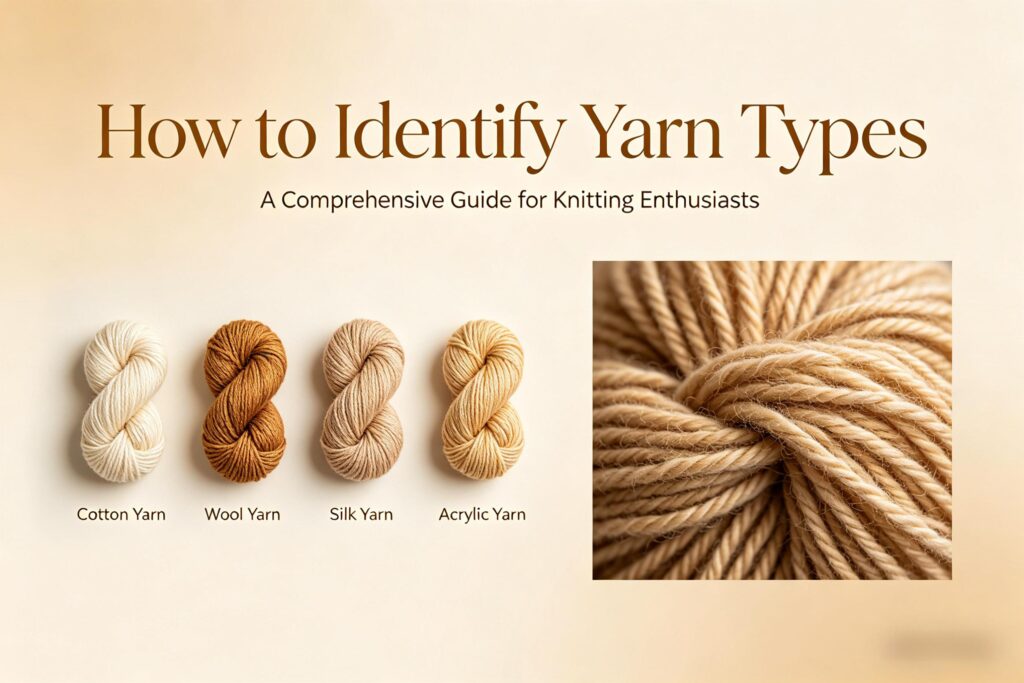
3.1 Hand Feel and Visual Inspection (Hand Feel Test)
The first, most immediate assessment.
- Cotton: Cool to the touch, matte appearance, good drape. A staple fiber with visible fuzz.
- Wool: Warm, slightly elastic, can feel scratchy if coarse. Staple fibers often have a crimp.
- Silk: Uniquely smooth, cool, and lustrous with a distinctive “scroop” sound when crushed.
- Linen: Crisp, cool, with visible slubs and high stiffness.
- Polyester: Can feel warm, often very smooth or deliberately textured, excellent recovery from wrinkling.
- Acrylic: Often mimics wool but is lighter, warmer to the touch, and less elastic.
3.2 The Burning Test
A highly informative and accessible test. Always conduct in a safe, well-ventilated area with tweezers and water nearby.
| Fiber Category | Approaching Flame | In Flame | Smell of Smoke | Residue/Ash |
|---|---|---|---|---|
| Cellulosic (Cotton, Linen, Viscose) | Catches fire quickly | Burns rapidly, yellow flame | Burning paper | Soft, gray, feathery ash |
| Protein (Wool, Silk) | Curls away, sinters | Burns slowly, may sputter | Burning hair/feathers | Brittle, black, crushable bead |
| Synthetic – Polyester | Melts and shrinks | Burns with difficulty, smoky flame | Chemical, sweetish | Hard, black or tan bead |
| Synthetic – Nylon | Melts and shrinks | Burns slowly, may self-extinguish | Celery-like or plastic | Hard, gray or tan bead |
| Synthetic – Acrylic | Melts and shrinks | Burns readily, sooty flame | Acrid, chemical | Hard, irregular black bead |
Table: A guide to common fiber reactions in the burning test.
3.3 Microscopy: The Definitive Visual Evidence
Observing the longitudinal and cross-sectional morphology under a microscope (100-500x magnification) is one of the most reliable methods, especially for natural fibers. This is often the first step in formal lab analysis per standards like FZ/T 01057.3.
- Cotton: Looks like a twisted ribbon with a natural convolution (like a collapsed tube).
- Wool: Shows an overlapping scaly surface.
- Silk: Appears as a smooth, structureless rod.
- Linen (Flax): Looks like bamboo with characteristic crosswise “nodes.”
- Most Synthetics: Appear as smooth, featureless rods, though some (like viscose) may have striations.
3.4 Chemical and Advanced Methods
For blends or definitive proof, these methods are essential.
- Solubility Test: Uses specific chemical solvents to dissolve one fiber in a blend while leaving others intact. For example, a 75% hydrochloric acid (HCl) solution will dissolve silk but not wool, helping distinguish between the two protein fibers.
- Modern Spectroscopy: Techniques like Fourier-Transform Infrared (FTIR) Spectroscopy analyze the molecular fingerprint of a fiber with extreme accuracy. Cutting-edge methods like Rapid Evaporative Ionization Mass Spectrometry (REIMS) can identify fiber composition from a tiny burn sample in seconds with over 97% accuracy for common fibers like cotton, polyester, and silk.
4. Part III: Applied Identification – Navigating Common Challenges
4.1 The Hairy Problem: Dissecting Blends
Blends are the norm, not the exception. A systematic approach is key:
- Microscopy First: Use a microscope to see how many different fiber morphologies are present (e.g., scaly wool next to smooth synthetic rods).
- Selective Dissolution: Choose a solvent that will dissolve one identified component. Weigh the sample before and after to calculate the blend percentage.
- Cross-Verification: Use a burning test to check the preliminary findings (e.g., the smell of burning hair plus a hard bead suggests a wool/polyester blend).
4.2 Spotting Quality Beyond Type
Identifying the fiber is just the start. Assessing quality within that type is crucial:
- Cotton: Longer staple length (e.g., Supima, Egyptian) means stronger, smoother, more lustrous yarn.
- Wool: Finer micron count (e.g., 18.5µ Superfine Merino) means softer, less prickly yarn. The presence of consistent crimp indicates good elasticity.
- Synthetics: Look for even filament thickness, consistency of texture (in textured yarns), and low levels of oligomer deposits on polyester.
4.3 Case Study: Building Trust in a Complex Supply Chain – The Glyarn Example
Navigating these complexities is why partnerships with transparent suppliers are invaluable. Consider a supplier like Glyarn, known for its specialty natural fiber yarns. When they offer a “100% Mongolian Cashmere” yarn, their credibility is built on more than a claim.
- Multi-Layer Verification: A buyer can first perform a burning test (characteristic protein fiber burn) and a microscopic check for the fine, scaly structure of cashmere.
- Supplier-Guaranteed Documentation: Glyarn’s value lies in backing their product with supply chain traceability and third-party test reports from accredited labs. These reports would likely include not just fiber identification via FTIR spectroscopy, but also objective quality data like average fiber diameter (microns) and length—proving it is not merely “cashmere,” but high-quality cashmere.
- Strategic Advantage: This level of transparency allows brands to procure with confidence, streamline their own QC, and market their products with verifiable, premium claims. It transforms the supplier relationship from a transactional one into a strategic partnership for quality assurance.
5. Conclusion: Building a Discerning Eye for Yarn
Mastering yarn identification is a journey that blends sensory skill with scientific methodology. Start by building your internal reference library: collect known yarn samples and practice burning and microscopic observation on them. Develop a systematic workflow: begin with hand feel and visual inspection, move to a burning test for category, and use microscopy for visual confirmation of natural fibers. For blends, complex synthetics, or legal disputes, never hesitate to enlist a professional textile testing laboratory.
Ultimately, in a market saturated with claims, the ability to independently verify material composition is a superpower. It protects your business, ensures product integrity, and builds brand authenticity. Partnering with suppliers who operate with the transparency and technical rigor of a company like Glyarn significantly de-risks this process. By combining your own discerning eye with the expertise of trusted partners, you can navigate the vast world of yarn with confidence, ensuring that the foundation of every product you create is exactly as intended.
