
Table of Contents
- Executive Summary
- Introduction
- 2.1 An Overview of rPET Chips
- 2.2 The Critical Importance of Moisture Control in rPET Processing
- The Impact of Moisture on rPET Chips and Final Products
- 3.1 Hydrolytic Degradation: The Breakdown of Polymer Chains
- 3.2 Product Quality Defects: Yellowing, Voids, and Reduced Strength
- 3.3 Process Disruption: Inconsistent Extrusion and Molding
- Core Methods for Measuring Moisture in rPET Chips
- 4.1 The Laboratory Benchmark: Loss-on-Drying (LoD) Oven Method
- 4.1.1 Principles and Standard Procedure
- 4.1.2 Advantages and Key Limitations
- 4.1.3 Relevant Standards (e.g., ASTM D6980)
- 4.2 The Workhorse for Quality Control: Halogen Moisture Analyzer
- 4.2.1 Principle of Operation (Thermogravimetric Analysis)
- 4.2.2 Operational Workflow and Primary Benefits
- 4.2.3 Critical Factors: Calibration and Sample Preparation
- 4.3 The Future of Process Control: Near-Infrared (NIR) Spectroscopy
- 4.3.1 Technological Principle and Measurement
- 4.3.2 Implementation: At-Line and In-Line Systems
- 4.3.3 Benefits and the Importance of Robust Calibration
- 4.4 Other and Emerging Techniques
- 4.4.1 Karl Fischer Titration (For Absolute Water Content)
- 4.4.2 Capacitance and Resistance-Based Sensors
- 4.1 The Laboratory Benchmark: Loss-on-Drying (LoD) Oven Method
- Selecting the Right Moisture Measurement Method: A Decision Framework
- 5.1 Defining Requirements: Accuracy, Precision, and Speed
- 5.2 Aligning Method with Production Scale and Workflow
- 5.3 Analyzing Capital and Operational Costs
- Best Practices for Accurate and Reliable Moisture Measurement
- 6.1 Consistent and Representative Sampling
- 6.2 Proper Handling and Storage of Samples Before Testing
- 6.3 Regular Calibration and Maintenance of Equipment
- 6.4 Documentation and Trend Analysis for Continuous Improvement
- Conclusion: Moisture Control as a Pillar of rPET Quality
- Glossary of Key Terms
1. Executive Summary
For processors of recycled polyethylene terephthalate (rPET), precise moisture control is not merely a quality parameter—it is a fundamental determinant of production efficiency, product performance, and economic viability. Excess moisture in rPET chips triggers irreversible hydrolytic degradation during high-temperature processing, leading to a cascade of problems: loss of intrinsic viscosity (IV), severe yellowing, the formation of splay and bubbles, and weakened mechanical properties in the final product.
This comprehensive guide details the principal methods for measuring moisture in rPET chips, each serving a distinct role in the quality assurance ecosystem. From the traditional but slow laboratory oven method to the rapid and precise halogen moisture analyzers that dominate quality control labs, and onward to the advanced Near-Infrared (NIR) spectroscopy systems enabling real-time process optimization, understanding these technologies is key. Selecting the appropriate method hinges on a balance of required accuracy, measurement speed, production scale, and cost. Ultimately, implementing a robust moisture measurement and control protocol is an essential investment. It safeguards material integrity, ensures consistent processing, minimizes waste, and guarantees that the final rPET products meet the stringent specifications required by today’s markets, thereby protecting brand reputation and supporting the circular economy mission.
2. Introduction
2.1 An Overview of rPET Chips
Recycled PET (rPET) chips are the foundational feedstock for producing sustainable polyester products, from fibers and strapping to food-contact bottles and sheets. These chips are produced through the collection, sorting, washing, and reprocessing of post-consumer or post-industrial PET waste. Unlike virgin PET, rPET chips have a history; their polymer chains may have undergone previous thermal and mechanical stress. This makes them inherently more sensitive to processing conditions, with moisture being the most critical factor to manage post-drying.
2.2 The Critical Importance of Moisture Control in rPET Processing
PET is a hygroscopic polymer, meaning it readily absorbs moisture from the atmosphere. For rPET, this tendency can be amplified due to increased surface area from flake size or residual contamination. During extrusion or injection molding, processing temperatures exceed 250°C. At these temperatures, any present water molecules act as a powerful agent of hydrolysis, randomly cutting the long polymer chains (esters) that give PET its strength and clarity. This chemical reaction is fast, irreversible, and its damaging effects are cumulative. Therefore, measuring and ensuring moisture content is below a critical threshold—typically between 0.02% (200 ppm) and 0.05% (500 ppm) depending on the application—is the single most important preventative step in rPET manufacturing.
3. The Impact of Moisture on rPET Chips and Final Products
3.1 Hydrolytic Degradation: The Breakdown of Polymer Chains
Hydrolysis is the chemical reaction between water and the ester bonds in PET. This severs the polymer chains, dramatically reducing the material’s average molecular weight and its key indicator: Intrinsic Viscosity (IV). A drop in IV translates directly to a loss of tensile strength, impact resistance, and barrier properties. For rPET, which may start with a lower IV than virgin material, preventing further IV drop is paramount.
3.2 Product Quality Defects: Yellowing, Voids, and Reduced Strength
- Yellowing/Browning: Hydrolysis and other thermal-oxidative reactions are accelerated by moisture, leading to the formation of chromophores that cause unacceptable yellow discoloration, especially critical for clear or light-colored products.
- Voids, Bubbles, and Splay: Trapped moisture vaporizes instantly in the hot melt, creating micro-bubbles. These manifest as surface defects (splay or silver streaks), internal voids that weaken the structure, and hazy appearance in sheets or preforms.
- Mechanical Failure: The shortened polymer chains result in brittle parts, poor elongation, and a high risk of failure under stress, such as bottle bursting or fiber breakage.
3.3 Process Disruption: Inconsistent Extrusion and Molding
Variable moisture content leads to unpredictable melt viscosity, causing surging, unstable parisons in blow molding, and inconsistent output from the extruder. This results in poor dimensional control, increased scrap rates, and frequent, unplanned production stoppages for die or mold cleaning.
4. Core Methods for Measuring Moisture in rPET Chips
4.1 The Laboratory Benchmark: Loss-on-Drying (LoD) Oven Method
- Principles and Standard Procedure: This is a gravimetric method. A weighed sample of rPET chips is placed in a ventilated oven at a standardized temperature (e.g., 105°C to 150°C as per ASTM D6980) for a specified time (often 1-2 hours) or until constant mass is achieved. The moisture content is calculated from the weight loss.
- Advantages and Key Limitations:
- Advantages: Considered a primary reference method; simple in concept; low equipment cost.
- Limitations: Extremely slow (hours); uses a large sample that may not be homogeneous; risk of oxidative degradation at high temperatures giving false high readings; not suitable for process control.
- Relevant Standards: ASTM D6980 provides a standard test method for moisture in plastics using loss-on-drying.
4.2 The Workhorse for Quality Control: Halogen Moisture Analyzer
- Principle of Operation: This is a rapid thermogravimetric technique. A halogen lamp or other integrated heating element radiates precise, controlled heat onto a small, continuously weighed sample. The instrument’s microprocessor monitors the weight loss in real-time and automatically calculates the moisture content once drying is complete, typically within 3-10 minutes.
- Operational Workflow and Primary Benefits:
- Workflow: Tare the pan, spread a representative 5-10g sample, select/start the drying program (often based on a pre-set temperature profile), and read the digital result.
- Benefits: Speed is the greatest advantage, providing results in minutes. It offers excellent precision, ease of use, and automated endpoint detection, making it ideal for incoming material checks, pre-production verification, and quality control labs.
- Critical Factors: Regular calibration with standard weights is essential. Consistent sample preparation (chip size, spread in the pan) is crucial for reproducible results.
4.3 The Future of Process Control: Near-Infrared (NIR) Spectroscopy
- Technological Principle: NIR systems measure the absorption of specific wavelengths of near-infrared light by the sample. The O-H bond in water has unique absorption bands in the NIR spectrum. A spectrometer measures the intensity of absorbed light, and a chemometric model (calibration curve) correlates this to a known moisture content.
- Implementation:
- At-Line: A portable or benchtop NIR analyzer used to test samples quickly taken from the production line.
- In-Line: A sensor probe installed directly in the material stream (e.g., above the dryer hopper or extruder throat), providing continuous, real-time moisture data without sampling delay.
- Benefits: In-line NIR enables true predictive and preventive process control. It allows for automatic feedback loops to dryers, ensuring moisture is always within spec and preventing the processing of off-spec material. It provides unparalleled data density for trend analysis.
4.4 Other and Emerging Techniques
- Karl Fischer Titration (KFT): A coulometric or volumetric chemical method that specifically and accurately titrates water. It is highly accurate for very low moisture levels but is more complex, slower, and requires chemical reagents. It is best used as a secondary method to calibrate or validate primary methods like halogen or NIR.
- Capacitance/Resistance Sensors: These measure the change in dielectric constant or electrical resistance of a material bulk caused by water. They are lower-cost and used for basic, non-precise trend monitoring in silos or hoppers but are highly influenced by material density, temperature, and packing, making them unsuitable for accurate, absolute measurement of rPET chips.
5. Selecting the Right Moisture Measurement Method: A Decision Framework
- For R&D and Absolute Reference: Use the Oven Method (ASTM) for foundational data or to settle disputes, accepting its slow turnaround.
- For Quality Control and Production Support: A Halogen Moisture Analyzer is the unequivocal choice for its optimal balance of speed, accuracy, cost, and ease of use. It is the industry standard for release-to-production testing.
- For High-Volume Production and Process Optimization: Invest in At-Line or In-Line NIR Spectroscopy to move from detection to true prevention, maximizing yield and consistency.
- For Ultimate Validation: Maintain a Karl Fischer Titration system to periodically verify the calibration of your primary methods, especially when working at the extreme low end of the moisture specification.
6. Best Practices for Accurate and Reliable Moisture Measurement
- Sampling: Use a proper sample thief to obtain a representative cross-section from multiple points in a bag, supersack, or silo. Follow a statistically sound sampling plan.
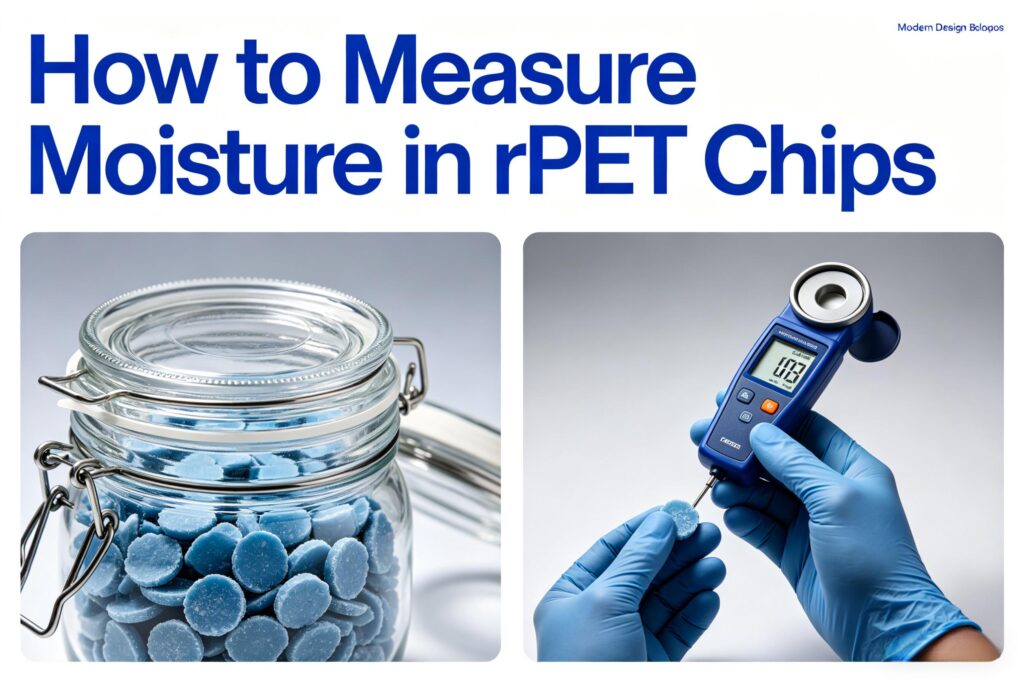
- Sample Handling: Transfer samples immediately into airtight, moisture-barrier containers (e.g., glass jars with seals). Test as soon as possible to prevent moisture gain or loss from ambient air.
- Equipment Care: Calibrate halogen analyzers weekly or monthly based on usage. Validate NIR models quarterly or after any major process change using a reference method (halogen or KFT). Keep sample chambers and optics clean.
- Data Management: Record not just the moisture value, but also sample ID, time, date, operator, and testing conditions. Chart data over time to identify trends related to supplier, season, or dryer performance.
7. Conclusion: Moisture Control as a Pillar of rPET Quality
In the competitive and quality-driven landscape of rPET manufacturing, ignorance of moisture content is not an option. The choice of measurement technology—from the practical halogen analyzer to the sophisticated in-line NIR system—defines a processor’s capability to control their process and protect their product. Implementing a rigorous, methodical approach to moisture measurement is a direct investment in operational excellence. It reduces waste, energy, and downtime while ensuring the production of high-quality, reliable rPET that meets the mechanical, aesthetic, and safety standards demanded by brand owners and end consumers. By mastering moisture, rPET producers solidify their role as essential, trusted contributors to a sustainable materials economy.
8. Glossary of Key Terms
- Hydrolysis: The chemical breakdown of PET polymer chains by reaction with water.
- Intrinsic Viscosity (IV): A measure of the average molecular weight of PET polymer chains; directly correlates to mechanical strength.
- Hygroscopic: The tendency of a material to absorb moisture from the air.
- Thermogravimetric Analysis (TGA): A technique where the mass of a sample is measured as a function of temperature; the principle behind halogen moisture analyzers.
- Chemometrics: The use of mathematical and statistical methods to extract information from chemical data, used to build NIR calibration models.
- ppm: Parts per million; a unit of concentration. 0.01% = 100 ppm.
