
Table of Contents
- Introduction: The Critical Role of Yarn Fineness in Sweater Design
- Understanding the Language of Yarn Thickness: Decoding Yarn Count Systems
- 2.1. The Universal Logic: Weight vs. Length
- 2.2. Key Yarn Count Systems and Conversions
- The Practical Spectrum: From Superfine to Bulky Yarns
- 3.1. Classification and Common Terminology
- 3.2. The Impact of Fineness on Fabric Characteristics
- Strategic Selection: Five Key Factors for Decision-Making
- 4.1. Seasonal Wear and Intended Function
- 4.2. Desired Fabric Handle, Drape, and Aesthetic
- 4.3. Stitch Definition and Design Complexity
- 4.4. Gauge and Production Machinery Compatibility
- 4.5. Fiber Type and Yarn Construction
- A Practical Guide: Fineness Recommendations for Specific Applications
- 5.1. Delicate, Lightweight Sweaters
- 5.2. Versatile Mid-Weight and Classic Sweaters
- 5.3. Warm, Textured, and Outerwear Sweaters
- Conclusion and Forward Look: Mastering Fineness for Success
1. Introduction: The Critical Role of Yarn Fineness in Sweater Design
Selecting the appropriate yarn fineness, or “yarn count,” is a foundational decision in sweater development that dictates the very essence of the final garment. This choice transcends simple aesthetics; it directly and profoundly impacts the sweater’s function, comfort, cost, and manufacturability. The fineness of the yarn is the primary determinant of the fabric’s weight, warmth, drape, and texture. A strategic selection ensures that a lightweight spring cardigan breathes and flows, while a rugged winter pullover provides substantial warmth and durability. Misjudging this parameter can lead to a garment that is too heavy for its intended season, too stiff for comfortable wear, or incompatible with the production machinery, resulting in costly inefficiencies. This guide provides a comprehensive framework for designers, product developers, and sourcing professionals to navigate the selection of yarn fineness, transforming it from a technical guess into a confident, value-driven strategy.
2. Understanding the Language of Yarn Thickness: Decoding Yarn Count Systems
Yarn fineness is universally quantified using standardized numbering systems, but navigating them requires understanding their underlying logic.
2.1 The Universal Logic: Weight vs. Length
All systems define fineness by the relationship between a fixed weight of yarn and its length, or vice versa. They are categorized into two main types:
- Fixed-Weight (Indirect) Systems: These measure how long a fixed weight of yarn is. A higher number indicates a finer yarn, as more length is spun from the same weight of fiber. This is the most common category for sweater yarns.
- Fixed-Length (Direct) Systems: These measure how much a fixed length of yarn weighs. A higher number indicates a coarser, heavier yarn.
2.2 Key Yarn Count Systems and Conversions
The three most prevalent systems in global trade are compared in the table below. Understanding their equivalence is crucial for international sourcing and specification.
| System | Type | Core Principle | Higher Number Means… | Common Use & Notes |
|---|---|---|---|---|
| Metric Count (Nm) | Fixed-Weight | Number of 1-kilometer hanks per 1 kilogram of yarn. | Finer yarn. | Widely used in Europe and for woolen yarns. Nm 1/28 means a single ply where 1 kg is 28 km long. |
| English Cotton Count (Ne) | Fixed-Weight | Number of 840-yard hanks per 1 pound of yarn. | Finer yarn. | Common for cotton and general textile trade. 40S means 40 hanks per pound. |
| Tex | Fixed-Length | Weight in grams of 1 kilometer of yarn. | Coarser yarn. | An international SI system, common for technical specifications. |
Critical Conversion Insight: A yarn labeled Nm 2/28 (a common fine-gauge wool) means it is a 2-ply yarn, where each single ply is Nm 28. When plied, its resultant fineness is approximately Nm 14 (28/2). This is roughly equivalent to a Lace or 2-ply Fingering weight in common knitting terminology.
3. The Practical Spectrum: From Superfine to Bulky Yarns
The industry uses both technical counts and descriptive categories to classify yarns for practical use. These categories align with distinct fabric outcomes and end uses.
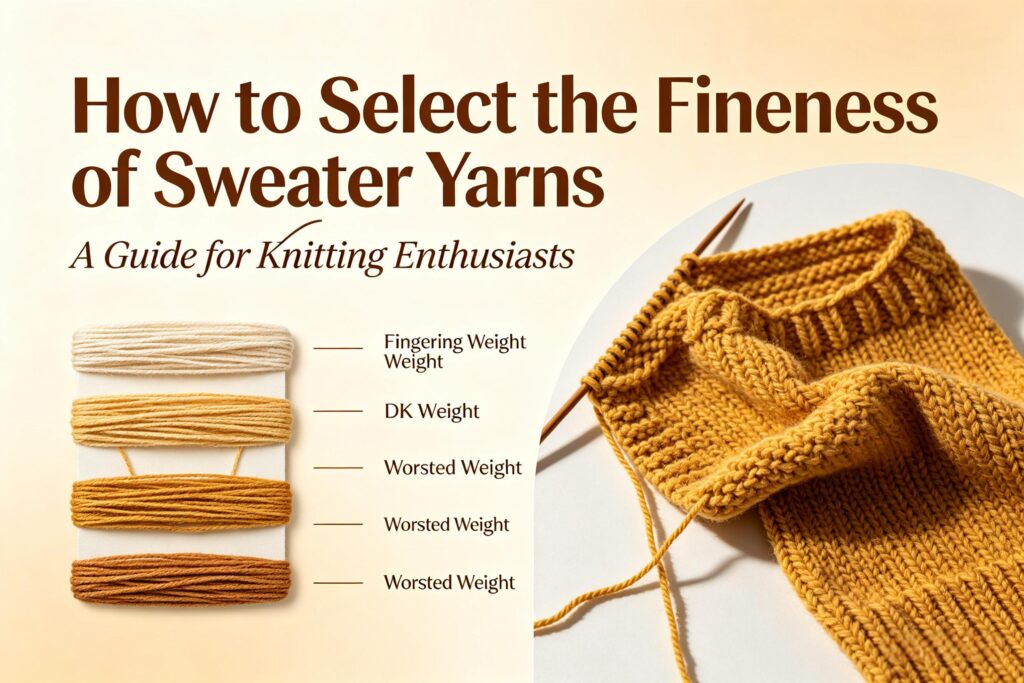
- Superfine / Fingering (Approx. Nm 14-30): This is among the finest yarns used for sweaters. It produces very lightweight, delicate, and drapey fabrics with excellent stitch definition. It is ideal for fine-gauge baby garments, lightweight lacy shawls, and sophisticated, close-fitting adult sweaters intended for layering or moderate climates. The production cost per garment is higher due to longer knitting times.
- Medium / Sport to DK (Approx. Nm 8-12): Often described as “medium” or “worsted” weight, this is the most versatile and commonly used category for a wide range of sweaters. It balances knitting efficiency with a substantial but comfortable fabric weight. It produces garments with good warmth, clear stitch definition for patterns like cables, and a classic hand-feel suitable for cardigans, pullovers, and accessories for three-season wear.
- Bulky / Chunky to Super Bulky (Approx. Below Nm 6): These are coarse yarns that knit up quickly into thick, warm, and highly textured fabrics. They are the primary choice for heavy winter sweaters, jackets, and outerwear where maximum warmth and a bold, rustic aesthetic are desired. The fabric has less drape and more rigidity, creating a bold silhouette. It is less suitable for intricate stitch patterns.
4. Strategic Selection: Five Key Factors for Decision-Making
Choosing the right fineness is a multi-variable optimization. Consider these five interrelated factors.
4.1 Seasonal Wear and Intended Function
The garment’s purpose is the primary filter. A fine (Nm 16+) yarn creates a lightweight, breathable fabric for spring/autumn or indoor wear. A medium yarn (Nm 8-12) offers versatile mid-layer warmth. For standalone winter outerwear, a bulky yarn (Nm 6 or below) provides the necessary thermal insulation through a dense, air-trapping fabric structure.
4.2 Desired Fabric Handle, Drape, and Aesthetic
Yarn fineness dictates fabric character. Finer yarns produce fabrics that are soft, fluid, and have an elegant, draping quality. They offer a smoother, more refined surface. Coarser yarns create fabrics with a more robust, hearty, and textured hand. They have more inherent stiffness, resulting in a boxier silhouette that holds its shape boldly.
4.3 Stitch Definition and Design Complexity
The scale of the yarn must match the design intent. Intricate colorwork (Fair Isle, intarsia), detailed cables, and lace patterns require the clear stitch definition provided by fine to medium yarns. The smaller stitches render the pattern with precision. Bulky yarns simplify designs, making them ideal for large-scale textures, basic silhouettes, or quick-knit projects where the yarn itself is the primary visual feature.
4.4 Gauge and Production Machinery Compatibility
This is a critical technical constraint. Yarn fineness must be compatible with the gauge of the knitting machine (industrial or domestic). Gauge refers to the number of needles per inch. A fine yarn requires a high-gauge machine (e.g., 7-gauge or higher) to form proper loops. Using a bulky yarn on a high-gauge machine is impossible, while a fine yarn on a low-gauge machine will produce an overly loose, unstable fabric. For manufacturers, the available machinery often defines the acceptable range of yarn counts.
4.5 Fiber Type and Yarn Construction
The fiber content interacts with fineness. Fine, delicate fibers like merino wool, cashmere, or silk are often spun into finer counts to showcase their softness and create luxurious fabrics. Sturdier fibers like robust wool breeds or acrylic can be spun across a wider range, including bulky counts. Furthermore, a multi-ply construction (e.g., a 4-ply yarn) can create a rounder, stronger, and more stable yarn compared to a single-ply of similar thickness, which can bias or pill more easily.
5. A Practical Guide: Fineness Recommendations for Specific Applications
To translate theory into practice, here are targeted recommendations based on common sweater types.
5.1 Delicate, Lightweight Sweaters
- Examples: Fine-gauge merino pullovers, silk-blend cardigans, lace-knit tops.
- Recommended Fineness: Superfine to Fine (Nm 16 – Nm 30+). This corresponds to Lace, 2/28, or 3/28 wool counts, or high cotton counts like 60S-80S for summer knits.
- Rationale: Achieves superior drape, breathability, and a silky hand-feel. Perfect for creating elegant, layerable pieces that are less about warmth and more about style and comfort.
5.2 Versatile Mid-Weight and Classic Sweaters
- Examples: Standard wool crewnecks, cable-knit cardigans, most commercially produced sweaters.
- Recommended Fineness: Medium (Nm 8 – Nm 12). This is the classic “Double Knit” (DK) or “Worsted Weight” zone, often seen as counts like Nm 2/12 or 2/16.
- Rationale: Offers the optimal balance of warmth, knitting efficiency, stitch definition, and durability. It provides enough substance for warmth without excessive weight, making it the versatile workhorse for everyday wear.
5.3 Warm, Textured, and Outerwear Sweaters
- Examples: Icelandic lopapeysa, chunky fisherman knits, oversized winter cardigans.
- Recommended Fineness: Bulky to Super Bulky (Below Nm 6). This includes terms like “Chunky,” “Aran,” or very coarse single counts.
- Rationale: Maximizes speed of production and thermal insulation. The thick fabric provides wind resistance and a bold, textured aesthetic that is the hallmark of traditional winter wear.
6. Conclusion and Forward Look: Mastering Fineness for Success
Selecting the fineness of sweater yarn is a fundamental design decision that synthesizes art, science, and commerce. It begins with a clear vision of the final garment—its season, function, and aesthetic—and proceeds through a systematic evaluation of how different yarn counts translate into fabric weight, hand, drape, and production feasibility. Mastering the language of yarn count systems (Nm, Ne, Tex) empowers clear communication with spinners and suppliers worldwide. Understanding the practical spectrum from superfine to bulky allows designers to align their creative vision with a tangible technical specification.
Ultimately, the most successful selections come from viewing yarn fineness not in isolation, but as the core of a holistic system that includes fiber type, ply, twist, and machine gauge. By applying the strategic framework outlined here, professionals can move beyond guesswork to make confident, informed decisions that optimize cost, ensure quality, and fulfill the creative and functional promise of the sweater. In an industry moving towards greater customization and sustainability, this knowledge also opens doors to innovation with blended and engineered yarns. For those seeking a reliable partner in this complex process, working with dedicated specialty producers can be invaluable. For instance, a company like Glyarn focuses specifically on developing and supplying high-quality, consistent yarns for knitting applications, offering technical expertise that can help brands effectively navigate these critical selection parameters to bring their specific sweater concepts to life.
