
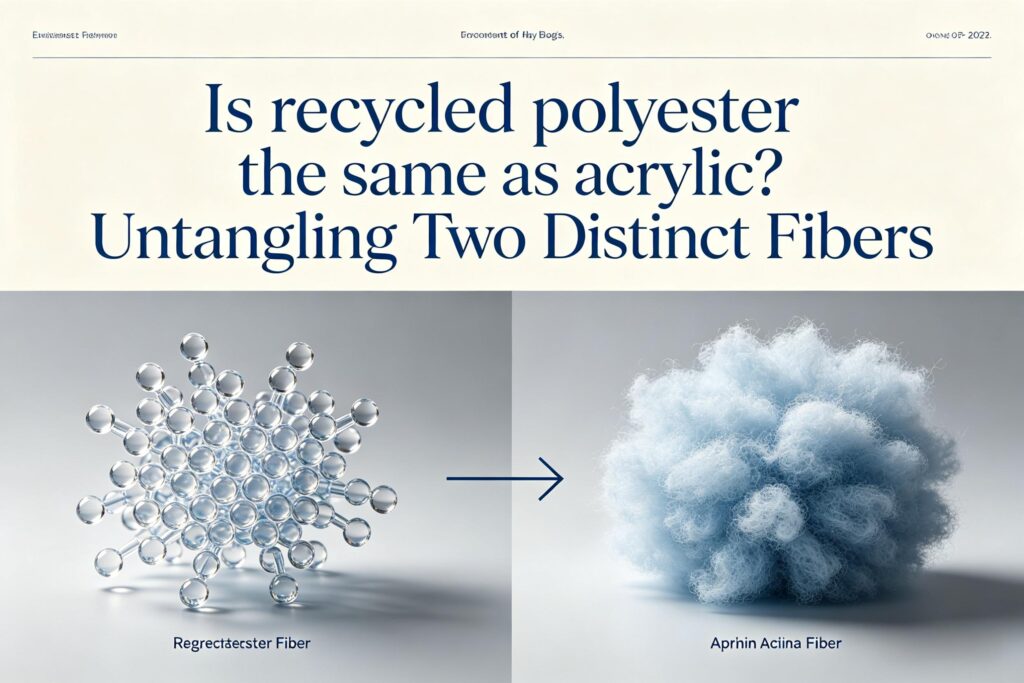
In the quest for sustainable and comfortable textiles, consumers often encounter a variety of fabric names, leading to potential confusion. A common question that arises is whether recycled polyester is the same as acrylic. The straightforward answer is no; they are fundamentally different materials at a chemical level, with distinct properties, origins, and environmental implications. Understanding these differences is key to making informed purchasing decisions.
The most critical distinction lies in their chemical composition, which dictates everything from their feel to their performance. Recycled Polyester (rPET) is a variation of polyethylene terephthalate (PET). It shares the exact same chemical structure as virgin polyester; the only difference is its source material, which is typically post-consumer PET bottles. As a synthetic polymer, it is derived from petroleum, but its recycled nature gives it a significantly lower carbon footprint than its virgin counterpart. Acrylic, on the other hand, is a polymer known as polyacrylonitrile (PAN). It is also a synthetic fiber derived from petroleum, but its chemical makeup is entirely different from that of polyester. This fundamental chemical divergence is the reason why the two fibers behave so differently.
These differences in chemistry translate directly to performance and hand feel, making each fiber suitable for unique applications. Recycled polyester is known for its:
- Strength and Durability: It is a strong, resilient fiber that resists wrinkling, stretching, and abrasion.
- Moisture-Wicking: It hydrophobic, meaning it repels water and dries quickly, making it ideal for athletic wear and outdoor gear.
- Smoothness or Insulation: It can be spun into fine, smooth filaments for flowing fabrics or into hollow fibers for thermal insulation.
Acrylic fiber is engineered specifically to mimic the look and feel of wool. Its key characteristics include:
- Warmth and Lightweight: It is an excellent insulator, providing considerable warmth without the heaviness of wool, making it popular for sweaters, blankets, and cold-weather accessories.
- Softness and Bulk: Acrylic can be made very soft and has a fluffy, bulky texture that closely resembles wool.
- Weakness When Wet: Unlike polyester, acrylic loses a significant amount of its strength when wet and is less durable overall.
- Pilling: Acrylic fabrics are generally more prone to pilling than polyester fabrics.
From a sustainability perspective, recycled polyester has a clear advantage in its current lifecycle. It directly diverts plastic waste from landfills and oceans, creating a circular solution for PET packaging. While both are ultimately petroleum-based, acrylic offers no widely available recycled equivalent on a commercial scale and is considered less environmentally friendly due to the chemicals used in its production and the challenge of recycling it.
In conclusion, recycled polyester and acrylic are not the same; they are distinct synthetic fibers with different DNA. Recycled polyester is a sustainable version of a strong, versatile, and moisture-managing workhorse fiber. Acrylic is a cost-effective wool substitute prized for its warmth and softness but with limitations in durability and environmental footprint. Recognizing these differences allows one to appreciate recycled polyester for its rugged, circular properties and acrylic for its cozy, wool-like comfort, applying each to the purposes for which they are best suited.
