
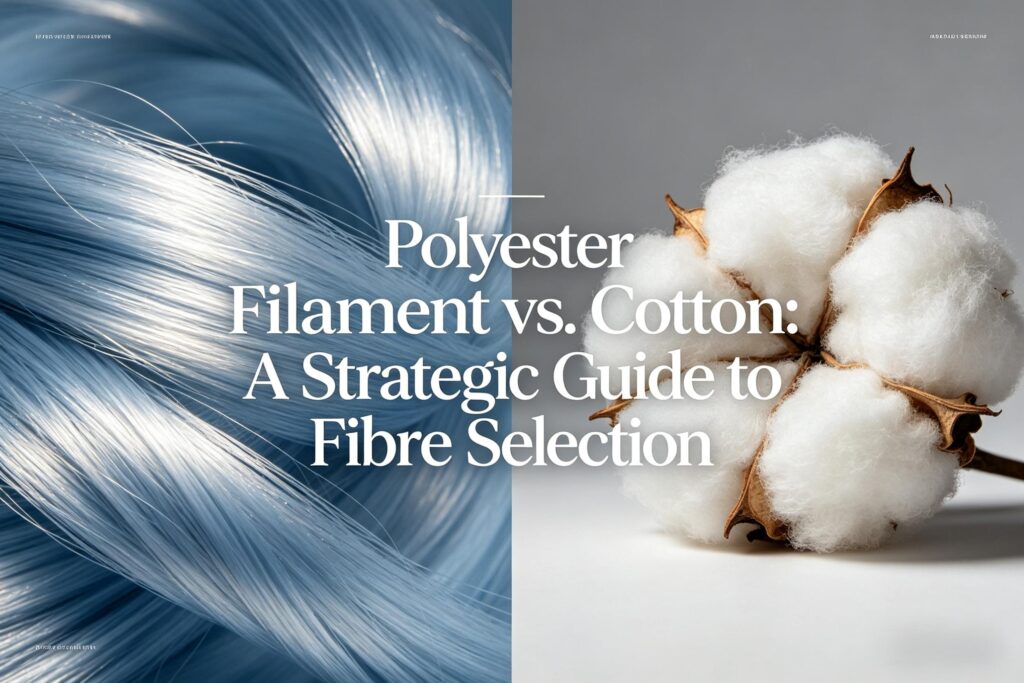
Executive Summary
In the ever-evolving global textile industry, choosing between polyester filament and cotton is not a simple binary choice. It is a strategic decision that impacts product performance, cost structure, supply chain resilience, and brand sustainability. Polyester filament, a dominant synthetic derived from petrochemicals, is celebrated for its superior strength, durability, and versatility in functional applications. Cotton, the quintessential natural fibre, is prized for its breathability, comfort, and biodegradability. This comprehensive analysis moves beyond subjective preference, providing data-driven insights, comparative metrics, and actionable frameworks. It empowers brands and manufacturers to make informed choices, navigate market complexities, and understand the transformative role of technical suppliers like Glyarn in bridging the gap between raw material potential and exceptional finished products.
Table of Contents
- The Contenders: A Technical & Market Profile
- 1.1. Polyester Filament: The Engineered Powerhouse
- 1.2. Cotton: The Natural Heritage
- 1.3. Market Dynamics: Global Trends and Dominance
- The Core Comparison: Property-by-Property Analysis
- 2.1. Mechanical & Durability Performance
- 2.2. Comfort, Moisture Management, and Aesthetics
- 2.3. Environmental and Economic Considerations
- 2.4. Comparative Summary Table
- Strategic Application: Matching Fibre to Function
- 3.1. Where Polyester Filament Excels
- 3.2. Where Cotton Remains Unrivalled
- 3.3. The Rise of Hybrids and “Best of Both Worlds” Solutions
- Future-Proofing Your Supply Chain: Innovation, Sustainability, and Partnership
- 4.1. The Role of the Value-Added Supplier
- 4.2. Innovation on Both Fronts: From Recycled Polyester to Engineered Cotton
- 4.3. Making the Strategic Choice: A Decision Framework
1. The Contenders: A Technical & Market Profile
1.1. Polyester Filament: The Engineered Powerhouse
Polyester filament is a continuous, man-made fibre produced by extruding molten polyethylene terephthalate (PET). This process allows for precise control over its physical and chemical properties. Its key strengths are intrinsic: high tensile strength, excellent abrasion resistance, and exceptional dimensional stability leading to low shrinkage and superior wrinkle resistance. Polyester is hydrophobic, repelling water, which contributes to its quick-drying nature. Recent advancements have focused on “learning from cotton” to address traditional weaknesses—for example, engineering multi-groove filaments for better moisture-wicking and adding anti-bacterial components for hygiene. The variety is vast, ranging from standard yarns to high-strength, high-modulus industrial variants used in technical textiles.
1.2. Cotton: The Natural Heritage
Cotton is a seed-hair fibre from the Gossypium plant, composed primarily of cellulose. Its performance is defined by nature: soft hand feel, high moisture absorbency, and superior breathability, making it extremely comfortable against the skin. It is generally biodegradable and has good biocompatibility. However, it is susceptible to shrinking, wrinkling, and mildew, and its strength decreases when wet. Cotton fibres vary; “long-staple” varieties like Egyptian or Pima cotton produce finer, stronger yarns for luxury products, while “upland” cotton serves as the everyday workhorse.
1.3. Market Dynamics: Global Trends and Dominance
The market data reveals a clear trajectory. Synthetic fibres, led by polyester, constitute 69% of the global fibre production, with polyester alone accounting for a staggering 59% (780 million tonnes). Cotton’s share has gradually declined to 19%. This shift is driven by polyester’s cost-effectiveness, consistent supply, and adaptability to fast fashion and industrial demand. However, the narrative is nuanced. While polyester dominates by volume, the market for sustainable and high-quality cotton remains robust. Notably, the portion of global cotton produced to recognized sustainability standards has risen from 28% to 34%, indicating a move towards value over volume. Furthermore, China’s cotton industry, while concentrated in Xinjiang (producing 95.8% of national output), faces volatility with import volumes falling significantly and price pressures affecting downstream yarn prices.
2. The Core Comparison: Property-by-Property Analysis
2.1. Mechanical & Durability Performance
- Strength & Abrasion Resistance: Polyester filament is significantly stronger and more abrasion-resistant than cotton. Its wet strength equals its dry strength, whereas cotton weakens when saturated. This makes polyester indispensable for applications like outdoor gear, luggage, and workwear.
- Shape Retention & Care: Polyester boasts excellent elastic recovery and is highly resistant to wrinkles and shrinkage. Cotton garments are prone to wrinkling and can shrink if not pre-treated or cared for meticulously.
2.2. Comfort, Moisture Management, and Aesthetics
- Moisture Handling: This is their fundamental divergence. Cotton is highly absorbent, drawing moisture into the fibre, which provides a cooling sensation but can leave fabric damp. Polyester is hydrophobic; it wicks moisture across its surface to evaporate, keeping the wearer drier during high-intensity activity.
- Skin Feel & Thermoregulation: Cotton’s natural softness and breathability offer superior comfort in moderate climates and for everyday wear. Polyester can feel less breathable and, in its basic form, may trap heat. However, modern micro-denier and textured polyester filaments can mimic cotton’s softness remarkably well.
2.3. Environmental and Economic Considerations
- Environmental Impact: The comparison is complex. Polyester is derived from non-renewable petroleum, is non-biodegradable, and its production is energy-intensive. Conversely, cotton cultivation is notoriously water-intensive and relies heavily on pesticides and fertilizers, though organic and sustainable programs aim to mitigate this. The rise of recycled polyester (rPET) and sustainably grown cotton are critical responses to these challenges.
- Cost & Stability: Polyester typically offers lower and more stable raw material costs, being less subject to agricultural volatility. Cotton prices fluctuate based on harvest yields, climate, and global trade policies, as seen in recent market data from China.
Table 1: Polyester Filament vs. Cotton – A Detailed Comparison
| Property | Polyester Filament | Cotton | Key Implication for Selection |
|---|---|---|---|
| Core Origin | Synthetic (Petrochemical) | Natural (Plant Cellulose) | Defines environmental profile and consumer perception. |
| Tensile Strength | Very High (Stronger when wet) | Moderate (Weaker when wet) | Polyester for durable goods, cotton where absolute strength is less critical. |
| Moisture Absorbency | Very Low (Hydrophobic) | Very High (Hydrophilic) | Polyester for activewear (wicking); Cotton for towels & comfort wear (absorbency). |
| Dimensional Stability | Excellent (Low shrinkage) | Poor (Prone to shrinkage) | Polyester ensures consistent sizing; Cotton requires pre-shrinking processes. |
| Care & Maintenance | Easy-care, quick-drying, wrinkle-resistant | Often requires ironing, slower drying | Polyester reduces lifetime cost of care; Cotton offers a natural, lived-in feel. |
| Environmental Profile | Fossil-fuel dependent, but recyclable (rPET) | Water & land-intensive, but biodegradable | Choice hinges on prioritizing circularity (recycling) or end-of-life (composting). |
| Typical Cost | Generally lower and more stable | Subject to agricultural market volatility | Polyester favors cost predictability; cotton can offer premium value. |
3. Strategic Application: Matching Fibre to Function
3.1. Where Polyester Filament Excels
- Performance & Active Apparel: Its strength, durability, moisture-wicking, and quick-dry properties are unmatched for sportswear, outdoor jackets, and base layers.
- Home Furnishings & Technical Textiles: Its resistance to stretching, fading, and abrasion makes it ideal for upholstery, curtains, seatbelts, and industrial fabrics (e.g., conveyor belts, geotextiles).
- Blends: A small percentage of polyester blended with cotton dramatically improves the durability, wrinkle resistance, and shape retention of shirts, bed linens, and casual trousers.
3.2. Where Cotton Remains Unrivalled
- Next-to-Skin Comfort: For everyday underwear, T-shirts, bed linens, and baby clothing, cotton’s softness, breathability, and hypoallergenic nature are paramount.
- Toweling and Terrycloth: Its high absorbency is functionally irreplaceable in bathrobes, towels, and washcloths.
- Sustainable & Luxury Segments: Organic cotton and premium long-staple varieties (e.g., Supima) cater to the growing market for natural, traceable, and high-quality essentials.
3.3. The Rise of Hybrids and Engineered Solutions
The debate is increasingly not “either/or” but “how best to combine.” Cotton-polyester blends are ubiquitous. More sophisticated is the concept of “cotton-like” polyester, where advanced fibre engineering—creating hollow, grooved, or irregular cross-sections—mimics cotton’s aesthetics and moisture management while retaining synthetic performance. This is where forward-thinking suppliers create immense value.
4. Future-Proofing Your Supply Chain: Innovation, Sustainability, and Partnership
4.1. The Role of the Value-Added Supplier
A modern supply chain requires more than a commodity vendor; it needs a solutions partner. This is where a supplier like Glyarn differentiates itself. For a brand developing a sustainable activewear line, Glyarn wouldn’t simply offer a choice between virgin polyester and organic cotton. Instead, they might propose a bio-enhanced recycled polyester filament. This yarn could be engineered with a proprietary cross-section for cotton-like softness, made from 100% GRS-certified recycled PET, and perhaps integrated with an odour-control technology. Glyarn’s role extends to providing comprehensive technical data, ensuring dyeing consistency, and guaranteeing traceability from chip to fabric. They transform the raw material selection into a de-risked, value-engineering process.
4.2. Innovation on Both Fronts
- Polyester’s Evolution: The future is functional and circular. Innovations include fibres with permanent UV protection, enhanced flame resistance, and the rapid scaling of recycled PET (rPET) production, which grew to 9.3 million tonnes in 2024.
- Cotton’s Renaissance: Cotton is undergoing a high-tech transformation. Beyond sustainable farming, plant synthetic biology is turning cotton into a bio-factory. Scientists have engineered cotton plants to produce valuable compounds like astaxanthin (a potent antioxidant) within the fibre itself, opening possibilities for “nutraceutical” textiles or naturally enhanced functional properties. The development of naturally coloured cotton (pink, gold) also points to a future with a reduced dyeing footprint.
4.3. Making the Strategic Choice: A Decision Framework
Ask these questions to guide your selection:
- What is the Primary Function? (Durability/Performance → Polyester; Comfort/Absorbency → Cotton).
- What is the Desired Care Profile? (Easy-care/Low shrinkage → Polyester; Accepts natural drape/crease → Cotton).
- What is the Sustainability Goal? (Circular Economy/Recycled Content → rPET; Natural Biodegradability/Organic Farming → Cotton).
- What is the Target Price & Value Proposition? (Cost-driven/Performance → Polyester; Premium/Natural Heritage → Cotton).
Conclusion
There is no universal “best” fibre. Polyester filament stands as the champion of durability, innovation, and value-driven performance. Cotton remains the sovereign of natural comfort, breathability, and timeless appeal. The most successful brands will be those that master the strategic application of each, leveraging deep technical knowledge and collaborative partnerships. By working with expert suppliers like Glyarn, brands can navigate this complex landscape, harnessing the latest innovations in both synthetic and natural fibres to create products that are not only profitable and performant but also aligned with the future demands of our industry and our planet.
