
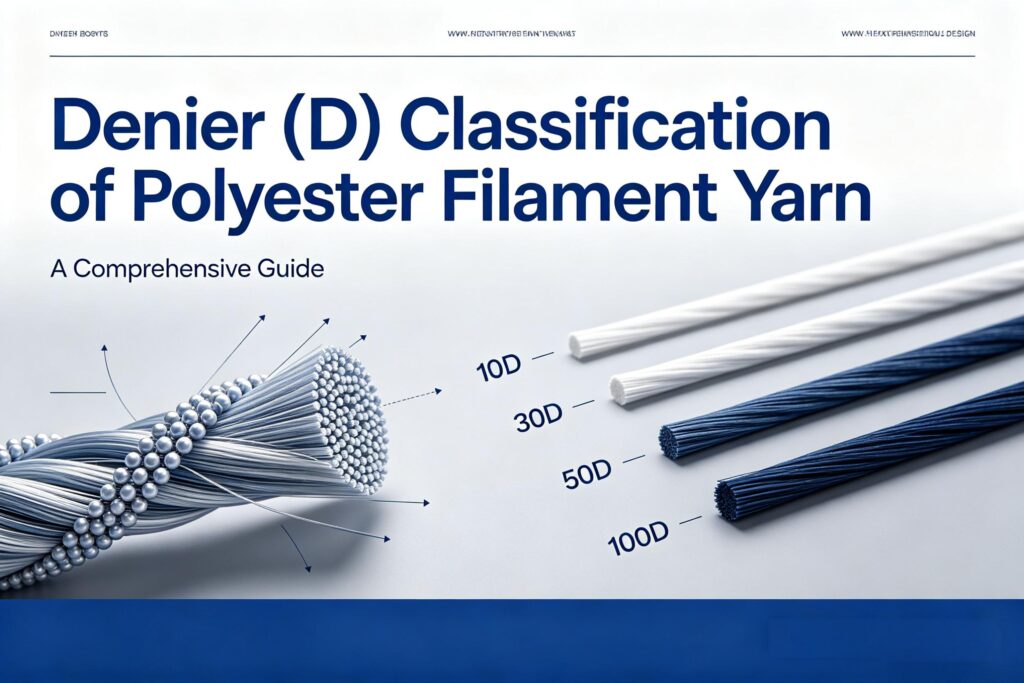
Table of Contents
- Executive Summary: Denier as the Universal Language of Fiber Specification
- Chapter 1: Defining Denier – The Core Unit of Linear Density
- 1.1 The Historical and Technical Definition
- 1.2 Denier vs. Other Units: Decitex and Yarn Count Systems
- Chapter 2: The Classification Spectrum: From Fine to Industrial Deniers
- 2.1 Microfilament and Ultra-Fine Denier (Below 1D)
- 2.2 Standard Textile Denier Ranges (1D to 300D)
- 2.3 Industrial and Heavy-Duty Deniers (300D and Above)
- Chapter 3: Determining Denier: Methods, Standards, and Tolerances
- 3.1 The Gravimetric Method: The Industry Gold Standard
- 3.2 Vibrational and Optical Methods for In-Line Control
- 3.3 Commercial Tolerances and the Importance of Uniformity
- Chapter 4: The Technical and Commercial Implications of Denier Selection
- 4.1 Denier, Fabric Weight, and Product Category
- 4.2 Denier, Drape, Hand Feel, and End-User Perception
- 4.3 Denier and Functional Performance: Strength, Durability, and Porosity
- Chapter 5: Strategic Sourcing Based on Denier Specifications
- 5.1 Mapping Denier to Global Manufacturing Capabilities
- 5.2 Cost Structures and Price Drivers Across Denier Ranges
- 5.3 Communicating Specifications and Ensuring Compliance
- Chapter 6: Future Trends: The Evolution of Denier in Advanced Textiles
- Conclusion and Actionable Recommendations for Buyers
- Appendix: Reference Tables and Conversion Tools
1. Executive Summary: Denier as the Universal Language of Fiber Specification
For international textile buyers, product developers, and sourcing professionals, the question of “How to classify the thickness of polyester filament raw material?” is fundamental. The answer lies in a precise, quantitative metric: Denier (D). Denier is the definitive, universal unit for specifying the linear density—and thus, the inherent fineness or coarseness—of polyester filament yarn. This guide provides a comprehensive framework for understanding denier classification, from its scientific definition and measurement to its profound impact on fabric aesthetics, performance, and cost. We translate this technical parameter into actionable commercial intelligence, detailing how denier choices dictate product categories, influence sourcing decisions, and drive value across the global textile supply chain. Mastery of denier is essential for effective supplier communication, accurate cost forecasting, and delivering products that meet exact market requirements.
2. Chapter 1: Defining Denier – The Core Unit of Linear Density
2.1 The Historical and Technical Definition
Denier is a direct mass-based system, rooted in the silk trade. It is defined as the mass in grams of 9,000 meters of fiber or yarn. A single filament weighing 1 gram over a 9,000-meter length is defined as 1 denier. Therefore, a higher denier number indicates a thicker, heavier, and coarser yarn. This direct relationship makes denier an intuitive and practical measure for synthetic filament yarns like polyester.
2.2 Denier vs. Other Units: Decitex and Yarn Count Systems
- Decitex (dtex): The modern SI-derived unit, more common in Europe. It is defined as the mass in grams of 10,000 meters. The conversion is simple: 1 Denier = 0.9 * dtex, or 1 dtex ≈ 1.11 Denier.
- Yarn Count Systems (Ne, Nm): Used primarily for spun staple yarns (like cotton or wool), these are indirect systems where a higher number indicates a finer yarn (e.g., Ne 40 is finer than Ne 20). This inverse relationship is a critical distinction to avoid confusion with the direct denier/dtex system.
Key Takeaway: For continuous polyester filament, denier and decitex are the dominant, globally understood languages of specification.
3. Chapter 2: The Classification Spectrum: From Fine to Industrial Deniers
Denier is not a single number but a spectrum that defines entire market segments. The classification below is central to translating technical specs into commercial reality.
3.1 Microfilament and Ultra-Fine Denier (Below 1D)
This is the pinnacle of fiber engineering, focusing on the Denier Per Filament (DPF)—the denier of a single strand within a multi-filament yarn.
- Specifications: Typical yarns are 50D/72F (DPF 0.69) or 75D/144F (DPF 0.52).
- Attributes & Applications: Creates exceptionally soft, silk-like hand feel, superb drape, and high moisture-wicking surface area. Used in luxury lingerie, high-performance activewear, premium linings, and high-end suede imitation fabrics.
- Sourcing Insight: Production is capital-intensive with lower machine speeds, commanding a significant price premium (often 25-50%+ over standard yarns).
3.2 Standard Textile Denier Ranges (1D to 300D)
The workhorse of the apparel and home furnishings industry.
- Fine Deniers (15D – 75D): Used in lightweight, sheer fabrics: chiffon, georgette, veils, linings (e.g., 30D, 50D). 75D is a standard for blouses and light dresses.
- Medium Deniers (100D – 150D): The most versatile range. 100D is standard for apparel linings and lightweight outerwear. 150D is a global benchmark for dresses, skirts, and shirting.
- Heavy Deniers (200D – 300D): Used for heavier apparel like trousers, jackets, workwear, and durable home textiles like curtains and upholstery. 300D is common in technical outerwear and bags.
3.3 Industrial and Heavy-Duty Deniers (300D and Above)
This segment prioritizes mechanical performance over aesthetics.
- Specifications: Ranges from 500D and 1000D for heavy-duty luggage, backpacks, and tarpaulins to 2000D+ for industrial belts, ropes, and geotextiles.
- Key Driver: Tenacity (strength per denier), often exceeding 8.0 grams/denier, is the critical specification, not just the denier itself.
4. Chapter 3: Determining Denier: Methods, Standards, and Tolerances
4.1 The Gravimetric Method: The Industry Gold Standard
This is the definitive laboratory method per ASTM D1907 / ISO 2060.
- A precise length of yarn is wound onto a reel (commonly 90 or 900 meters for ease of calculation to the 9,000-meter basis).
- The skein is conditioned in a standard atmosphere and weighed on a precision balance.
- Denier is calculated:
Denier = (Weight in grams / Length in meters) * 9,000.
This method provides the reference “true” denier.
4.2 Vibrational and Optical Methods for In-Line Control
Modern production uses real-time monitoring:
- Vibrational Frequency: A running yarn is vibrated; its resonant frequency is inversely proportional to its linear density, allowing continuous denier measurement.
- Optical Diameter Scanning: Cameras measure yarn diameter, which is correlated to denier based on known polymer density.
These systems allow for immediate process adjustments, ensuring consistency.
4.3 Commercial Tolerances and the Importance of Uniformity
No process is perfect. Commercial contracts specify tolerances, typically ±3% on denier for standard textile yarns. Uniformity is as important as the average value. A high Coefficient of Variation (CV%) in denier along the yarn length leads to:
- Fabric barre (streaky appearance after dyeing).
- Inconsistent fabric weight and coverage.
- Problems in high-speed weaving and knitting.
High-quality yarns exhibit a denier CV% of less than 2.0%.
5. Chapter 4: The Technical and Commercial Implications of Denier Selection
5.1 Denier, Fabric Weight, and Product Category
Denier is the primary driver of Fabric Grams per Square Meter (GSM). Heavier denier yarns produce heavier fabrics. For example:
- A blouse made from 50D yarn may weigh 70-90 GSM.
- Trousers made from 150D yarn may weigh 180-220 GSM.
- A backpack made from 1000D fabric may weigh 400+ GSM.
Product category and target market price point directly dictate the appropriate denier/GSM range.
5.2 Denier, Drape, Hand Feel, and End-User Perception
- Drape: Lower denier yarns (finer) have lower bending rigidity, creating fluid, graceful drape essential for flowing garments.
- Hand Feel: Finer deniers feel softer and smoother. Coarse deniers (>300D) feel crisp, firm, or rugged.
- Luster: Finer filaments in a multi-filament yarn scatter light more diffusely, giving a softer, more pearl-like luster compared to the glassy shine of coarse filaments.
5.3 Denier and Functional Performance: Strength, Durability, and Porosity
- Strength: While a 300D yarn is stronger in absolute terms than a 75D yarn, the key metric is tenacity (strength/denier). High-tenacity industrial yarns maximize strength per unit weight.
- Durability: Abrasion resistance generally increases with denier, making higher deniers essential for applications like upholstery and workwear.
- Porosity & Breathability: Fabrics woven from finer denier yarns can be constructed with higher thread density while maintaining air permeability, a critical factor in performance apparel.
6. Chapter 5: Strategic Sourcing Based on Denier Specifications
6.1 Mapping Denier to Global Manufacturing Capabilities
- Ultra-Fine & Microdeniers (China & Advanced Producers): Dominated by large, integrated Chinese conglomerates (e.g., Tongkun, Hengli) and specialized Korean/Taiwanese producers with advanced R&D.
- Standard Textile Deniers (Pan-Asia): Produced widely across China, India, Vietnam, Indonesia, and Pakistan. Choice depends on trade agreements, labor costs, and vertical integration.
- Technical/Industrial Deniers (Specialized Hubs): Produced by suppliers with specific expertise in high-tenacity polymer and engineering, often located near downstream industrial fabric manufacturers.
6.2 Cost Structures and Price Drivers Across Denier Ranges
Cost is not linear with denier. Key drivers include:
- Polymer Cost: The largest component, so a 300D yarn uses roughly 4x the polymer of a 75D yarn, directly increasing raw material cost.
- Production Speed & Efficiency: Spinning finer deniers (e.g., 20D) is slower and has higher breakage rates than spinning 150D, increasing production cost per kilogram.
- Technology Premium: Microdenier and specialty high-tenacity production requires expensive, specialized equipment.
6.3 Communicating Specifications and Ensuring Compliance
- Precise Language: Never use “lightweight” or “medium.” Always specify: “Polyester FDY, 75 Denier / 48 Filaments, Semi-Dull”.
- Golden Sample: Establish a physical, signed reference sample for each order.
- Certified Testing: Require suppliers to provide third-party test reports (from SGS, Intertek, etc.) confirming denier and uniformity per agreed standards.
7. Chapter 6: Future Trends: The Evolution of Denier in Advanced Textiles
- Sub-Microdenier (<< 0.5 DPF): Push towards nano-scale filaments for unprecedented softness and new functional surfaces.
- Variable Denier Yarns: Single yarns with programmed thick-and-thin sections for unique aesthetic and tactile effects.
- Sustainable Denier: Optimization of denier for recycled (rPET) filaments, balancing performance with the intrinsic viscosity challenges of recycled polymer.
8. Conclusion and Actionable Recommendations for Buyers
- Specify with Absolute Precision: Use the full denier/filament count specification in all documents. It is your primary quality and cost control.
- Select Denier Strategically: Match the denier to the functional and aesthetic requirements of the final product, not just historical precedent.
- Audit for Consistency: Prioritize suppliers who can demonstrate low CV% in denier uniformity through certified test data.
- Understand Total Cost: Recognize that the cheapest yarn per kilogram may be a false economy if its inconsistent denier causes production defects and seconds.
- Future-Proof Your Sourcing: Engage with suppliers who are investing in the technology to produce the finer and more specialized denier ranges that future markets will demand.
By mastering the classification and implications of denier, you transform from a passive purchaser into a strategic specifier, capable of driving value, innovation, and quality throughout your global textile supply chain.
9. Appendix: Reference Tables and Conversion Tools
- Table A.1: Standard Denier Ranges and Corresponding End-Use Applications
- Table A.2: Typical Fabric GSM for Common Polyester Deniers in Woven Constructions
- Formula: Denier to dtex:
dtex = Denier * 1.111| dtex to Denier:Denier = dtex * 0.9
