
Table of Contents
- Introduction: The Critical Need for Material Identification
- 1.1. Why Confusion Arises: The Overlap in Utility
- 1.2. Consequences of Misidentification: Cost, Performance, and Compliance Risks
- Material Science Fundamentals: Polymer DNA
- 2.1. Polyester (PET): The Aromatic Workhorse
- 2.2. Polypropylene (PP): The Olefinic Lightweight
- The Practical Identification Toolkit: From Sight to Lab
- 3.1. Visual & Tactile Inspection: The First Clues
- 3.2. The Burn Test: A Classic Field Method
- 3.3. Density/Sink-Float Test: A Simple Physical Check
- 3.4. Chemical & Solvent Resistance
- 3.5. Advanced Analytical Methods (DSC, FTIR)
- Comparative Performance Analysis: Data-Driven Decision Making
- 4.1. Table 1: Head-to-Head Property Comparison
- 4.2. Mechanical Properties: Strength, Elongation, and Abrasion
- 4.3. Environmental Resistance: UV, Moisture, and Chemicals
- 4.4. Thermal Behavior: Melting Point and Shrinkage
- Strategic Application Guidance: Choosing the Right Material
- 5.1. Apparel & Footwear: Where Each Excels
- 5.2. Industrial & Technical Uses: Load-Bearing vs. Chemical Environments
- 5.3. Consumer Goods & Outdoor Gear
- Procurement & Quality Assurance Protocols
- 6.1. Developing a Supplier Verification Checklist
- 6.2. Implementing Incoming Inspection Procedures
- 6.3. The Role of Certificates of Analysis (CoA)
- Conclusion: Mastering Material Specification for Optimal Value
1. Introduction: The Critical Need for Material Identification
In the global supply chain for textiles and manufactured goods, the ability to accurately distinguish between Polyester (PET) Filament Yarn and Polypropylene (PP) Webbing is not merely academic—it is a fundamental commercial and technical competency. For procurement managers, product developers, and quality assurance professionals across industries from apparel to automotive, misidentifying these materials can lead to catastrophic product failure, non-compliance with specifications, and significant financial loss.
At first glance, especially when dyed similar colors and woven into narrow webbing or tape, PET and PP can appear deceptively similar. Both are versatile, cost-effective synthetics used in straps, belts, loops, reinforcements, and trim. However, their underlying polymer chemistry is profoundly different, leading to divergent performance profiles in strength, durability, environmental resistance, and dyeability. This guide provides a comprehensive, actionable framework for identification and selection, empowering you to specify the correct material with confidence and avoid the high cost of error.
2. Material Science Fundamentals: Polymer DNA
Understanding the core chemistry is the first step to reliable identification.
2.1. Polyester (PET): The Aromatic Workhorse
- Chemistry: Polyethylene terephthalate is a condensation polymer formed from terephthalic acid and ethylene glycol. Its backbone contains aromatic (benzene) rings, which contribute to its rigidity, strength, and higher melting point.
- Key Trait: PET is a hydrophilic polymer, meaning it has a slight affinity for water (moisture regain ~0.4%). This property is crucial for its dyeability with disperse dyes.
2.2. Polypropylene (PP): The Olefinic Lightweight
- Chemistry: Polypropylene is an addition polymer of propylene monomers. It is a polyolefin, with a simple hydrocarbon chain structure.
- Key Trait: PP is intensely hydrophobic (moisture regain ~0.01%). It repels water and lacks dye sites in its polymer chain, making solution dyeing (adding color during melt extrusion) the standard and most colorfast method.
3. The Practical Identification Toolkit: From Sight to Lab
A systematic approach, starting with simple methods, is most effective.
3.1. Visual & Tactile Inspection (Initial Indicators)
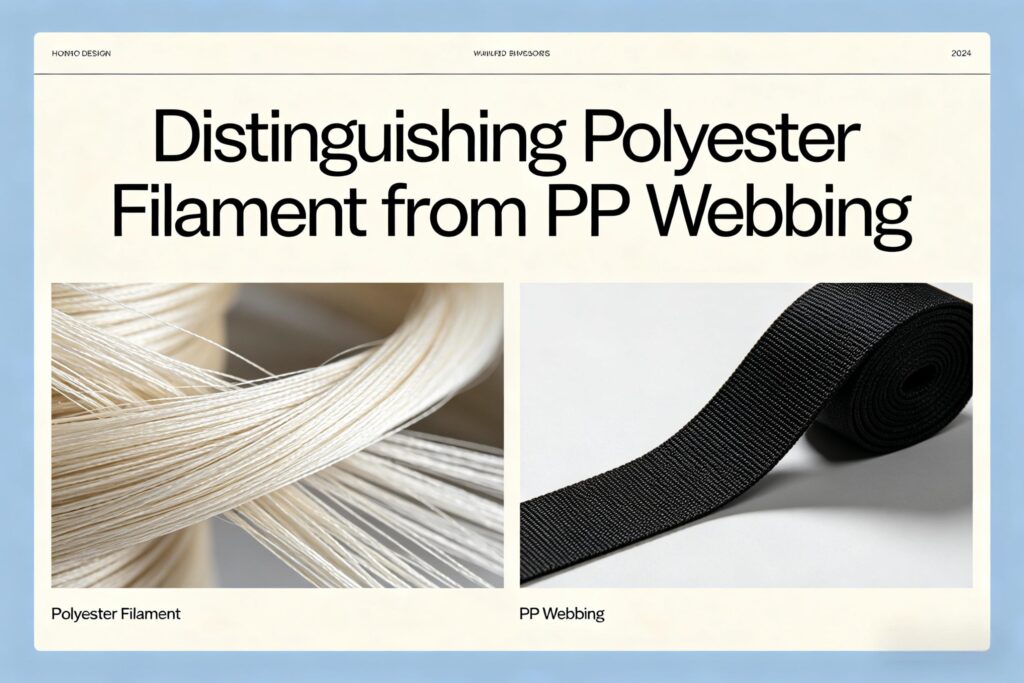
- Luster: Virgin PET filament often has a brighter, crisper luster. PP tends to have a waxier, duller sheen.
- Hand Feel: PET can feel slightly cooler and crisper. PP often feels warmer and has a distinctive “dry,” almost waxy smoothness.
- Color Depth: Solution-dyed PP can have very vibrant, locked-in color. PET dyed post-production may show the color more on the surface. Faded, chalky appearance often indicates PP degraded by UV exposure.
3.2. The Burn Test (The Most Definitive Simple Method)
WARNING: Perform in a controlled, safe environment with proper ventilation.
- Polyester (PET):
- Flame: Melts and burns slowly. May sputter.
- Odor: Characteristic sweet, aromatic, somewhat acrid smell (like vinegar or burnt honey).
- Smoke: Black, sooty smoke.
- Residue: Forms a hard, black, round bead that is difficult to crush.
- Polypropylene (PP):
- Flame: Melts and burns readily with a steady, blue-centered flame.
- Odor: Distinctly paraffin-like, similar to a candle or petroleum wax.
- Smoke: Less smoke, with a lighter color.
- Residue: Forms a soft, pliable, tan-to-brown bead.
3.3. Density/Sink-Float Test
This is a remarkably reliable and safe test.
- Preparation: Mix a solution of 70% isopropyl alcohol and 30% water at room temperature. This creates a solution with a specific gravity of approximately 0.92-0.94 g/cm³.
- Procedure: Cut a small snippet of the yarn or webbing and drop it in.
- Polyester (PET): SINKS. PET density is ~1.38 g/cm³, heavier than the solution.
- Polypropylene (PP): FLOATS. PP density is ~0.91 g/cm³, lighter than the solution.
This test alone can conclusively separate the two materials.
3.4. Chemical & Solvent Resistance
- Acetone Test: PET is generally resistant to acetone. PP will soften, swell, or begin to dissolve upon prolonged contact. A simple swab test can show a difference in surface reaction.
3.5. Advanced Analytical Methods
For absolute, litigation-grade certainty:
- Fourier-Transform Infrared Spectroscopy (FTIR): Creates a molecular “fingerprint” of the polymer. The spectra for PET and PP are distinctly different, with PET showing a strong carbonyl (C=O) peak.
- Differential Scanning Calorimetry (DSC): Measures melting temperature (Tm). PET melts at ~250-260°C. PP melts at a much lower ~160-165°C.
4. Comparative Performance Analysis: Data-Driven Decision Making
Table 1: Head-to-Head Property Comparison
| Property | Polyester (PET) Filament | Polypropylene (PP) Webbing | Practical Implication |
|---|---|---|---|
| Density | 1.38 g/cm³ (Heavy) | 0.91 g/cm³ (Light) | PP offers more yardage per kg; critical for weight-sensitive applications. |
| Tensile Strength | Very High (4.5-6.5 g/den) | Moderate to High (3.5-5.0 g/den) | PET is stronger for its size; preferred for critical load-bearing. |
| Abrasion Resistance | Excellent | Good | PET lasts longer in high-friction applications (e.g., backpack straps). |
| UV Resistance | Good (with stabilizers) | Poor (Degrades rapidly) | PP requires heavy UV stabilization for outdoor use; otherwise, it becomes brittle. |
| Moisture Absorption | ~0.4% | ~0.01% (Negligible) | PP will not rot, mildew, or lose strength when wet. Dries instantly. |
| Chemical Resistance | Excellent to oils, solvents. Poor to strong alkalis. | Excellent resistance to acids, alkalis, solvents | PP is the choice for harsh chemical environments (e.g., marine, cleaning). |
| Melting Point | 250-260°C | 160-165°C | PET can withstand higher ironing/processing heat. |
| Dyeability | Excellent (Disperse dyes) | Poor (Requires solution dyeing) | PET offers unlimited, vibrant color options post-weaving. PP color is limited to producer’s palette. |
| Cost | Moderate | Generally Lower | PP often has a raw material cost advantage. |
4.2. Mechanical Properties: PET’s higher tenacity and superior creep resistance (resistance to stretching under constant load) make it the choice for applications like automotive seatbelts, lifting slings, and high-performance luggage. PP’s strength is adequate for many uses, but it is more prone to creep over time.
4.3. Environmental Resistance: This is a major differentiator. PP’s severe vulnerability to UV degradation is its Achilles’ heel. Unstabilized PP exposed to sunlight can lose most of its tensile strength in a matter of months. PET, while also benefiting from stabilizers, is inherently more resistant. Conversely, PP’s near-zero moisture absorption makes it ideal for marine, aquatic, and outdoor applications where constant wetness is a factor.
4.4. Thermal Behavior: The nearly 100°C difference in melting point is critical. In applications near engines or involving heat sealing, PET’s higher tolerance is a key advantage.
5. Strategic Application Guidance: Choosing the Right Material
- Choose POLYESTER (PET) When:
- High Strength & Durability are Critical: Heavy-duty cargo straps, automotive safety components, climbing harnesses, long-lasting backpack straps.
- UV Exposure is Significant: Outdoor furniture strapping, permanent outdoor signage, automotive interior trim.
- Aesthetic & Color Flexibility Matter: Fashion apparel belts, decorative trim, where specific Pantone colors are required post-production.
- High-Temperature Environments are Present: Applications near engines or requiring heat-set shaping.
- Choose POLYPROPYLENE (PP) When:
- Low Cost is the Primary Driver: Promotional items, disposable straps, low-cost packaging.
- Lightweight & Buoyancy are Required: Marine ropes, water sport equipment, geotextiles.
- Constant Moisture or Chemical Exposure is Expected: Wash-down environments, chemical tank covers, aquaculture.
- The Application is Primarily Indoor or Short-Term: Temporary bundling, lightweight retail bag handles.
6. Procurement & Quality Assurance Protocols
To institutionalize correct material sourcing:
- Specify Precisely: In RFQs and POs, never use generic terms like “poly strap.” Specify “100% Polyester (PET) Filament Webbing” or “100% Polypropylene (PP) Webbing” and include key specs (width, breaking strength, UV treatment).
- Implement Incoming Inspection: Adopt the Sink-Float Test as a fast, reliable, and safe incoming QC check for random samples from every batch.
- Demand Documentation: Require suppliers to provide a Certificate of Analysis (CoA) that states the polymer type, often verified by FTIR. Reputable suppliers, from yarn producers to webbing converters, should provide this transparency.
- Audit Your Supply Chain: Understand your supplier’s source. A webbing converter who purchases from a dedicated yarn producer like Glyarn (specializing in engineered polyester filaments) provides a more reliable and traceable material chain than one sourcing generic commodity fibers.
7. Conclusion: Mastering Material Specification for Optimal Value
Distinguishing polyester filament from PP webbing is a blend of simple science and disciplined process. While they compete in similar markets, their inherent properties dictate vastly different performance lifespans and suitability.
The informed professional uses the burn test or density test for identification and the comparative performance data for selection. By making the correct choice at the specification stage—opting for the strength and weather resistance of PET for demanding applications or the lightweight economy and chemical resistance of PP for specific uses—you safeguard product integrity, brand reputation, and ultimately, profitability. In a world of look-alike materials, this knowledge is your most powerful tool for ensuring value and performance in your supply chain.
