
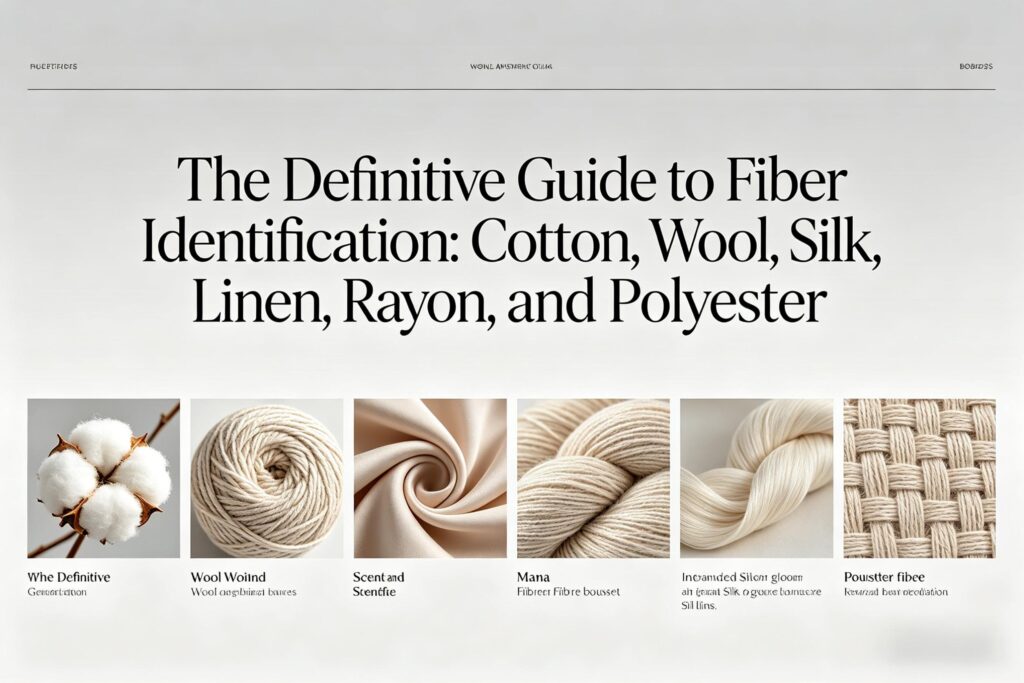
Table of Contents
- Introduction: The Critical Imperative of Fiber Identification
- 1.1. Commercial Consequences and Value Chain Integrity
- 1.2. Navigating a World of Blends and Adulteration
- 1.3. A Tiered Approach: From Field to Laboratory
- Chapter 1: Foundational Knowledge – The Origin and Structure of Six Key Fibers
- 1.1. Natural Cellulosic Fibers: Cotton & Linen (Flax)
- 1.2. Natural Protein Fibers: Wool & Silk
- 1.3. Man-Made Fibers: Rayon (Viscose) & Polyester (PET)
- Chapter 2: Preliminary Identification – Sensory and Visual Analysis
- 2.1. The “Look and Feel” Protocol: Luster, Hand, and Drape
- 2.2. Microscopic Examination: A First Glimpse at Morphology
- 2.3. The Burning Test: A Classic, Accessible Method
- Table 1: Burn Test Characteristics for Common Fibers
- Chapter 3: Chemical Identification – Solvent and Staining Methods
- 3.1. The Logic of Chemical Sensitivity: Protein vs. Cellulose vs. Synthetic
- 3.2. Key Solvent Tests: Hydrochloric Acid, Sodium Hypochlorite, Acetone
- 3.3. Staining with Chemical Indicators (e.g., Shirlastain)
- Table 2: Chemical Solubility and Reaction Guide
- Chapter 4: Advanced Instrumental Analysis for Definitive Proof
- 4.1. Fourier-Transform Infrared Spectroscopy (FTIR): The Molecular Fingerprint
- 4.2. Differential Scanning Calorimetry (DSC): Measuring Thermal Transitions
- 4.3. Microscopy Enhanced: Scanning Electron Microscopy (SEM) for Detail
- Table 3: Key Thermal Properties (Melting & Decomposition Points)
- Chapter 5: Special Focus – The Challenge of Blends and Quantitative Analysis
- 5.1. Deconstructing Blends: Sequential Chemical Dissolution (AATCC 20A)
- 5.2. Case Study: Analyzing a Common Cotton/Polyester Blend
- 5.3. Legal and Compliance Implications of Blend Verification
- Chapter 6: Building a Practical Identification Workflow for Industry Professionals
- 6.1. Developing a Cost-Effective Tiered Testing Protocol
- 6.2. Interpreting Supplier Certificates of Analysis (CoA)
- 6.3. When to Use an External Testing Laboratory
- Conclusion: Knowledge as a Shield in the Global Marketplace
1. Introduction: The Critical Imperative of Fiber Identification
In the complex, multi-tiered global textile supply chain, the accurate identification of fiber content is not an academic exercise—it is a fundamental commercial, legal, and ethical necessity. For procurement managers, quality assurance professionals, and brand executives, the ability to distinguish between cotton, wool, silk, linen, rayon, and polyester is a core competency that protects profit margins, ensures regulatory compliance, and upholds brand integrity.
The risks of misidentification are severe: substituting inexpensive polyester for promised silk constitutes fraud; incorrectly labeled fiber content can lead to costly product recalls and legal action under laws like the U.S. Textile and Wool Acts; and unexpected fiber performance (e.g., wool shrinking, rayon weakening when wet) can result in consumer complaints and damaged reputation. Furthermore, the prevalence of blended fabrics (e.g., 65% polyester/35% cotton) adds a layer of complexity, requiring not just qualitative identification but precise quantitative analysis.
This guide provides a comprehensive, actionable framework for fiber identification. We will progress from simple, accessible methods suitable for a mill floor or inspection office to sophisticated laboratory techniques, arming you with the knowledge to verify claims, troubleshoot problems, and make informed sourcing decisions with confidence.
2. Chapter 1: Foundational Knowledge – The Origin and Structure of Six Key Fibers
Understanding a fiber’s origin and inherent structure is the first step in predicting its behavior during identification tests.
- Cotton: A natural seed fiber composed of almost pure cellulose. Under a microscope, it appears as a flattened, twisted ribbon with a central lumen. It is hydrophilic, strong when dry, and weakens when wet.
- Linen (Flax): A natural bast fiber. Its microscopic view shows long, cylindrical fibers with characteristic nodes or cross-markings. It is stronger than cotton, especially when wet, and has a distinct, crisp hand.
- Wool: A natural protein fiber (keratin) from sheep. Scales on the surface are visible under microscopy, which are responsible for felting. It is highly elastic, hygroscopic, and susceptible to alkali damage.
- Silk: A natural protein fiber (fibroin) produced by silkworms. It appears as a smooth, translucent, triangular prism under the microscope, giving it its characteristic luster. It is strong, lustrous, and dissolves in strong alkaline solutions.
- Rayon (Viscose): A regenerated cellulose fiber, made by chemically dissolving wood pulp and extruding it. Its morphology can be engineered but often shows distinct striations lengthwise. It is highly absorbent but loses significant strength when wet.
- Polyester (PET): A synthetic polymer fiber derived from petroleum. Under a microscope, it appears as a smooth, rod-like cylinder (unless modified). It is hydrophobic, strong, resistant to wrinkles and chemicals, and has a defined melting point.
3. Chapter 2: Preliminary Identification – Sensory and Visual Analysis
Before any chemical test, a systematic visual and tactile inspection can yield valuable clues.
3.1. The “Look and Feel” Protocol: Assess luster (silky shine of silk, waxy sheen of polyester, matte of cotton), hand feel (coolness of linen, warmth of wool, softness of cotton, smoothness of polyester), and drape (fluid silk, stiff linen).
3.2. Microscopic Examination: A standard light microscope (100-400x) is a powerful tool. The presence of scales indicates wool; twists indicate cotton; nodes indicate linen; smooth rods indicate polyester or silk (though silk’s triangular shape can sometimes be discerned).
3.3. The Burning Test:
This is the most widely used preliminary test. Always conduct in a safe, ventilated area with tweezers and a fireproof surface.
Table 1: Burn Test Characteristics for Common Fibers
| Fiber | Approach to Flame | In Flame | After Flame | Odor | Residue (Ash) |
|---|---|---|---|---|---|
| Cotton/Linen | Catches quickly | Burns rapidly, yellow flame | Continues to glow/ember | Smells of burning paper or leaves | Soft, gray, feathery ash |
| Wool/Silk | Curls away, may sputter | Burns slowly, may self-extinguish | Does not usually continue | Strong smell of burning hair or feathers | Brittle, black, crushable bead |
| Rayon | Catches quickly | Burns very rapidly (like cotton) | May continue to glow | Burning paper | Very little, fine gray ash |
| Polyester | Melts and shrinks away | Melts and burns with smoky flame | May self-extinguish | Sweet, chemical, or vinegar-like | Hard, black, round bead |
4. Chapter 3: Chemical Identification – Solvent and Staining Methods
These tests exploit the fundamental chemical differences between fiber types.
4.1. The Logic of Chemical Sensitivity:
- Protein Fibers (Wool, Silk): Soluble in strong alkaline solutions (e.g., 5% NaOH) and attacked by chlorine bleach.
- Cellulosic Fibers (Cotton, Linen, Rayon): Resistant to alkali but soluble in strong mineral acids (e.g., 70% Sulfuric Acid, H₂SO₄). They can be distinguished by their reaction to a zinc chloride-iodine solution.
- Synthetic Polyester: Resistant to most acids and alkalis but soluble in specific solvents like hot meta-cresol or a phenol/tetrachloroethane mixture.
4.2. Key Solvent Tests:
- Hydrochloric Acid (HCl – 20%): Dissolves silk quickly; wool is slower; others are unaffected.
- Sodium Hypochlorite (Bleach – 5%): Dissolves silk; causes wool to yellow and degrade; others are unaffected.
- Acetone: A key test. Dissects acetate (not in our list), but does not dissolve polyester. This can help rule out other synthetics.
Table 2: Chemical Solubility and Reaction Guide
| Fiber | 70% H₂SO₄ (Cold) | 5% NaOH (Boiling) | Acetone (Room Temp) | Hot Meta-Cresol |
|---|---|---|---|---|
| Cotton | Dissolves | Resistant | Insoluble | Insoluble |
| Linen | Dissolves | Resistant | Insoluble | Insoluble |
| Wool | Insoluble | Dissolves | Insoluble | Insoluble |
| Silk | Dissolves | Dissolves | Insoluble | Insoluble |
| Rayon | Dissolves | Resistant | Insoluble | Insoluble |
| Polyester | Insoluble | Insoluble | Insoluble | Dissolves |
5. Chapter 4: Advanced Instrumental Analysis for Definitive Proof
For unambiguous identification, especially in disputes or complex blends, instrumental analysis is required.
5.1. Fourier-Transform Infrared Spectroscopy (FTIR): This is the industry standard for polymer identification. It measures how a sample absorbs infrared light, creating a unique molecular fingerprint. The spectrum of cotton (cellulose) is distinctly different from polyester (PET) or wool (protein).
5.2. Differential Scanning Calorimetry (DSC): This measures thermal transitions. Polyester has a sharp melting point (Tm) around 250-260°C. Natural fibers like cotton and wool do not melt; they decompose at higher temperatures. DSC can positively confirm the presence of polyester and measure its purity.
Table 3: Key Thermal Properties
| Fiber | Melting Point (Tm) | Decomposition Point | Key DSC Observation |
|---|---|---|---|
| Cotton/Linen | Does not melt | ~350°C | Endothermic decomposition peak |
| Wool/Silk | Does not melt | ~230-300°C | Complex decomposition peaks |
| Rayon | Does not melt | ~300-350°C | Endothermic decomposition peak |
| Polyester | ~250-260°C | ~450°C | Sharp endothermic melting peak |
6. Chapter 5: Special Focus – The Challenge of Blends and Quantitative Analysis
Most modern textiles are blends. The goal is not just to say “polyester and cotton,” but to determine “65% polyester, 35% cotton.”
6.1. Sequential Chemical Dissolution (AATCC 20A): This is the standard gravimetric method. A sample is weighed, then one component is selectively dissolved using a specific chemical (e.g., 75% sulfuric acid to dissolve cotton/rayon, leaving polyester intact). The remaining residue is weighed, and the percentages are calculated.
6.2. Case Study: Analyzing a 65/35 Poly-Cotton Blend:
- Weigh initial dry sample (e.g., 1.000g).
- Treat with 75% H₂SO₄ to dissolve the cotton component.
- Filter, dry, and weigh the remaining polyester residue (e.g., 0.650g).
- Calculation: Polyester % = (0.650g / 1.000g) * 100 = 65%. Cotton % = 100% – 65% = 35%.
7. Chapter 6: Building a Practical Identification Workflow
A cost-effective approach uses a tiered system:
- Tier 1 (All Incoming Goods): Visual/hand feel inspection, burn test.
- Tier 2 (Spot Check/Dispute): Simple chemical tests (acid, alkali, acetone) and basic microscopy.
- Tier 3 (Supplier Qualification/Serious Dispute): Send samples to a certified lab for FTIR, DSC, and quantitative blend analysis per ISO 1833 or AATCC 20A standards.
Always cross-reference results with the supplier’s Certificate of Analysis (CoA), but verify critical shipments independently.
8. Conclusion: Knowledge as a Shield in the Global Marketplace
The ability to accurately identify fibers is a form of power in the textile industry. It transforms procurement from a game of trust into a process of verification. By mastering the progression of tests—from the simple burn test to an understanding of advanced instrumental analysis—you equip yourself to ensure value, enforce contracts, mitigate risk, and build a supply chain based on transparency and quality.
In a market where margins are tight and the temptation for adulteration is real, this professional knowledge is your most reliable shield. It allows you to speak the technical language of your suppliers, ask the right questions, and demand the proof that ensures the fibers you pay for are the fibers you receive.
