
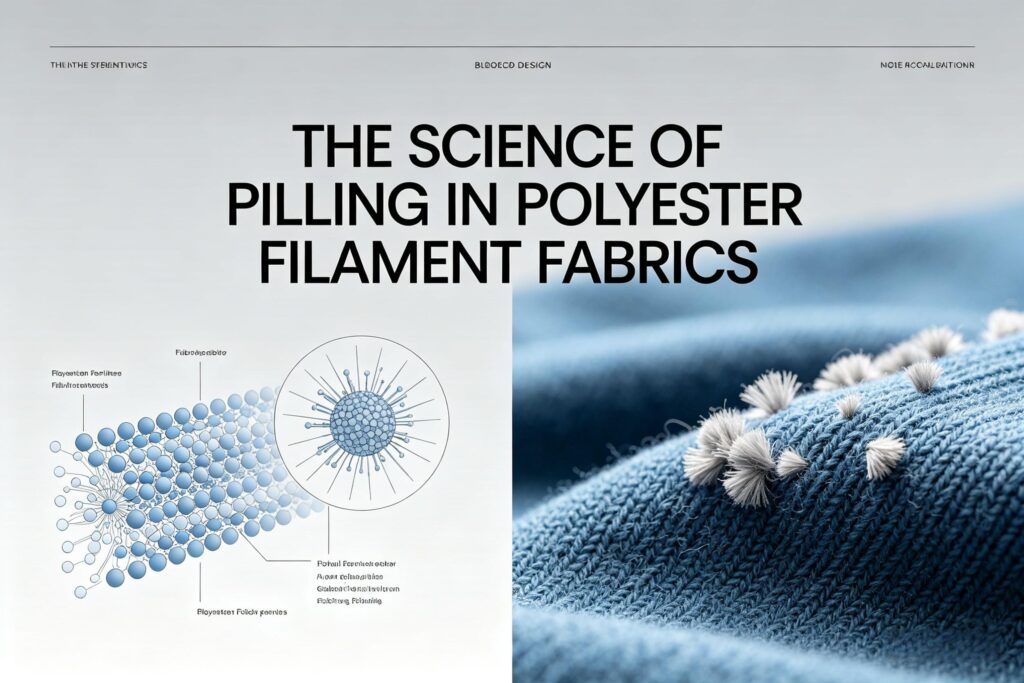
For procurement managers and product developers across the apparel, home textiles, and manufacturing sectors, fabric quality is paramount. Among the most common and frustrating quality defects is pilling—the formation of small, tangled fiber balls on a fabric’s surface. While polyester is celebrated for its strength and durability, fabrics made from its filament form are not immune to this issue. Understanding the pilling mechanism of polyester filament is not an academic exercise; it is a critical necessity for specifying materials, controlling production costs, managing supplier quality, and ultimately, ensuring end-customer satisfaction.
This comprehensive guide delves beyond surface-level explanations. We will explore the fundamental polymer science behind pilling, analyze how processing and construction parameters influence its severity, review standardized testing methodologies, and provide a strategic framework for mitigation. This knowledge empowers you to make informed decisions, from the spinning mill to the finished product.
Table of Contents
- Introduction: The Business Impact of Pilling in Synthetic Textiles
- Defining the Problem: What is Pilling? The Four-Stage Lifecycle
- The Polyester Filament Advantage: Intrinsic Resistance and Its Limits
- Root Cause Analysis: The Mechanics of Pill Formation in Filament Yarns
- Key Contributing Factors: From Polymer to Product
- Quantifying the Problem: Standardized Pilling Test Methods (ASTM, ISO, Martindale)
- The Influence of Fabric Construction and Finishing
- Comparative Analysis: Pilling in Filament vs. Spun Polyester and Other Fibers
- Strategic Prevention and Mitigation for Buyers and Manufacturers
- Interpreting Test Reports and Setting Specification Limits
- Future Directions: Polymer and Finishing Innovations
- FAQ: Addressing Practical Concerns from Industry Professionals
1. Introduction: The Business Impact of Pilling in Synthetic Textiles
Pilling is a surface defect with profound commercial consequences. For brands, it translates to customer returns, negative reviews, and damage to brand equity perceived as “low quality.” For manufacturers and wholesalers, it leads to claims, rework, and inventory devaluation. The global textile testing market, valued at over $8 billion, dedicates a significant portion to pilling and abrasion resistance evaluation, underscoring its financial importance.
While staple spun yarns are historically more pill-prone, the assumption that continuous filament polyester is entirely pill-free is a misconception. Under specific conditions of mechanical stress, friction, and material construction, pilling can and does occur. This guide provides the technical depth needed to identify risk factors in your supply chain and product designs.
2. Defining the Problem: What is Pilling? The Four-Stage Lifecycle
Pilling is a progressive, wear-related phenomenon. Its lifecycle can be systematically broken down into four distinct stages:
- Fuzz Formation: Loose fiber ends or filaments are pulled from the yarn structure due to abrasive forces (rubbing against skin, furniture, other fabrics). This is the initial “fuzzy” appearance.
- Entanglement: These loose fibers, due to their flexibility and continued friction, become intertwined with each other.
- Ball Formation (Pilling): The entangled mass rolls into a compact spherical or oval-shaped knot—a pill. At this stage, it is anchored to the fabric by a few unbroken fibers.
- Wear-Off: Depending on fiber strength and anchor stability, the pill may eventually break off (common with weaker fibers like cotton) or remain stubbornly attached (common with strong fibers like polyester).
The core problem with polyester lies in Stage 4. Its high tenacity (typically 4.5-7.0 g/den) means the fibers anchoring the pill are extremely strong. Pills do not easily detach, leading to persistent, visible surface blemishes.
3. The Polyester Filament Advantage: Intrinsic Resistance and Its Limits
Continuous filament yarns are inherently more resistant to pilling than spun yarns. The reasons are structural:
- No Fiber Ends: Spun yarns are composed of short fibers (staples) with countless loose ends prone to pulling out. Filament yarns are continuous, with drastically fewer free ends to initiate fuzz.
- High Cohesion: Filaments within a yarn are parallel, twisted, and tightly integrated, offering greater resistance to being pulled loose.
However, this resistance is not absolute. Pilling in filament fabrics occurs primarily through two mechanisms:
- Filament Breakage: Abrasive forces can cause individual filaments within a multi-filament yarn to break. These broken ends then become the source of fuzz.
- Yarn Slippage and Loop Formation: In woven or knitted structures, abrasive force can cause whole yarns to shift, pulling filament loops to the surface. These loops can then be broken or abraded, creating loose fiber material.
4. Root Cause Analysis: The Mechanics of Pill Formation in Filament Yarns
The propensity for a polyester filament fabric to pill is governed by a classic “Force vs. Anchor” battle.
- The Attacking Force (Abrasion): This is the external mechanical stress from use (e.g., backpack straps, armrest friction, garment seams).
- The Defense (Yarn/Fabric Integrity): This is the ability of the yarn and fabric structure to resist filament breakage and loop formation.
When the attacking force overcomes the local defense, a loose fiber element is created. Polyester’s high strength then transforms this from a temporary fuzz into a permanent pill.
5. Key Contributing Factors: From Polymer to Product
Table 1: Factors Influencing Pilling in Polyester Filament Fabrics
| Factor Category | Specific Factor | Effect on Pilling | Technical Rationale |
|---|---|---|---|
| Fiber Properties | Tenacity (High) | Increases Pill Persistence | Strong anchor fibers prevent pill wear-off. |
| Abrasion Resistance (High) | Reduces Initial Fuzz Formation | Fiber resists surface damage and breaking. | |
| Filament Cross-Section | Round: Standard | Smooth surface offers less inter-filament grip. | |
| Tri-lobal, Multi-lobal | Can increase inter-filament grip, slightly raising fuzz risk but often used for aesthetics. | ||
| Yarn Parameters | Total Denier / Filament Count | Higher denier/fewer filaments (coarser) | Thicker filaments are more abrasion-resistant. |
| Lower denier/more filaments (finer) | Finer filaments are more flexible but easier to break. | ||
| Yarn Twist Level (TPI) | Higher Twist | Significantly reduces pilling. Increases inter-filament cohesion, reducing slippage and breakage. | |
| Intermingling / Air-jet Tangling | Improves | Replaces twist for some applications, bundling filaments together effectively. | |
| Fabric Construction | Fabric Density (Thread Count/Stitch Density) | Higher Density | Reduces pilling. Yarns are locked in place, minimizing movement and loop formation. |
| Weave/Knit Structure | Tighter Weaves (e.g., Plain, Twill) | Resistant. | |
| Finishing Processes | Heat Setting | Improves | Stabilizes the fabric structure, reducing residual shrinkage and yarn mobility. |
| Anti-pilling Chemical Finishes | Significantly Improves | Polymer-based coatings reduce friction or bind fiber ends to the yarn. | |
| Shearing / Singeing | Significantly Improves | Physically removes surface fuzz before it can entangle. |
6. Quantifying the Problem: Standardized Pilling Test Methods
Subjective assessment is insufficient for quality control. Reputable supply chains rely on standardized lab tests.
- ASTM D4970 / ISO 12945-2: Martindale Abrasion and Pilling Test: The global benchmark. Fabric samples are rubbed against a standard abradant in a Lissajous figure motion under controlled pressure. Pilling is assessed visually against standard reference images (Rating 1=Severe Pilling to 5=No Pilling) after a set number of cycles (e.g., 2,000, 5,000, 7,000).
- ASTM D3512 / ISO 12945-1: Random Tumble Pilling Test: Samples are tumbled in a cylindrical box with a mild abrasive liner. Simulates more gentle, all-directional wear.
- ASTM D3514: Elastic Pad Method: For woven fabrics, using a rotary rubbing action.
Critical Insight for Buyers: Always specify the test method and the acceptable rating at a defined number of cycles in your technical specifications. E.g., “Fabric must achieve a minimum pilling rating of 3.5 on ASTM D4970 after 7,000 cycles.”
7. The Influence of Fabric Construction and Finishing
A tight, stable fabric is the first line of defense.
- Wovens: A high-thread-count plain or twill weave will outperform a loose hopsack weave.
- Knits: A compact interlock or double-knit structure will be far more pill-resistant than a single jersey, which has a tendency to curl and expose yarn loops.
- Finishing: Singeing passes fabric over a flame to burn off protruding fibers—a highly effective physical solution. Shearing cuts them off mechanically. Anti-pilling softeners can be applied, though they may affect hand feel.
8. Comparative Analysis: Pilling in Filament vs. Spun Polyester and Other Fibers
Table 2: Pilling Propensity Across Common Textile Fibers & Forms
| Fiber & Yarn Type | Pilling Propensity | Primary Reason | Typical Martindale Rating (5,000 cycles) |
|---|---|---|---|
| Polyester Filament (Standard) | Low to Moderate | Few fiber ends, but strong pills if formed. | 3.5 – 4.5 |
| Polyester Spun (Staple) | High | Many short fiber ends easily pulled out. | 2.0 – 3.0 |
| Nylon Filament | Very Low | High abrasion resistance & elasticity. | 4.0 – 5.0 |
| Cotton | Low (but pills wear off) | Fibers pull out but break easily; pills detach. | 3.0 – 4.0 (appears better over time) |
| Acrylic | Very High | Low strength, high abrasion creates persistent fuzz. | 1.5 – 2.5 |
| Wool | Moderate (felts instead) | Fibers tend to felt into the fabric rather than form discrete pills. | NA |
9. Strategic Prevention and Mitigation for Buyers and Manufacturers
For Procurement & Design:
- Specify Yarn Construction: Opt for higher twist levels (e.g., 15-20 TPI for textured yarns) and coarser filament deniers where possible.
- Choose Dense Fabrics: Select tight weaves or stable knits. Request fabric specs like weight (GSM) and thread count.
- Mandate Finishing: Require singeing or shearing for products where a smooth face is critical (e.g., dress shirts, fine knits).
- Set Clear Test Standards: Build pilling test requirements into your purchase orders.
For Mills & Finishers:
- Optimize Yarn Parameters: Increase twist, use intermingling, and select appropriate filament cross-sections.
- Precise Fabric Engineering: Calibrate looms/knitters for maximum fabric sett/density without compromising other properties.
- Leverage Finishing Technology: Implement robust heat-setting and consider anti-pilling chemical treatments for high-risk applications.
- Rigorous In-house QC: Perform pilling tests on every batch to catch deviations early.
10. Interpreting Test Reports and Setting Specification Limits
A pilling rating of “3” is a common industry threshold. Understand what it means:
- Rating 5: No change.
- Rating 4: Slight fuzz or one or two small pills.
- Rating 3: Moderate fuzz and/or several small, distinct pills. (Often the minimum acceptable limit for mid-market apparel).
- Rating 2: Distinct pilling, fabric appearance significantly affected.
- Rating 1: Severe pilling, fabric surface covered with dense pills.
For performance wear or luxury items, a rating of 3.5 or 4.0 after higher cycles (e.g., 7,000) should be targeted.
11. Future Directions: Polymer and Finishing Innovations
The industry is moving towards engineered solutions:
- Modified Polymer Chains: Polymers designed with controlled molecular weight distribution to balance strength and flexibility.
- Nanocomposite Additives: Incorporating nano-silica or other particles during extrusion to enhance surface hardness and abrasion resistance.
- Advanced Durable Finishes: Developing next-generation cross-linking chemistries that provide anti-pilling effects that survive 50+ home launderings.
12. FAQ: Addressing Practical Concerns from Industry Professionals
Q1: We always used polyester filament assuming it doesn’t pill. Why did our latest batch of polo shirts show pilling?
A1: This is likely due to a combination of factors: an overly loose knit structure (like a light single jersey) to achieve softness, use of very fine denier filaments for a silky hand feel, and inadequate twist in the yarn. These choices prioritize aesthetics at the expense of pilling resistance.
Q2: Is there a correlation between pilling and general abrasion resistance?
A2: Yes, they are closely related but not identical. Abrasion resistance measures overall fabric wear and breakdown (e.g., hole formation). Pilling is a specific type of surface abrasion result. A fabric can have good abrasion resistance (doesn’t tear) but poor pilling resistance (forms many pills). Both are tested on the Martindale machine but assessed differently.
Q3: Can pilling be “fixed” or removed after it occurs on a finished garment?
A3: There is no reliable, scalable method for finished goods. Consumer solutions like battery-powered fabric shavers are temporary and can damage the fabric. Prevention at the manufacturing stage is the only effective strategy.
Q4: Do anti-pilling chemical finishes affect other properties like color fastness or breathability?
A4: Potentially, yes. Some polymer-based coatings can slightly reduce moisture vapor transmission (breathability). They must be tested for compatibility with dyes to avoid affecting crocking or wash fastness. Reputable chemical suppliers provide full data on these interactions.
Q5: How do recycled polyester filaments compare to virgin in terms of pilling?
A5: Recycled polyester (rPET) can sometimes show slightly higher pilling propensity. The recycling process (melting, re-extrusion) can lead to polymer degradation, potentially reducing tensile strength and making filaments more prone to breakage—the first step in pilling. This must be counteracted with optimal yarn and fabric engineering.
Q6: For a plush toy manufacturer, is pilling a major concern with polyester fur?
A6: Yes, critically so. “Petting” or frequent handling is a direct abrasive action. For plush fabrics, fiber shedding and pilling are key quality metrics. Solutions include using continuous filament shag or faux fur (not spun), ensuring high-density tufting, and applying effective shearing/singing during finishing to create a clean, secure pile.
Q7: What is the single most effective specification we can demand from a yarn supplier to reduce pilling risk?
A7: Specify a minimum yarn twist level (TPI). Increased twist is the most direct and measurable way to enhance filament cohesion within the yarn, directly combating the root causes of fuzz and loop formation. This should be a non-negotiable parameter in your yarn specifications for pilling-sensitive applications.
